
 •



Nov


By Steve Pawlyk
Published November 12, 2026
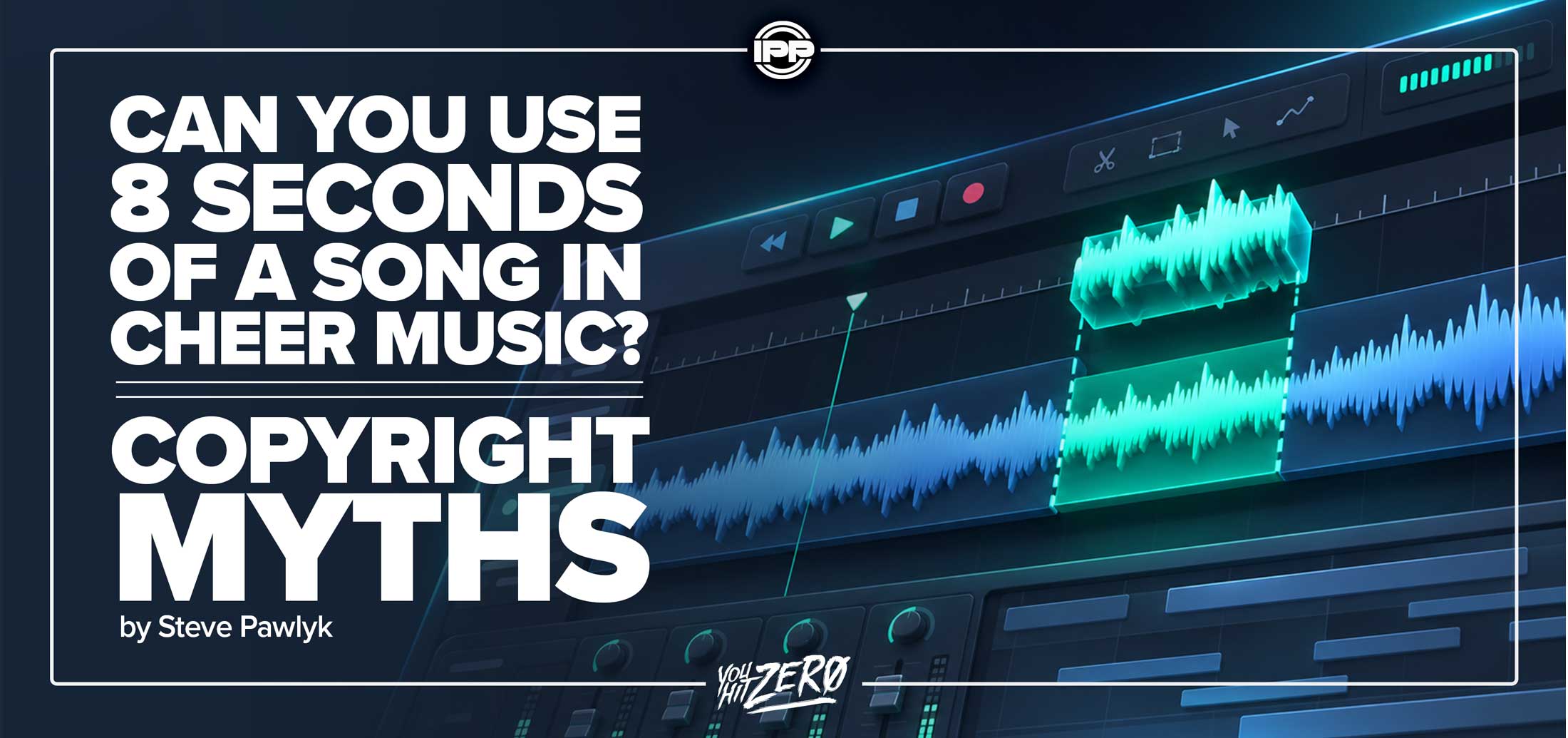
If you’ve spent much time around competitive cheerleading, you’ve probably heard someone claim that using less than eight seconds of a copyrighted song is perfectly legal. Some people say seven seconds. Others insist the limit is five.
The advice usually comes up when a coach wants to incorporate a recognizable song into a routine without purchasing additional music licenses. After all, cheerleading mixes frequently feature short musical clips, and an eight-second excerpt might seem too brief to cause a copyright problem.
Unfortunately, following that advice could leave your team using music without the necessary permissions.
U.S. copyright law contains no universal rule allowing the unlicensed use of a song simply because the excerpt falls below a particular duration. The legality of using copyrighted music depends on the rights involved, the permissions obtained, and whether any applicable copyright exceptions cover the intended use.
For cheer coaches, understanding these requirements can help prevent licensing problems before competition season begins.
Is There an Eight-Second Copyright Rule for Cheer Music?
There is no eight-second rule under U.S. copyright law.
The U.S. Copyright Office addresses this question in its guidance on fair use, explaining that there is no predetermined number of musical notes, words, or percentage of a work that can be used without permission.
The Copyright Office also discusses the closely related seven-second sampling myth in its educational publication Sampling, Interpolations, Beat Stores and More.
The duration of a musical excerpt can be relevant when evaluating copyright issues, particularly when considering fair use. However, courts examine several factors, and the length of a sample alone cannot establish whether its use is permitted.
A cheer music producer who incorporates eight seconds of a popular recording into a routine may need authorization from the relevant copyright holders. Reducing that excerpt to four seconds would not automatically eliminate the need for permission.
Even extremely short recordings can contain distinctive, recognizable elements of a copyrighted song.
Why Do People Believe Short Music Clips Are Copyright-Free?
The origins of the eight-second claim are difficult to establish precisely. Similar claims have circulated for decades among musicians, DJs, video editors, and online content creators.
Much of the confusion appears to come from misunderstandings about fair use, a legal doctrine that permits certain uses of copyrighted material without permission.
Because fair use sometimes considers how much material was copied, people may assume the law must establish a specific maximum duration. The actual analysis is more complicated.
Commercial music sampling has also contributed to the confusion. Listeners regularly encounter popular recordings that contain brief excerpts from other songs. Without knowing how those recordings were produced or licensed, it can be tempting to assume that short samples are legally unrestricted.
In reality, producers may have obtained the necessary licenses, relied on an applicable legal exception, or released material that has never been challenged by the rights holders.
The eight-count structure of cheerleading routines may also make the idea of an eight-second allowance sound familiar, although eight counts and eight seconds represent different measurements. An eight-count describes a sequence of musical beats whose duration depends on the tempo.
Whatever the source of the claim, coaches should avoid relying on a fixed number of seconds when evaluating music licenses.
Why Popular Songs Often Require Multiple Permissions
A commercially released song generally involves two separate categories of copyright protection.
Copyright in the Musical Composition
The musical composition includes the melody, harmony, and lyrics of a song.
These rights may be owned or administered by songwriters, music publishers, or other rights holders.
For example, an artist might record a song written by several different songwriters, each of whom holds an interest in the underlying composition.
Copyright in the Sound Recording
The sound recording covers a particular recorded performance of the composition.
A record label, performing artist, or another entity may control these rights.
When someone copies audio directly from an existing commercial recording, the use can implicate both the musical composition and the sound recording.
A producer who records an entirely new performance of the same song may avoid copying the original sound recording, but the underlying composition generally remains protected.
The Copyright Office’s information for musicians provides additional explanations of these rights.
These separate protections help explain why licensing a cheerleading mashup containing several popular songs can become complicated. Depending on how the mix is created and used, multiple rights holders and different types of permission may be involved.

Does Changing a Song’s Speed or Pitch Avoid Copyright Restrictions?
Cheer music producers frequently modify recordings to match the tempo and structure of competitive routines.
Common adjustments include increasing playback speed, changing pitch, shortening musical phrases, adding percussion, and combining several recordings into a continuous mix.
These production techniques can substantially change the sound of a recording, but the underlying copyrighted material may remain protected.
For example, speeding up a recognizable chorus and placing new sound effects beneath it may still involve reproducing and adapting protected musical material.
The same applies when a producer rearranges several short excerpts into a new sequence.
Copyright law gives rights holders certain exclusive rights over reproductions and adaptations of their works. Determining whether a particular use infringes those rights requires examining the material used and the applicable legal circumstances.
For coaches purchasing customized competition music, it is worth confirming that the producer has permission to incorporate any third-party recordings used in the finished mix.
Can You Use a Popular Song If You Purchased It Legally?
Purchasing music through a legitimate digital music store gives the buyer access to an authorized copy under the terms of the purchase.
The purchase generally does not provide unrestricted permission to reproduce, remix, distribute, or commercially exploit the recording.
However, cheerleading organizations recognize that teams sometimes perform to a single, legally obtained song rather than a specially produced cheer music mix.
USA Cheer’s Guidelines for Single-Song Performances
USA Cheer’s music copyright FAQ explains how teams may use legally purchased music at events governed by its guidelines.
The guidance permits certain minor timing edits to a single purchased recording, such as removing a chorus or bridge to fit the required performance length.
It distinguishes those edits from more extensive music production activities, including combining multiple recordings, incorporating additional sound effects, or making other alterations that require appropriate authorization.
Coaches considering a routine performed to one purchased song should review the current USA Cheer guidance and their event producer’s rules.
The policies governing a particular competition may include additional documentation or music-use requirements.
A purchased recording may therefore be suitable for some cheerleading performances while still being unsuitable for producing an unauthorized mashup.

Do School Cheer Teams and Nonprofit Programs Need Music Licenses?
Copyright questions apply to school cheerleading programs, recreational teams, nonprofit organizations, and all-star gyms.
Federal copyright law provides certain exceptions for educational activities, and nonprofit status can be relevant to a fair use analysis. The availability of those exceptions depends on the particular circumstances.
For instance, a teacher using an excerpt from a recording during a qualifying classroom activity may be operating under different legal provisions than a competitive cheerleading team distributing a custom mashup to its athletes.
School affiliation does not automatically authorize a team to reproduce or modify commercial music for competition.
The fact that a team performs without receiving compensation also does not independently establish that the music use is permitted.
Coaches should evaluate their program’s music arrangements based on the intended use and applicable licensing requirements.
Are Cover Songs Legal to Use in Cheerleading Routines?
Some cheer music producers use newly recorded versions of popular songs instead of incorporating the original commercial recordings.
A cover recording may reproduce the melody and lyrics of an existing composition while featuring different performers and a new recording.
This approach can avoid using the original artist’s sound recording. However, the underlying composition may still be subject to copyright.
U.S. copyright law includes a mechanical licensing system that permits certain cover recordings under specified conditions.
Those permissions have limitations, particularly when a recording is extensively rearranged or combined with other works.
A license covering the production and distribution of an ordinary cover song may not provide all the rights needed to create a customized cheerleading remix.
Before purchasing a mix containing cover recordings, coaches can ask the producer whether the necessary permissions extend to the modifications and uses included in the finished music.

What Does Royalty-Free Music Mean for Cheerleading?
Royalty-free music is frequently promoted as an alternative to commercially released songs.
The term generally describes a licensing arrangement under which specified uses are permitted without recurring royalty payments for each individual use.
The precise permissions depend on the license agreement.
For example, one royalty-free music library may authorize recordings to be used as background music in videos but prohibit redistribution of those recordings as standalone audio files.
Another may allow commercial productions but restrict certain modifications.
For cheerleading, the relevant questions include whether a license allows the music to be edited, combined with other recordings, distributed to athletes, and used during competitive performances.
Coaches should also review restrictions associated with sound effects, samples, and prerecorded voiceovers used in a routine.
A producer may have permission to use an audio element in one context without having permission to include it in a commercially distributed cheerleading mix.
Can Fair Use Protect Short Music Samples?
Fair use permits certain uses of copyrighted material without permission. Its application depends on the circumstances of the individual use.
Under Section 107 of the U.S. Copyright Act, courts consider four factors.
1. Purpose and character of the use
Courts examine why and how the copyrighted material is being used. They may consider whether the new work serves a sufficiently different purpose from the original and whether the activity is commercial.
2. Nature of the copyrighted work
This factor considers characteristics of the original material. Music is generally considered a creative work, which can affect the analysis.
3. Amount and substantiality of the material used
Courts consider both the quantity of material copied and the significance of the portion selected.
A short excerpt containing the most distinctive part of a song may be evaluated differently from a similarly short excerpt containing less significant material.
4. Effect on the potential market
Courts consider whether the use affects the existing or potential market for the copyrighted work, including relevant licensing markets.
Fair use decisions weigh these factors together, with the importance of individual factors depending on the circumstances.
A brief recording used to analyze a musical passage in an educational documentary, for example, can raise different legal considerations from the same recording inserted into a cheer routine for entertainment.
Fair use may apply to some music uses, but coaches should obtain appropriate authorization rather than assume their competition mix qualifies.
The U.S. Copyright Office Fair Use Index provides additional information and examples of how courts evaluate fair use claims.
Does a USA Cheer Music Provider Listing Guarantee Copyright Compliance?
USA Cheer maintains a Music Provider Directory containing companies that have committed to following applicable copyright requirements.
The directory can help coaches locate providers familiar with the music licensing expectations of competitive cheerleading.
USA Cheer explains, however, that it does not audit every recording offered by listed providers or independently verify all licensing claims.
The directory should therefore be viewed as a resource for identifying potential music companies rather than a guarantee covering every product in their catalogs.
When choosing a provider, coaches should review the licensing documentation associated with the specific mix they intend to purchase.
A provider should be able to explain the permitted uses, relevant restrictions, and documentation available for competition organizers.
Can You Post a Competition Video Featuring Licensed Cheer Music?
Many cheerleading teams record their performances and share the videos with athletes, parents, and followers.
A team may have obtained permission to use its music during a live competition without obtaining the additional rights that may be required to distribute a recording of that performance.
Combining music with video can implicate synchronization rights in the underlying composition and rights associated with the sound recording.
The necessary permissions depend on the music, the video, and the intended distribution.
This helps explain why some competition recordings are distributed with their original music removed or replaced.
Online platforms also operate their own copyright identification and enforcement systems.
YouTube’s Content ID system, for example, can identify copyrighted audio and generate claims that affect how uploaded videos are viewed or monetized.
An automated claim does not necessarily establish infringement. A team may have obtained a license that the platform’s automated system cannot independently verify.
Before posting competition videos, coaches should check whether their music agreement permits the relevant video uses, including social media uploads, livestreams, promotional recordings, and event broadcasts.
If the license terms are unclear, the music provider or relevant rights holder can clarify what additional permissions may be necessary.
Does Crediting the Artist Make Copyrighted Cheer Music Legal?
Adding an artist’s name to a routine video or including a song title in the description does not grant permission to use the recording.
The same applies to statements such as “no copyright infringement intended.”
Attribution and copyright authorization serve different purposes.
Some licenses require users to credit the original creator, but complying with an attribution requirement is only one part of complying with the license.
A coach who wants to incorporate a particular commercial recording should determine whether the necessary permission is available.
What Can Happen When a Team Uses Music Without Proper Licensing?
The consequences of unauthorized music use depend on the circumstances and the rules of the competition involved.
Under copyright law, unauthorized reproduction, adaptation, or distribution of protected recordings can result in infringement claims.
Rights holders may demand removal of the material, request that its use stop, or pursue other legal remedies.
Competition organizers may also require teams to provide proof of music licensing.
Depending on an event’s published policies, music compliance issues may lead to requests for documentation, corrective action, or competitive penalties.
Coaches should consult the event’s rules for specific enforcement procedures rather than assume every organizer applies identical penalties.
From a practical standpoint, discovering a music licensing problem shortly before competition can force a team to revise choreography, replace recordings, or obtain permissions under difficult circumstances.
Addressing licensing requirements when choosing the routine music gives the coaching staff more time to resolve questions before athletes begin practicing.
How to Check Whether Your Cheer Music Is Properly Licensed
Coaches can reduce the likelihood of music-related problems by reviewing a few essential details before finalizing a routine.
1. Purchase Music From a Reputable Provider
Choose a company that can explain how its music is created and what licensing documentation accompanies the purchase.
Cheer-specific providers such as IPP Music offer premade and customized mixes designed for competitive routines.
When purchasing original cheer music, coaches should still review the terms of use and confirm that any third-party material incorporated into the mix has been appropriately authorized.
2. Review the License Agreement
Read the documentation supplied with your music.
Pay attention to which team or organization receives the license, whether the agreement covers a particular season, and what restrictions apply to modifying or distributing the recording.
If your team intends to reuse the mix during a future season, confirm whether the agreement permits that use.
3. Confirm Your Competition’s Music Requirements
Review the policies published by the organizations responsible for your competitions.
USA Cheer provides useful general guidance, but particular events may impose additional requirements.
If you have questions about using a purchased song, a custom mix, or a recording containing third-party audio, contact the event organizer before competition.
4. Save Your Licensing Documentation
Keep copies of invoices, licensing agreements, and written permissions.
Make the documentation available to the coaches or administrators responsible for competition registration.
Where possible, retain records identifying the recording, licensee, permitted uses, and applicable dates.
5. Check Before Modifying an Existing Mix
Adding or replacing sections of a licensed mix can introduce material that was not covered by the original agreement.
For example, a coach may decide to incorporate a popular song into the final eight-count of a routine or replace a voiceover with dialogue from a movie.
Before making those changes, check the licensing terms and contact the music provider when necessary.
Frequently Asked Questions About Cheer Music Copyright
Can I use five seconds of a copyrighted song in cheer music?
U.S. copyright law establishes no universal five-second exception. The permissibility of a short musical excerpt depends on the relevant rights, authorization, and applicable legal exceptions.
Can I use the instrumental version of a popular song?
Instrumental portions of copyrighted songs may still be protected. Removing the vocals from a commercial recording does not automatically authorize its use in a cheerleading mix.
Can I record my own version of a copyrighted song?
You may be able to make a cover recording under an appropriate license or other applicable authorization. The underlying composition generally remains protected, and additional permissions may be necessary for substantial rearrangements or other uses.
Can I use public-domain music in my cheer routine?
Music in the public domain may be used without permission from a copyright owner for the public-domain material. However, a modern recording or arrangement of a public-domain composition may carry separate copyright protection.
Can I use popular music during cheerleading practice?
The applicable copyright rules depend on the activity and setting. Listening to a legally obtained recording, publicly performing music, reproducing audio, and distributing edited recordings can involve different rights and exceptions.
A recording used during practice should not automatically be assumed suitable for distribution or use in a competition mashup.
Can my team reuse its licensed music next season?
Check the terms of your original agreement. A license may contain restrictions on the applicable season, team, duration, or permitted uses.
Can I add a popular movie quote to my cheer music?
Audio taken from a film or television program may be protected by copyright. Using a short quotation can require permission, depending on the recording and circumstances. Other legal considerations may also apply to certain uses of recognizable voices.
Is original cheer music easier to license than popular music?
Original music created and licensed specifically for cheerleading can simplify the process because the provider may control the necessary rights or have secured the relevant permissions.
Coaches should still verify what the agreement covers, particularly for video distribution, edits, and reuse.
What Cheer Coaches Should Remember About Copyright
Cheerleading music has changed substantially over the years, and modern mixes often incorporate intricate arrangements, custom vocals, sound effects, and rapid transitions.
These production techniques give teams considerable creative flexibility, but the finished recording must still comply with applicable copyright requirements.
Coaches who want to include recognizable commercial songs should confirm that the necessary rights have been obtained. Buying a song, shortening a clip, or modifying its tempo may leave additional permissions unresolved.
For teams purchasing original or professionally licensed cheer music, reviewing the agreement before choreography begins can prevent problems later in the season.
The eight-second rule has circulated for years despite having no basis as a universal exception under U.S. copyright law. Coaches can make more reliable music decisions by consulting official copyright resources, reviewing competition policies, and asking providers for clear licensing documentation 👍

IPP's Premade Mixes are USA Cheer Compliant and customizable! Add Sound FX, swap songs, & more! Add your Team Name to the mix for only $10!


Sources and Further Reading
- U.S. Copyright Office: Fair Use Frequently Asked Questions
- U.S. Copyright Office: Sampling, Interpolations, Beat Stores and More
- U.S. Copyright Office: Information for Musicians
- U.S. Copyright Office: Fair Use Index
- USA Cheer: Music Copyright FAQ
- USA Cheer: Music Information and Provider Directory
- YouTube Help: Tips to Find Safe Music
This article provides general educational information about U.S. copyright law and cheerleading music practices. It does not constitute legal advice. International copyright requirements and individual competition policies may differ.
 Cheer Mixes
 Past-Season Mixes (50% off!)
 You Hit Zero Cheer Blog
 Spotify Playlists
 Quick Quote Video Tutorial