Author Archives: Steve Pawlyk

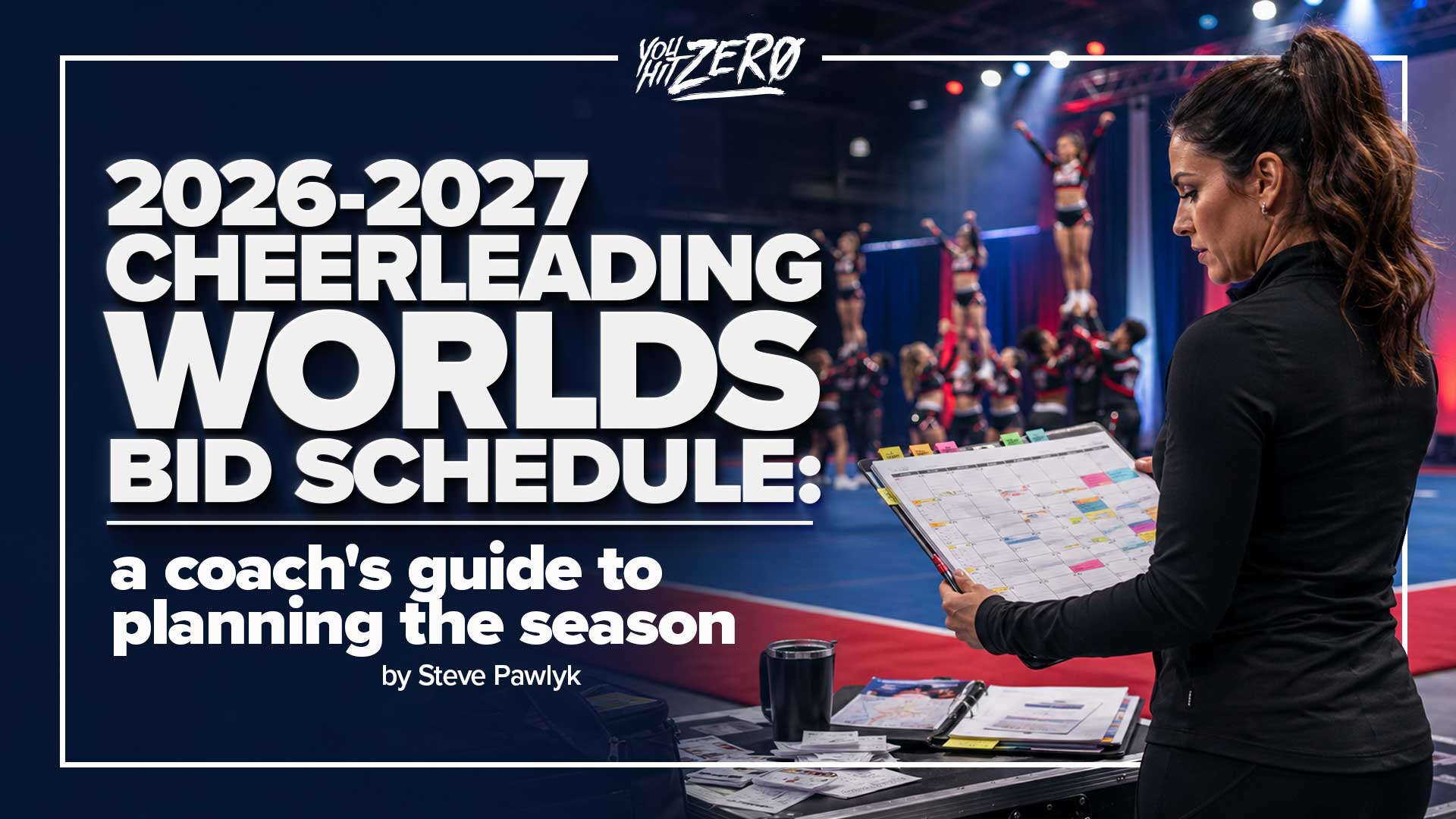
Why Winning Your Division Might Beat Your Score: A Worlds Bid Strategy Guide

worlds paid bid strategy 2026 2027

By Steve Pawlyk

Published October 21, 2026

Here’s a scene most of us have lived through. Your Senior team hits zero, the scoresheet looks great, and you’re sitting in awards feeling pretty good about that Paid bid. Then the bids go out and you don’t hear your name. A team from a different division with a lower score just walked off with it.

Under Varsity’s October 2026 bid declaration, that’s going to happen more often. And honestly? It’s not a glitch. It’s the design.

The new declaration puts division champions at the center of how Paid bids get handed out. So the question you need to ask about a bid event isn’t just “can we score high enough?” anymore. It’s “can we win our division at this event, and does winning it actually put us in line for a Paid bid?”

This post won’t rehash every table in the declaration. You can read the documents yourself, and you should. Instead, we’re going to walk through some made-up teams, look at where winning your division gives you an edge, and finish with a couple of decision trees you can use before you sign a check for a big travel event.

Worlds Paid bid strategy

The short version of what changed

For years, a lot of us thought about Paid bids as a scoreboard. Get the highest score among eligible teams and you’re probably getting one.

That’s not how it works anymore. At many qualifying events, some Paid bids are now set aside for division champions before score ranking even comes into play.

Take an event offering three Paid bids under the general declaration. One goes to a Senior All Girl champion. One goes to a Senior Coed champion. Only one goes to the highest-scoring eligible team under the rules that apply.

So two of those three bids aren’t about who scored highest across the whole event. They’re about who won their division.

The big events don’t all follow the general rules, either. NCA, CHEERSPORT, JAMfest and One Up each have their own declarations with their own twists. Bid counts vary a lot, too. CHEERSPORT is listing 10 full Paid bids for 2026-27, while One Up Grand Nationals lists 4 and CHAMPS Grand Nationals lists 2. The number of bids matters, but how they’re split matters just as much.

The takeaway: before you look at your scores from last season, pull up the declaration for the specific event you’re considering and find out how many of its Paid bids go to champions.

Four teams, four very different bid outlooks

These teams are made up. The situations aren’t. You’ll probably recognize your own program in at least one of them.

For all four, picture the same event: three Paid bids, split the way the general declaration describes. One for a Senior All Girl champion, one for a Senior Coed champion, one for the top eligible score.

Team A: the big fish in a small division

Team A is a Senior Coed squad. They’re solid but not elite. On a good day they’re scoring a few tenths behind the best All Girl teams in the region.

Here’s the thing, though. At this event, only four teams are registered in their Senior Coed division, and Team A has beaten all four at least once this year.

Under the old way of thinking, Team A would never chase this bid. Their score wouldn’t touch the top of the event. Under the new declaration, they might be the favorite for the Coed champion bid. If they win their division, they don’t need to outscore anybody else in the building.

The lesson: a team that can’t win on raw score might win on placement. Look at who’s actually in your division before you write off an event.

Team B: the high scorer stuck behind a powerhouse

Team B is an All Girl team with big numbers. They’d be top three in score at most events. Problem is, they share a division with a national powerhouse that beats them by half a point every time.

Team B is likely to finish second in division. That means the All Girl champion bid probably isn’t theirs. Their only real shot is the one bid that goes to the highest eligible score, and they’ll be fighting every non-champion at the event for it.

It gets tougher. If the powerhouse already has a Paid bid from an earlier event, check how that event’s declaration handles it. Some declarations pass a bid down to the next eligible team in the division. Some open it up across divisions. That one detail can swing Team B’s chances a lot.

The lesson: a great score doesn’t help much if you keep running into the same team. Sometimes the smart move is to find an event that powerhouse isn’t attending.

Need Competition Music Blue 1

Team C: the team that already has a bid

Team C picked up a Paid bid in December. Now they’re signed up for a February event with a strong field.

They can’t earn a second Paid bid. But they can still win their division. And if they win, that champion bid usually doesn’t vanish. Depending on the declaration, it can pass to another team, which is great news for whoever finishes behind them.

For Team C, this event is about getting the routine in front of judges one more time before Worlds. That’s still a fine reason to go. Just be honest with your parents about why you’re going.

The lesson: once you have your bid, your schedule should change. You’re competing for different reasons now.

Team D: the team chasing an At-Large-to-Paid upgrade

Team D earned an At-Large bid at their first event. They’d love a Paid bid to ease the cost for families.

Team D has to look at every remaining event the same way. Can we win our division? If not, can we beat every other non-champion for the score-based bid? If both answers are “probably not,” a big travel event isn’t going to change that, no matter how good their routine looks in practice.

The lesson: hope isn’t a strategy. Count the bids, count the champions, and do the math.

How this changes which events you pick

The old habit was simple. Go to the biggest event you can afford, because more bids means more chances.

That’s not always true now. A huge event with 10 Paid bids can be a worse bet than a smaller one with 3, depending on your division.

Your division’s field matters more than the event’s size

If most of an event’s Paid bids go to division champions, the question becomes: how many teams in my division are registered, and how many of them can beat me?

A small event where your division has three teams you match up well against might give you a better shot than a giant event where your division has fifteen teams and two Worlds medalists.

Registration lists usually aren’t final until close to the event. But last year’s results for the same event will tell you a lot about who tends to show up. A few texts to coaches you know will fill in the rest.

Watch for powerhouses that already have bids

This one sounds backwards, but stick with me. If the team that always wins your division already has a Paid bid when they show up, that can actually help you. Depending on how that event handles a champion who’s already holding a Paid bid, the bid may roll down to the next team in your division.

Read that part of the declaration closely. The rules aren’t the same everywhere, and some only pass the bid down if the next team places high enough in the division.

cheerleading Paid bids

Senior vs. non-Senior gets more lopsided

If an event’s champion bids are reserved for Senior All Girl and Senior Coed champions, then non-Senior teams are fighting over fewer bids. That doesn’t mean they can’t get one. It means the score-based bids get more crowded.

If you coach an Open or Limited team, count how many Paid bids at a given event are realistically available to you after the champion allocations. That number might be one.

The math on cost

A Paid bid is worth real money to your families. But a travel event can cost a family more than the bid covers, once flights and hotel rooms get added on top of registration.

So it’s worth putting the two numbers side by side. Roughly what will this trip cost each athlete? And honestly, what are your odds of a Paid bid at this specific event? If those odds are low, you might be spending more chasing a bid than the bid would give back.

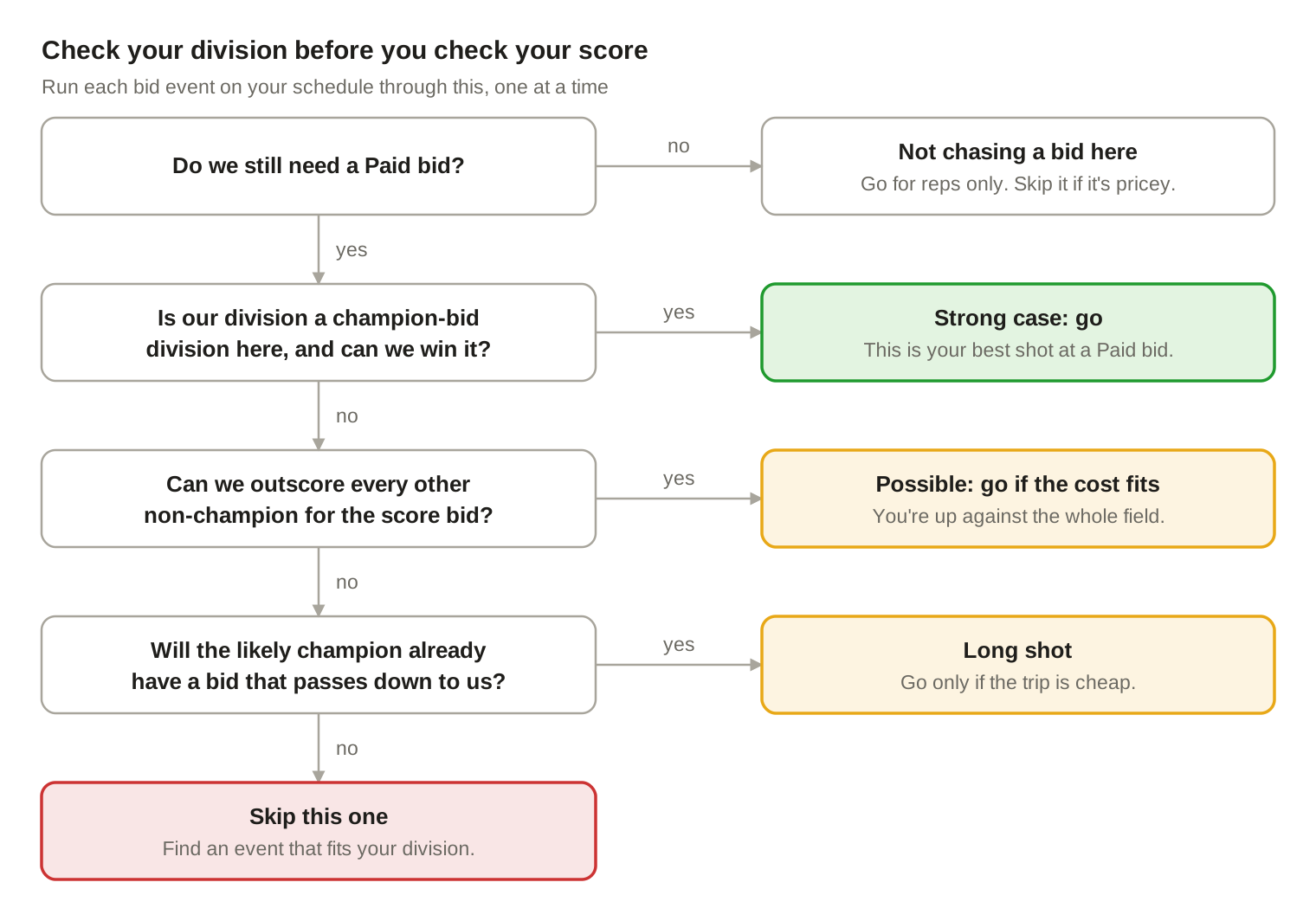
A decision tree for every bid event on your schedule

Take each bid event you’re considering and walk it through this. Start at the top and answer honestly. If you have to squint to get a “yes,” call it a “no.”

bid decision tree

The order matters. Winning your division comes before your score, because at a lot of events that’s where most of the Paid bids are now. Only if that path is closed should you start counting on the score-based bid or a pass-down.

A quick tip for using it with a full season: run every event through the tree, then line them up by outcome. If you’ve got two “strong case” events and three “long shots,” you probably know which ones to cut. If everything comes out as a long shot, that’s a sign to rethink the bid goal for this team, not to book more travel.

Questions to answer before you commit thousands to a travel event

Print these out. Answer them with your staff before you announce the schedule to parents. If you can’t answer one, that’s your homework.

Varsity Worlds bids

About the event

How many Paid bids does this event offer for the 2026-27 season?

  1. How many of those are reserved for division champions, and which divisions?
  2. Does this event use the general declaration or its own (like NCA, CHEERSPORT, JAMfest or One Up)?
  3. What happens to a champion bid if that champion already has a Paid bid?

About your division

  1. Is my team’s division one of the champion-bid divisions at this event?
  2. Who attended this event in my division last year, and who won?
  3. Have we beaten the likely division winner at any point this season

About your team

  1. Are we realistically a division champion here, or are we chasing the score-based bid?
  2. If it’s the score-based bid, how many other non-champion teams could outscore us?
  3. Do we already have a bid? If so, why are we going?

About your families

  1. What’s the rough cost per athlete for this trip, all in?
  2. If we don’t get a Paid bid, will parents feel the trip was still worth it?

The bottom line

Your score still matters. It always will. But this season, where you finish in your division might matter more than where you finish in the building.

The coaches who do well under this system won’t be the ones who just pick the biggest events. They’ll be the ones who know exactly who’s in their division and build a schedule around the bids they can realistically win.

So before you lock in that February trip, sit down with the declaration and run your team through the tree above. It takes about half an hour. It might save your families a lot more than that 😊

Steve Pawlyk Signature Full

IPP's Premade Mixes are USA Cheer Compliant and customizable!  Add Sound FX, swap songs, & more!  Add your Team Name to the mix for only $10! 

SLAM artwork
Full_Out_130 mp3 image
1 minute cheer mix
WAKE UP THE FIRE
SLAM artwork
WAKE UP THE FIRE
Full_Out_130 mp3 image
1 minute cheer mix

Does your cheer program have an emergency action plan?

cheerleading emergency action plan 1

By Steve Pawlyk

Published September 21, 2026

On September 16, 2026, a University of Connecticut cheerleader fell during practice at the UConn Volleyball Center. Paramedics treated the athlete at the scene, and a medical helicopter took the athlete to Hartford Hospital. The university said the athlete stayed overnight for evaluation and left the hospital the next morning with no major physical injuries. That good outcome does not make the incident easy to dismiss. It raises a direct question for every cheer coach: If an athlete suffers a serious fall at your next practice, does everyone know what to do?

A cheerleading emergency action plan answers that question before anyone gets hurt. It assigns jobs, gives responders the correct address, identifies the nearest AED and tells staff how to manage the rest of the team. A plan on paper is only the start. Your staff and athletes must practice it.

cheerleading injury response

What is a cheerleading emergency action plan?

An emergency action plan, often called an EAP, is a written response plan for a serious injury or medical emergency. It tells each person what to do from the moment activity stops until emergency medical services take control. It also covers team supervision, parent contact and incident records. USA Cheer provides a sample cheerleading emergency action plan, a 9-1-1 phone script, an athlete information card and a printable flip chart.

Those tools give programs a good starting point, but each program must adapt them to its own staff, athletes and facilities. Your school or gym may already have a general emergency plan. Read it, then check whether it works for cheer practice. A plan for the football field may fail inside an auxiliary gym with a locked exterior door and no athletic trainer nearby.

Write a different plan for each venue

One address does not equal one response plan. Your main gym, tumbling room, outdoor practice field and performance space may have different entrances. The AED may sit near one location but several hallways away from another. USA Cheer advises teams to create a separate plan for each venue. Practice also needs its own plan when the medical staff who attend games are not present.

The same rule applies when your team trains in a rented facility. A venue sheet gives every staff member the same information.

Create one page for every place where your team practices or performs, and include these details:

  • The full street address and ZIP code
  • The building name, room name and floor
  • The nearest cross street
  • The best entrance for an ambulance
  • The door or gate that staff must unlock
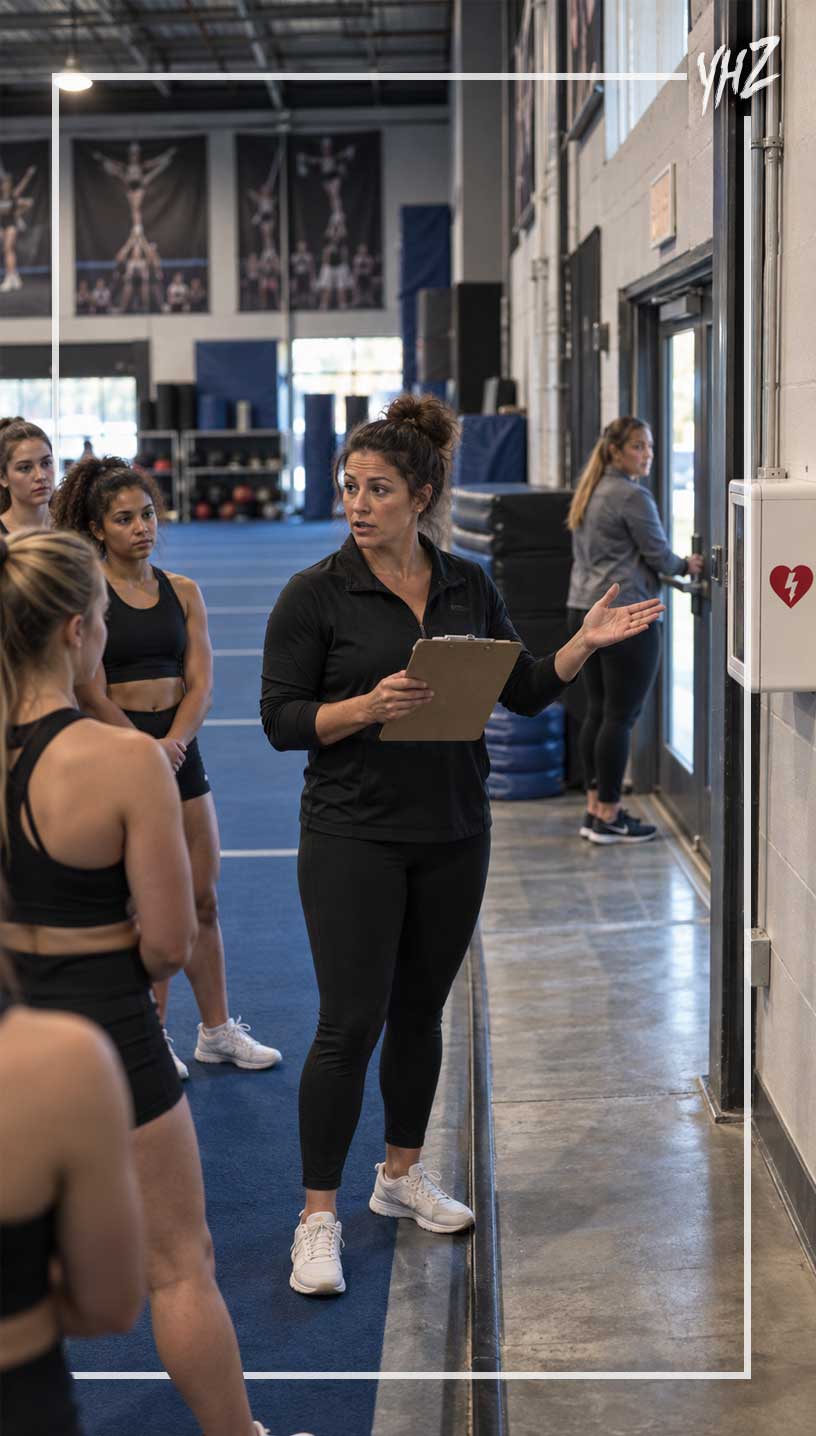
  • The AED location
  • The first-aid kit location
  • The name and phone number of the athletic trainer, nurse or facility manager
  • The location where a staff member will meet emergency responders

Do not assume that a person who calls 9-1-1 can describe the location from memory. Many athletes do not know the street address of their practice facility, and a visiting coach may not know which parking lot leads to the gym. Post the venue sheet near the practice floor. Keep a copy in the coach’s bag and on each staff member’s phone. Make sure staff can reach it if a power outage or weak internet connection blocks the usual system.

Assign jobs before the emergency

A vague instruction such as “someone call 9-1-1” wastes time. Name the primary person and a backup for each job, then update the names when staffing changes. The head coach or another trained adult should stay with the injured athlete. That person should give care only within the limits of their training. USA Cheer recommends that coaches complete first-aid and CPR/AED training.

Assign the remaining jobs to adults when possible. Use the roles below as a starting point. Add other jobs when your building or program requires them:

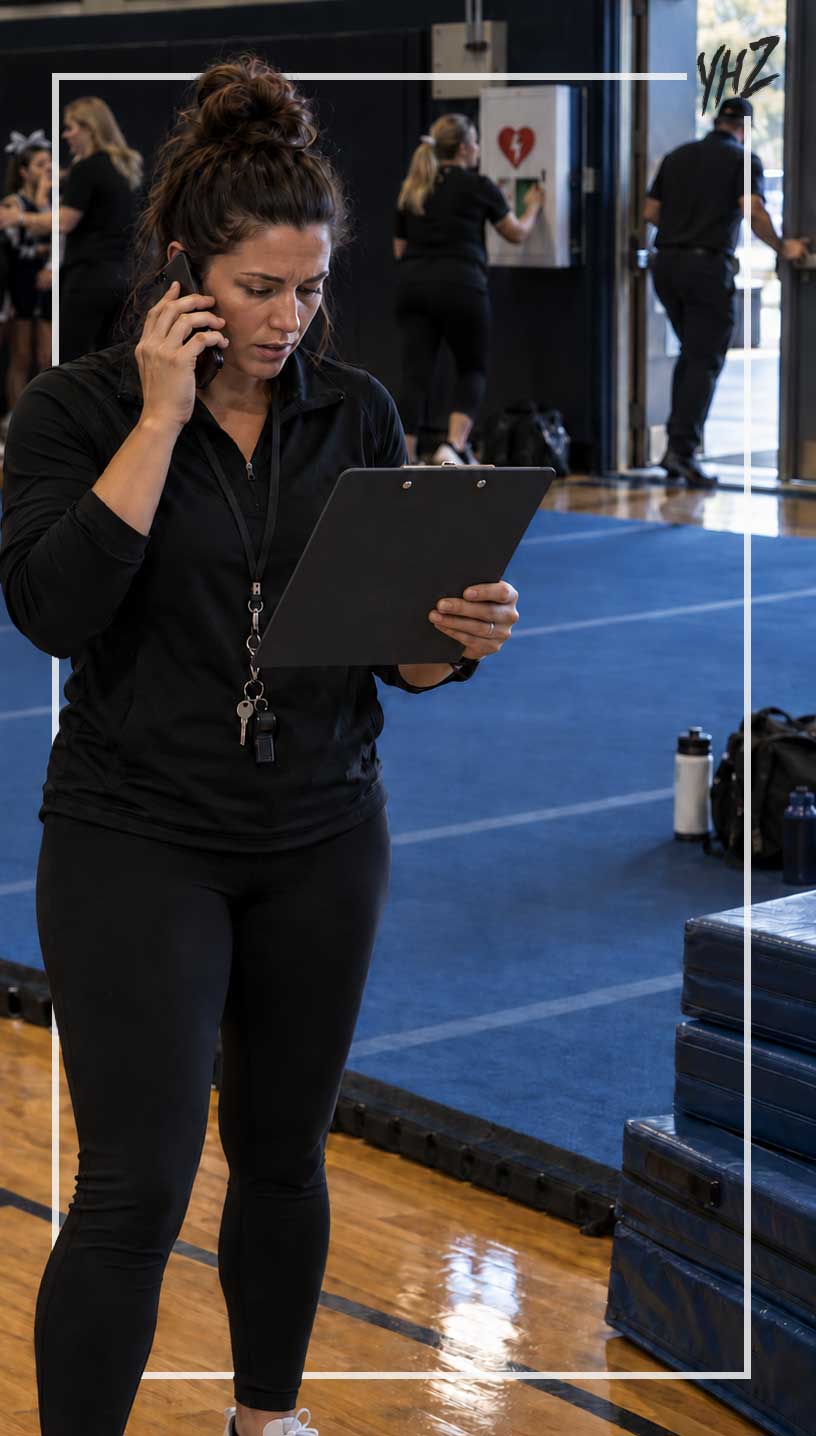
  • One person calls 9-1-1.
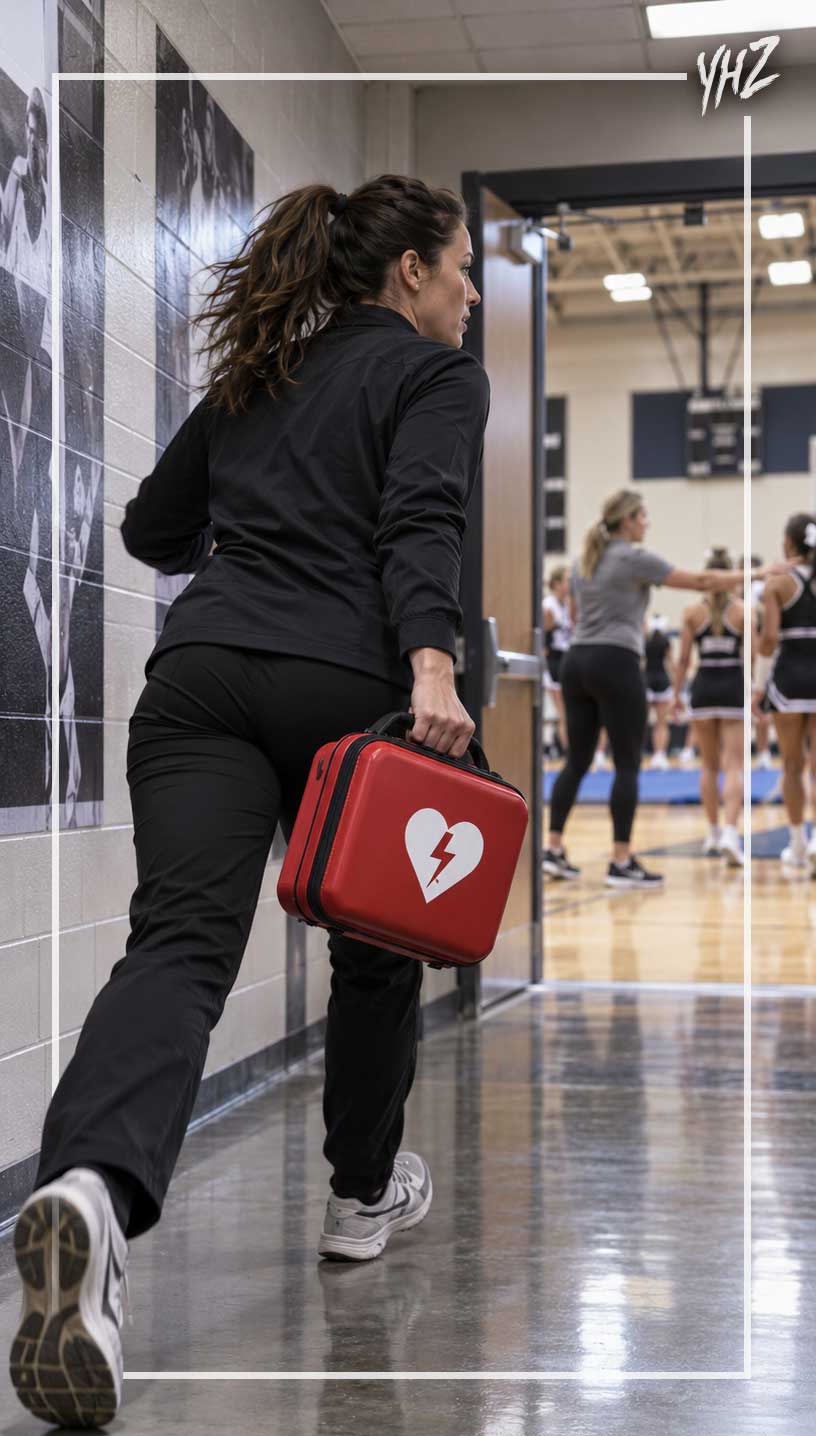
  • One person gets the AED and first-aid kit.
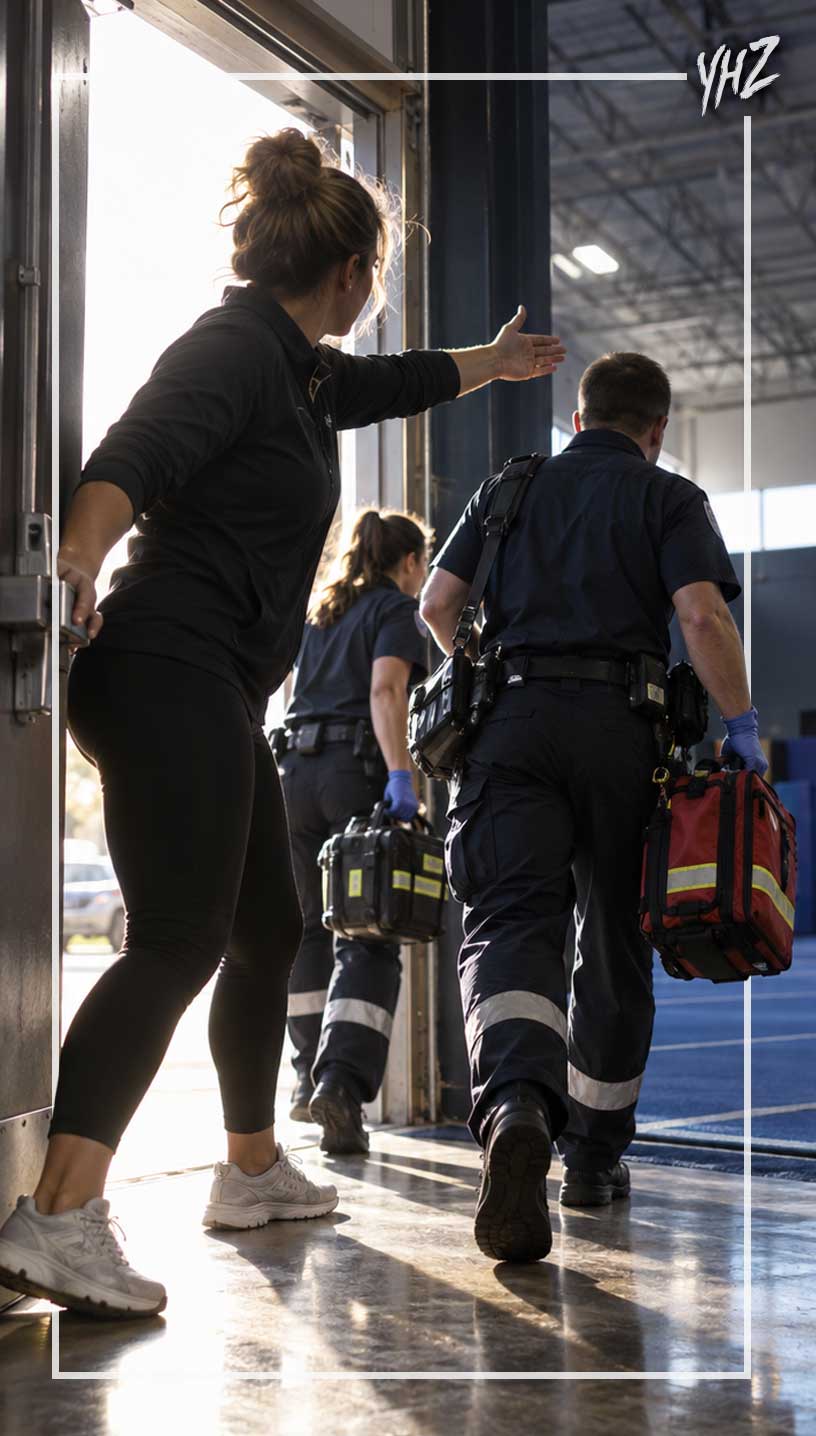
  • One person opens the correct entrance and meets emergency responders.
  • One person contacts the athletic trainer, nurse or facility manager.
  • One person supervises the rest of the team.
  • One person contacts the athlete’s parent or guardian.
  • One person records the timeline after medical staff take control.

Give every job a backup because the primary caller may be absent. The assistant coach may be the person who needs medical care. A useful plan still works when one assigned person cannot do the job. Review the assignments whenever your roster or staff changes.

You can give older athletes simple support jobs during a drill, such as clearing the entrance or guiding an adult to the correct door. Keep an adult in charge of the response. Do not make a minor solely responsible for medical care, team supervision or parent contact. Age-appropriate practice can still help athletes follow directions and stay calm.

Need Competition Music Blue 1

Prepare a 9-1-1 script

Stress changes how people speak and remember. A written script helps the caller give clear information without searching for words. Place the script beside the venue sheet. Give the caller a paper copy in case a phone battery dies.

The caller should know what information the dispatcher will request. Keep the details short and factual. The script should cover these points:

  • “We have a medical emergency.”
  • The full address and nearest cross street
  • The exact place inside the building
  • The athlete’s condition, including whether the athlete is conscious and breathing
  • A short description of what happened
  • The entrance where someone will meet responders
  • The phone number used for the call

The caller should answer the dispatcher’s questions and follow the dispatcher’s instructions. Do not guess about an injury or give a diagnosis. Describe what you can see and what happened. Run a phone-script drill without placing a real emergency call. Have each designated caller read the script out loud so you can fix awkward wording and missing information during practice.

emergency action plan for coaches

Clear a route for emergency responders

An ambulance in the parking lot does not help if responders cannot find the athlete. Locked doors, crowded hallways and unclear building names can slow access. Your plan must cover the full path from the road to the practice floor. Walk that path during the same hours when your team trains. A school entrance that stays open at noon may lock at 4:00 p.m.

Equipment carts, other teams or event barriers may block a route that looked clear in the morning. Assign one person to meet responders outside and place another person at any turn where the route becomes unclear. Give those people a way to unlock doors and gates. At competitions, ask event staff which entrance emergency crews use. Find the athletic training area and AED before warm-ups, then save the venue address in the team travel notes.

Keep medical and contact information ready

Emergency responders may need an athlete’s name, age, allergies, medical conditions and current medications. Coaches also need current parent or guardian phone numbers. Outdated forms can create another problem during an already difficult situation. Review athlete information before each season and ask families to report changes during the year.

Store the forms in a secure place that authorized staff can reach quickly. Decide who can open that file when the head coach is absent. Share medical information only with the people who need it for care. Do not discuss the athlete’s condition in a team group chat or on social media.

concussion protocol for cheerleading

Know where the AED is

An automated external defibrillator cannot help if no one can find it or access it. Record its exact location in each venue plan. Check whether a locked office, closed school wing or after-hours schedule limits access. USA Cheer recommends CPR, first-aid and AED training for coaches. At least one trained adult should attend every practice, game and performance.

More than one trained adult gives the program coverage when a coach is absent or attending to another athlete. Include the AED in each drill. The assigned person should walk to it and return to the practice area. This test tells you how long retrieval takes and whether anything blocks access.

Treat a possible head, neck or spine injury with care

A coach should not diagnose an injury, but a coach must recognize when an athlete needs immediate medical help. Loss of consciousness, breathing trouble, loss of sensation or a suspected head, neck or spine injury calls for a trained response. USA Cheer’s emergency plan tells responders not to move an athlete when they suspect a head, neck or spine injury, unless an immediate hazard makes the location unsafe. Keep the athlete still and wait for trained medical help. Follow instructions from the 9-1-1 dispatcher.

Do not ask an athlete to “walk it off” after a serious fall. Do not let the desire to restart practice rush the decision. Stop activity and give responders room to work. Resume practice only after qualified staff say the area and remaining athletes are ready.

Use a firm concussion rule

A concussion can follow a hit to the head or a forceful hit to the body. Symptoms may appear without a loss of consciousness. Coaches should know the signs and remove the athlete from participation when they suspect a concussion. The coach should not judge the severity of a possible concussion.

The CDC HEADS UP guidance says to remove the athlete right away, check for danger signs and keep the athlete out for the rest of that day. A healthcare provider must clear the athlete before return to sport. Write that rule into your plan and explain it to athletes and parents before the season starts. A close competition or an important practice does not change the medical standard. This article gives emergency-planning information and does not replace medical advice, professional training or instructions from emergency personnel.

Manage the rest of the team

A serious injury affects every athlete in the room. Some athletes may panic, cry or crowd around their teammate. Others may reach for a phone and start recording. Assign an adult to move the team to a set location away from the injured athlete. Keep the group supervised and leave the access route open.

Tell athletes not to record, post or speculate about what happened. Give the team a short, factual update when you can do so without exposing private medical information. Do not blame an athlete, stunt group or coach during the emergency because staff can review the incident later. Your plan must also state who supervises the team if the head coach goes to the hospital. Do not leave minors alone or dismiss them without an approved pickup plan and confirmed parent contact.

Practice the plan like a routine

An unread EAP will not control a stressful room. Run a drill and give each person a job. Stop the clock when the assigned person reaches the AED and when the outside guide reaches the ambulance entrance. USA Cheer advises programs to practice the plan until everyone knows the assigned roles, then repeat the drill each month. The organization compares the process to a fire drill because repetition helps people act when the room becomes loud and confusing.

Test more than one situation. Run a drill with the head coach “unavailable,” then run another after normal school hours when exterior doors are locked. Test the plan during a travel practice or at a secondary facility. After each drill, ask whether the caller found the address, the guide opened the correct door and an adult supervised the rest of the team. Fix each failure before the next practice.

Review what happened after an emergency

Complete an incident report as soon as the situation allows. Record the time of the injury, the observed condition, the care provided, the 9-1-1 call and the transfer to medical personnel. Use facts and avoid guesses about fault or diagnosis. Meet with the adult staff after the emergency and check which parts of the plan worked. Note where the response slowed down.

Update the plan, replace used supplies and contact the proper school or gym administrator. Witnessing a serious injury can upset teammates and staff. Offer access to the school counselor or another qualified support person when needed. Give the injured athlete and family control over what medical information the program shares.

cheer safety plan

A 15-minute safety check for cheer coaches

You do not need a full staff meeting to find the largest gaps in your current plan. Take 15 minutes before your next practice and complete this check. Record any item that your staff cannot confirm:

  • Ask one coach to state the facility’s full address.
  • Ask one athlete to point to the nearest AED.
  • Check whether staff can open the ambulance entrance.
  • Confirm that at least one present adult has current CPR/AED and first-aid training.
  • Open the emergency contact file and check when families last updated it.
  • Name the adult who will call 9-1-1.
  • Name the adult who will supervise the team.
  • Walk the route from the street to the practice floor.
  • Schedule the first full drill.

Any answer of “I think” or “probably” identifies work that your program needs to do. Write down the correct answer, assign a person and test it. The best emergency drill feels boring because everyone moves to the assigned place, the caller reads the correct address and the right door opens. That is the goal.

Find the confusion during a drill, not while an injured athlete waits on the mat.

Steve Pawlyk Signature Full

IPP's Premade Mixes are USA Cheer Compliant and customizable!  Add Sound FX, swap songs, & more!  Add your Team Name to the mix for only $10! 

SLAM artwork
Full_Out_130 mp3 image
1 minute cheer mix
WAKE UP THE FIRE
SLAM artwork
WAKE UP THE FIRE
Full_Out_130 mp3 image
1 minute cheer mix

Sources

Return to Cheerleading After a Break: A Safer Practice Plan

return to cheerleading after a break

By Steve Pawlyk

Published September 10, 2026

The first practice after a break can create false confidence. Athletes remember the counts, grips, and skills, so everyone expects their bodies to follow. Some skills may look ready during the first few attempts. That does not mean the team can safely repeat them through a full practice.

Memory is not readiness.

Athletes may lose strength, timing, balance, endurance, or confidence during time away. Stunt groups can also lose the small adjustments that keep skills stable. Bases may reach at different times, flyers may rush transitions, and spotters may react a fraction too late. Coaches need to rebuild those connections before adding difficulty or volume.

A return to cheerleading after a break should follow demonstrated ability, not the calendar. Your team may move quickly through basic progressions. Another team may need several practices at one stage. Both responses can be correct.

cheerleading return to sport

New Research Points to a Return-to-Activity Risk

A 2026 study in Pediatrics examined 15,799 cheerleading injuries among athletes ages 6 through 18. The cases represented an estimated 551,258 emergency department injuries from 2004 through 2023. Fourteen percent involved concussions or other closed-head injuries. Stunting contributed to 39 percent, while teammate collisions contributed to 37 percent.

The researchers also found recurring injury peaks during return-to-sport or return-to-activity periods. They identified those periods as an opportunity for prevention. The study did not test a specific cheer practice plan. It did show why coaches should treat returns as distinct training periods.

The study also examined the 2012–2013 rule change that restricted double-down dismounts for high school and younger teams. Head injuries and teammate collisions declined after that change. The researchers connected the improvement with matching advanced skills to the athlete’s level and environment. You can read the full study summary through the American Academy of Pediatrics.

That principle also makes sense after a break. An athlete may have owned a skill three months ago but lack the current timing to perform it safely. Coaches should evaluate present ability instead of granting permanent ownership of a skill.

Not Every Return Requires the Same Process

“Returning to cheer” can describe several different situations. A team may return after summer, winter break, competition downtime, illness, or injury. Those situations require different levels of oversight. Coaches should identify the reason for the break before planning the athlete’s return.

This article mainly covers healthy athletes returning after scheduled or voluntary time away. It can also help coaches organize practices for medically cleared athletes. It cannot replace an individual rehabilitation or return-to-play plan. A healthcare professional must control medical restrictions and clearance.

Use four return categories:

Return Type

Who Controls the Progression?

Scheduled team break

Coach, using current athlete readiness

Reduced training or vacation

Coach, after reviewing recent activity

Illness

Parent, healthcare professional, school policy, and coach

Injury or concussion

Qualified healthcare professional and applicable return-to-play rules

Do not combine these groups without reviewing their needs. A healthy athlete returning from vacation may start with normal conditioning. An athlete returning from concussion may have strict limits. A single team practice plan cannot override those individual instructions.

Need Competition Music Blue 1

Start Before the First Practice

Send athletes a short return questionnaire before they enter the gym. Ask when they last trained, what they practiced, and whether they currently have restrictions. Include private lessons, camps, open gyms, strength training, and other sports. “I stayed active” does not tell you what the athlete’s body prepared to do.

Ask these questions:

  • When did you last complete a full cheer practice?
  • What cheer skills have you performed during the break?
  • Did you attend tumbling, stunt, strength, or conditioning sessions?
  • Do you have pain, unusual soreness, or movement restrictions?
  • Did you experience an injury, concussion, or significant illness?
  • Did a healthcare professional give you restrictions?
  • Do you feel nervous about any skill that previously felt comfortable?
  • Has your stunt position changed since your last season?
  • Are you returning to more than one cheer team?

Do not use this form as medical clearance. Use it to identify conversations that should happen before practice. When an athlete reports an injury or restriction, follow your organization’s medical procedures. Do not let the athlete “test it” during practice.

Review your emergency plan, mats, equipment, and staff assignments before the return session. Coaches often focus on athlete readiness while ignoring the environment. A crowded floor, missing spotters, or unclear tumbling lanes can create preventable problems. The gym must also return ready.

Check Current Readiness Without Turning Practice Into a Medical Exam

Coaches should assess cheer skills, not diagnose injuries. Your first practice should show how athletes move, land, balance, and respond to corrections. Start with skills below the team’s maximum difficulty. Watch repeated attempts instead of celebrating the best attempt.

A basic return assessment may include:

  • Dynamic movement and gradual warmup
  • Basic body positions
  • Controlled landings
  • Jump preparation and single jumps
  • Core control and balance
  • Motion technique
  • Low-level tumbling fundamentals
  • Stunt grips and timing
  • Prep-level stunt entries and dismounts
  • Spotter positioning and reactions

The goal is not to prove that athletes can survive practice. You want to see whether they can repeat basic movements with control. Watch what happens as mild fatigue appears. Technique that disappears after three attempts needs more work.

Keep the assessment separate from team selection or punishment. Athletes will hide problems when they think one weak session can cost them a position. Tell them why you are reducing difficulty. Honest communication gives you better information.

cheer preseason practice plan

Rebuild the Warmup for the Work Ahead

A few laps and static stretches do not prepare athletes for every cheer skill. Your warmup should match the work planned for that practice. Prepare landing mechanics before tumbling. Prepare shoulders, wrists, legs, and core control before stunting.

Increase the warmup gradually across the return period. Early practices may need more time for movement preparation and skill review. Later practices can move faster after athletes show consistent control. Do not copy the final-week competition warmup on the first day back.

The warmup also gives you your first fatigue check. Watch for athletes who struggle with movements they previously controlled. Ask questions before adding impact. A difficult warmup may mean the planned practice needs adjustment.

For more help organizing complete sessions, check out our guide to planning cheer practices effectively.

cheerleading injury prevention

Return to Stunting From the Ground Up

Stunt groups need a progression even when every athlete returns to the same position. Timing and trust can fade during a break. Start with grips, body positions, dips, catches, and verbal cues. Make each athlete explain their job before increasing height or difficulty.

A general stunt return can follow this order:

  1. Ground-level positions and grips
  2. Loading drills and controlled dips
  3. Prep-level skills
  4. Basic extensions
  5. Body positions
  6. Simple transitions
  7. More difficult entries and releases
  8. Dismounts, baskets, and pyramids
  9. Connected stunt sequences
  10. Routine-speed execution under fatigue

This list does not replace your governing rules or credential requirements. Adjust the order for your athletes, division, and legal skills. Do not skip a stage because the group performed the skill last season. Make them show current control.

Repeat skills enough to judge consistency, but do not chase exhaustion. Adding more repetitions can make a shaky skill worse. Stop when timing or technique begins to decline. Return to an easier version and correct the cause.

USA Cheer gives coaches a direct rule for repeated stunt falls. When falls happen too often, return to the previous progression and rebuild the technique. Its National Cheer Safety Month guidance also teaches coaches when to stop trying to save a failing stunt.

Spotters Need Their Own Progression

Coaches often focus on the flyer and bases while treating the spotter as automatic protection. Spotting also requires timing, positioning, attention, and practice. A spotter returning from a break may react late or reach toward the wrong area. That can turn a controlled error into a collision.

Review where spotters stand and what they watch. Practice responses to common failures at low difficulty. Teach when to help lower a stunt and when to move into a controlled catch. Do not introduce difficult releases before the spotters demonstrate readiness.

Avoid assigning an unfamiliar athlete to spot an advanced skill without preparation. Being nearby does not make someone an effective spotter. The athlete must understand the skill, likely failure paths, and required response. Coaches must also follow all applicable spotting rules.

Control Teammate Collisions

The 2026 Pediatrics study found that teammate collisions contributed to 37 percent of concussions and closed-head injuries in its dataset. The study does not prove that floor traffic caused every collision. Many likely occurred during stunts or catches. Coaches should still control every collision risk they can see.

Set clear tumbling lanes and one-way traffic. Separate standing tumbling, running tumbling, and stunt work whenever space allows. Do not let athletes walk across active lanes. Assign a coach to control starts when several groups share the floor.

Stunt groups also need enough room for safe catches and unexpected movement. A stunt that falls sideways should not enter another group’s space. Mark group areas when the floor becomes crowded. Reduce the number of active groups when spacing becomes unsafe.

Music can also hide warnings and verbal cues. Control volume during early stunt progressions. Athletes should hear coaches and teammates clearly. Save competition-level sound for sessions that actually require it.

Rebuild Tumbling in Layers

Start tumbling with shapes, landings, and basic skills that support later passes. Then add standing skills, running entries, connected passes, and routine combinations. An athlete who can throw one skill may not have the endurance for repeated passes. Evaluate both execution and recovery.

Separate current skill ability from previous skill history. Ask athletes to show the progression that leads to the target skill. If the setup, body position, or landing has changed, stay at the easier stage. Do not let pride choose the tumbling plan.

Control the number of passes. More attempts do not always create better training. Repeated poor attempts teach poor timing and increase fatigue. Stop the set when the athlete cannot maintain the required technique.

Use appropriate surfaces and qualified coaches. Follow your program’s rules for spotting and skill level. Never use the return period to rush a new tumbling skill before choreography. Restore existing foundations first.

Delay Full-Outs Until the Routine Parts Are Ready

A full-out combines skill difficulty, repetition, timing, performance, and fatigue. It exposes every weakness that basic drills can hide. Running a full routine too early does not prove toughness. It gives coaches poor information because several failures happen at once.

cheer stunt progressions

Build toward full-outs in stages:

  1. Walk counts and spacing
  2. Mark choreography without major skills
  3. Perform individual sections
  4. Connect two sections
  5. Run the routine with selected skills
  6. Add more difficulty while controlling repetitions
  7. Perform a full routine after every section meets the standard

Do not let a competition date force a full-out before the team is ready. Change the routine, reduce difficulty, or adjust the practice plan. A clean legal routine helps the team more than an ambitious routine that rarely survives practice. The schedule cannot perform the skills for your athletes.

When you begin full-outs, track where technique changes. Note missed grips, short landings, slow timing, and mental errors. Those failures may point to conditioning, skill readiness, or routine design. Do not answer every problem with more full-outs.

A Sample 10-Practice Return Plan

No fixed schedule can fit every team. Use this sample as a planning model, not automatic permission. Athletes must meet each practice goal before moving forward. Repeat or change a stage when the team lacks control.

Practices 1 and 2: Assess and Rebuild Basics

Review recent training, restrictions, and athlete concerns. Evaluate basic movement, landings, motions, jumps, tumbling foundations, stunt grips, and prep-level timing. Keep conditioning controlled and relevant to the planned skills. Do not run full-outs.

Use these sessions to identify groups that need separate progressions. Returning athletes may not start at the same point. Keep notes on consistency, confidence, and fatigue. Plan the next practices from those observations.

Practices 3 and 4: Restore Individual Skills

Add familiar tumbling and stunt skills after athletes demonstrate the required foundations. Keep difficult skills separate instead of connecting long sequences. Rebuild jump technique and basic conditioning. Continue training spotters at every stunt level.

Increase either difficulty or repetition with care. Do not increase both simply because the first practices looked good. Watch how athletes respond during the next session. Delayed soreness or fatigue may change your plan.

Practices 5 and 6: Reconnect Skills

Begin connecting tumbling passes, stunt transitions, jump combinations, and short routine sections. Keep a simpler version available for each difficult sequence. Use it when timing or technique declines. Do not reward athletes for hiding pain or fear.

Start building performance endurance through short sections. Allow enough recovery for athletes to maintain form. Track which section creates the first technical breakdown. That section needs work before the full routine does.

Practices 7 and 8: Add Routine Demand

Connect larger sections and add more routine-speed skills. Test spacing, transitions, communication, and spotter reactions. Continue to limit repetitions that lose quality. A failed section needs correction, not immediate punishment.

You may introduce partial full-outs during this stage. Choose the sections and skills in advance. Do not surprise athletes with added difficulty halfway through the run. Record the results and adjust the next practice.

Practices 9 and 10: Evaluate Full-Routine Readiness

Perform a controlled full routine only when each section meets your stated standard. Reduce difficulty when the team cannot maintain technique under fatigue. One completed full-out does not prove repeatable readiness. Review the run before adding another.

Some teams will reach this stage earlier. Others will need several more practices. The number does not matter as much as the execution. Your athletes should earn progression through current performance.

Need Competition Music Blue 1
first cheer practice after summer

Use Readiness Gates Instead of Dates

A practice number should never provide the only reason to advance. Set readiness gates for tumbling, stunts, jumps, and routine sections. Athletes should know what they must demonstrate. This approach makes your decisions easier to explain.

A readiness gate may require:

  • Several controlled repetitions
  • Legal technique for the athlete’s division
  • Stable timing across the stunt group
  • Safe catches and landings
  • Correct spotter positioning
  • No technique breakdown under normal practice fatigue
  • Athlete confidence without pressure or coercion
  • No conflict with medical restrictions
  • Enough space, mats, and qualified supervision

Choose the number of repetitions that fits the skill and your governing guidance. Do not invent one universal number for every team. A basic prep and an advanced release do not need identical standards. Higher-risk skills demand more evidence.

Document when a group meets each gate. This record helps when athletes miss practice or groups change. It also prevents the coaching staff from advancing one group based on excitement. Use the same standard throughout the team.

Watch What Fatigue Changes

Fatigue often appears first through technique. Bases may bend their arms early, flyers may lose body control, and tumblers may shorten landings. Spotters may drift or react slowly. Athletes may also forget counts that they knew at the start of practice.

Stop and review when several errors appear together. The team may need water, rest, a lower skill, or the end of that section. Do not add punishment conditioning after fatigue causes failures. That response adds load without correcting the original problem.

Ask athletes what changed. They may report fear, pain, poor sleep, or another practice earlier that day. You do not need to accept every explanation without question. You do need accurate information before deciding what happens next.

Record repeated patterns across practices. One difficult session may mean little. The same breakdown at the same point needs attention. Change the practice plan before the problem becomes normal.

Returning After Injury Requires Medical Direction

A coach cannot clear an athlete after injury. Follow the instructions from the athlete’s qualified healthcare professional and your organization. Ask for written restrictions when your policy permits it. Do not guess what “limited participation” means.

Medical clearance also does not require an immediate full-out. Follow the athlete’s prescribed return plan, then rebuild cheer timing within those limits. The healthcare professional controls medical readiness. The coach controls legal skill progressions and team placement.

Do not pressure athletes to return for a competition date. Do not ask parents to find a different medical opinion because the first answer disrupts your lineup. Build an alternate plan and protect the athlete’s long-term participation. The routine can change.

Concussion Return Follows a Separate Process

Do not use the sample 10-practice plan as a concussion protocol. The athlete must receive approval and supervision from a healthcare professional. The CDC uses a six-step return-to-sports progression based on international concussion guidance. Each stage usually takes at least 24 hours.

The athlete advances only when the current stage causes no new symptoms. If symptoms return, the athlete stops and contacts the medical provider. The provider may direct the athlete to return to the previous stage. Coaches do not shorten this process for cheer.

The CDC HEADS UP return-to-sports guidance moves athletes from regular activities through aerobic work, moderate activity, heavy non-contact work, practice, and competition. Cheer coaches must fit sport-specific activity within the provider’s plan. Stunting, tumbling, and full-outs do not belong in the early stages.

Keep the athlete connected with the team when appropriate. They may attend meetings, review video, or help with counts if their medical plan allows it. Do not make the athlete earn their position by ignoring symptoms. Recovery is not a character test.

Communicate the Plan to Parents and Athletes

Explain the return plan before the first practice. Parents should understand why the team will repeat easier skills. Athletes should know that coaches will use current execution to control progression. This message reduces pressure to prove everything on day one.

Tell families how to report pain, restrictions, or concussion symptoms. Give them one contact person and a private communication method. Do not discuss medical information in the team group chat. Share information only with staff who need it.

Explain how missed practices affect progression. An athlete who misses the first four sessions may need an individual assessment. Do not drop them directly into the team’s current stage. The group’s progress cannot prove that athlete’s readiness.

Common Return-to-Cheer Mistakes

Starting Where the Team Finished

Last season’s final routine represents months of training. It does not provide the correct starting point after a long break. Begin below the team’s maximum and move forward through evidence. Familiar skills can still require restored timing.

Using Conditioning as the Entire Return Plan

Conditioning supports cheer skills, but running and bodyweight exercises cannot restore stunt timing. Athletes need gradual sport-specific work. They also need controlled tumbling, landing, spotting, and group practice. General fitness does not replace technical readiness.

Chasing New Skills Too Soon

The return period should restore foundations before introducing major upgrades. New skills can hide problems because everyone expects errors. Familiar skills give you a cleaner view of current control. Add upgrades after the team restores dependable technique.

Letting Strong Athletes Pull the Whole Team Forward

Your most prepared athlete should not control the pace for every group. Athletes return with different training histories and bodies. Split groups when readiness differs. A fast group can progress without forcing another group to follow.

Treating Falls as Normal Repetition

Every stunt group will make errors. Repeated falls tell you that the current progression is not working. Return to the previous skill and correct the cause. Do not keep throwing the same stunt until chance produces one hit.

Advancing Because Competition Is Close

A deadline can guide planning, but it cannot create readiness. Reduce difficulty when the available training time cannot support the original routine. Coaches control routine design. Athletes should not carry the risk of unrealistic choreography.

Frequently Asked Questions About Returning to Cheerleading

How Long Should a Return to Cheerleading Take?

No universal number fits every athlete or team. The length depends on time away, recent training, age, skill level, and current execution. Use readiness gates instead of fixed dates. Medical returns must follow professional instructions.

When Should a Team Start Full-Outs After a Break?

Begin full-outs after athletes demonstrate control in every routine section. They should also maintain technique as fatigue increases. Start with marked routines, sections, and partial runs. Do not use a full-out to discover whether basic skills are ready.

Should Athletes Repeat Skills They Already Mastered?

Yes. Previous mastery does not prove current timing, strength, or consistency. A short progression allows the athlete to demonstrate readiness. Athletes who remain prepared may move through basic stages quickly.

Do Spotters Need Return Training?

Yes. Spotters need current timing, positioning, focus, and knowledge of the skill. Review catches and common failure paths at easier levels. Do not treat a spotter as passive protection. Their actions require preparation.

What Should a Coach Do When an Athlete Reports Pain?

Stop the activity that causes or changes the pain. Follow your school or gym procedures and contact the parent or medical staff when required. Coaches should not diagnose the problem. Medical professionals should control injury evaluation and return instructions.

Can an Athlete Return to Cheer as Soon as Concussion Symptoms Stop?

No. The athlete needs healthcare approval and a supervised, step-by-step return. The CDC progression usually requires at least 24 hours at each stage. Symptoms that return require the athlete to stop and contact the provider. Competition comes only after successful completion of the earlier stages.

Do Not Confuse Familiar With Ready

Your athletes may remember every skill they performed before the break. Their current bodies still need to prove timing, control, strength, and endurance. Start with foundations, watch repeated execution, and advance through clear gates. Move backward when the evidence tells you to.

A slower first week can protect the work that follows. A rushed return can cost far more practice time later. Build the team you have today, then train them toward the team they were before the break.

Steve Pawlyk Signature Full

IPP's Premade Mixes are USA Cheer Compliant and customizable!  Add Sound FX, swap songs, & more!  Add your Team Name to the mix for only $10! 

SLAM artwork
Full_Out_130 mp3 image
1 minute cheer mix
WAKE UP THE FIRE
SLAM artwork
WAKE UP THE FIRE
Full_Out_130 mp3 image
1 minute cheer mix

All-Star and School Cheer: How Coaches Can Manage Two-Team Workloads

all star and school cheer

By Steve Pawlyk

Published September 8, 2026

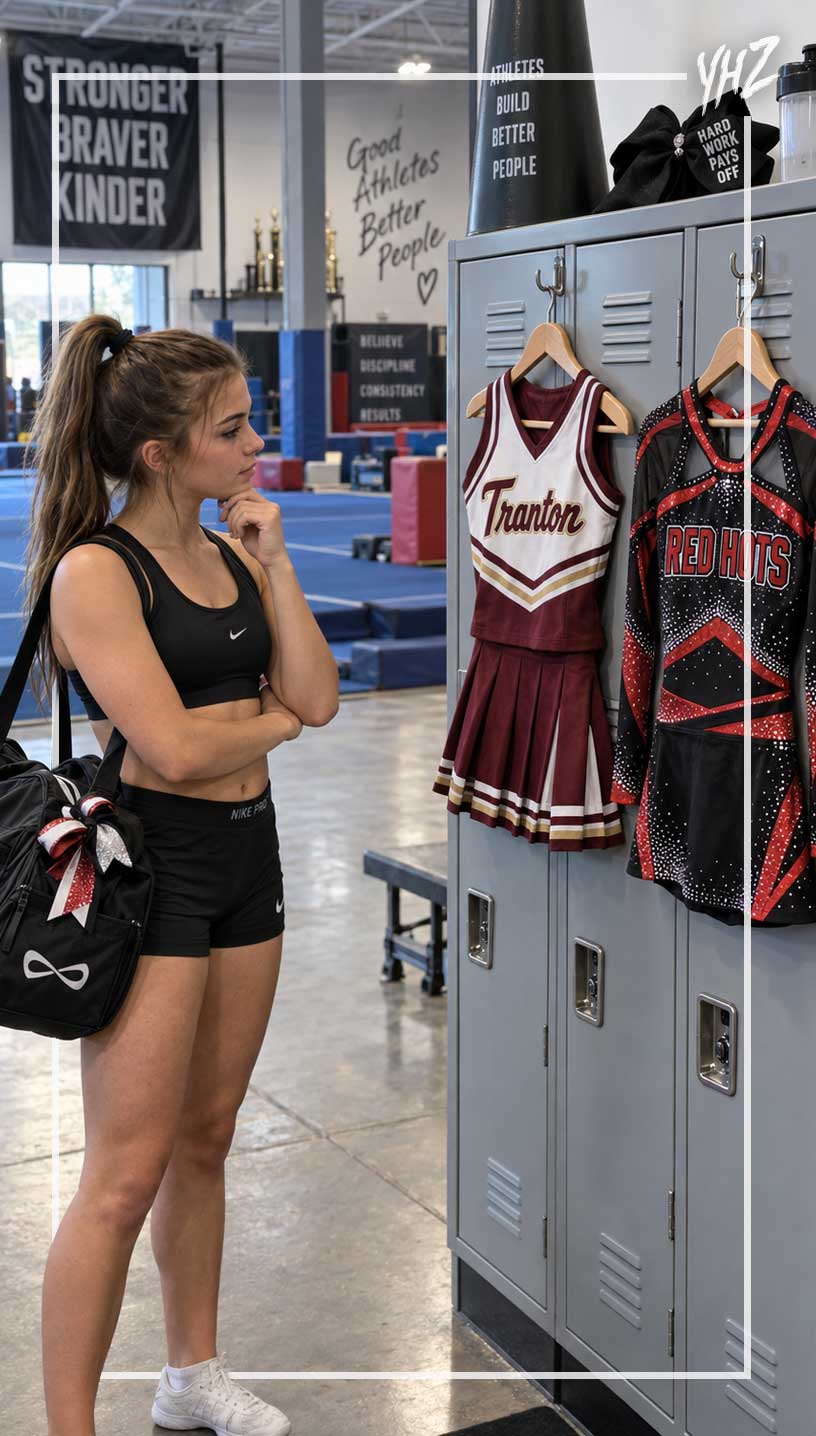
Many athletes participate in all-star and school cheer during the same season. Each coach may see a reasonable schedule, while the athlete experiences something very different. School practices, games, tumbling classes, all-star practices, and weekend travel can fill every day. Homework and sleep must fit around whatever time remains.

Doing both programs can work for some athletes. It can also create an exhausting schedule that neither coach fully understands. The problem starts when each program acts like the other one does not exist. An athlete only has one body, regardless of how many uniforms hang in the closet.

Coaches do not need to fight over ownership of an athlete. They need to see the complete workload and make informed decisions. That requires honest schedules, protected recovery, and clear attendance rules before the season begins.

all star cheer and high school cheer

Two Cheer Teams Create One Combined Workload

School and all-star cheer may have different goals, but they use many of the same physical skills. Both programs can include tumbling, jumps, stunts, baskets, pyramids, conditioning, and full-out routines. The athlete does not recover separately for each team. Every repetition contributes to the same weekly load.

A school coach may schedule two practices, a football game, and a Saturday competition. The all-star coach may add three practices, a tumbling class, and a Sunday event. Neither schedule looks extreme when viewed alone. Together, they can leave the athlete without a full recovery day.

This situation differs from seasonal participation in two distinct sports. All-star and school cheer repeat many of the same movements and impact patterns. The athlete may perform running tumbling for both teams within several hours. They may also base, backspot, or fly through dozens of added stunt repetitions.

The American Medical Society for Sports Medicine warns against simultaneous participation on multiple teams in the same sport. Its guidance links overscheduling with overtraining, injury, illness, sleep problems, stress, and burnout.

USA Cheer also recognizes the schedule problem. Its youth and junior national team guidance discourages athletes from joining multiple cheer teams during national team preparation. USA Cheer cites the number of required practices as the reason.

That does not mean every athlete must choose one team. It means coaches should stop treating dual participation as a harmless scheduling detail.

Coaches Usually See Only Half the Problem

A coach knows when an athlete attends that coach’s practice. They may not know what happened during the previous six hours. The athlete could arrive from another practice after completing full-outs, tumbling passes, or repeated elite stunts.

Young athletes often describe every practice as “fine.” They may worry that honest fatigue will cost them a position. Some athletes also believe that constant soreness proves commitment. That silence prevents both coaches from adjusting the workload.

Parents may know the schedule but lack the technical context. Two hours of choreography does not place the same demand on an athlete as two hours of full-outs. A game may include long breaks, while a stunt clinic may produce hundreds of high-effort contacts. Total hours matter, but the contents of those hours matter too.

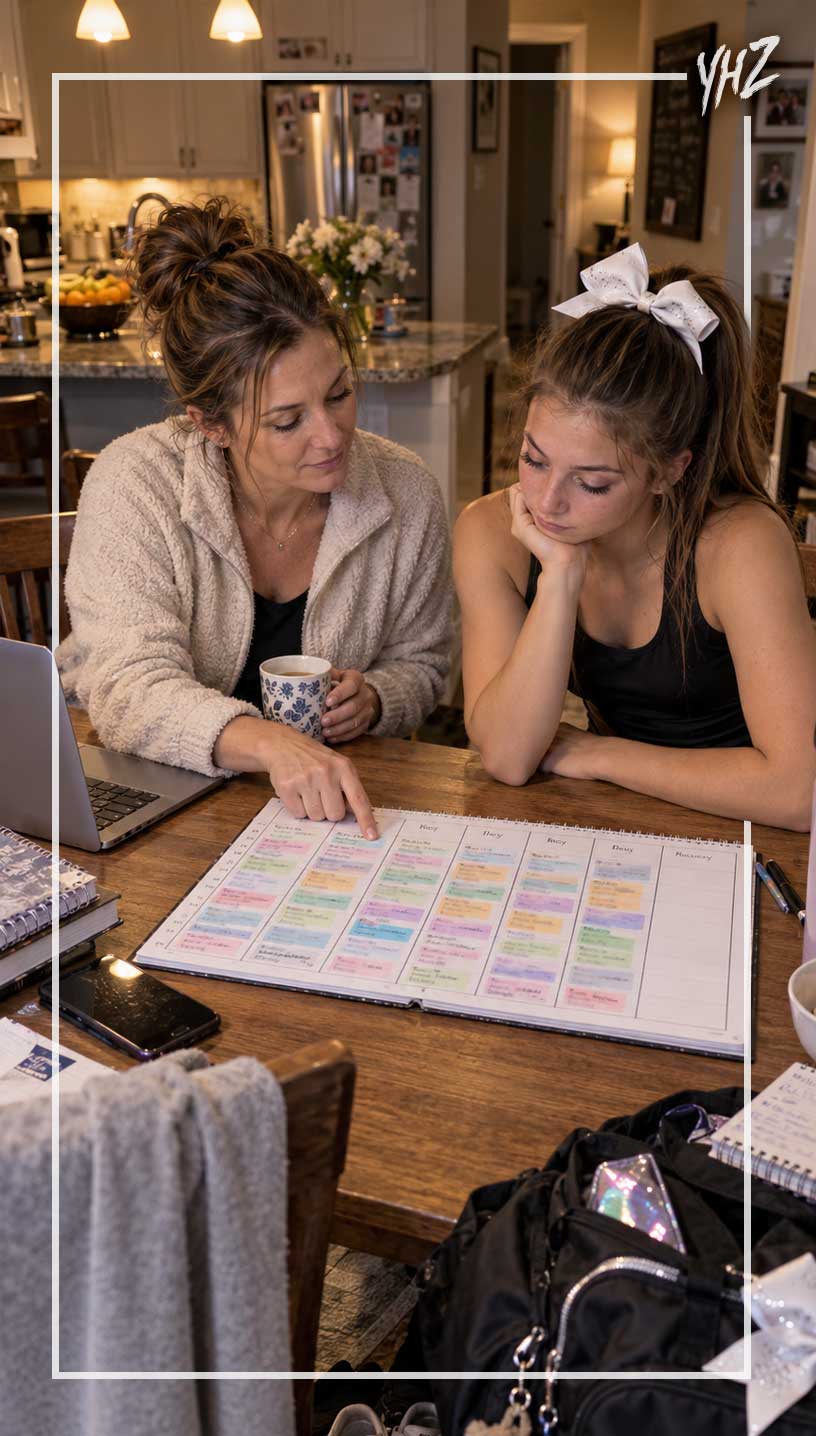
Every dual-team athlete needs one complete weekly schedule. That schedule should include both teams, games, competitions, tumbling classes, private lessons, open gyms, strength work, and required school events. Travel time also affects recovery, even when it does not count as training.

Build a Weekly Cheer Workload Sheet

You do not need expensive tracking software. A shared spreadsheet or weekly form can expose the problem quickly. The athlete or parent can update it each Sunday. Both coaches can review it before planning the week.

Track these details:

Workload Item

What to Record

School cheer practices

Date, duration, and planned sections

All-star practices

Date, duration, and planned sections

Games and performances

Call time, performance time, and physical demands

Competitions

Warmups, performance rounds, travel, and return time

Tumbling classes

Duration and approximate number of passes

Stunt classes or privates

Position, skills, and approximate repetitions

Full-outs

Full routine, marked routine, or section full-out

Strength and conditioning

Duration, exercises, and intensity

Pain or unusual soreness

Area, activity that caused it, and whether it changed movement

Sleep

Approximate hours and major disruptions

Academic demands

Tests, projects, and weeks with unusual school pressure

The sheet does not need perfect numbers. Its job is to reveal crowded days, repeated high-impact sessions, and missing recovery. A blank calendar can make six practices look manageable. A detailed calendar may show three straight days of tumbling and full-outs.

Coaches should also mark each session as low, medium, or high demand. A film review may carry low physical demand. Stunt sections and repeated tumbling may carry medium or high demand. Full-outs, competitions, and intense double sessions usually belong in the high-demand category.

Do not use these labels to compete with the other coach. Use them to decide when an athlete needs reduced repetitions, modified conditioning, or a different practice assignment.

Need Competition Music Blue 1

Count Repetitions, Not Only Practice Hours

Two practices of equal length can place very different demands on an athlete. One practice may focus on motions, counts, and transitions. The other may include repeated baskets, standing tumbling, and full-outs. Counting both as “two hours” hides the difference.

Track the skills that create the greatest load for each athlete. Flyers may need extra attention after repeated baskets, inversions, and body positions. Bases and backspots may need adjustments after heavy stunt sessions. Tumblers may need reduced passes after clinics, private lessons, or competitions.

You do not need an exact count for every motion. Approximate counts can still reveal patterns. “About 30 running passes” provides more useful information than “one tumbling class.” “Five full-outs” tells the other coach what happened before the athlete entered the next practice.

Ask athletes to report added training outside both programs. Open gym, backyard tumbling, and private lessons still create physical load. Optional training does not become invisible because neither head coach assigned it.

two cheer teams

Protect Real Recovery Days

Medical groups differ slightly on the number of recommended rest days. They agree that young athletes need regular recovery.

The American Academy of Pediatrics recommends at least one or two days off each week from competition and sport-specific training. It also recommends two or three months away from one sport each year. The AAP connects insufficient recovery with overuse injuries, overtraining, lower performance, and burnout.

AMSSM advises young athletes to keep organized sports to five or six days each week. The organization also recommends at least one full day away from sports. NATA takes a stronger position and recommends two days away from organized training and competition.

At minimum, protect one complete rest day every week. Aim for two when the competition calendar permits it. A “rest day” cannot include tumbling privates, open gym, conditioning, or another team’s practice. Walking through choreography may also defeat the purpose when the athlete never gets a mental break.

Recovery cannot depend on whichever program gives in first. Coaches and families should identify the protected day before the season. When an event takes that day, move the recovery day somewhere else. Do not simply erase it.

Use Age-Based Hours as a Warning Light

NATA recommends that young athletes avoid more weekly organized sport hours than their age in years. Under that guidance, a 13-year-old should avoid more than 13 organized hours each week. The recommendation includes practices, competitions, classes, and other organized training.

This age-based measure cannot account for every athlete or practice. A low-impact instructional session does not equal two hours of full-outs. Still, the measure gives families and coaches a useful warning light. A 12-year-old logging 18 organized hours needs closer review.

Do not wait until the athlete crosses a number before paying attention. Rapid schedule increases can create problems even when total hours appear acceptable. The AAP recommends gradual increases in weekly training time and repetitions. Two programs can accidentally create a sudden increase because neither coach sees the combined change.

Need Competition Music Blue 1
cheerleading workload

Decide Which Coach Adjusts the Load

Both programs cannot demand maximum effort every day. Someone must adjust when high-demand sessions overlap. That does not require one program to surrender authority to the other.

Start with the complete schedule. Identify games, competitions, choreography, camps, and required practices. Then mark dates when both programs plan high-demand work. Address those dates before the athlete reaches them.

The adjustment may involve fewer tumbling passes, marked sections, limited stunt repetitions, or removal from conditioning. Coaches can also assign film review, counts, motions, or leadership work. The athlete can still contribute without repeating every high-impact skill.

Do not make the athlete negotiate two coaches during practice. The adults should settle foreseeable conflicts before the session. A teenager should not have to choose which coach to disappoint while both wait for an answer.

When direct coach communication fits program policy, get written permission from the parent or guardian. Keep the exchange factual and limited to scheduling, workload, injuries, and attendance. Do not discuss routine strategy, athlete rankings, or another program’s private information.

Set Attendance Priorities Before the Season

Schedule conflicts will happen. Football games, pep rallies, choreography, all-star competitions, and school events do not coordinate themselves. Waiting for the first conflict guarantees anger and rushed decisions.

Both programs should publish their non-negotiable dates before athletes commit. Families should compare the calendars and identify every known conflict. Coaches should then approve the plan in writing. An athlete should not learn in October that both programs claim the same weekend.

A program can reasonably refuse dual-team participation when the schedule cannot work. Coaches also have the right to set attendance standards. They should state those standards before accepting the athlete. A clear “no” before the season causes less damage than a forced choice during competition week.

Do not punish an athlete for following a preapproved conflict plan. Extra conditioning adds physical load to a schedule that already caused concern. It also turns communication into punishment. Handle repeated unapproved absences through your normal attendance policy.

The athlete should know which event takes priority when both programs compete. School rules, contracts, and governing policies may decide the answer. When no rule applies, the coaches and family must agree before the season. “We will figure it out later” is not a plan.

Watch for Changes in the Athlete

Coaches should not diagnose overtraining or medical conditions. They should notice changes and involve qualified healthcare professionals when needed.

The AAP lists fatigue, mood changes, sleep problems, poor academic performance, and declining athletic performance among possible warning signs. Persistent muscle or joint complaints also deserve attention. AAP guidance explains that excessive training without enough recovery can affect physical and psychological health.

Watch for these changes:

  • Skills that suddenly lose consistency
  • Unusual fear during previously comfortable skills
  • Repeated complaints of heavy or tired legs
  • Pain that changes technique or movement
  • Irritability or emotional withdrawal
  • Trouble staying focused during practice
  • Falling asleep during travel or team meetings
  • Declining school performance
  • Frequent minor illnesses
  • Loss of interest in either team
  • Anxiety about disappointing coaches
  • Soreness that never appears to improve

One rough practice does not prove that an athlete has exceeded their limits. A repeated pattern deserves action. Speak privately with the athlete and parent. Ask about the complete schedule, sleep, pain, school pressure, and recent changes.

Remove the athlete from activity when you suspect a concussion or serious injury. Follow your organization’s emergency and return-to-play rules. A workload spreadsheet cannot replace an athletic trainer, physician, or other qualified professional.

Sleep and School Still Count

An athlete can follow every practice plan and still lack enough recovery. Travel, homework, early school hours, and family responsibilities affect the same body. Weekend competition travel can remove sleep before Monday’s practice. Late games can create the same problem during the school week.

Do not treat academic decline as an unrelated issue. The AAP lists poor academic performance among the possible signs of excessive training or inadequate recovery. AMSSM also warns that overscheduling can damage academic and athletic performance. School success belongs in the workload discussion.

Ask families about major exams, school projects, and travel weeks. A short practice adjustment during finals may protect both performance and attendance. Coaches often gain more from a rested athlete on Friday than an exhausted athlete who survived every practice.

Stop Rewarding Athletes for Hiding Fatigue

Cheer culture often praises athletes who push through everything. That attitude can make honest communication feel weak. Athletes may hide pain or exhaustion because they fear losing their spot. Coaches create that fear when every modification carries a punishment.

cheer practice schedule

Tell athletes that reporting workload will not automatically remove them from the routine. Explain how you use the information. You may adjust repetitions, change conditioning, or ask a healthcare professional for guidance. Silence creates more risk than an honest report.

Do not praise an athlete for completing two full practices while injured or exhausted. Effort matters, but judgment matters too. Coaches should model the difference between normal training discomfort and symptoms that need attention.

Your team culture should reward athletes who communicate early. Early reports give you more options. Late reports often arrive after the athlete loses skills, misses school, or needs a longer break.


Give Dual-Team Athletes a Written Plan

A short dual-team participation agreement can prevent many conflicts. This document does not need legal language. It should record what the athlete, family, and coaches already discussed. Everyone should receive the same copy.

Include these items:

  • Names and contact information for both programs
  • Complete practice and competition calendars
  • Known date conflicts
  • Attendance priorities
  • Protected weekly recovery day
  • Private lessons and outside training
  • Process for reporting pain or unusual fatigue
  • Process for schedule changes
  • Rules for injury information
  • Conditions that may require reduced participation
  • Person responsible for updating the master schedule
  • Review dates during the season

Review the plan after choreography, during competition season, and before major travel. A schedule that worked in September may fail in February. Added practices and bid events can change the load quickly. The plan should change when the season changes.

Parents Must Manage the Master Calendar

Coaches control their own practices, but parents usually see the athlete’s complete life. They should maintain the master calendar and disclose schedule changes. They should also include private lessons, school demands, and optional training. Leaving out “extra” sessions defeats the process.

Parents should not use the second team to pressure either coach. “The other coach allows it” does not settle a safety or attendance question. Each program can set its own standards. The family must decide whether those standards can coexist.

Parents also need to protect sleep and recovery. An open day does not always need another class. More training can produce worse results when the athlete never absorbs the work. Improvement happens after the body gets time to recover.

cheer burnout

When Doing Both No Longer Works

Some athletes can handle school and all-star cheer with good planning. Others cannot maintain both schedules safely or successfully. Age, skill level, travel, schoolwork, sleep, injuries, and program demands all affect that decision.

Do not frame leaving one team as failure. The athlete may need to protect their health, grades, or long-term development. Reducing commitments can help the athlete perform better for the remaining program. It can also help them enjoy cheer again.

Set specific reasons to review dual participation:

  • The athlete cannot keep a weekly recovery day
  • The schedule repeatedly violates attendance rules
  • Pain or fatigue keeps returning
  • School performance declines
  • Sleep remains inadequate
  • Skills continue to regress
  • The athlete loses interest or shows persistent distress
  • Coaches cannot coordinate necessary adjustments
  • Competition conflicts have no workable solution

When these problems continue, the family may need to choose one program. Make that decision before an emergency or major competition. Coaches can provide honest information, but the family should make the final participation choice. Healthcare professionals should guide decisions involving injury or illness.

Frequently Asked Questions About All-Star and School Cheer

Can You Do All-Star and School Cheer at the Same Time?

Yes, some athletes successfully participate in both programs. The schedules must allow adequate recovery, schoolwork, sleep, and required attendance. Families should compare both calendars before committing. Coaches also need to consider the athlete’s combined physical workload.

How Many Days Per Week Should a Young Cheerleader Practice?

AAP and AMSSM guidance supports at least one full rest day each week. NATA recommends two days away from organized training and competition. The athlete’s age, health, schedule, and practice demands may require more recovery. A tumbling class or open gym does not count as rest.

What Should Coaches Count as Cheer Workload?

Count practices, games, competitions, tumbling classes, stunt privates, conditioning, open gyms, and full-outs. Also record high-impact repetitions and travel that reduces sleep. Total hours provide only part of the answer. Coaches need to know what the athlete did during those hours.

Which Team Should Take Priority?

School rules, program contracts, and published attendance policies may decide priority. When they do not, both coaches and the family should agree before the season. The athlete should not make the choice during a conflict. Programs should publish non-negotiable dates before accepting dual-team athletes.

What Are Possible Signs of Too Much Training?

Possible signs include persistent fatigue, sleep changes, mood changes, recurring pain, declining performance, and academic problems. These signs do not prove a specific condition. Coaches should speak with the family and refer medical concerns to qualified professionals. Suspected concussions and serious injuries require immediate action.


The Athlete Has One Body

School cheer and all-star cheer can both give an athlete valuable experiences. That does not make every combined schedule reasonable. Each coach must consider what happens outside their own gym. Ignoring the other program does not make its workload disappear.

Build one calendar, track demanding repetitions, protect recovery, and settle conflicts before the season. Listen when the athlete reports fatigue or pain. Adjust the plan when the workload grows. If two programs cannot share the athlete responsibly, the athlete should not carry the cost.

Steve Pawlyk Signature Full

IPP's Premade Mixes are USA Cheer Compliant and customizable!  Add Sound FX, swap songs, & more!  Add your Team Name to the mix for only $10! 

SLAM artwork
Full_Out_130 mp3 image
1 minute cheer mix
WAKE UP THE FIRE
SLAM artwork
WAKE UP THE FIRE
Full_Out_130 mp3 image
1 minute cheer mix

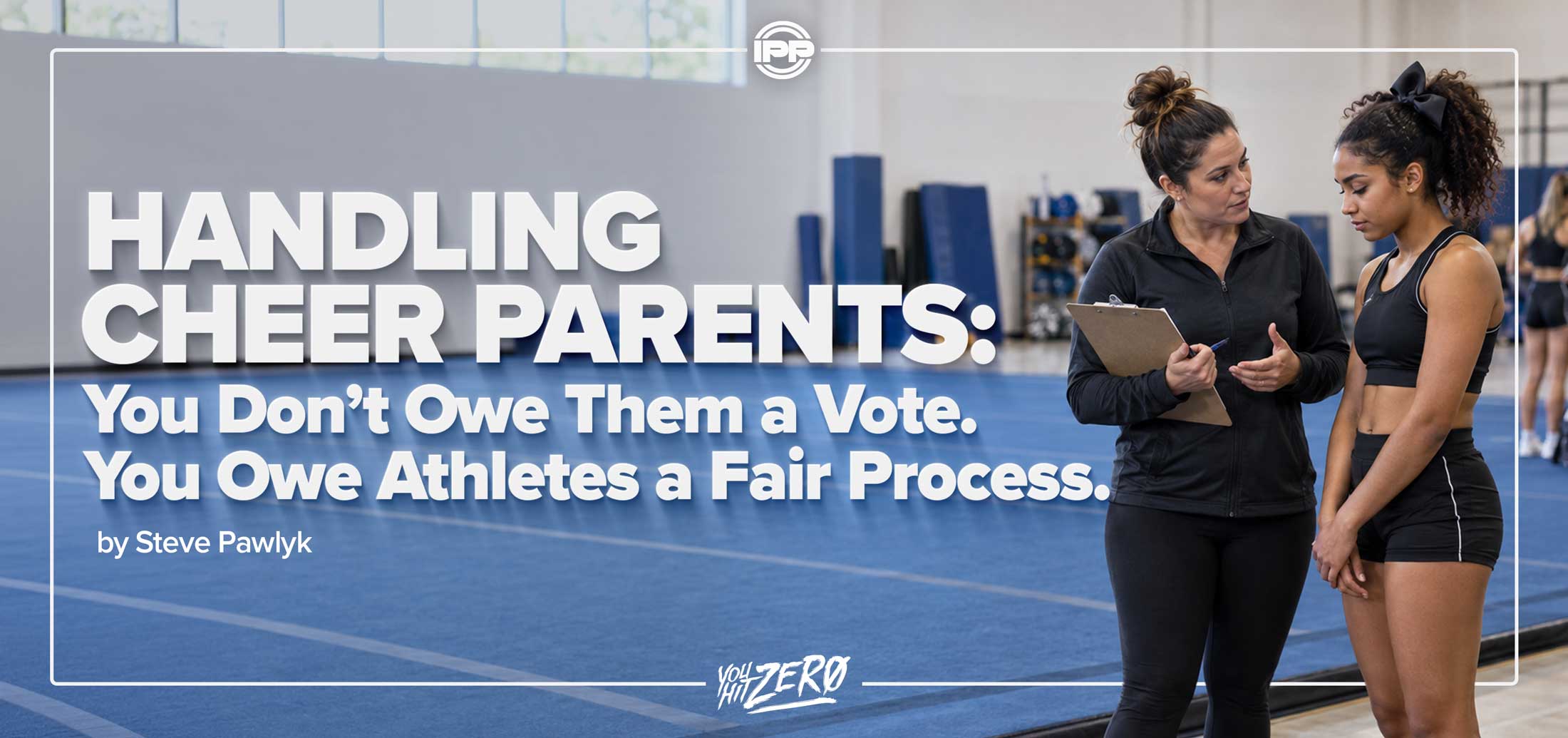
Handling Cheer Parents: You Don’t Owe Them a Vote. You Owe Athletes a Fair Process.

Handling Cheer Parents Without Giving Them a Vote

By Steve Pawlyk

Published September 7, 2026

Cheer team placement decisions can cause more conflict than almost any other coaching responsibility. Cuts, level assignments, and stunt positions affect athletes deeply. When coaches provide weak explanations, families fill the silence themselves. They blame politics, favoritism, seniority, body size, or another athlete.

You may make the right decision and still handle it badly. A fair result cannot repair a careless process. Athletes deserve honest feedback, while parents deserve clear rules. Neither group gets a vote on your final roster.

cheer team placement decisions 1

A Cheer Team Is Not a Tryout Leaderboard

Tryouts measure individual athletes, but competitions judge complete routines. Your highest-scoring tumbler may not fill your greatest roster need. Strong jumps cannot replace a dependable main base or backspot. One athlete may perform harder skills while another executes simpler skills more reliably.

USA Cheer applies this principle during national team selection. Its selectors build the best routine for the scoresheet instead of following a universal skills checklist. USA Cheer explains that athletes can earn selection through exceptional ability in specific categories. An athlete does not need every preferred skill.

Your roster must produce safe stunt groups, legal skills, strong sections, and dependable alternates. Individual rankings alone cannot build that roster. This fact does not give you permission to make unexplained choices. You still need to document why each choice helps the team.

Define What “Placement” Means

Coaches often use “placement” to describe four separate decisions:

  • Team selection
  • Level or division placement
  • Stunt position
  • Competition lineup assignment

Explain each decision before evaluations begin. Athletes and parents should know which decisions can change during the season. A team selection may last for the full year, while a stunt position may change after one unsafe practice. Do not let families assume every decision carries the same weight or duration.

A varsity athlete may serve as an alternate. A junior varsity athlete may move up after meeting specific standards. Your program may also keep rosters fixed for the entire season. State those rules before disappointment tests them.

Build a Cheer Tryout Rubric That Matches the Job

A good cheer tryout rubric measures more than visible difficulty. It measures whether an athlete can perform a specific job within your program. You can adjust the percentages below for your division and team goals. Set the weights before tryouts and keep them consistent.

Evaluation Area

Suggested Weight

What You Should Measure

Safety and consistency

25%

Control, technique, timing, landings, catches, and repeated execution

Role-specific skills

20%

Flyer, base, backspot, tumbler, dancer, or Game Day responsibilities

Tumbling, jumps, and motions

20%

Difficulty, execution, synchronization, and performance quality

Routine contribution

15%

Skills that help your planned sections and scoresheet

Coachability and team behavior

10%

Response to corrections, effort, focus, and treatment of teammates

Attendance and readiness

10%

Reliability, conditioning, preparation, and required commitments

Your program may value different categories. A non-tumbling team should not copy the rubric from an all-star Level 6 program. The rubric must match the actual job that each athlete will perform. Otherwise, you create false expectations and collect useless scores.

Do not award points for popularity, family connections, or how long an athlete has cheered. Do not let a parent’s volunteer work affect an athlete’s score. Returning athletes should meet the same stated standards as new athletes. Seniority can break a true tie only when your published policy allows it.

Need Competition Music Blue 1

Measure Safety and Consistency First

A skill does not help your routine when the athlete hits it once in five attempts. Ask each athlete to perform important skills more than once. Record successful repetitions instead of the athlete’s best attempt. Tryouts reward luck when one clean attempt controls a placement.

Watch how athletes enter, execute, and finish each skill. A tumbling pass with uncontrolled steps does not equal a clean pass. For stunts, track stable holds, safe catches, body control, grips, timing, and communication. Difficulty should never erase repeated safety problems.

Evaluate Athletes in Their Actual Roles

Do not evaluate every athlete as though each position requires the same abilities. Flyers, bases, and backspots solve different problems. A flyer needs body control, timing, flexibility, confidence, and consistent technique. Body size alone does not prove flyer readiness.

cheerleading team selection

Bases need strength, control, timing, footwork, and reliable grips. Backspots need awareness, power, quick reactions, and strong communication. Test multiple stunt combinations when time allows. An athlete may struggle in one group and perform well in another.

Group results do not excuse individual weaknesses. They can help you separate poor technique from a poor stunt-group match. Record both the athlete’s individual performance and the group’s complete execution. That information will help when you build final stunt groups.

Score Coachability With Observable Evidence

“Bad attitude” tells an athlete very little. It can also hide personal bias. Instead, record what the athlete did and how that behavior affected the evaluation. Observable evidence produces better feedback and gives your staff something concrete to review.

Did the athlete apply a correction during the next attempt? Did the athlete stay engaged while another group worked? Did the athlete blame teammates after a fall? Did the athlete help reset the stunt and ask what needed to change?

These actions show focus, effort, and response to coaching. A vague personality label does not. Score the athlete’s behavior during the evaluation, not the reputation that followed them into the gym. If past conduct affects eligibility, state that rule before tryouts.

Need Competition Music Blue 1

Use More Than One Evaluator

Use at least two trained evaluators when your staffing allows it. Have each person score independently before discussing results. Compare scores after the session, then review large differences. Ask each evaluator to identify the exact skill or behavior that caused the difference.

One evaluator may miss a landing error while watching upper-body technique. Another may notice the error but miss how quickly the athlete applied a correction. Multiple evaluators also reduce the effect of personal relationships. They cannot remove every bias, but they make unsupported decisions harder to defend.

Tell evaluators what each score means before tryouts. A score of four must represent the same standard at every station. Run a short test evaluation with video when possible. This step exposes scoring differences before actual athletes enter the gym.

Record Evidence, Not Impressions

Your notes should help you explain a decision several days later. Words such as “weak,” “messy,” or “inconsistent” will not help. Use numbers and visible actions whenever possible. Your notes should answer what happened, how often it happened, and what standard the athlete missed.

Weak Feedback

Useful Feedback

Your tumbling was inconsistent.

You completed two of five running passes without a landing deduction.

Your stunt was shaky.

The group completed one of four extended liberties without a fall or major balance check.

You need a better attitude.

You stopped applying corrections after the second stunt attempt.

You were not ready for varsity.

Your motions met the standard, but your jumps and stunt timing scored below the varsity range.

Another athlete fit better.

The roster needed a backspot who could execute the required sequence consistently.

You do not need to hand families every evaluator’s private note. You need enough evidence to explain your decision accurately. Save evaluation sheets according to your school or gym policy. Do not rely on memory after emotions rise.

how coaches choose flyers

Explain When Team Needs Affect the Result

A composite score should inform your decision, but it should not automatically control every roster spot. Imagine that your 20 highest scores include eight flyers and only three dependable bases. A strict ranking cannot create safe stunt groups. Your roster needs enough athletes for every required role.

State before tryouts that team composition affects final placement. Define the positions, specialties, and alternates you expect to select. If your final decision differs from the score ranking, document the team need that caused it. This record helps you separate legitimate roster judgment from personal preference.

Do not hide every choice behind “team needs.” Name the actual need when you can discuss it without exposing another athlete’s information. You can say the roster needed another backspot. You cannot discuss another athlete’s score, injury, behavior, or private circumstances.

If your planned routine shapes the roster, complete a cheerleading skills audit before choreography. Build for the athletes you have. Do not select a roster that depends on skills your team rarely hits. Potential cannot replace current readiness when safety depends on the result.

Stop Promising Permanent Positions

Never promise an athlete a flyer spot, varsity placement, or competition position before evaluations. Previous placement does not guarantee future placement. Athletes change, and teams change with them. Rules, divisions, attendance, injuries, and routine needs also affect assignments.

A returning flyer may become a stronger base. A new athlete may fill a missing stunt position. You can respect an athlete’s preferred role without granting ownership of it. Team positions belong to the program, not individual athletes.

Explain this policy before the season. Do not introduce it after you move someone. Families may still dislike the change, but they cannot honestly call the rule new. Consistency gives your explanation credibility.

Announce Results With Respect

Do not post a public ranking. Share the roster, then keep individual evaluations private. Every athlete should receive enough information to understand the result. The message should remain direct, brief, and specific.

Each athlete should receive five pieces of information:

  1. The placement decision
  2. The main reason
  3. One or two demonstrated strengths
  4. Specific areas to improve
  5. A re-evaluation date, when one exists

Do not spend ten minutes praising an athlete before stating the result. They will hear the coming rejection and distrust the praise. Give them the decision first, then explain the evidence. Respect does not require you to hide bad news inside compliments.

Do not invent a future opportunity to soften the result. False hope delays the athlete’s next decision and damages your credibility. If your roster stays fixed, say so. You can still provide a useful development plan.

A development plan should name skills and standards. “Work harder” does not tell an athlete what to practice. You can use a structured cheerleading progression program to guide that work. Give the athlete a realistic path, even when that path starts next season.

What to Say During Difficult Placement Conversations

Clear language prevents long, confusing conversations. It also keeps you from making emotional promises. You do not need a perfect speech. You need an honest decision, supporting evidence, and the next available step.

When an Athlete Does Not Make the Team

We did not select you for the roster this season. You showed strong motions and effort, but your stunt timing needs more work.

I can show you the two standards to improve before your next evaluation.

State the result before discussing improvement. Do not imply that extra classes guarantee future selection. Training can improve the athlete’s chances, but the next roster will still depend on performance and team needs. Say what you know and stop there.

cheer team cuts

When an Athlete Makes Junior Varsity Instead of Varsity

We placed you on junior varsity because you can contribute and train safely there now. Your tumbling met our varsity range, but your stunt timing did not. We will review your placement on October 15.

Only offer a review date when your program permits movement. Do not create a date that carries no real possibility. Explain the standards that the athlete must meet before that review. The date means little without measurable requirements.

When You Move a Flyer to Base

We are moving you to main base because the stunt groups perform more safely with that change. This assignment does not punish you. We will train you in the new role and review the groups after four practices.

Don’t tell the athlete that another flyer “beat” them. Explain the team decision and the athlete’s new responsibilities. Give the athlete real instruction in the new role. A reassignment without training sets the athlete up to fail twice.

When a Parent Demands Information About Another Athlete

I can explain our criteria, your athlete’s evaluation, and the available next steps. I can’t discuss another athlete’s scores, health, behavior, or placement. The coaching staff makes final lineup decisions.

Repeat the boundary once if needed. Do not defend another athlete or confirm the parent’s rumors. End the meeting when the parent refuses to respect your privacy rules. Your willingness to meet does not require you to accept abuse.

Speak With the Athlete Before the Parent

When age and program rules allow it, ask the athlete to begin the conversation. This approach teaches self-advocacy and reduces secondhand claims. The athlete can ask what needs improvement and hear the answer directly. Parents can join later when the situation requires their involvement.

NFHS recommends an athlete-to-coach-to-athletic-director communication chain. Its parent guidance also supports preseason meetings and clear communication rules. A 2022 survey cited by NFHS found that 73 percent of coaches worried about parent abuse. Playing time and athlete roles caused many of those concerns.

The NFHS parent-partnership workshop provides the survey data and communication recommendations. Tell families how to request a meeting before tryout results appear. Do not accept placement debates during practice, in parking lots, or through team group chats. Those settings invite rushed answers and public conflict.

Your program may also use a 24-hour pause after results. Follow your school or gym policy, and allow immediate contact for safety concerns. The pause should reduce emotional confrontations, not block legitimate questions. For wider behavior problems, use the separate YouHitZero guide to dealing with difficult parents.

JV cheer placement

Run the Parent Meeting Without Losing Control

Start with the placement decision. Explain the criteria and show the athlete’s relevant results. Let the parent ask reasonable questions, then bring the discussion back to the athlete. Do not let the meeting become a trial involving every person on the team.

Keep the discussion centered on what the athlete demonstrated, what the current team needs, and what the athlete can do next. Do not compare children or defend rumors. Never reveal private information about another athlete. You can acknowledge disappointment without changing the decision.

You can say:

I understand that this result disappointed you. I will explain how we reached it and what your athlete can control next.

Don’t compare their child to another team member.

Set a meeting length before you begin. Fifteen focused minutes often accomplish more than an open-ended argument. Include another coach or administrator when your policy requires it. And (obviously) follow all program rules for communication with minor athletes.

Explain Midseason Lineup Changes Before They Happen

Making the team does not always guarantee a competition spot. State that fact during registration or your preseason meeting. Explain whether alternates travel, warm up, perform, or receive another assignment. Families should understand the role before the first lineup change.

List the reasons that may change a lineup:

  • Safety concerns
  • Missed practices
  • Injury or illness
  • Repeated execution errors
  • Routine or scoresheet changes
  • Division changes
  • Stunt-group compatibility
  • Athlete conduct
  • Team emergency

You can’t use this list as unlimited cover. Apply each rule consistently and document why you made the change. Tell the athlete quickly, because delays create rumors. Teammates should never need to explain your decision for you.

Give the athlete a new role whenever possible. Alternates still need practice assignments, performance goals, and honest expectations. Do not make them stand at the edge of the mat without direction. A meaningful alternate plan can keep the team ready when an emergency occurs.

Avoid These Common Placement Mistakes

Changing the Criteria After Tryouts

Do not add a standard because your preferred athlete missed the published standard. That choice destroys the value of your rubric. If the rubric failed, repair it next season. Document any urgent exception and involve your program administrator.

Using Body Size as a Shortcut

Do not choose flyers by weight alone. Evaluate body control, technique, flexibility, timing, confidence, and complete group performance. Never discuss an athlete’s body with other families. Use role-specific performance standards instead.

Giving Vague Feedback

“Work harder” does not tell an athlete what to practice. Name the skill, the error, and the required standard. Useful feedback turns disappointment into a plan. Empty feedback turns it into resentment.

Claiming the Process Is Completely Objective

Every roster includes coaching judgment. Admit that fact instead of pretending that a spreadsheet made every decision. Your rubric supplies evidence, but your staff still builds the routine. Document where team needs changed the numerical order.

Hiding Behind “Coach’s Discretion”

You have final authority. Authority does not replace an explanation. If you cannot connect a decision to safety, performance, conduct, or a stated team need, review it. “Because I said so” protects weak decisions, not good coaches.

Letting Parent Pressure Change Standards

A loud parent should not receive a different process. Apply the same meeting rules, privacy limits, and evaluation standards to every family. Changing a placement to end an argument teaches parents that pressure works. It also tells athletes that performance does not control results.

Frequently Asked Questions About Cheer Team Placement Decisions

Why Would a Coach Select a Less Advanced Tumbler?

The team may need that athlete’s stunt position, consistency, motions, jumps, or performance ability. Coaches must build complete routines instead of tumbling exhibitions. The coach should still explain the relevant team need. “Coach’s decision” alone gives the athlete no useful information.

How Do Coaches Choose Flyers?

Coaches should evaluate body control, technique, flexibility, timing, confidence, consistency, and group compatibility. Weight alone cannot measure flyer ability. Repeated execution should carry more value than one impressive attempt. Safety must control the final assignment.

Can a Coach Move an Athlete From Flyer to Base?

Yes, when program rules allow role changes. Coaches may adjust stunt groups for safety, execution, attendance, or routine needs. The coach should explain the reason and train the athlete for the new role. A position change should never serve as public punishment.

Should Parents Receive Their Child’s Tryout Scores?

Your school, gym, or governing policy should control score access. Coaches should never release another athlete’s private evaluation. Even when you withhold raw sheets, you should provide specific feedback about the athlete’s performance. Explain what the athlete did well and what missed the standard.

Should Athletes Get Another Evaluation?

Offer another evaluation only when your program allows roster or role changes. Give the athlete a date and measurable standards. If the placement remains final, say that directly. You can still explain what the athlete should develop before the next season.

Even a Defensible Decision Still Might Sting

No placement system will make every family happy. That shouldn’t be your standard. Your process should produce consistent criteria, recorded evidence, private feedback, and useful next steps. Your boundaries should protect athletes, coaches, and private information.

Review any decision that you cannot explain with observable facts or a stated team need. Strong coaching does not require unanimous approval. It requires a process you can defend after the excitement, disappointment, and parking-lot opinions arrive.

Steve Pawlyk Signature Full

IPP's Premade Mixes are USA Cheer Compliant and customizable!  Add Sound FX, swap songs, & more!  Add your Team Name to the mix for only $10! 

SLAM artwork
Full_Out_130 mp3 image
1 minute cheer mix
WAKE UP THE FIRE
SLAM artwork
WAKE UP THE FIRE
Full_Out_130 mp3 image
1 minute cheer mix

Cheer competitions are paying real prize money. Is that good for the sport?

cheer competition prize money

By Steve Pawlyk

Published August 31, 2026

Cash prizes are spreading through competitive cheer, and Olympia Cheer Championships’ $50,000 purse is the latest test case. Prize money is a net positive for the sport if it’s funded by sponsors rather than by raising athlete fees and only if safety enforcement keeps pace with the added incentive to win.


The Olympia Cheer Championships announced its judging panel on August 20, drawing on judges with long resumes across All Star, college, school, and international cheer. That’s useful information if you plan to compete, but the money is the more interesting story.

The inaugural Olympia Cheer Championships arrives in Las Vegas on September 25 and 26 during Joe Weider’s Olympia Weekend, and organizers are advertising $50,000 in cash prizes and bid boosts. Friday even has an official name: “Cash Day.” Athletes will compete in individual cheer, partner stunt, and group stunt divisions for direct cash prizes, while Saturday’s team competition adds financial awards through bid boosts. Cheer has paid winners before, but Olympia adds another test of a question the sport should spend more time asking: what happens when winning cheer competitions starts paying?

Pro Cheer League paid competitive cheer

Olympia Is Putting Meaningful Money on the Floor

Some Olympia payouts exceed what most athletes would consider novelty prize money. First place in several college and open stunt divisions pays $2,250, second place pays $1,250, and third place pays $750. Youth, junior high, and high school individual champions can win $1,000, and the same $1,000 first-place prize applies to several youth stunt divisions.

Saturday’s team awards use a different system. Olympia lists Level Grand Champion bid boosts ranging from $2,000 at Level 1 up to $6,800 at Level 6, though those amounts can vary with participation. The event FAQ says Olympia will award $50,000 total across cash prizes and bid boosts, and that awards remain guaranteed regardless of eligible division entry counts. That creates a very different sales pitch from the usual medal, banner, jacket, ring, or bid: win this competition, and somebody may hand your group a check.

Cash Prizes in Cheer Aren’t Actually New

Olympia didn’t invent this idea. Varsity already awards serious money through the Varsity Cheer League — League 6 currently lists $10,000 for first place and $7,500 for second. Varsity’s Ultimate Battle events also pay cash; the 2027 USA Ultimate Battle advertises a $25,000 purse with at least 25 participating teams, and first place among Paid Worlds Bid holders earns $6,000.

USASF also allows event producers to award Worlds Bid Boost cash, letting winning teams receive up to $100 per performing athlete toward Worlds expenses. Then there’s the Pro Cheer League: Varsity launched its first professional season in January 2026, with athletes receiving part-time compensation, travel, lodging, bonuses, and prize incentives. Cheer has already crossed the line into paid competition, but Olympia still does something worth watching, by putting direct prize money into a conventional competition weekend that includes individual athletes and small stunt groups. That distinction matters.

Cheer Has Usually Made the Athlete the Customer

The economics of competitive cheer have always felt strange compared with most spectator sports. Programs pay competition fees, and athletes pay tuition, travel costs, uniforms, choreography, music, and other season expenses. Parents often buy admission to watch the athletes whose families already funded the trip. Success can earn prestige, bids, jackets, medals, or lower costs at another competition, but direct financial rewards have occupied a much smaller part of the system.

Olympia doesn’t completely reverse that arrangement: each competitor still needs a $150 athlete pass, and some divisions carry separate registration costs, including $250 for college coed partner stunt. Athletes still pay to enter. The difference comes at the other end of the transaction: a strong performance can return actual money. That sounds like a small change, but economically, it can become a very important one.

Need Competition Music Blue 1

Partner Stunt Could Feel the Effect First

Partner stunt may provide the best test case. A large All Star team can spend thousands of dollars traveling to an event, so a $2,000 team prize may disappear quickly against that budget. The math looks different for two athletes: a $2,250 first-place prize can meaningfully offset registration, airfare, hotels, and training costs for a college or open partner stunt group.

More money would make the calculation even more interesting. Imagine several independent events offering $5,000 or $10,000 partner stunt purses — elite stunters could start choosing events partly by prize opportunity, and you could eventually see athletes traveling to compete as specialized stunt teams outside their normal program schedule. Cheer already has athletes with enough name recognition to market those matchups, and cash gives event producers another reason to invite them.

Money Could Change How Coaches Choose Competitions

Coaches don’t build schedules around prize money today — reputation, bids, location, competition quality, timing, and program goals usually carry more weight. But cash could enter that equation. Suppose two comparable events land on the same weekend: one offers banners and bids, while another adds $20,000 in guaranteed divisional payouts. Some coaches will notice, and that pressure becomes stronger if parents see the difference too.

Families spend enormous amounts supporting competitive cheer, and an event that returns some money to successful programs can make a persuasive argument — even if the purse doesn’t come close to covering the season. It only needs to influence the decision between two otherwise similar competitions. Event producers understand incentives, and once money starts moving schedules, other producers will respond.

Olympia Cheer Championships

Prize Money Could Become Another Recruiting Tool

Event producers already compete for strong programs. A prestigious field attracts other teams, which in turn attract spectators, social content, sponsors, and attention — and prize money can help build that field. An organizer could invite strong Level 6 teams with a guaranteed purse, or build a partner stunt championship around recognizable athletes; cash makes those invitations more persuasive.

It also gives smaller event producers something established brands can’t own exclusively. You can’t manufacture decades of prestige overnight, but you can write a check. That could make prize money especially useful for new competitions trying to establish themselves quickly — Olympia looks like a good example. Its cheer competition has no history yet, so the event instead borrows recognition from Mr. Olympia and gives competitors another reason to take the debut seriously.

paid cheer competitions

There Is One Big Condition

Prize money only improves the athlete economy when someone other than the athletes meaningfully funds it. If an event raises entry fees by $500 and creates a $500 prize, nobody has changed the system — the event has simply repackaged the money.

Sponsors create a more interesting model, where outside money enters the competition and athletes earn some of it through performance. Varsity already uses sponsorship in parts of its cash-prize system, including sponsor-backed cash prizes in its League 6 awards, and Olympia actively sells sponsorship packages with Kaepa as its headline cheer sponsor. Olympia doesn’t publish enough financial detail to determine exactly how it funds every award, which is something worth watching. The healthiest version of this trend brings new sponsor money into cheer and sends part of it toward competitors; the weakest version uses higher competitor fees to advertise a flashy purse. Coaches should care about the difference.

Could Prize Money Make Cheer Less Safe?

Cash creates another incentive to win, which deserves discussion in a sport where athletes already accept significant physical risk. But competition pressure existed long before purses — world titles, bids, scholarships, roster spots, social attention, and gym reputation already give athletes powerful reasons to push difficulty.

The correct response to cash prizes is strict safety enforcement. Olympia says safety officers will monitor the event, and its published rules include deductions or disqualification for safety violations. Prize money should never create permission for looser standards; if anything, an event offering serious cash should expect more scrutiny around rules, scoring, conflicts, and deductions. Money makes judging disagreements more expensive, which means event producers need scoring systems athletes can trust.

Cash Also Creates Questions Cheer Will Need to Answer

Who receives the money when minors win? How should a four-person stunt group divide a prize? What happens when athletes compete under a gym’s name — does the gym keep the award, or do the athletes receive it? Programs and event producers need clear policies before these situations create disputes, and the questions become more complicated as payouts grow. Nobody fights very hard over a trophy, but people behave differently when $10,000 sits behind first place. That isn’t an argument against prize money — it’s an argument for written rules.

Professional Cheer Already Exists, But Another Model Could Grow Beside It

The Pro Cheer League changes the old athlete-customer model much more directly: its athletes receive compensation for participating, and the league completed five events during its inaugural 2026 season. Olympia uses a different model — you enter as a competitor, pay the required costs, and compete for a purse.

That model could grow beside professional league cheer. Picture an open circuit of partner stunt, group stunt, individual, and elite team competitions with meaningful purses, where athletes don’t need a contract with one professional league to earn money from high-level cheer. A talented stunt group could compete at several cash events during a year, event producers could build specialty competitions around those athletes, and sponsors could attach themselves directly to divisions or purses. Cheer suddenly has more ways to create economic value from elite performance.

That’s Probably Good for Cheer

Competitive cheer has built a large business around athletes spending money. There’s nothing inherently wrong with that — competitions cost money to operate, and families voluntarily choose the sport. Still, elite athletic performance has value, and if sponsors, ticket buyers, broadcasters, event producers, and audiences benefit from that value, athletes should have opportunities to share in it. Cash prizes provide one way to do that.

Olympia’s $50,000 won’t rewrite the economics of cheer by itself, and the event hasn’t even happened yet…the results will tell us more than the announcement. Do strong athletes enter the cash divisions? Do coaches care about the bid boosts? Do spectators respond to partner stunt competition with money attached? And most importantly, does Olympia come back in 2027 with a larger purse?

If the answer is yes, watch what other event producers do next. Cheer already proved athletes will pay to compete. Now we may find out how much competitions will pay them to win.

Steve Pawlyk Signature Full

IPP's Premade Mixes are USA Cheer Compliant and customizable!  Add Sound FX, swap songs, & more!  Add your Team Name to the mix for only $10! 

SLAM artwork
Full_Out_130 mp3 image
1 minute cheer mix
WAKE UP THE FIRE
SLAM artwork
WAKE UP THE FIRE
Full_Out_130 mp3 image
1 minute cheer mix

2026-27 NFHS cheer rules: What coaches need to know before competition season

2026 27 NFHS cheer rules

By Steve Pawlyk

Published August 31, 2026

NFHS released the 2026-27 Spirit rule changes in March. On August 25, NFHS published new comments that explain how coaches should read those changes. Several updates affect skills that high school cheer teams already use. Others change definitions that can affect whether a skill counts as tumbling or a legal transition. If you coach under NFHS rules, this is a good time to review your routine. A small detail can change the legality of a sequence.

Here are the 2026-27 NFHS cheer rules that coaches need to understand before competition season starts.

NFHS cheer rules 2026

NFHS changed the definition of tumbling

This change could affect more routines than its short wording suggests.

NFHS now defines tumbling as an unsupported hip-over-head skill that begins and ends on the performing surface. A base cannot support the athlete during the skill.  That definition creates a clearer line between tumbling and other acrobatic movements.

NFHS specifically mentions seat rolls and side rolls as examples. Those movements do not become tumbling simply because an athlete rolls across the floor. That matters most in divisions or situations that restrict tumbling. A coach could see an acrobatic floor skill and assume that officials will classify it as tumbling. The new definition gives coaches a better test.

Ask four questions when you review a questionable floor skill:

  • Does the athlete’s hip travel over the head?
  • Does a base support the athlete?
  • Does the skill begin on the performing surface?
  • Does it also end there?

If those details do not match the NFHS definition, the rulebook may classify the movement differently. Do not rely on what your gym has always called the skill. Use the NFHS definition when you build an NFHS routine.

A loading position can now occur during a transition

NFHS also changed its definition of a loading position, or load. A loading position occurs when bases support the top person under the feet below the bases’ shoulder level. NFHS now states that transitions can include loads. The 2nd part is kinda confusing…you might hear “load” and picture the starting position before a stunt goes up. NFHS does not limit the term to that moment.

Your group can move through a loading position during a transition. That wording matters because other rules can refer to a load position during a stunt sequence. Coaches now have a more exact definition. Watch the support point and height during transitions. Do not identify the position only by where it appears in the sequence.

NFHS expanded the rules for flip inversions

Rules 2-3-5a and the new 2-3-5k change one type of braced flip inversion. NFHS now allows a flip inversion when the top person and bracer use a hand-to-foot connection. The rule also adds restrictions for that connection.

The connection can exist without an additional hand-to-arm connection. That doesnt mean coaches can use any flip inversion with a hand-to-foot connection. NFHS prohibits twisting when the hand-to-foot connection is the only connection. The other requirements for the skill still apply.

This rule gives coaches another construction option for some inversion sequences. It does not create an unrestricted new category of flipping skills. If you add this connection, check the entire inversion against Rule 2-3-5. Don’t stop your review after you confirm the hand-to-foot grip.

Need Competition Music Blue 1

A bracer can release during some descending flip inversions

NFHS also changed Rule 2-3-5d.

A bracer can now release the top person during certain parts of a flip inversion. The bracer can also move into a load position. (NFHS)

Timing matters here: The top person must be descending. The top must also move toward a cradle, horizontal position, or the performing surface. (NFHS)

in plain english :): The flyer can’t be released by the bracer while she is still rising, hovering, or transitioning into another elevated stunt. She must already be coming down, and her destination must be one of three things: a cradle, a horizontal catch/position, or the floor.

Don’t read this rule as permission for a bracer to release anywhere during the inversion. The rule applies to a specific part of the skill. The top person’s direction and destination both matter. Coaches who use braced inversions should review the moment when the connection changes. Video can help you see exactly when the bracer releases. Slow the video down. Check the top person’s body position at the instant the connection ends.

NFHS spirit rules changes 2027

New catchers must be free when a transition starts

Rules 2-4-2c and 3-4-3c address vertical-to-horizontal releases that use new catchers. NFHS now states that new catchers cannot take part in another skill when the transition starts.

Picture a top person who releases from a vertical stunt and travels into different catchers. Those catchers must already be available when the transition begins. You cannot pull them from another active stunt after the release starts.

This can affect busy pyramid choreography. A routine might look possible because the new catchers reach the top person on time. Their activity when the transition begins can still create a problem. Review the whole stunt group during these transitions. Do not watch only the top person.

A top person cannot pass over another top person or bracer

NFHS added Rule 2-5-5g for 2026-27. The rule prohibits a top person from passing over another top person or bracer during a stunt. (NFHS) This wording gives coaches a direct restriction for overlapping stunt paths. You should check this rule when two stunt groups work close together. Pay special attention when one top travels across another group’s space. A sequence can look clean from the front while the athletes’ paths overlap from another angle. Record these sections from the side during practice. That view can make the travel path easier to see.

2026 high school cheerleading rule changes

Extended releases can now include up to one twist

Rule 2-5-6c contains one of the more interesting changes for advanced high school teams. NFHS now permits a non-braced vertical release from an extended position to include up to one twist. (NFHS)

The change applies to an extended-to-extended vertical release. NFHS already allowed a full twist from prep level to an extended position. The new rule permits similar twisting progression from extension. (NFHS)

The wording matters. NFHS did not open every extended release to twisting. The rule covers the specific release described in Rule 2-5-6c. Coaches should check the starting position, release type, body position, catch position, and number of twists. Do that before you teach the skill as part of competition choreography.

This change may give advanced teams another way to add difficulty or movement without changing the final stunt position. Still, legality comes before routine construction. Build the skill from the exact rule language.

Vertical-to-horizontal releases require two catchers

NFHS also clarified Rule 2-5-6e. A release from a vertical position to a horizontal position requires two catchers. That requirement also applies when one base starts the stunt. (NFHS) The single-base detail can catch coaches.

You might build a stunt around one strong base and assume the same athlete can complete the entire release. The new wording removes that interpretation. Once the top releases toward a horizontal position, the skill needs two catchers. Look closely at creative single-base sequences in your routine. Check any release that changes the top from vertical to horizontal.

Dismounts to new catchers can include a quarter twist

Rules 2-7-8d and 3-7-8d add another useful option. NFHS now allows a quarter twist during a dismount to new catchers. (NFHS)

NFHS gives a simple example:

A forward-facing top person can dismount toward new catchers who stand to the side. The top can use a quarter twist to face the catch correctly. (NFHS)

This change can make some transitions easier to choreograph. It can also solve awkward spacing when the next formation sits beside the original stunt group. The limit still matters. The rule permits a quarter twist in this situation. Do not turn that allowance into a larger twisting dismount without checking the rest of Rule 2-7.

The new rules give coaches more options, but details decide legality

The 2026-27 NFHS cheer rules do not rewrite high school cheer from scratch. Most changes deal with specific positions, connections, catchers, releases, and definitions. Those details can still change what you can put on the floor.

The extended twisting release may attract the most attention. The new tumbling definition could affect more teams. The catcher rules also deserve a careful review. They can affect choreography that coaches already built before the season started.

NFHS approved eight rule changes and two definition changes for the 2026-27 Spirit season. The organization published its detailed comments on August 25. (NFHS) They also published a free 2026-27 Spirit Rules poster in August. Might be useful as a quick reference during practice. (NFHS)

What coaches should review in their routines now

Start with every inversion, release, dismount, and vertical-to-horizontal transition in your routine. Check the actual athlete connections. Then check where each catcher stands and what each catcher does when the skill begins.

Review your floor choreography under the new tumbling definition. A movement your team calls tumbling may not meet the NFHS definition. The reverse assumption can also cause trouble.

Check extended releases for twisting. If your team uses an extended-to-extended release, confirm that the skill fits Rule 2-5-6c before you keep it.

Review any stunt that sends one top person across another stunt group. Rule 2-5-5g now directly prohibits a top person from passing over another top person or bracer.

Finally, check your dismounts to new catchers. A quarter twist now has a legal use in that situation. That does not make larger twisting dismounts legal under the same rule.

Don’t wait for competition day to find a rules problem

A routine can feel familiar and still contain a rule issue after a definition changes. Run a rules review before your team locks its competition routine. Review the skills again after major choreography changes.

Keep the current NFHS Spirit Rules Book available during that process. NFHS comments can explain the changes, but the complete rulebook contains the full requirements around each skill.

When a sequence sits near the edge of a rule, get an official ruling before competition. Changing four counts in practice is much easier than changing a stunt during warmups.

Steve Pawlyk Signature Full

IPP's Premade Mixes are USA Cheer Compliant and customizable!  Add Sound FX, swap songs, & more!  Add your Team Name to the mix for only $10! 

SLAM artwork
Full_Out_130 mp3 image
1 minute cheer mix
WAKE UP THE FIRE
SLAM artwork
WAKE UP THE FIRE
Full_Out_130 mp3 image
1 minute cheer mix

The Cheerleading Worlds 2027 scoring changes: What coaches need to know

Cheerleading Worlds 2027 scoring changes What coaches need to know

By Steve Pawlyk

Published August 18, 2026

USASF has changed the scoring system for The Cheerleading Worlds 2027. Club divisions will move from a 170-point score sheet to 100 points.

At first glance, that sounds like a major scoring overhaul. The numbers look very different, but most of the scoring priorities remain almost the same.

USASF kept the same scoring categories and changed most category weights by less than one percentage point. One change deserves more attention: jump difficulty will now use a capped scoring system.

For coaches, that distinction matters. You probably don’t need to full-on rebuild your whole routine just because the score sheet now totals 100 points.

Buuuut…you do need to understand where the percentages moved and how the new jump cap affects the decisions you make about your routine.

USASF score sheet

What changed on the 2027 Worlds score sheet?

The previous USASF Worlds score sheet had 170 available points. The new sheet has 100, which makes the scoring system easier to read and compare.

USASF kept all 10 categories from the previous Worlds scoring system. Difficulty, execution, participation, synchronization, variety, pace, composition and performance still affect your score.

USASF Executive Director Dana Fielding described the update as primarily a scale conversion rather than a change in scoring philosophy.

That is probably the best way for coaches to view it.

A stunt section that scored well under the old system should still score well under the new one. The same applies to tumbling, pyramids and performance.

The percentages tell the real story.

How the category weights changed

Stunts accounted for 23.53% of the previous USASF score. They now account for 24%.

Pyramids made the same move, from 23.53% to 24%. Standing and running tumbling each move from 11.76% to 12%.

Here is the full comparison:

Category

2026 weight

2027 weight

Stunts

23.53%

24%

Pyramids

23.53%

24%

Tosses

5.88%

6%

Standing tumbling

11.76%

12%

Running tumbling

11.76%

12%

Jumps

5.88%

6%

Dance

5.88%

6%

Routine composition and creativity

5.88%

4%

Formations and transitions

2.94%

3%

Performance and showmanship

2.94%

3%

Building now accounts for 54% of the USASF score. Under the old sheet, building accounted for 52.94%. Tumbling moves from 29.41% to 30%. The remaining categories drop from 17.65% to 16%.

Those differences are real, but small. Building gains 1.06 percentage points, while tumbling gains only 0.59 percentage points. Routine composition and creativity has the largest percentage change. It drops from 5.88% of the total score to 4%.

That doesn’t mean you should stop caring about creative routines. It means composition carries slightly less scoring weight than it did last season.

The jump change matters more than the new total

The new jump system deserves more attention than the move from 170 points to 100. USASF will now use a capped system for jump difficulty. Teams can reach the maximum difficulty score by meeting the required standard. Once your team reaches that standard, adding more jump difficulty cannot increase the difficulty score further.

That changes the risk calculation.

Suppose your athletes can perform the required jump sequence with good timing and technique. Adding another difficult element may give you no extra difficulty credit.

If the added element hurts synchronization or landing control, the extra difficulty could work against you. The 2027 jump category still has six available points. Three points come from difficulty, while three points come from execution. Reaching the difficulty cap does not finish the job.

Your athletes still need good height, body position, timing and landings. A team that reaches the cap with poor execution can still lose points.

This should encourage coaches to stop adding difficulty once the section already earns full difficulty credit. At that point, clean execution becomes the better use of practice time.

USASF may release more scoring education during the season. Coaches should check the current USASF scoring documents before making final choreography decisions.

Need Competition Music Blue 1

Building still controls more than half of the score

Stunts carry 24 points under the new USASF score sheet. Pyramids carry another 24, while tosses account for six points. That gives building 54 of the available 100 points.

The scoring system still gives coaches a strong reason to prioritize reliable building sections. A difficult stunt that rarely hits remains a poor routine choice. Difficulty matters, but judges also score technique and execution. Your hardest stunt does not help much if athletes fight through it every time.

The same principle applies to pyramids. Your athletes need enough time to complete the structure, show the skill and move into the next section. Rushed building creates problems beyond the stunt itself. Late grips and slow dismounts can also affect transitions, timing and the next skill. The new score sheet does not reward difficulty at any cost.

Tumbling gained weight, but only slightly

You may hear that USASF increased the value of tumbling for Worlds 2027. That statement is technically correct, but it needs context.

Standing tumbling now carries 12% of the score. Running tumbling also carries 12%, while jumps account for another 6%.

The combined tumbling group now accounts for 30% of the score. Last season, the same group accounted for 29.41%.

That is an increase of only 0.59 percentage points.

A coach should not add a risky pass because tumbling “went up.” The scoring change is too small to justify skills athletes cannot perform consistently.

If two routine options already make sense, the new weighting can help you choose between them. It should not dictate your entire tumbling plan.

Participation still matters. Clean technique still matters. A controlled pass from more athletes can beat harder tumbling with poor execution.

Cheerleading Worlds 2027 scoring

Routine composition lost some weight

Routine composition and creativity had 10 available points on the old 170-point sheet. The category now has four points on the 100-point sheet. That changes its weight from 5.88% to 4%.

For some coaches, this may give permission to simplify sections that cause repeated problems. A clever transition has little value if athletes arrive late to the next stunt.

You should still create a routine that looks intentional and complete. Judges continue to score composition, formations, transitions, dance and performance. Those categories still account for meaningful points when you combine them. The change simply gives coaches more room to ask a useful question: does this creative choice help the routine enough to justify its cost?

Sometimes the answer will be yes. Sometimes removing one complicated transition will make the entire routine cleaner.

This could change how you clean a routine

The new scoring system may affect practice priorities more than choreography.

Start with jumps. Confirm that your planned sequence can reach the difficulty cap, then put more time into execution. After that, review your building sections. Stunts, pyramids and tosses account for more than half of the USASF score.

Ask how often each major skill hits during normal practice. Do not judge reliability from your best full-out of the week. A skill that hits eight times out of ten gives you a very different competition plan from one that hits three times. Then look at tumbling participation and technique. The small scoring increase makes clean team tumbling slightly more valuable, but reliability still comes first.

Finally, review transitions and composition. Simplify anything that creates more problems than scoring value. This is especially useful later in the season. Coaches often keep choreography because they spent time teaching it, even when the section never becomes dependable.

The score sheet gives you a reason to be more selective.

USASF Scoring Changes 2027

Do not confuse difficulty with maximum score potential

One mistake coaches can make is treating every scoring change as a request for more difficulty. The 2027 sheet does not say that.

Your score still depends on how well athletes perform the skills in the routine. Difficulty only works when the team can execute it at the required level.

That becomes especially clear with the new jump cap. Once your team reaches maximum difficulty credit, adding more difficulty offers no scoring benefit there. The same basic logic should guide the rest of your routine.

Ask whether a harder skill increases your realistic score. Do not ask whether it makes the routine look harder on paper. Those are different questions.

USASF and IASF both changed their totals

The scoring update also affects IASF divisions at The Cheerleading Worlds 2027. IASF tumbling divisions will move from 150 points to 100 points. IASF non-tumbling divisions will move from 135 points to 92. The similar totals may make the USASF and IASF systems look almost identical. Their scoring weights remain different.

USASF gives 54% of its Level 6 score to building. IASF tumbling divisions give considerably more weight to building. IASF stunts and pyramids each account for 30% of the 100-point tumbling score sheet.

That difference matters for programs that compete under both systems. A routine plan built for USASF scoring does not automatically transfer to an IASF division. Coaches should compare the category weights, not only the final point total.

So what should you do now?

First, download the current Worlds scoring documents from USASF. Make sure your staff uses the same version when you discuss routine changes.

Next, check your jump plan against the new difficulty cap. You need to know when your team has already reached maximum difficulty credit. Then review your building difficulty and hit rate. Building still carries 54% of the USASF score, so consistency deserves serious attention. Do the same with tumbling. Do not add difficulty simply because the combined tumbling percentage increased.

Review composition last. The category lost weight, which may make some risky transitions easier to remove. You should also get outside scoring feedback before your most important event.

USASF lists sanctioned 2026-2027 competitions that will use The Cheerleading Worlds scoring system. An early score sheet can expose problems you miss in your own gym. Video review helps, but an outside judge sees the routine differently. That feedback can tell you whether your intended difficulty and execution actually read from the judges’ table.

The biggest mistake would be overreacting

The move from 170 points to 100 points creates a large visual change. The actual USASF scoring priorities changed much less. Building gained a little weight. Tumbling gained a little. Routine composition lost some weight, and jump difficulty now has a defined ceiling.

For most Worlds teams, that should lead to adjustments rather than a full routine rebuild. Make sure your jumps reach the cap. Put your best building skills on the floor, and remove difficulty your athletes cannot perform reliably. Then clean the routine until the score sheet has fewer places to take points away.

The total at the bottom changed. The basic job did not.

Steve Pawlyk Signature Full

IPP's Premade Mixes are USA Cheer Compliant and customizable!  Add Sound FX, swap songs, & more!  Add your Team Name to the mix for only $10! 

SLAM artwork
Full_Out_130 mp3 image
1 minute cheer mix
WAKE UP THE FIRE
SLAM artwork
WAKE UP THE FIRE
Full_Out_130 mp3 image
1 minute cheer mix

Cheer camp is over: Your 30-day camp-to-season plan

Cheer camp is over 30 day camp to season plan

By Steve Pawlyk

Published August 4, 2026

Cheer camp can make a team feel like it improved an entire season in four days.

Athletes learn new stunts. Captains come home motivated. Coaches have videos, notes, cheers, dances, warmups and corrections they swear they will remember. Everyone is tired, sore and excited about what the team could become.

Then regular practice starts.

Two weeks later, half the new material has disappeared. The stunt that hit at camp will not hit in your gym. Athletes remember different versions of the same motion sequence. Coaches move on to the next deadline before deciding which camp lessons belong in the season plan.

That is why every program needs a cheer camp follow-up plan.

Many teams are returning from camp right now. Recent NCA cheer camps included sessions at Shippensburg University from July 27 through August 3, the Gaylord Texan from July 30 through August 2 and the Renaissance Esmeralda from August 3 through August 6. UCA also held a University of Texas camp from July 23 through July 26.

The timing matters. What coaches do during the first month after camp will decide whether those four days become part of the team’s season or simply become a collection of videos on everyone’s phone.

Soooo…here’s a practical 30-day plan for turning camp progress into cleaner practices, safer skills and material your athletes can still perform when the season picks up

Why cheer camp material disappears so quickly

Camp is a controlled environment.

Your team has long practice blocks, instructors standing nearby and very few outside responsibilities. Athletes are surrounded by other teams working hard. They get immediate corrections and more repetitions than they normally would during a school-week practice.

That environment helps athletes learn quickly. It can also give coaches a misleading picture of what the team owns.

cheer camp follow up plan

A stunt that hits twice with an instructor nearby is not automatically ready for a football game. A dance athletes performed after learning it that morning may look completely different a week later. A team can leave camp understanding a correction without having repeated it enough to make it a habit.

NCA overnight camps include both game day and performance training, while other camp formats may concentrate on leadership, skills, non-building material or custom instruction. Home camps can also be adjusted to spend more time on areas such as stunts, pyramids or baskets.

Your follow-up plan should match what your team actually worked on. A squad that spent four days learning game day material needs a different first month than a team that used camp to rebuild stunt technique.

The problem starts when coaches try to keep everything.

You do not need every cheer, dance, transition and stunt variation taught at camp. You need the material that fits your athletes, your schedule and the jobs your team must perform this season.

Before the first practice back, meet with your staff

Do not wait until athletes walk into the gym to decide what happens next. Set aside 45 minutes for the coaching staff. Include assistants, choreographers and any captains who need to understand the plan.

Bring your camp notes, score sheets, instructor feedback and videos. Put everything in one shared folder before the meeting. If four coaches each have different clips on their phones, nobody has a complete record of what happened.

During the meeting, answer these questions:

  1. What improved most during camp?
  2. Which corrections did athletes hear repeatedly?
  3. Which skills only worked with instructor assistance?
  4. Which material fits our actual season?
  5. What caused the team the most trouble?
  6. Did anyone leave camp injured, unusually sore or mentally discouraged?
  7. What do we want to look different 30 days from now?

Be specific.  “The stunts got better” isn’t super helpful…“Our main bases stopped stepping forward during full-ups after the instructor changed their starting position” gives you something you can coach.

“Game day improved” is too broad….“The team’s volume dropped whenever they added signs and poms” tells you what to test at home.

End the meeting with no more than 4 priorities for the month. Your team may have learned 20 things at camp. They can’t treat all 20 as equally urgent.

Need Competition Music Blue 1

Sort every piece of camp material

Create one list of everything the team brought home. Include:

  • Cheers and chants
  • Band dances and timeout material
  • Fight song changes
  • Stunts and stunt variations
  • Pyramid ideas
  • Basket drills
  • Tumbling corrections
  • Jump drills
  • Warmups and conditioning
  • Leadership exercises
  • Team traditions
  • Practice-management ideas

Give each item one of four labels:

Ready now

The team remembers it, can perform it safely and has an immediate use for it.

This might include a sideline cheer, a motion correction or a conditioning drill you want to use every week.

Needs work

The material fits your team, but the athletes do not own it yet.

Most new stunts and dances will probably land here. That is fine. “Needs work” means the material earns practice time. It does not mean you should put it into a performance immediately.

Save for later

The idea may help during basketball season, competition season or a future phase of training, but it does not deserve time right now.

Save the video and notes. Add a date for reviewing it again. Without a review date, “later” usually means “never.”

Cut it

Some camp material will not fit your team.

Maybe the cheer is too long. Maybe the stunt requires a top athlete you do not have. Maybe another team in your conference already uses the same dance. Maybe you simply dislike it.

Cutting material is part of coaching. Camp gave you options. It did not give you an obligation to use every option.

Days 1 through 3: Recover, review and take inventory

Your first practice after camp should not be a test of toughness.

Athletes may be dealing with sore wrists, ankles, backs or shoulders. Some will have bruises they ignored during camp because they wanted to keep participating. Others may be mentally drained after several long days of learning and performing.

Start practice with a physical check-in. Ask athletes to report pain, not just general soreness. Make it clear that honesty will not cost them a position.

The USA Cheer Cheerleading Safety Manual covers performer readiness, medical responsibilities, spotting and skill progression. Those standards still apply when a team returns home excited about new skills. A camp success does not replace your normal readiness and progression requirements.

Use the first practice to see what athletes remember without turning it into a pass-or-fail evaluation.

Ask the team to perform camp material in small sections. Record each attempt. Do not provide several minutes of reminders before the first run. You need to see what remained after the athletes left the camp environment.

You will probably find three kinds of memory:

  • Material the athletes remember accurately
  • Material they remember with small differences
  • Material they barely remember at all
cheer camp practice plan

Do not spend an hour rebuilding a routine nobody retained. Save the video, decide whether the material is worth relearning and keep practice moving.

A sample first practice back

Try this structure for a two-hour practice:

First 15 minutes: Athlete check-in, light movement and mobility

Next 20 minutes: Review cheers, dances and motions without extensive coaching

Next 25 minutes: Revisit stunt grips, body positions and timing on the ground or at a reduced level

Next 10 minutes: Water break and staff discussion

Next 30 minutes: Test the two or three camp skills most likely to become part of the season

Next 15 minutes: Review the correction that helped the team most at camp

Final 5 minutes: Explain the 30-day plan and tell athletes what they should review before the next practice

The goal is to collect information. You are not trying to recreate the final night of camp.

Days 4 through 7: Test camp skills in your own environment

Camp conditions are different from home.

The floor may feel different. Ceiling height may change what athletes are comfortable throwing. Your normal practice could be shorter. An instructor who helped identify a timing problem is no longer standing beside the group.

This week, find out which improvements survive those changes.

Start new stunts below their highest camp level. Check grips, feet, timing and athlete confidence before adding difficulty. If the group learned a full-up to extension, begin with the entry at prep level. If they learned a new pyramid connection, test each piece separately.

You are looking for repeatability.

A stunt that hits once and falls four times is not ready. A stunt that requires a different save on every attempt is not ready. A skill that only works when the strongest coach spots one side is not ready.

That does not mean the stunt was a bad choice. It means you have found its current place in the progression.

Track the following for each stunt group:

  • Number of attempts
  • Number of clean hits
  • Where the skill breaks down
  • Whether the same mistake repeats
  • How much coaching or spotting is required
  • Whether athletes can explain the correction themselves

The last point matters. Athletes who understand why a correction works are more likely to reproduce it when the coach moves to another group.

Keep the language athletes heard at camp

Ask athletes what words the instructor used when the skill improved.

Maybe the instructor said “wait for the dip,” “hips under,” “finish through the top” or something else that clicked with the group. Write that language down and use it consistently.

Coaches sometimes replace a successful correction with their own preferred wording. That can create unnecessary confusion. If the camp cue worked and it is technically sound, keep it.

Week 2: Decide what stays in the season plan

By the second week, the excitement has settled enough for you to make better decisions.

Review your videos from camp and your first week at home. Move each item into one of these categories:

  • Use immediately
  • Continue developing
  • Revisit on a specific date
  • Remove from the plan

Be honest about your practice time.

If you have two 90-minute practices each week, you cannot maintain the same amount of material as a team practicing four days a week. Keeping too much creates rushed practices and half-clean performances.

Choose material based on where your team will use it.

For sideline and game day material

Ask:

  • Can athletes perform it while watching the game?
  • Is the wording easy for the crowd to follow?
  • Does it work with your signs, poms or megaphones?
  • Can the team maintain volume while moving?
  • Is it different enough from your existing material to earn a place?
  • Does it fit the moments your team regularly encounters?

A cheer can look great in a quiet camp setting and fall apart beside a loud student section. Practice it with noise. Have someone call out game situations. Make athletes find their spacing quickly instead of walking into perfect lines.

For competition material

Ask:

  • Does the skill fit your division and routine needs?
  • Can the team perform it when tired?
  • Does it connect cleanly to the skills before and after it?
  • Will the skill score well enough to justify its risk and practice time?
  • Do you have backup athletes who understand the positions?
  • Can the group hit it without constant coach intervention?

Do not place a camp stunt into choreography simply because athletes love it.

Athletes usually love the newest and hardest option. Your job is to decide whether it makes the routine better.

For practice drills

Keep drills that solve a problem you see regularly.

A drill may have helped one stunt group at camp but be unnecessary for the rest of the team. Another drill may be useful enough to become part of every warmup.

Assign each drill a purpose. Athletes should know whether it is improving timing, strength, body position, technique or confidence. Randomly repeating camp drills will make practice feel busy without making it productive.

cheer camp follow up plan

Week 2 is also the time to reset expectations

Camp can temporarily change team dynamics.

An athlete may have won an individual award and returned with more confidence. Another athlete may have struggled in front of instructors and returned questioning her role. Captains may expect the team to maintain camp-level intensity at every practice.

Talk about it.

Explain what camp results mean and what they do not mean.

An award recognizes what an athlete showed during camp. It does not settle every lineup decision for the season. Struggling with one skill does not erase an athlete’s value. A great final-day performance does not mean the team can stop drilling fundamentals.

Give athletes clear jobs for the next two weeks.

One athlete may need to review material before practice. Another may need to improve her conditioning. A stunt group may need ten focused repetitions of the same entry at every practice.

Athletes handle corrections better when they know what success looks like.

Week 3: Connect camp lessons to regular practice

By the third week, camp should stop feeling like a separate event.

The useful parts should now appear in your normal practice structure.

If the team learned a better jump warmup, put it into the warmup. If athletes improved their motion placement, hold that standard during every cheer. If a stunt correction worked, use it across groups instead of treating it as a one-time camp note.

This is where coaches often lose progress. They review camp material for two weeks, then return to the same practice habits they used before camp.

Choose one camp lesson for each part of practice:

  • Warmup
  • Motions and jumps
  • Stunts
  • Tumbling
  • Game day material
  • Conditioning
  • Team communication

You do not need a new lesson in every category. Use only what made a measurable difference.

Give athletes ownership without handing over practice

Captains and experienced athletes can help maintain camp material, but their role needs boundaries.

Assign one athlete to call a cheer review. Ask another to check whether a stunt group is using the agreed starting position. Have captains maintain the shared video folder.

Do not ask athletes to correct advanced technique they are not qualified to coach. Athlete leadership works best when the assignment is specific.

“Help everyone remember camp” is vague.

“Run the first five minutes of the sideline review using the videos in our folder” is clear.

Week 3 pressure test

Once material looks comfortable, change the conditions.

You are checking whether the team can perform the material while handling the distractions that come with the season.

Clean skills should survive small changes.

For game day material:

  • Add crowd noise
  • Use poms and signs
  • Put athletes in their actual sideline spacing
  • Call cheers from unexpected situations
  • Require athletes to react without a long setup
  • Run material after jumps or conditioning

For stunt material:

  • Run the skill after a normal practice block
  • Change which side of the floor the group uses
  • Add the transition before the stunt
  • Require the group to reset within a time limit
  • Test backup athletes at safe progression levels
  • Record from the front and side

Week 4: Record a new baseline

At the end of 30 days, film the same material you recorded during your first practice back. Use the same angle whenever possible. Do not choose only the best attempt. Record enough repetitions to show the team’s normal level.

Compare the videos with your staff & look for specific changes:

  • Are motions arriving together?
  • Has stunt timing become more consistent?
  • Are athletes using the corrections without reminders?
  • Can the team perform while tired?
  • Is game day material loud and easy to follow?
  • Did any pain or fear appear as repetitions increased?
  • Has the material earned a permanent place in practice?

Share selected comparisons with athletes. Showing the team that its work produced visible improvement can be more effective than another speech about effort.

You should also identify what did not improve. Maybe the stunt is still inconsistent. Maybe the dance takes too much practice time. Maybe the cheer is difficult for the crowd to understand. Removing something after 30 days is not failure. It is a coaching decision based on evidence.

What to do when a camp stunt stops working

This happens every year: The stunt hit at camp. The group felt confident. Everyone came home expecting to use it. Now it will not stay in the air.

Start by comparing the camp video with your current attempts.

Check:

  • Starting positions
  • Grip placement
  • Dip speed
  • Footwork
  • Flyer timing
  • Base spacing
  • Where athletes are looking
  • Whether the group pauses between counts
  • Which person begins correcting the stunt after a miss

Do not let the group redesign the skill after every attempt. Pick one correction, reduce the difficulty and repeat the corrected version. If the group cannot perform the lower progression consistently, stay there. Athletes may see that as moving backward. It is usually the fastest way forward.

Also consider whether the camp environment hid a personnel problem. An instructor may have provided a spot that changed the group’s confidence or timing. Another athlete may have filled a position for part of the session. The group may have attempted the stunt while fresher than it is during regular practice.

None of that makes the camp success fake. It tells you what support the group still needs.

cheer coaches practice planning

What to do with all those camp videos

Create one shared folder for the team. Do not rely on social media posts or group-message history. Those are difficult to search, and important clips will disappear beneath hundreds of unrelated messages.

Organize the folder by subject:

  • Cheers
  • Dances
  • Stunts
  • Pyramids
  • Tumbling
  • Jumps
  • Instructor corrections
  • Team performances
  • Leadership notes

Name files clearly. “IMG_4837” tells you nothing. “Varsity full-up correction, left group, day two” is much easier to find in October.

Keep a second folder for coaches only. Use it for lineup discussions, injury information, athlete evaluations and anything else that should not be shared with the full team. Choose a few team videos for at-home review. Do not send athletes 40 clips and expect them to know which ones matter.

A simple camp follow-up assignment for athletes

Give each athlete a short reflection during the first week back.

Ask them to answer:

  1. What correction helped you most?
  2. What skill do you understand better now?
  3. What material do you need to review?
  4. Where did you struggle?
  5. What is one job you can take responsibility for this month?
  6. Is there any pain, fear or confusion the coaching staff should know about?

This gives quieter athletes a chance to communicate without speaking in front of the team. Read the answers. If athletes take the time to be honest and nothing changes, they will stop giving you useful information.

The biggest mistakes coaches make after cheer camp

Trying to keep every piece of material

Camp gives you a menu. Choose what your team needs.

Throwing new skills into performances too soon

A stunt that worked at camp still needs to pass your normal safety and consistency standards.

Forgetting the exact corrections that worked

Write down the instructor’s language while it is fresh.

Running a punishing first practice back

Tired and sore athletes do not need to prove their commitment by taking unnecessary repetitions.

Treating camp awards as permanent rankings

Use awards as recognition, not as the entire basis for lineup decisions.

Returning to the old practice routine

If camp taught your team a better way to warm up, communicate or correct skills, put it into the weekly plan.

Waiting too long to review material

The longer you wait, the more time you will spend reteaching.

30 day checklist cheer camp download

Your 30-day cheer camp follow-up checklist

Before practice resumes

  • Collect coach and athlete videos
  • Save instructor feedback
  • Hold a staff debrief
  • Identify injured or unusually sore athletes
  • Choose the month’s top priorities
  • Sort material into ready, needs work, later or cut

During the first week

  • Test what athletes remember
  • Rebuild stunts through safe progressions
  • Keep the camp cues that worked
  • Record the first attempts
  • Choose which material deserves practice time
  • Explain the follow-up plan to athletes

During the second week

  • Make final keep-or-cut decisions
  • Assign athlete review responsibilities
  • Connect material to actual game or competition needs
  • Set measurable standards for each skill
  • Speak privately with athletes whose confidence changed at camp

During the third week

  • Add useful camp lessons to regular practice
  • Test material under realistic conditions
  • Practice transitions and equipment
  • Check whether athletes can self-correct
  • Introduce backup personnel where appropriate

At the end of 30 days

  • Record a new baseline
  • Compare it with the first week
  • Review pain, fear and readiness
  • Remove material that has not earned its place
  • Set the next month’s priorities
  • Tell athletes what improved and what comes next

Cheer camp should change something

Camp does not need to transform your entire program.

It should change something specific.

Maybe your stunt groups now understand timing. Maybe your sideline material is cleaner. Maybe captains communicate better. Maybe your staff finally found language that helps athletes understand a correction.

The coach’s job is to notice what worked, build it into practice and let go of the rest.

Thirty days from now, your team probably will not remember every cheer it learned at camp. That is normal. The goal is for your athletes to retain the lessons that make them safer, cleaner and easier to coach throughout the season.

That is how cheer camp becomes more than four exhausting days in the summer. ☺️

Steve Pawlyk Signature Full

IPP's Premade Mixes are USA Cheer Compliant and customizable!  Add Sound FX, swap songs, & more!  Add your Team Name to the mix for only $10! 

SLAM artwork
Full_Out_130 mp3 image
1 minute cheer mix
WAKE UP THE FIRE
SLAM artwork
WAKE UP THE FIRE
Full_Out_130 mp3 image
1 minute cheer mix

Frequently asked questions about cheer camp follow-up

How soon should a team practice after cheer camp?

The answer depends on travel, athlete soreness and your normal schedule. Avoid returning immediately to full-intensity repetitions when athletes are unusually tired or experiencing pain. Your first practice should include a physical check-in and a controlled review of what the team learned.

Should we use every cheer and dance learned at camp?

No. Keep material that fits your team’s game day responsibilities, identity and available practice time. Save other material for later or remove it from the plan.

When is a stunt learned at camp ready to perform?

A stunt is ready when athletes can perform it safely and repeatedly under normal practice conditions without unusual assistance. Coaches should also test the entry, exit, transitions and athlete readiness before using it in public.

How can athletes remember cheer camp material?

Record clear videos, organize them in a shared folder and assign small review sections before practice. Review the material within the first few days instead of waiting several weeks.

What should coaches discuss after cheer camp?

Coaches should review athlete health, repeated corrections, skill readiness, material retention, season needs and which camp lessons should become part of regular practice.

How to get recruited for college cheer or STUNT in 2026-27

How to get recruited college cheer STUNT 2026 2027

By Steve Pawlyk

Published July 28, 2026

USA Cheer updated its 2026 College Cheer and STUNT Recruiting Combine page on July 14. Athlete registration runs $99, with an early bird discount that takes off another $10. College coaches attend free, which is why so many of them show up.

The recruiting picture also changed this year. In January 2026, all three NCAA divisions voted to make STUNT a championship sport, the 94th one the NCAA sponsors. The first NCAA STUNT championship happens in spring 2027.

So if you’re a current junior, you’re being recruited into a sport that will crown an NCAA champion during your freshman year. That’s new. Here’s how to handle the next twelve months.

What a college cheer and STUNT combine is

A combine is a recruiting event, not a tryout. You register as an individual, you demonstrate skills in front of coaches from dozens of programs at once, and then you talk to those coaches face to face.

USA Cheer publishes a sample schedule for the day. Registration comes first, then a welcome session where each college program introduces itself. After a warm-up, you demonstrate two jumps and standing tumbling.

A second warm-up leads into running tumbling. Partner stunts follow, split between all girl and coed. Then a college coaches panel takes questions from the floor.

The day ends with table time. You walk the room and talk one on one with coaches at their tables. That last stretch does more for your recruiting than anything you throw on the mat.

USA Cheer recruiting combine 2026 2027 schedule

You don’t have to bring a stunt group. USA Cheer encourages it, and your own group gives you the best chance of hitting clean. If you come alone, you’ll stunt with other attendees, and some colleges bring current team members who pull participants into groups. Wear your hair in a ponytail. Athletic shorts, a tank or t-shirt, cheer shoes and socks. Nothing you have to adjust mid-tumbling pass.

Who should go

USA Cheer aims these events at high school juniors, high school seniors and junior college athletes. There’s a separate freshman and sophomore rate too, so underclassmen can attend. The early bird discount doesn’t apply to that rate.

Go if you’re weighing cheer against STUNT. Go if you genuinely don’t know what level is realistic for you. Three hours of watching coaches react to your skills answers that question better than a year of guessing from Instagram.

One administrative note. Junior college participants who are 18 or older need a current USA Cheer membership before they can register. Sort that out first, because the event won’t show up in the app otherwise.

The 2026 combine dates

The Nashville combine already ran on July 9, alongside the USA Cheer and USASF National Conference. Here’s what’s left.

August:

  • Aug 22, River Forest, IL, Concordia University Chicago
  • Aug 29, Bethany, OK, Southern Nazarene University
  • Aug 30, Dallas, TX, Dallas Baptist University

September:

  • Sep 12, Costa Mesa, CA, Vanguard University (two sessions)
  • Sep 13, Sacramento, CA, Sacramento State University
  • Sep 26, Newark, DE, University of Delaware
  • Sep 27, Raleigh, NC, NC State University (two sessions)

October:

  • Oct 3, Fresno, CA, Fresno Pacific University (two sessions)
  • Oct 4, Spokane, WA, Whitworth University
  • Oct 24, Ogden, UT, Weber State University

USA Cheer adds participating colleges to each location as programs register, and the list looks very different in August than it did in May. Check the page again before you book travel. Some programs attend virtually, marked with a “(v)” next to the school name, so a school on the list isn’t necessarily in the room.

Need Competition Music Blue 1

What coaches evaluate

Tumbling gets watched twice, standing and running. Coaches care about what you land clean under pressure, not the one skill you hit in April. A clean back handspring tuck reads better than a shaky full.

Stunting comes down to position and flexibility. A base who can also back spot is easier to roster than a base who can only base. Flyers who can base are rare and coaches notice them immediately.

Jumps and motions tell coaches how you were trained. Sloppy motions are visible from the top row of a basketball arena, and a coach watching you at a combine is doing that math already.

Game day presence matters for traditional cheer programs, since those teams work football and basketball all season. Coaches are watching whether you look like you want to be there during the parts that aren’t skills.

Coachability shows up in the panel and at the tables. Take a correction without making a face. Answer a question with more than three words.

Fitness and injury history come up in conversation, so be ready to talk about both honestly. Academics come up too, and this is where athletes lose spots. A coach can’t recruit you if admissions won’t take you.

Cheer recruiting and STUNT recruiting work differently

Traditional college cheer isn’t an NCAA sport. Some programs sit under athletics, some under student affairs, and each school sets its own rules for aid, roster size and tryouts. There’s no NCAA recruiting calendar telling coaches when they can contact you.

That’s why so much traditional cheer recruiting still ends at a spring campus tryout. The combine gets you invited. It doesn’t get you rostered.

STUNT works like other varsity sports. A match runs four quarters: partner stunts, pyramids and tosses, group jumps and tumbling, then a team performance. Both teams run the same routine at the same time and officials score execution and synchronization. Whoever performs it better takes the point.

STUNT rosters have defined positions, including main bases, secondary bases, flyers, back spots and tumblers. A tumbling specialist can hold a spot without ever stunting. If your tumbling runs well ahead of your stunt work, that’s worth knowing.

The growth numbers explain why coaches are recruiting hard right now. STUNT cleared the 40-program threshold in its first year as an emerging sport across all three divisions, faster than any of the sports that came through that program before it.

If you’re open to both, say so out loud at every table. Plenty of schools at these combines run a cheer program and a STUNT program, sometimes under different coaches.

college cheerleading recruitment

What to prepare before you go

Film a skills video first. Sixty to ninety seconds is plenty. Standing tumbling, running tumbling, jumps and stunting, shot from an angle where a coach can actually see your body line. Post it unlisted on YouTube and keep the link somewhere you can paste it in five seconds.

Write your academic information on a card and put it in your bag. Unweighted GPA, test scores if you have them, intended major. You will absolutely blank on your GPA at the third table.

Build a target list of eight to twelve schools before the event. For each one, check whether the school has traditional cheer, STUNT or both, whether the team competes, and roughly what the admissions profile looks like. Sort the list by how likely you are to make that roster.

Then take an honest inventory of your own skills. Write down what you hit nine times out of ten, not what you hit once at a competition in March. Bring contact information you can hand someone, and clean up your public social profiles before you go. Coaches look. So do compliance offices.

Mistakes that cost athletes roster spots

Inflating your skills is the fastest way to lose a coach. Tell someone you have a full and you’ll get asked to throw one that afternoon. Coaches talk to each other and they remember.

Generic outreach is the second. An email that opens with “Dear Coach, I am interested in your program” gets deleted before the second line. Name the school, name the coach, say what specifically drew you to that program.

Ignoring admissions requirements wastes months. If a school’s average admitted student sits well above your transcript, no coach can fix that for you.

Chasing only the programs you see on TV in January is a strategy that fails almost everyone. There are hundreds of college cheer and STUNT programs, and the ones with open spots aren’t usually the famous ones.

Failing to check what a school actually offers is a common one. A school might have STUNT and no traditional cheer, or both under separate staffs with separate tryouts.

Treating the combine as an audition is the last one. Nobody hands out roster spots on the mat that day. You’re opening conversations that play out over the next six to nine months.

questions to ask college cheer coaches

Questions to ask coaches

Ask these at every table and write the answers down. The differences between programs will surprise you.

  • Is there scholarship or aid money for this team, and how do you award it?
  • What does a normal practice week look like during the season?
  • How much travel is there, and who pays for it?
  • What do athletes pay out of pocket for uniforms, shoes, camp and warmups?
  • How many spots are you filling this year, and how many returners do you have?
  • Who covers injuries, and is there an athletic trainer at practice?
  • Does the team compete, and at what event?

That last question catches people off guard more than it should. Some programs go to nationals every January. Some do game day only.

What to do in the 48 hours after

Email every coach you spoke with within two days. Reference something specific from your conversation so they can place you. Attach your video link and your academic information in the same message.

Then keep those coaches updated on a schedule. New skill, better grades, a competition result. A short email every six to eight weeks does more than one long one in March.

Start this week

Pick the closest combine date from the list above and register in the USA Cheer app. Then film your skills video this weekend, while you still have gym time and a spotter.

Steve Pawlyk Signature Full

IPP's Premade Mixes are USA Cheer Compliant and customizable!  Add Sound FX, swap songs, & more!  Add your Team Name to the mix for only $10! 

SLAM artwork
Full_Out_130 mp3 image
1 minute cheer mix
WAKE UP THE FIRE
SLAM artwork
WAKE UP THE FIRE
Full_Out_130 mp3 image
1 minute cheer mix

2026-2027 Cheerleading Worlds bid schedule: a coach’s guide to planning the season

Cheerleading Worlds bid schedule 2027

By Steve Pawlyk

Published July 13, 2026

The official 2026-2027 Cheerleading Worlds bid schedule is out, which means Worlds teams can start building a real competition plan instead of circling dates on a calendar and hoping everything works out.

As of July 7, 2026, the schedule includes nearly 70 U.S. bid events. The first competitions take place November 21-22, 2026, and the final two bid weekends fall on April 2-4, 2027. The Cheerleading Worlds will follow less than three weeks later, from April 23-26, 2027.

That four-and-a-half-month window gives coaches plenty of choices. It also creates an easy way to overspend, overcompete and reach April with an exhausted team.

A good Worlds schedule does more than identify competitions that offer bids. It gives a team enough time to build its routine, absorb feedback, recover between events and make another attempt if the first plan fails.

Here is how coaches should approach the 2026-2027 Worlds bid calendar.

What the 2026-2027 Cheerleading Worlds bid schedule tells us

The current schedule opens with two events on November 21-22:

  • World Cheer Company Rocky Mountain Nationals in Aurora, Colorado
  • Cheer Spirit Competitions Bid Bash Nationals in Muncie, Indiana
Worlds Bid Boost cheerleading competition strategy

December brings several large clusters of bid events, including WSF Grand Nationals in Louisville, Spirit Celebration Christmas Grand Nationals in Dallas and eight separate events scheduled for December 12-13.

The calendar grows much busier after the holidays. January includes JAMfest Cheer Super Nationals, Spirit of Hope Grand Nationals, Battle at the Boardwalk and several other established events.

February includes CHEERSPORT Nationals in Atlanta, Coastal at the Capitol in Washington, D.C., and multiple Grand Nationals across the country. March contains UCA All Star Nationals, USA Cheer Super Nationals, NCA All Star Nationals, CANAM Grand Nationals and Reach the Beach.

The final opportunities currently listed are One Up Grand Nationals in Nashville on April 2-4 and Bring It at the World Equestrian Center in Ocala on April 3-4.

The number of events may look comforting. Coaches still need to remember one fact: every bid weekend does not offer the same opportunity for every team.

Location, division size, bid allocation, travel cost and timing all matter. A competition that looks perfect on paper may make little sense once the gym reviews the event packet and likely competition.

Decide what your team actually needs from a bid event

Before selecting competitions, define the team’s goal.

Some programs need any qualifying bid. Others need financial assistance to make the Orlando trip possible. A team with a strong chance at a paid bid should build a different schedule from a team attempting to qualify for Worlds for the first time.

Start with four questions:

  1. Can the team attend Worlds with an at-large bid?
  2. Does the program need a paid or partial-paid bid to make the trip affordable?
  3. How many bid attempts can families realistically support?
  4. When will the routine become competitive enough to earn the bid the team needs?

Do not skip the first question.

A coach may view earning a bid as the end of the financial conversation. For many families, it starts the largest financial conversation of the season. Teams still need to account for transportation, lodging, registration packages, meals, spectator costs and missed work.

Estimate the full Worlds cost before the first bid competition. A team should know what it will do with each type of bid before athletes walk onto the floor.

Choose an early, middle or late bid path

Most Worlds teams will follow one of three general schedules.

The early bid path

An early bid plan targets events in November or December.

This route works best for established teams with experienced athletes, stable stunt groups and choreography that can reach competition condition quickly. It may also work for programs trying to secure a bid before injuries, school conflicts and winter weather begin disrupting the roster.

The advantage is obvious. An early bid gives the team several months to prepare specifically for Worlds.

It can also remove pressure from the rest of the competition season. Coaches may use later events to work on scoring, test upgrades and seek Bid Boost funding instead of treating every performance as another qualification attempt.

The risk is equally obvious. A team may reach its first bid event before the routine is ready.

Coaches sometimes mistake high difficulty for competition readiness. A routine does not become ready because every skill hit once in practice. Athletes need enough repetition to perform the routine under warm-up restrictions, travel fatigue and competition pressure.

An early bid attempt makes sense when the team can perform its full routine consistently before the event. It makes much less sense when coaches still expect major choreography changes during the final two weeks.

Need Competition Music Blue 1

The midseason bid path

For most programs, January or February offers the most practical route.

The team has several months to train after summer choreography. Coaches can use early competitions to collect scores and correct weaknesses without placing the entire season on one performance.

The 2027 calendar gives teams many midseason choices. January 15-17 includes All Out Grand Nationals in Orlando, while January 16-17 includes JAMfest Cheer Super Nationals, Spirit of Hope Grand Nationals, Mardi Gras Grand Nationals and other bid events. February includes several weekends with events in different regions of the country.

A midseason plan gives coaches room to schedule:

  • An early performance event
  • A primary bid event
  • A second attempt several weeks later

That structure usually provides enough pressure to keep the team focused without turning every competition into an emergency.

My opinion: this is the best route for most Worlds teams.

A January or February bid still leaves enough time for meaningful changes. It also gives coaches a clearer picture of the team’s real scoring range. By that point, coaches should know whether the routine needs cleaning, difficulty changes or a larger reconstruction.

The late bid path

A late plan targets March or early April.

Some teams have no choice. Injuries, roster changes, unsuccessful early attempts or financial limits may force a program into a late qualification push.

March contains many bid opportunities. Several events take place on March 6-7, followed by UCA All Star Nationals, USA Cheer Super Nationals and other events on March 12-14. NCA All Star Nationals takes place March 19-21, with several other bid competitions scheduled that weekend.

A strong team can earn a late bid. That does not make a late bid plan safe.

The April 2-4 events end fewer than three weeks before Worlds begins. A team that qualifies there will have little time to organize travel, collect payments, repair injuries or make large routine changes.

Treat April as an emergency option, not the center of the season plan.

A coach who deliberately waits until April should have a good reason. “We perform better later in the season” is not enough by itself. The team also needs reliable funding, flexible families and a routine that will require little work after qualification.

2026 2027 Cheerleading Worlds bid schedule

Build the calendar backward from Worlds

Worlds takes place April 23-26, 2027.

Start there and work backward.

Mark the following dates before choosing competitions:

  • The final date families can commit to Worlds
  • The deadline for collecting deposits
  • The team’s preferred qualification deadline
  • School vacations and testing periods
  • Prom, graduation and major school events
  • Gym closures and holiday breaks
  • Known conflicts involving coaches or crossover athletes

Then choose the first bid event.

The first bid event should fall after the team has enough time to complete the routine and perform it in front of judges at least once. A team should not learn its first useful scoring lesson during its most important competition.

Next, choose a backup event. Give the team enough time to respond to the first result.

Two consecutive bid weekends rarely provide enough time to make a meaningful correction. Coaches may clean timing and fix small execution problems in a week. They cannot safely rebuild major stunt sequences, replace several athletes or restructure an entire routine that quickly.

For most teams, three to five weeks between primary bid attempts works better.

Finally, identify one emergency option. Do not register for every possible backup in July. Mark the event and learn its registration deadline. Use it only when the team needs it.

Do not pick events based on reputation alone

Large national events attract attention, deep divisions and strong competition. They can also create a poor bid opportunity for the wrong team.

When evaluating an event, examine:

The bids available

Read the event’s current bid declaration or event packet. Record the number and type of bids offered.

Do not assume a familiar competition will offer the same bids it offered last season. Event producers may change bid allocations, and the number of bids may affect how the producer awards them.

Likely division competition

Review which programs traditionally attend the event, but do not pretend you can predict every roster six months early.

The goal is not to find a weak competition. The goal is to understand the likely score needed to earn a bid.

A team that needs a paid bid may benefit from entering a deeper competition that offers more funded opportunities. A team that needs any bid may prefer a smaller regional event with lower travel costs.

Travel difficulty

A direct flight or reasonable drive has real competitive value.

Complicated travel adds missed school, sleep disruption and expense. Winter events in cold-weather cities also carry cancellation risks.

Calculate the complete trip cost before committing. Include baggage, ground transportation and the extra hotel night a flight schedule may require.

Worlds bid events 2027

The scoring system

The Cheerleading Worlds uses the current USASF rules for its club divisions, while the Worlds Score Sheet Committee reviews and updates the Worlds score sheet each year. The official scoring page still displays 2026 materials, so coaches should watch for the 2027 documents before treating any scoring strategy as final.

Ask whether the event uses the Worlds scoring system or another score sheet.

A team can earn a bid under a different scoring system, but the results may tell you less about how the routine will score in Orlando. The best calendar includes enough exposure to the score sheet the team expects to face at Worlds.

The team’s history at the event

Past performance does not guarantee another result, but it gives coaches useful information.

Review:

  • How the team handled the venue
  • Whether travel affected performance
  • How athletes responded to the warm-up setup
  • Whether the judges’ feedback helped the team improve
  • Whether families considered the event worth the cost

Do not return to a competition automatically because it appears on last year’s calendar. Make the event earn its place again.

Schedule competitions around routine development

Your competition calendar and routine plan should support each other.

Set a routine lock date before the primary bid event. After that date, limit changes to adjustments the team can train safely and repeat consistently.

A routine that changes every Monday never develops confidence.

This does not mean coaches should ignore scoring problems. It means they should separate genuine corrections from panic.

Before changing a section, ask:

  • Did the judges consistently identify the same problem?
  • Will the change raise the score enough to justify retraining it?
  • Can the athletes perform the new version under pressure?
  • Does the team have enough full-outs left before the next competition?

Music changes need the same discipline. A rushed edit can damage counts, transitions and athlete confidence. Lock the major structure early enough for athletes to stop thinking about the track and start performing to it.

When a team misses a bid, coaches often assume the routine needs more difficulty. Sometimes it needs fewer mistakes.

Plan for recovery, not endless competition

A team does not need to attend every bid event within driving distance.

Competition weekends remove practice time and place stress on athletes’ bodies. Travel also takes a toll on coaches and families.

For most programs, two serious bid attempts and one backup should provide enough opportunity. A team that keeps missing bids should examine the routine and performance instead of buying another entry fee every weekend.

Build at least one recovery weekend after a major competition. Use the next practice to review video, scores and athlete health before announcing changes.

This matters even more after a poor result. Coaches should not punish a team with an emotional full-out practice on Monday. Find the problem first.

Use Bid Boost events after earning a bid

Qualification does not always need to end a team’s financial strategy.

USASF’s Worlds Bid Boost program allows designated sanctioned competitions to award cash to teams that already hold a current bid to the 2027 Cheerleading Worlds or Dance Worlds. A winning team may receive up to $100 for each performing athlete to apply toward Worlds expenses.

That creates another option for early bid winners.

Instead of chasing a different bid, the team can attend selected Bid Boost events and compete for added funding. Coaches should compare the possible award with the registration and travel cost before adding an event.

Spending $15,000 to chase $2,000 makes no sense. A nearby Bid Boost event may make much more sense.

Create a decision rule for every bid attempt

Decide what happens after each competition before the results arrive.

For example:

  • If the team earns the needed bid, shift training toward Worlds.
  • If the team misses by a narrow scoring margin, keep the routine and address the identified weakness.
  • If the team scores well below the expected bid range, reconsider the next event.
  • If injuries change the team’s ceiling, revise the season goal honestly.
  • If families cannot afford another attempt, stop adding competitions.

This prevents emotion from controlling the calendar.

A close loss can make coaches believe the team needs one more chance next weekend. A poor performance can create pressure for an immediate rebuild. Neither reaction guarantees a smart decision.

Review the score, deduction report and performance video. Then decide.

Sample Worlds bid schedules

No model fits every program, but these examples show how coaches can space events.

Early qualification plan

  • October or early November: first performance event
  • Late November or December: primary bid event
  • January: backup bid event
  • February or March: scoring event or Bid Boost opportunity
  • April 23-26: Worlds

This plan suits experienced teams that train consistently during the summer and early fall.

Midseason qualification plan

  • November or December: first scored competition
  • January: routine evaluation event
  • February: primary bid event
  • March: backup bid event
  • April 23-26: Worlds

This schedule gives the team time to improve without relying on a last-minute qualification.

Late-development plan

  • January: first competition
  • February: scoring and routine assessment
  • Early March: primary bid event
  • Late March: backup bid event
  • Early April: emergency option only
  • April 23-26: Worlds

This route may work for new teams, late-forming rosters or teams that need more training time. It leaves very little room for another major setback.

USASF Worlds bids

Mistakes coaches should avoid

Registering for too many events

A long list of bid competitions does not create a good plan. It creates more bills and less practice time.

Depending on one competition

Even strong teams have bad performances. Illness, weather, injuries or a single deduction can change the result. Build one realistic backup into the season.

Waiting to discuss Worlds costs

Families should know the estimated cost and payment timeline before the team starts chasing a bid.

Chasing difficulty after every score

Difficulty only helps when athletes perform it well enough to receive credit. Do not replace reliable skills with unstable upgrades because another team scored higher.

Treating an April bid like an ordinary qualification

An April bid creates immediate deadlines. The gym should prepare travel plans, payment procedures and parent communication before attending the event.

Ignoring athlete fatigue

A team can look strong in January and worn down by March. Watch soreness, attendance and performance quality. More full-outs do not solve every problem.

Frequently asked questions about the 2026-2027 Worlds bid schedule

When do 2027 Cheerleading Worlds bid events begin?

The first listed bid events take place November 21-22, 2026, in Aurora, Colorado, and Muncie, Indiana.

When is the final 2027 Worlds bid event?

The current schedule ends with One Up Grand Nationals on April 2-4 and Bring It in Ocala on April 3-4, 2027. The schedule may receive further updates, so coaches should verify the official listing before booking travel.

When is the 2027 Cheerleading Worlds?

The Cheerleading Worlds will take place April 23-26, 2027.

How many 2027 Worlds bid events are scheduled?

The July 7 schedule contains nearly 70 U.S. bid events between November 2026 and April 2027.

Should a team try to earn its bid early?

An early bid gives a team more time to prepare for Worlds, but only teams with a competition-ready routine should build their entire plan around November or December. Most programs will have a better balance of preparation time and backup opportunities in January or February.

How many bid events should a team attend?

Most teams should plan two serious attempts and identify one backup. Programs that need a particular funded bid may require a different strategy, but competing every weekend usually creates more problems than it solves.

Start with the official bid calendar, but do not let the calendar make the decisions.

Choose events that fit the team you actually have. Consider the routine’s development, the families’ budget, the team’s scoring range and the amount of recovery time between performances.

Set a preferred qualification deadline. Build one backup. Prepare the Worlds budget before earning the bid.

Most importantly, do not confuse having more chances with having a better plan. The best Worlds schedule puts the team on the floor when it has a legitimate chance to earn the bid it needs.

Steve Pawlyk Signature Full

IPP's Premade Mixes are USA Cheer Compliant and customizable!  Add Sound FX, swap songs, & more!  Add your Team Name to the mix for only $10! 

SLAM artwork
Full_Out_130 mp3 image
1 minute cheer mix
WAKE UP THE FIRE
SLAM artwork
WAKE UP THE FIRE
Full_Out_130 mp3 image
1 minute cheer mix

The summer skills audit: stop choreographing the cheer team you wish you had

cheerleading skills audit before choreography

By Steve Pawlyk

Published June 29, 2026

Every coach has done it.

You look at the team in June or July and imagine what they could become by competition season. The stunt group is close. The tumbling is almost there. The flyer has the body position if she stays tight. The bases can hit it when everyone is fresh. The jumps are not sharp yet, but they will be.

So the routine gets built around the future version of the team…a version that may never show up.

This is where a summer skills audit helps. It forces coaches to separate what athletes can actually hit from what they might hit later. That difference matters before choreography starts, before music gets ordered, and before athletes spend weeks learning a routine that does not fit them.

The goal is not to lower expectations. The goal is to build a routine with clean, realistic skills and smart upgrade paths. Coaches can still push the team. They just need to know which skills belong in the routine now, which skills need more time, and which skills should stay out until the team proves they can handle them.

What is a summer skills audit?

A summer skills audit is a routine-readiness check; not a tryout. It’s not a punishment or a way to embarrass athletes who are behind. It is a coaching tool.

The audit asks one question over and over: Can this team perform this skill safely, cleanly, and consistently enough for choreography?

cheerleading practice plan

A skill that hits once in practice is not ready. A stunt that works only with one perfect group is not ready. A tumbling pass that lands when the athlete feels good but disappears under pressure is not ready. A pyramid section that needs five coach saves before it works is not ready. Summer is when coaches should find that out. Too many routines get choreographed around hope. Hope is fine in a team meeting.  It’s not a routine strategy.

Why coaches overestimate summer skills

Coaches usually do not overestimate their teams because they are careless. They do it because cheer makes almost-finished skills look tempting.

A stunt that hits three times in a row can feel routine-ready. Then the group loses it when they add counts, music, formations, fatigue, and pressure. A tumbler who lands a pass on a dead mat can look ready. Then the pass changes when the athlete has to wait through a transition, run from a new corner, and perform after jumps.

A flyer may hit a body position during drills. Then the same body position falls apart inside a full sequence with choreography before and after it. That’s normal…practice skills and routine skills are not the same thing. A summer skills audit closes that gap. It asks athletes to prove the skill in conditions that look more like the routine.

The 8-out-of-10 rule

A clean routine needs skills that repeat. For most teams, a useful standard is simple: if a skill does not hit cleanly at least 8 out of 10 times in practice, it should not be locked into choreography yet. That doesn’t mean the team stops training it. It means the coach treats it as an upgrade, not a foundation.

Use 3 categories:

Green skills are ready. They hit most of the time. Athletes understand the timing. Coaches do not have to stop practice every time the skill appears. The skill can handle counts, music, and pressure.

Yellow skills are close. They hit sometimes, but they still need help. Timing changes. Technique slips. Groups need extra resets. These skills may work in a routine if the coach builds a backup plan.

Red skills are not ready. They miss too often, need heavy spotting, create safety concerns, or only work when conditions are perfect. Red skills belong in training, not choreography.

The categories should stay flexible. A yellow skill can become green. A green skill can become yellow when the team adds movement or music. The audit is not a one-day verdict. It is a way to keep the routine honest.

Need Competition Music Blue 1

Audit stunts first

Stunts deserve the first audit because they take the most time to fix after choreography. A shaky stunt section does not stay isolated. It affects formations, transitions, pyramid timing, music pacing, athlete confidence, and the rest of practice. If a coach builds the routine around stunt skills that are not ready, the team spends the whole season chasing the routine instead of cleaning it.

Start with each stunt group by itself. Ask the group to perform the skill ten times. Track clean hits, shaky hits, missed grips, late dips, unstable body positions, rough dismounts, and coach saves. Don’t count a skill as clean just because nobody fell.

A clean hit should look controlled. The flyer should show the intended body position. Bases should stay under the stunt. The back spot should not rescue every rep. The dismount should land safely. Athletes should know where they go next.

Then test the skill in motion. Add the entrance. Add counts. Add the transition before it. Add the transition after it. Add nearby groups. Add music when possible.

This is where the truth usually shows up. A stunt that looks good in isolation may not survive the routine. That does not make the skill useless. It tells the coach where the skill belongs.

Maybe it stays in training. Maybe it moves later in the routine. Maybe it gets simplified. Maybe only one group performs it. Maybe it becomes an upgrade after the first competition. That decision is easier in July than October.

summer skills audit

Do not let one strong stunt group trick you

One strong group can make a team look more advanced than it is. That group hits the elite skill. Everyone gets excited. The routine gets built around that level of difficulty. Then the other groups spend months trying to catch up.

This is a bad trade.

Competition routines are judged as full-team products. If one group looks great and two groups fight for survival, the routine does not look strong. It looks uneven. The summer skills audit should judge the team, not the best group.

If only one group can hit the skill, the coach has a choice to make. Feature that group intentionally, or choose a skill the full section can hit. Both choices can work. Pretending the whole team owns the skill does not work.

A clean stunt section with slightly lower difficulty will usually age better than a high-difficulty section that scares everyone in the gym.

Audit tumbling under routine conditions

Tumbling is another place where coaches overcount skills.

An athlete may have a pass. That does not mean the pass belongs in the routine.

Test tumbling in the way the routine will use it. If the athlete has to run from a corner, test that corner. If the pass comes after jumps, test it after jumps. If the pass comes after a long transition, test it after movement. If the athlete has to wait on music, test the timing.

A tumbling pass should not count as routine-ready until the athlete can land it with the same setup they will use in the routine.

Coaches should also separate technical readiness from performance readiness.

A pass may be legal and land safely, but still look messy. Bent legs, low chest, uncontrolled rebounds, and scary landings can hurt the routine. They can also make the athlete less confident over time.

Some passes need more training. Some need a different placement. Some need to come out until the athlete can hit them without the whole section holding its breath.

That is not negative coaching. That is good routine design.

Audit jumps without lying to yourself

Jumps often get treated as a small section. They should not.

A weak jump section can make a polished routine look unfinished fast. Bent knees, low height, loose arms, bad timing, and messy landings are easy to see. Judges do not need replay to notice them.

A summer jump audit should test three things: technique, timing, and recovery. Technique asks whether the jumps have the shape the coach wants. Timing asks whether the team can hit together. Recovery asks whether athletes can land and move into the next skill without falling apart.

That last part matters. Many jump sections look acceptable until the team has to tumble, transition, or stunt immediately after. If the jumps drain the athletes so much that the next section suffers, the coach needs to know that now.

Do not build the jump section around the one athlete with great flexibility. Build it around what the team can hit together. Clean, synchronized jumps usually beat ambitious jump combinations that land like popcorn.

cheer routine planning

Audit pyramids in pieces

Pyramids can fool coaches because small pieces may work even when the full structure is not ready. Start with the parts.

Can each group hit its job? Can the bracers stay connected? Can flyers maintain body positions? Can bases move safely? Can the team hit the timing without a coach talking them through every count? Then connect the pieces.

This is where pyramid problems usually appear. Groups that hit alone may not travel well. Bracers may arrive late. Flyers may look unsure. Transitions may take more counts than expected. The pyramid may technically hit, but the visual may not read from the front.

The audit should include a front-view check. Record the pyramid from the judges’ angle and watch it without sound. If the visual does not make sense on video, music will not fix it. Pyramid difficulty should serve the routine. It should not become a maze the team barely survives.

Audit transitions like skills

Transitions are skills. Coaches do not always treat them that way, but they should.

A transition needs timing, spacing, body control, traffic awareness, and performance quality. Bad transitions make strong skills look worse. They also create avoidable stress for athletes.

During the summer audit, coaches should identify the athletes who struggle with spacing, speed, direction changes, and formation responsibility. That information should shape choreography.

Some teams can handle fast, layered transitions. Some teams need cleaner pathways and simpler movement. Some teams need extra counts because they have younger athletes, mixed experience levels, or big formation changes. That does not mean the routine has to feel slow. It means the routine has to move in a way the team can execute.

A coach who ignores transition skill level will end up cleaning the same traffic problems all season.

Film everything

Video makes the audit harder to argue with.

Athletes often feel like a skill hit because they survived it. Coaches may remember the best rep because it was exciting. Parents may hear that a skill is close and assume it should go in the routine.

Film solves a lot of that.

Record stunt reps, tumbling passes, jump sections, pyramid pieces, and short routine-style sequences. Watch them from the front. Watch them without stopping after the first hit. Watch the misses too.

The camera shows what the judges will see.

It also helps coaches spot patterns. Maybe a stunt group misses every time the flyer rushes the body position. Maybe a tumbler changes technique when tired. Maybe the jump timing problem starts with the arms, not the legs. Maybe the transition looks messy because two athletes cross the same lane.

Those details are easy to miss live.

A summer skills audit does not need fancy software. A phone camera and honest eyes are enough.

summer skills audit

Create a no-drama scoring system

A skills audit can get emotional if athletes think every result is a judgment of their worth. Keep the language clean.

Do not label athletes as good or bad. Label skills as ready, close, or still training. That distinction matters.

A flyer is not a problem because one body position is inconsistent. A base is not a failure because one grip needs work. A tumbler is not behind as a person because one pass is not routine-ready.

The audit should help athletes see the path forward.

Use simple notes:

Ready for routine
Needs more reps
Needs technique fix
Needs safer version
Use only in featured spot
Train as upgrade
Do not use yet

That kind of language gives coaches useful information without turning the audit into a public ranking.

Build the routine with a base version and upgrades

The smartest coaches do not choose between easy and hard. They build layers.

Start with a base routine the team can hit. Then plan upgrades that can replace sections when the team earns them.

For example, a stunt group may start with a cleaner prep-level body position, while training the extended version as an upgrade. A tumbling section may start with the passes athletes can land under pressure, while keeping harder passes ready for later. A pyramid may use a safer connection first, then add a harder visual once timing improves. This approach gives the team confidence early.

It also keeps the routine from becoming stale. Athletes can work toward upgrades without feeling like the first version is a failure. The base version should still look intentional. It should not look like a watered-down placeholder. It should be choreographed to score as cleanly as possible.

If the upgrade never becomes safe or consistent, the team still has a routine. That is the point.

Set deadlines for routine decisions

A skill cannot stay “almost ready” forever. Coaches need decision deadlines. Without them, the team keeps waiting for skills that may not arrive in time.

Set a date before choreography when each major skill must prove itself. Set another date after choreography for upgrades. Set a final date before the first competition when the coach stops adding risk and starts cleaning.

The exact timeline depends on the program, but the principle stays the same. At some point, a skill either belongs in the routine or it does not. This protects the team. It also protects practice time.

A team that changes major routine sections too late loses cleaning reps. Athletes get nervous. Coaches get frustrated. Music edits pile up. The routine starts to feel temporary. Temporary routines do not perform with confidence.

cheerleading tumbling audit

Watch for the “one more week” trap

“Give it one more week” can become a season-long habit. Sometimes one more week makes sense. A group may need reps. An athlete may be coming back from vacation. A stunt may need one technical fix. But coaches should ask what will actually change in that week.

Will the team get more reps with the full group present? Will a coach fix a specific technique problem? Will the athlete get private tumbling work? Will the group drill the entry that keeps breaking?

If the answer is no, one more week may only delay the decision. Hope is not a training plan.

When a skill stays inconsistent after repeated chances, the coach should move it out of the routine and keep training it separately. That choice may feel disappointing in the moment. It usually saves the routine later.

Match skills to the team’s identity

The summer audit should not only ask what the team can do. It should ask what the team can sell.

Some teams are explosive. Some are sharp and clean. Some have strong stunt technique. Some have big personalities. Some have excellent dancers. Some have powerful tumbling but need simpler transitions. Some have young athletes who perform better when the routine is clear and confident. The routine should fit that reality.

Do not build a routine that hides the team’s best qualities because everyone is chasing difficulty. Use the audit to find what the team can own.

If the team has strong jumps, give the jump section a real moment.

If the team has one standout tumbler, feature that pass without forcing everyone else into skills they cannot match.

If the team performs well, give them music and choreography that let them connect with the crowd.

If the team has clean stunts, do not bury them inside overcomplicated transitions.

A good routine makes the team look more like itself. A bad routine makes the team look like it is pretending.

Use the audit to guide music and count sheets

The skills audit should feed directly into the count sheet.

If the team needs extra time for stunt setups, the count sheet should show that. If a transition needs more room, plan the counts before the music gets built. If the pyramid has one major visual, make sure the music supports that moment. If jumps need a clean recovery before tumbling, do not cram the next section too close.

Music cannot solve a routine that ignores skill readiness. A producer can help with pacing, energy, voiceovers, sound effects, and section changes. But the coach has to know what the team can actually execute.

The audit gives the music producer better information. It also helps the choreographer make smarter choices. This is where planning pays off. The routine feels less forced because the counts, skills, and music all come from the same honest picture of the team.

What to do when parents push for harder skills

Parents hear what their athlete says. Athletes often say the skill is close. That can create pressure.

A parent may ask why a stunt is not in the routine. An athlete may say they hit it at practice. Another parent may compare the team to a rival program. Someone may post a video of one successful rep and wonder why the coach will not use it. This is where the audit helps.

The coach can explain that routine decisions come from consistency, safety, and full-team execution. One hit does not decide choreography. Ten reps tell a better story. Routine conditions tell an even better one. Keep the message simple.

The team will train upgrades. The routine will use the skills that give the team the best chance to hit. The goal is not to avoid difficulty. The goal is to earn it.

Most parents can understand that when the coach explains it before emotions take over.

A sample summer skills audit plan

Coaches can run a basic audit in one or two practices. Start with stunts. Test the main skills each group wants to use. Track clean hits out of ten. Add entries and exits after the first round.

Move to tumbling. Test standing tumbling and running tumbling from routine-style setups. Record landings, timing, and consistency.

cheer tumbling readiness

Run jumps as a group. Check height, timing, arm placement, landings, and recovery into the next section. Break down pyramid pieces. Test each group, then connect sections. Film from the front.

Finish with transitions. Give athletes formation changes and watch spacing, speed, and confusion points. After practice, sort the results into green, yellow, and red.

Then make routine decisions from that list.

Green skills can go into the first choreography plan.

Yellow skills need backup versions.

Red skills stay in training until they prove they are ready.

The audit does not need to be complicated. It needs to be honest.

The coach’s real job

Cheer coaches live between ambition and reality. Push too little, and the team never grows. Push too much, and the routine becomes a weekly emergency.

The summer skills audit helps coaches find the middle. It gives athletes room to improve without letting unfinished skills take over the routine. It helps choreographers build around truth. It helps music producers support the routine instead of guessing. It helps parents understand why consistency matters more than one good video.

Most of all, it protects the team from spending the season chasing a version of itself that only exists in the coach’s imagination.

Build for the team in front of you.

Train for the team they can become.

Those are different jobs. Good coaches know when they are doing each one.

Steve Pawlyk Signature Full

IPP's Premade Mixes are USA Cheer Compliant and customizable!  Add Sound FX, swap songs, & more!  Add your Team Name to the mix for only $10! 

SLAM artwork
Full_Out_130 mp3 image
1 minute cheer mix
WAKE UP THE FIRE
SLAM artwork
WAKE UP THE FIRE
Full_Out_130 mp3 image
1 minute cheer mix

7 Routine Trends That Dominated Cheerleading Worlds 2026

cheerleading worlds 2026 routine trends

By Steve Pawlyk

Published June 23, 2026

Every coach watches Worlds looking for something to bring home: a stunt entry, a pyramid idea, a transition, a music moment, a dance section that makes the crowd lose it.

But Cheerleading Worlds 2026 told a bigger story than one new skill or one viral clip. The best teams in Orlando did not win because they crammed the most difficulty into two and a half minutes. They won because they made smart routine choices, protected their score, and gave judges a clear reason to reward every section.

The lesson from Worlds 2026 was not “go harder.” The lesson was “build smarter.”

From Top Gun TGLC winning Senior Large Coed again, to Cheer Extreme Senior Elite defending Large Senior, to The California All Stars Lady Bullets controlling Senior XSmall, the routines that stood out had more than difficulty. They had identity, structure, pacing, and discipline.

Here are the seven routine trends coaches should take from Cheerleading Worlds 2026:

all star cheer routines

1. Deductions Decided the Story

The cleanest lesson from Worlds 2026 came straight from the score sheet.

Difficulty mattered. It always matters.

But deduction control separated champions from runners-up.

Look at L6 Senior Medium Coed. Spirit of Texas Royalty posted the highest raw score in the division with a 163.4. That should put a team in position to win. But four points in deductions dropped Royalty to a 159.4 final event score. Top Gun All Stars Savannah Legends scored a 162.3 raw score, took only one point in deductions, and won the division with a 161.3.

That is not a small detail.

That is the entire division.

Senior Large told the same story. Central Jersey All Stars Bombshells outscored The Stingray Allstars Orange in raw score, 151.65 to 149.45. But Bombshells took three points in deductions. Orange took zero. Orange finished second. Bombshells finished third.

Coaches love talking about upgrades. Worlds 2026 gave everyone a reminder that an upgrade only helps if the team can hit it when the lights are brightest.

A harder elite stunt that falls does not make your routine more competitive, it makes your math worse.

What This Means for Your Routine

Before adding difficulty, ask one brutal question: Can this team hit this skill three times under pressure?

Not once in a great practice. Not once when everyone feels fresh.

Three times. Under pressure. With fatigue. With nerves. With the season on the line. If the answer is no, the skill may belong in the gym longer.

2. Zero-Deduction Routines Became the Biggest Flex

A zero-deduction routine at Worlds says more than “we hit.” It says the coaches chose the right skills, trained the right details, and built a routine athletes could handle when everything got loud. Plenty of major 2026 champions made that point.

Top Gun TGLC won L6 Senior Large Coed with a 166.1 and zero deductions. Prodigy All Stars Midnight won L6 Senior Small Coed with a 164.15 and zero deductions. Cheer Extreme Raleigh SSX won L6 Senior Small with a 163.25 and zero deductions. The California All Stars Lady Bullets won L6 Senior Extra Small with a 162.4 and zero deductions.

Those teams did not water down their routines. They made elite difficulty look stable. That difference matters.

Worlds-level judges do not reward survival. They reward control. They reward body positions that finish. They reward groups that move together. They reward tumbling that lands with confidence instead of panic. They reward routines that look like the team owns every skill.

The best routines at Worlds 2026 did not feel like athletes were hanging on. They felt trained.

What This Means for Your Routine

Clean is not boring. Clean is expensive. It takes time, reps, honest coaching, and the discipline to remove skills that only hit when everything goes perfectly. A routine that hits clean in April starts with smart decisions in summer.

Need Competition Music Blue 1

3. Program Identity Mattered More Than One Surprise Skill

The teams that people remembered had a point of view. You could feel it before awards.

Top Gun did not bring one team to Orlando with one style. The program brought different versions of the same confidence. TGLC won Senior Large Coed. Lady Jags won Senior Medium. Legends won Senior Medium Coed. Double O won International Open Large Coed Level 6. Toxic won International Open Small Coed Level 7.

Those routines did not look identical. They felt connected. That is program identity.

Cheer Extreme gave the same lesson in a different way. Courtney Smith’s Kernersville side had Senior Elite back on top in Large Senior. Kelly Helton’s Raleigh side had SSX winning Senior Small and Code Black winning International Open Coed Non-Tumbling Level 6.

Different teams. Different divisions. Same clear standard.

That matters because judges and fans can feel when a program knows exactly who it is. The routine has a tone. The athletes perform with confidence. The choreography matches the team. The music does not feel pasted on. The routine does not chase every trend at once. It commits.

What This Means for Your Routine

Your routine should not look like a highlight reel from five other gyms. Take inspiration from Worlds, but do not copy blindly.

Build around your team’s strengths, your program’s personality, and the athletes standing in front of you. A routine with a clear identity will always feel more confident than one built from random “cool parts.”

4. The Best Routines Used Pacing Like a Weapon

Worlds routines can get messy fast.

Everyone wants a big opening. Everyone wants an elite stunt. Everyone wants a basket moment. Everyone wants tumbling. Everyone wants a pyramid people remember.

The problem comes when a routine tries to scream for two and a half minutes.

The best Worlds 2026 routines understood pacing.

They gave the audience and judges a reason to keep watching. They built from section to section. They created rises and releases. They did not treat transitions as dead space. They used choreography to set up skills instead of simply filling time between them.

That is why routines like TGLC, Senior Elite, Orange, Lady Jags, Royalty, Legends, Peach, Midnight, Black Ops, and Double O kept showing up in fan conversations and replay lists. Those teams did not only perform skills. They managed attention.

That is a massive coaching skill.

A routine should not feel like a playlist of unrelated moments. It should feel like one idea that keeps developing.

cheerleading routine trends

What This Means for Your Routine

Watch your routine without music. If the structure still makes sense, you probably built something solid. If the routine only feels exciting because the music covers awkward transitions, you have work to do.

Transitions should move the story forward. They should set up formations, create visual interest, and help the next section arrive with purpose.

5. Crowd Favorites Had More Than Difficulty

Crowd reaction does not determine the score, but it tells coaches something useful.

The routines people replay after Worlds usually have a clear identity, strong pacing, and at least one moment fans want to see again. FloCheer’s most-watched Worlds 2026 list made that obvious. The Stingray Allstars Orange finished second in Senior Large, but ranked first among the most-watched routines. Spirit of Texas Royalty finished second in Senior Medium Coed, but ranked third on that replay list. Top Gun Lady Jags, Senior Elite, Legends, Peach, Midnight, TGLC, Black Ops, and Double O all landed in the top ten.

That list matters because it shows the difference between scoring well and being remembered. Coaches should care about both.

A routine does not need gimmicks to be memorable. It needs moments that feel earned. A stunt sequence that builds tension. A pyramid that resolves cleanly. A dance that matches the team’s personality. A music change that lands at the exact right second. A formation that makes the floor feel full.

The audience reacts when the routine gives them a reason.

What This Means for Your Routine

Do not add “performance value” as decoration at the end; build it into the routine from the start.

Performance value comes from confidence, pacing, musicality, formations, and athletes who know what the moment means. If your team only performs during dance, the routine will feel flat everywhere else.

6. International Programs Are No Longer Chasing From Far Behind

The international divisions made one thing clear: the gap keeps shrinking.

Unity Allstars Ruby from England won International Open Level 6 with a zero-deduction 132.05. Cheer Sport Sharks Ottawa Silky Sharks from Canada won International Open Non-Tumbling Level 6 with a zero-deduction 125.9. TR Cheer Beast from Canada won International Open Small Coed Level 5 with a zero-deduction 133.85. ACE Athletics Rouge from Canada won International Open Large Coed Level 5 with a zero-deduction 137.05. Then you had Barcelona Bears Legacy from Spain winning International Open Coed Non-Tumbling Level 7 with a zero-deduction 132.15.

That is not “international teams are improving” as a polite throwaway line, that is international programs winning divisions, hitting zero, and forcing everyone else to match their standard. The depth showed up across the results too. Canada, England, Australia, Germany, Japan, Mexico, Chile, Puerto Rico, Wales, Spain, Sweden, Ireland, and other countries appeared throughout Finals and Semi-Finals. Worlds has always been international by name, but in 2026, it felt international by competitive reality.

What This Means for Your Routine

Stop treating international teams as side stories. If you coach in the United States, the standard is no longer local, regional, or even national. The standard is global.

If you coach outside the United States, Worlds 2026 should give your athletes proof that the door is open. Programs from outside the U.S. are not just showing up. They are winning, globing, and hitting routines that belong on the biggest stage.

Worlds cheerleading results 2026

7. The Small Details Moved Teams Up the Rankings

Every coach says details matter. Worlds 2026 proved it.

Small details turned into placements. A cleaner landing. A sharper motion. A controlled body position. A stunt group that finishes together. A transition that does not waste counts. A pyramid that hits the picture without wobble.

These details do not always make the highlight clip, but they make the score sheet. The Senior Small Coed division gave coaches a perfect example. Prodigy Midnight, Brandon Senior Black, and CALI SMOED finished first, second, and third. All three hit zero-deduction routines. At that point, the division turned into a battle of execution quality, routine construction, and who could create the most complete performance without giving anything back.

That is Worlds. At lower levels, teams can sometimes survive messy details because the difficulty gap creates separation. At Worlds, every detail has a cost.

What This Means for Your Routine

Film everything. Not just full-outs. Film stunt reps. Film transitions. Film jumps. Film pyramid timing. Film athletes walking into formations. Film what happens after a skill hits. Then watch without making excuses.

If motions finish late, fix them. If groups dip at different times, fix them. If athletes travel through transitions without purpose, fix them. If your pyramid picture takes too long to settle, fix it. The fastest way to improve your routine may not be adding a skill. It may be cleaning the five seconds before the skill.

Cheerleading Worlds 2026 did not reward chaos; it rewarded control.

The champions and fan favorites had difficulty, but they also had restraint. They knew what their athletes could hit. They protected the score sheet. They built routines with identity. They gave each section a job. They created moments without letting performance value turn into clutter.

That is the real trend. Not one stunt. Not one pyramid. Not one dance move.

The best routines at Worlds 2026 looked intentional from the first count to the final pose. That should be the goal for every coach planning a new season.

Build a routine your athletes can hit. Give it a clear identity. Train the details until they look automatic. Then clean it again.

Worlds did not prove that safe routines win, it proved that smart routines win..and there’s a difference.

Steve Pawlyk Signature Full

IPP's Premade Mixes are USA Cheer Compliant and customizable!  Add Sound FX, swap songs, & more!  Add your Team Name to the mix for only $10! 

SLAM artwork
Full_Out_130 mp3 image
1 minute cheer mix
WAKE UP THE FIRE
SLAM artwork
WAKE UP THE FIRE
Full_Out_130 mp3 image
1 minute cheer mix

University Cheer Worlds Just Crowned a New Champion

University Cheer Worlds 2026 Just Crowned a New Champion

By Steve Pawlyk

Published June 15, 2026

The University Cheer Worlds just wrapped in Gothenburg, Sweden. The FISU World University Championship ran from June 5 to 7. Twelve countries left with medals.

Most of your athletes have no idea this event exists. That is a problem worth fixing.

Canada cheerleading bronze FISA 2026

What went down in Gothenburg

The United States won gold in Coed Premier with an 84.12. Japan took silver at 78.28. Canada grabbed bronze in its first trip to the division.

Canada actually medaled twice. The University of Alberta took silver in All Female Elite. That marked a second straight podium for the program in that category.

The US still owns the top spot. But widen the lens and the story shifts. Athletes from a dozen countries stood on a podium last weekend.

That spread matters. Strong programs now live far beyond the names you expect.

Wait, what is university Worlds?

You can be forgiven for not knowing this event. The first one happened in Lodz, Poland, back in 2018. It is still young.

FISU runs the championship. The International Cheer Union governs the cheer side. Athletes do not just rep their gym here. They compete for their whole country.

The event splits into two lanes. Cheer covers stunts, tumbling, and the loud stuff. Cheer Dance leans on synchronized, gymnastic dance work.

Here is how it differs from the path your athletes know. All Star runs through USASF clubs. Most US college hopefuls aim for Daytona. University Worlds sends them to a world stage under their flag instead.

Need Competition Music Blue 1

Why your athletes should care

Most cheerleaders think the sport ends at graduation. They watch teammates age out of All Star and assume the sidelines are the only road left.

University cheer kills that assumption. Athletes compete for their country and their school at a world level. Some keep training hard into their mid-twenties.

This changes the conversation you have with a 16-year-old. Cheer can shape which college they pick. It does not have to be the thing they quit.

What the scoreboard teaches

Here is the part you can use on Monday. Clean wins at this level.

The medal teams did not stack the hardest skills and hope. They hit. International judges reward routines that land every element with control.

world university games cheerleading

Say this to your athletes now, while it sticks. A clean Level 4 routine beats a shaky Level 5 every time. That truth runs from your gym floor straight to Sweden.

Canada cheerleading bronze FISA 2026

How an athlete actually gets there

Start with the truth. This path is narrow but real. Spots on a national team stay limited.

Selection works differently by country. It usually runs through national federations and university programs. A school with a serious competitive team gives an athlete the best shot.

You do not need every athlete to aim for Sweden. You need a few to know the option exists. That knowledge keeps them training when the All Star clock runs out.

How to bring it back to your gym

Pull the routines up online and watch them as a team. Point out how the top squads control their pace. Ask your athletes what they notice about consistency.

Then map the path out loud. Show them which schools send teams to international meets. Let them picture cheer as a long game, not a countdown.

The athlete who hears this at 15 trains with more purpose at 17. Give them the reason.

Steve Pawlyk Signature Full

IPP's Premade Mixes are USA Cheer Compliant and customizable!  Add Sound FX, swap songs, & more!  Add your Team Name to the mix for only $10! 

SLAM artwork
Full_Out_130 mp3 image
1 minute cheer mix
WAKE UP THE FIRE
SLAM artwork
WAKE UP THE FIRE
Full_Out_130 mp3 image
1 minute cheer mix

USASF 2026-2027 Cheer Rules: Nothing Changed. Now Use It.

USASF 2026 2027 cheer rules 1

By Steve Pawlyk

Published June 10, 2026

USASF just dropped its 2026-2027 update, and the headline was almost boring. No changes to the cheer rules. No changes to the cheer age grid.

A lot of coaches read that, shrugged, and scrolled past. Big mistake. A quiet rule year is the best gift your program gets all season.

cheer age grid 2026 2027

What stayed the same

The cheer age grid keeps its current structure for 2026-2027. Birth years move forward one year, the way they always do. The top and bottom age limits for each division hold steady.

That covers every division, including Flex and Non-Tumbling. USASF landed here after surveying and meeting with more than 2,000 members. So this was a deliberate call, not an oversight.

For you, the math stays simple. The athlete who fit a division last year fits the same division this year. Nothing about your roster planning gets harder.

What actually changed

Two things shifted, and both live on the dance side. If you only coach cheer, you can almost skip this part. Almost.

First, Intermediate and Premier dance routines get shorter. The max time drops from two minutes and fifteen seconds to two flat. That is fifteen seconds you have to cut and rebuild around.

Second, USASF added a Groups and Pairs safety rule on inverted movement. It limits how a dancer travels through an inverted position during a descent. If you coach dance, read the full rule text before you choreograph anything.

Why a “no changes” year is a gift

Most seasons, you burn your summer relearning rules. You decode new legality charts. You rebuild skills that suddenly crossed a line.

Not this year. Your progressions from last season still stand. The skills you taught in May are still legal in August.

That frees up something you almost never have. Time. You get a full off-season to make good athletes great instead of making legal athletes legal again.

Need Competition Music Blue 1

What to do with the calm

Go deep, not wide. Pick the skills your teams rushed last season and slow them back down. Clean up the technique you papered over when the clock was ticking.

Audit your progressions on paper. Map how a flyer moves from a basic skill to the hard one, step by step. A written progression survives staff turnover and keeps your gym consistent.

Then build depth where you are thin. If your seniors lacked bases, train younger athletes to fill that hole now. You know the rules will not move under your feet.

This is also the year to fix culture, not just skills. Set your standards and expectations before the season heats up. Calm rule years reward the programs that plan.

Don’t get too comfortable

Quiet now does not mean quiet forever. The IASF plans a new 100-point score sheet for the 2027 Cheerleading World Championships. Bigger scoring shifts are already on the way.

So treat this season as runway. The programs that build real skill depth now will adapt faster when the next change lands. Use the gift while you have it.

USASF rules update

USASF handed you a rare season with stable footing. The athlete who fit last year fits this year, and your progressions still hold. Smart coaches will not coast on that. They will pour the saved time into technique, depth, and culture.

Do that, and a boring rule update turns into your edge.

Steve Pawlyk Signature Full

IPP's Premade Mixes are USA Cheer Compliant and customizable!  Add Sound FX, swap songs, & more!  Add your Team Name to the mix for only $10! 

SLAM artwork
Full_Out_130 mp3 image
1 minute cheer mix
WAKE UP THE FIRE
SLAM artwork
WAKE UP THE FIRE
Full_Out_130 mp3 image
1 minute cheer mix

College Cheer Recruiting Starts Now. Are Your Athletes Ready?

college cheer recruiting

By Steve Pawlyk

Published June 9, 2026

Something worth telling your athletes about happened in Sweden this past weekend.

The FISU World University Championships wrapped in Gothenburg on June 7. University teams from across the world competed for cheer titles. Team Canada came home with two medals.

Canada took silver in All Female Elite and bronze in Coed Premier. The All Female Elite squad came entirely from the University of Alberta. The Coed Premier team came from the University of British Columbia.

Australia won the All Female Elite title with a score of 70.64. Canada, the defending champion, finished at 61.82.

So a university team from Australia just beat a university team from Canada for a world title. Your athletes probably have no idea this event exists. That gap is the opportunity.

cheer recruiting tips

Why this matters to the kids on your mat

Most of your athletes think cheer ends after high school or their last all-star season. They do not see a road past 18. The mat feels like a countdown clock to them.

That road exists, and it keeps getting wider every year. College programs compete for national titles. National teams compete at world championships. Now university squads compete on a world stage too.

Think about what that means for a 15-year-old on your team. She can train today with a real shot at a college floor in three years. She just needs someone to tell her the floor is there.

When a parent asks “where can this actually go,” you finally have a clean answer. You can point to a college team, a national team tryout, or a world championship floor. That answer changes how families weigh the time and money they pour in.

It also changes how your athletes show up to practice. A kid chasing a college spot trains differently than a kid running out the clock.

Two pathways your athletes should understand

There are two separate international routes, and people mix them up constantly. Knowing the difference makes you the coach parents trust.

The first is the ICU World Championships. Athletes try out and represent their country on a national team. Team USA won its fourth straight All Girl Premier title at ICU Worlds in April. The USA program also chased a ninth straight Coed Premier crown this year.

That route is national pride at the highest level. Your athlete wears the flag, not a school logo.

The second is the FISU route you just read about. Athletes compete for their university, not their country directly. The University of Alberta and UBC athletes earned those Canadian medals as students first. They made a college team, then reached the world stage through it.

Both routes start the exact same way. An athlete keeps training past the age where most kids walk away. Skills do not disappear at graduation unless your athlete lets them.

There is also a closer target most families forget. College cheer nationals in Daytona Beach draw programs from every division each spring. That floor is reachable for far more of your athletes than a world championship.

Need Competition Music Blue 1

What you can do this off-season

You do not need a new program or a bigger budget to open this door. You need to talk about it out loud and often.

Start by naming the pathway at practice this week. Tell your older athletes that college cheer and national teams are real goals, not fantasies. Say it to the whole gym, not just your standout flyer.

Then help them prepare like it counts. Capture clean film of their stunting, tumbling, and jumps now, while the season is fresh. Shoot it in good light against a plain background, and keep each clip short.

College coaches scan film fast. They want a full standing tumbling pass, a running pass, and a clean stunt sequence. Give them that in the first thirty seconds or they move on.

Male athletes have a real edge here, so push your boys especially hard. College coed teams hunt for strong male bases every single year. Many of those spots come with scholarship money attached.

Build a short list of programs with your athletes too. Match a kid’s skills to schools that compete at their level. A realistic target beats a dream school with no roster spot.

cheer after high school college cheer scholarships

The takeaway

Cheer is no longer a sport kids age out of at graduation.

The floor in Gothenburg proved that again this weekend.

Your job is to make sure your athletes know the door is open. Point at it early and name it often. Back it up with film, and watch how their training changes when the goal feels real.

Steve Pawlyk Signature Full

IPP's Premade Mixes are USA Cheer Compliant and customizable!  Add Sound FX, swap songs, & more!  Add your Team Name to the mix for only $10! 

SLAM artwork
Full_Out_130 mp3 image
1 minute cheer mix
WAKE UP THE FIRE
SLAM artwork
WAKE UP THE FIRE
Full_Out_130 mp3 image
1 minute cheer mix

Competition Anxiety: Your Team Isn’t Choking, the Room Got Bigger

Competition Anxiety Your Team Isnt Choking the Room Got Bigger

By Steve Pawlyk

Published June 3, 2026

A JV coach posted a question on Reddit that a lot of you will recognize. Her team made nationals last year, looked sharp at every local comp, then fell apart in front of a packed arena.

She has 26 years in cheer and still couldn’t believe the size of that crowd. Her girls are good enough, she says. They just got scared. Here is how to help them handle it before next time.

reddit post about cheerleading competition anxiety

Your girls didn’t forget their routine at nationals. They forgot they knew it.

You said they looked ready at every local comp, and I believe you. The skills were there. Then they walked into a room with thousands of people instead of a hundred. The room changed, and their bodies did the rest.

Here is the good news. You can train for the room, not just the routine.

competition anxiety

The crowd is the opponent, not the routine

Nerves don’t show up because athletes doubt their tumbling. They show up because the brain reads a giant, loud, packed arena as a threat.

The heart races. The hands shake. The memory goes foggy. That is the nervous system reacting to scale, not skill.

So running the routine one more time won’t fix it. Changing how a big room feels to them will.

Recreate the chaos in practice

Your gym is quiet. Nationals is not. That gap is the problem you need to close.

Make practice loud and uncomfortable on purpose. Blast crowd noise through a speaker at full volume during full-outs. Pull up arena audio on YouTube and play buzzers, cheering, and announcers while they perform.

Invite people to watch, too. Ask other teams, parents, siblings, and the front desk staff to fill the gym. A bigger crowd in practice makes the real one feel smaller.

Give them a routine before the routine

Pressure makes athletes forget what to do with the ninety seconds before they take the floor. So hand them a script.

Same warm-up. Same stretch order. Same words in the huddle. Same spot in line, every single time.

A repeatable pre-performance routine tells the body it has done this before. Familiar actions quiet a panicked brain.

Teach them to breathe on command

Anxiety speeds up the breath, which speeds up everything else. Slow the breath and you slow the panic.

Teach box breathing and drill it until it sticks. Breathe in for four counts, hold for four, out for four, hold for four.

Run it at every rehearsal so it turns automatic. Then they can use it in the lineup without thinking.

Rename the feeling

A pounding heart before you compete feels almost the same as a pounding heart from excitement. Your athletes get to choose the label.

Stop telling them to calm down. Tell them they are excited and ready to go.

Athletes who treat nerves as fuel perform better than athletes who fight the feeling. So give that feeling a better name.

Need Competition Music Blue 1

Shrink the goal to one 8-count

Standing on the mat thinking about winning nationals is too big. The brain freezes under a goal that size.

Teach them to think about the next eight count and nothing else. Hit this section, then the next one, then the next.

A whole routine feels like a mountain. One 8-count feels like a single step.

They are watching your face

Athletes borrow their coach’s energy. If you look tense in the warm-up room, they will feel it before they hit the floor.

Stay loose. Crack a joke. Walk like you have done this a hundred times, even on the first time.

Your calm spreads to them. So does your panic. Pick one on purpose.

Talk about it before you go

Last year the nerves ambushed them. This year, take the surprise away.

Tell them straight. The arena will be huge and loud, their hearts will pound, and their legs might feel weird. That feeling is normal and expected.

When the nerves arrive right on schedule, they feel like part of the plan instead of a sign something went wrong.

full out practice tips for competition anxiety cheerleading

Your team is good enough. You said so yourself, and I trust your read after 26 years in this sport.

They don’t need better skills. They need reps in the chaos, a routine they trust, and a coach who looks unshakeable in the tunnel.

Train the room this season, not just the mat. Then walk into nationals like you own the place 😊

Steve Pawlyk Signature Full

IPP's Premade Mixes are USA Cheer Compliant and customizable!  Add Sound FX, swap songs, & more!  Add your Team Name to the mix for only $10! 

SLAM artwork
Full_Out_130 mp3 image
1 minute cheer mix
WAKE UP THE FIRE
SLAM artwork
WAKE UP THE FIRE
Full_Out_130 mp3 image
1 minute cheer mix

Varsity Killed Flex Divisions. Then They Brought Them Back. Here’s What to Do With Your 2026-27 Roster.

Varsity Killed Flex Divisions Then They Brought Them Back Heres What to Do With Your 2026 27 Roster

By Steve Pawlyk

Published May 6, 2026

The whiplash

On March 19, 2026, Varsity Spirit told program owners they would eliminate Flex divisions starting the 2026-27 season. Six days later, on March 25, they walked it back. Flex now lives for one more year and dies in 2027-28.

If you missed the first announcement and only caught the second, you might think nothing changed. That would be a mistake. The clock just started ticking on a roster strategy a lot of gyms have been quietly relying on.

What Flex actually was

USASF added Youth Flex and Junior Flex for the 2025-26 season. The whole point was to give programs more wiggle room with age ranges on a single team. A smaller gym that couldn’t quite field a Junior 3 could fold in a couple of Youth athletes and still compete.

Flex was provisional from day one. USASF said they would evaluate at the end of the season. Now we know how that evaluation went, even if Varsity later fuzzed the timeline.

flex divisions competitive cheer

Why Varsity wants Flex gone

Varsity has been pretty consistent in their reasoning. Age-based divisions, they say, create cleaner developmental tracks and clearer evaluation standards. They also pointed at “team culture” and “competitive balance,” which is corporate code for “older kids dominating teams of younger kids isn’t a great look.”

There’s a real argument here. A 14-year-old and a 9-year-old are not the same athlete. Putting them on the same team can blur what each of them actually needs.

The counter argument is also real. Small programs in small towns just can’t always hit roster minimums in strict age bands.

You can have your own opinion on which one wins. Varsity has made the decision for you either way.

What this means for your 2026-27 season

If you already planned to run a Flex team next season, run it. Nothing about the reversal changes your immediate plans. You have one more year to use this format the way you intended.

But if you were going to build a multi-year roster around Flex, stop. The 2027-28 cliff is real, and you need to plan backward from it now. Any athlete you bring into a Flex team in fall 2026 needs a home in fall 2027 without Flex.

That sounds obvious. In practice, gyms screw this up all the time because next August feels far away.

It isn’t.

Need Competition Music Blue 1

The age math you need to run before summer

Pull up your projected 2026-27 Flex roster. For every athlete on it, figure out their 2027-28 birth year and what divisions they’ll qualify for in a Flex-free world.

You’re going to find three groups.

Group one is athletes who can move cleanly into a standard age division on a team that will exist anyway. These kids are fine.

Group two is athletes who will age into a division where you can build a team around them. You might need to pair them with kids you don’t have on your roster yet. That means recruiting starts now, not in spring 2027.

Group three is the painful one. These athletes need divisions your gym can’t field a team in, because you’re a smaller program and the numbers just aren’t there.

You have three options for each kid in this group. You can develop them up a level so they can play on a team you do have. You can be honest with the family early so they have time to consider another gym.

Or you can use the 2026-27 season to build a recruiting pipeline that brings in age-eligible teammates for 2027-28.

None of these are quick fixes. All of them work better when you start in May than when you start in October.

flex divisions varsity spirit cheer
Need Competition Music Blue 1
flex divisions competitive cheer

The Division 2 reality

If your gym is at or under the 125-elite-athlete threshold, this hits you harder. Flex existed exactly for programs your size. Losing it changes how you have to think about every roster decision for the next 18 months.

The extra year matters here. Use it to either grow your athlete count past the math problem, or to specialize hard in the divisions you can actually compete in. Trying to hold the same shape your gym had in 2025-26 will not work.

What this signal is really about

Pay attention to what Varsity has been doing across the board. They’ve consolidated around stricter age divisions.

They launched the Pro Cheer League with a clean professional age cutoff. They’re partnering with Curv AI to push more objective competitive measurement.

Flex was an experiment in flexibility. The Flex experiment ended quickly. The direction is toward tighter, more standardized division structure, even when that direction makes life harder for smaller programs.

If you build your gym’s strategy assuming Varsity will keep adding loopholes, those loopholes will keep disappearing on you. Build for what’s actually coming.

What to do this week

Three things will save you the most pain a year from now.

First, audit your Flex roster math against the 2027-28 grid. Highlight the kids in Group three above. They’re your priority.

Second, talk to those families now, before spring 2027 surprises them. You don’t need a solution yet. You need them to know you’re thinking about it.

Third, look at your current 6 to 9 year old recruiting funnel. Two years from now, those kids fill out the divisions that the 27-28 grid will require you to actually build. Recruiting today is roster planning for the cliff.

The extra year is a head start. Don’t waste it.

Steve Pawlyk Signature Full

IPP's Premade Mixes are USA Cheer Compliant and customizable!  Add Sound FX, swap songs, & more!  Add your Team Name to the mix for only $10! 

SLAM artwork
Full_Out_130 mp3 image
1 minute cheer mix
WAKE UP THE FIRE
SLAM artwork
WAKE UP THE FIRE
Full_Out_130 mp3 image
1 minute cheer mix

2026 NCA College Nationals Results in Daytona: Biggest Winners, Standout Programs, and What Mattered Most

2026 NCA College Nationals Results in Daytona Biggest Winners Standout Programs and What Mattered Most

By Steve Pawlyk

Published April 13, 2026

Daytona did what Daytona always does. It stripped away the noise.

All season, teams can look unbeatable on social media, in warmups, or on a good weekend in January. Then NCA College Nationals shows up, puts everybody on the same stage, and forces the truth out into the open. The oceanfront, the pressure, the history, the crowd, the expectation, all of it makes this event different. That is exactly why the results still carry so much weight in college cheerleading.

The 2026 NCA & NDA College National Championship returned to Daytona Beach from April 9 through April 11, with college cheer and dance teams competing at the Ocean Center and the Oceanfront Bandshell. Varsity’s event coverage positioned it once again as one of the biggest stages in collegiate spirit competition, and for cheer programs, winning in Daytona still means something different than winning almost anywhere else.

This year’s NCA side delivered exactly what people expect from Daytona. There were power programs doing power program things, smaller schools making serious statements, junior college teams refusing to let go of their place in the conversation, and a few schools that left no doubt about who owned the weekend.

And if you’re looking thru the searchable results below, the biggest story is pretty obvious.

2026 Daytona Weber State NCA Nationals

Weber State owned Daytona

No way around it. Weber State was the headline.

Based on the results, Weber State University walked out of Daytona with five NCA titles:

  • Advanced Large Coed Division I
  • Advanced Small Coed Division I
  • Coed Partner Stunt
  • Large Coed Grand Champion
  • Small Coed Grand Champion

That is not just a strong weekend. That is domination.

When one program wins across multiple coed disciplines and then backs it up with grand champion titles, that tells you the roster was not just talented. It was deep, efficient, and built for this exact environment. Plenty of teams can hit. Plenty of teams can throw difficulty. Very few can do it across enough categories to make the rest of the field feel like they are chasing shadows.

Weber State did.

New Hampshire made a massive statement on the all girl side

If Weber State was the coed story, the University of New Hampshire was the all girl story.

UNH won:

  • Advanced All Girl Division I
  • All Girl Grand Champion

That matters. A lot.


Winning Advanced All Girl Division I in Daytona is one thing. Leaving with the grand champion title too is another. It means your routine did not just survive the weekend. It separated itself. In a setting where even tiny mistakes get magnified and where execution decides everything, New Hampshire clearly brought a routine that was polished enough to rise above a brutal field.

That is the kind of result that changes how the rest of the division looks at you next season.

2026 UNH University New Hampshire NCA Nationals

Texas Tech, Oklahoma Baptist, and McKendree did real damage

Three other programs also left Daytona with multiple titles, and none of them should be treated like a footnote.

Texas Tech University won both:

  • Advanced Large Coed Division IA
  • Advanced Small Coed Division IA

That is a serious weekend and a reminder that Texas Tech is not showing up to be respectable. They are showing up to take divisions.

Oklahoma Baptist University won:

  • Advanced All Girl Division II
  • Intermediate All Girl Division II
  • Spirit Rally Division II

That is one of the more impressive all-around program performances in the results. It shows competitive range, not just one hot routine.

McKendree University won:

  • Advanced Large Coed Division II
  • Advanced Small Coed Division II

That kind of sweep is exactly how a program builds a reputation for consistency. Not flashy hype. Just results.

Need Competition Music Blue 1

Junior college cheer was still loaded with killers

Anybody who dismisses junior college cheer as some side conversation is not paying attention.

The 2026 results showed junior college programs once again landing major titles:

  • Navarro College won Advanced All Girl Junior College
  • Trinity Valley Community College won both Advanced Large Coed Junior College and Advanced Small Coed Junior College
  • Riverside City College won Intermediate All Girl Junior College
  • Dodge City Community College won Intermediate Small Coed Junior College

No surprise that Navarro and Trinity Valley were right in the middle of the title picture again. Those names keep showing up in Daytona because those programs understand what this event demands. They recruit for it, they train for it, and they perform like they expect to win.

That is why they keep doing exactly that.

The intermediate divisions were not filler. They were loaded

One of the easiest mistakes people make with Daytona results is only paying attention to the highest-profile divisions. That is lazy.

The intermediate winners this year included:

  • California Baptist University in Intermediate All Girl Division I
  • Georgia Southern University in Intermediate All Girl Division IA
  • Oklahoma Baptist University in Intermediate All Girl Division II
  • Christopher Newport University in Intermediate All Girl Division III
  • Stephen F. Austin State University in Intermediate Large Coed Division I
  • East Carolina University in Intermediate Large Coed Division IA
  • Tarleton State University in Intermediate Small Coed Division I
  • Florida Atlantic Univ Club Team in Intermediate Small Coed Division IA
  • Saginaw Valley State University in Intermediate Small Coed Division II
  • University of New England in Intermediate Small Coed Division III
  • University of Texas-Tyler in Intermediate Coed Division II
  • Hope International University in Intermediate All Girl NAIA
  • Morningside University in Intermediate Small Coed NAIA

That is a wide spread of programs from different levels, different regions, and different institutional profiles. Which is part of why Daytona still hits so hard. It is not just one division with the same familiar names. It is a massive pressure test across the whole college cheer landscape.

Game Day and Spirit Rally still matter, whether some people like it or not

There is always a weird chunk of the cheer world that tries to act like Game Day and Spirit Rally are somehow less real than traditional routine divisions.

That argument is old and dumb.

These divisions test different skills, different crowd connection, and different program identity. And for a lot of schools, that matters because actual sideline presence and school spirit are part of the job.

The 2026 winners were:

Game Day

  • Bryant University, Division I
  • Dallas Baptist University, Division II

Spirit Rally

  • Tarleton State University, Division I
  • University of Texas San Antonio, Division IA
  • Oklahoma Baptist University, Division II
  • Alma College, Division III
  • Midland University, NAIA

Those titles count. Full stop.

Group stunt, mascot, and specialty divisions still gave Daytona some of its best moments

Not every headline needs to come from a full team routine.

The 2026 results also saw:

  • University of Alabama win All Girl Group Stunt
  • Georgia Tech win Mascot
  • Weber State win Coed Partner Stunt

These divisions are part of what makes college nationals so watchable. They break up the weekend, add variety, and give programs more ways to prove what they can do under pressure.

They also tend to expose raw execution fast. There is nowhere to hide in stunt-based categories.

What actually mattered most in Daytona

Here is the clean version.

The 2026 NCA College Nationals results showed that the top of college cheer is still being defined by programs that can do three things at once:

  1. Build real difficulty
  2. Stay clean under pressure
  3. Repeat that standard across multiple divisions

That is why Weber State was the biggest story. That is why New Hampshire’s all girl win mattered. That is why Texas Tech, Oklahoma Baptist, McKendree, Navarro, and Trinity Valley all left a mark.

Daytona does not care about your reputation unless you back it up. This year, those programs backed it up.

And for everyone else, the message is pretty simple. If you want to be taken seriously next season, you better show up with more than branding, more than highlight clips, and more than a fan base that talks big online. You need routines that can survive Daytona.

That is the standard. It has always been the standard.

Daytona college cheer results 2026 college cheer nationals

The 2026 NCA College Nationals gave us what Daytona is supposed to give us: clarity.

Some teams confirmed they were exactly who people thought they were. Some raised their profile. Some got exposed. And a few programs flat-out took over the weekend.

If you are combing through the full searchable results on our site, start with Weber State, New Hampshire, Texas Tech, Oklahoma Baptist, McKendree, Navarro, and Trinity Valley. That is where a huge chunk of the story lives.

The scores are there. The placements are there. And Daytona, once again, told the truth.

nca college nationals 2026 results

2026 NCA Nationals Results

Steve Pawlyk Signature Full

IPP's Premade Mixes are USA Cheer Compliant and customizable!  Add Sound FX, swap songs, & more!  Add your Team Name to the mix for only $10! 

SLAM artwork
Full_Out_130 mp3 image
1 minute cheer mix
WAKE UP THE FIRE
SLAM artwork
WAKE UP THE FIRE
Full_Out_130 mp3 image
1 minute cheer mix

Varsity Antitrust Settlement Checks Explained: 5,831 Claims Approved for Payment

Varsity Antitrust Settlement Checks Explained 5831 Claims Approved for Payment

By Steve Pawlyk

Published April 10, 2026

After years of litigation, a federal judge approved the final distribution of funds in the $82.5 million antitrust settlement involving Varsity Brands and related defendants. The court’s February 12, 2026 order cleared payments to eligible claimants, and the numbers are not small: 8,875 claims were processed, 5,831 were ultimately deemed valid and payable, and $47,708,437.40 was approved for distribution to the state-law damages class. The estimated average payment came out to $8,181.86, with projected payments ranging from $334.67 to $51,604.97.

That means the Instagram post making the rounds is basically right on the core facts. It is not just rumor, and it is not one of those class-action situations where people wait years for a coupon and a shrug. Real payments have started hitting mailboxes and accounts. Cheer Daily reported on March 27, 2026 that it had confirmed multiple family payments, including examples around $8,000 and $12,000, with one reported payout of $18,570.90 tied to documented participation spanning multiple years.

Varsity monopoly lawsuit

What the Varsity Brands antitrust settlement was about

The lawsuit accused Varsity and related entities of maintaining and exploiting monopoly power across cheer competitions, camps, and apparel. In the court-approved long-form notice, plaintiffs alleged that Varsity used an exclusionary scheme involving acquisitions, exclusive dealing, and collusion with USASF, and that this conduct caused families and others to overpay for cheer competitions, camps, and apparel. Defendants denied wrongdoing and maintained that their conduct was pro-competitive and that they had valid defenses.

That matters because this case was never just about one fee, one event, or one invoice. The broader accusation was that the structure of competitive cheer itself had become too concentrated, and that families were effectively paying the price for that concentration year after year. The court did not rule on the merits at trial because the case settled, but the settlement amount and the accompanying business-practice changes make it clear this was a major industry case, not background noise.

Why only 5,831 claims were approved

This is the part a lot of social posts leave out.

The settlement was not a blank check for everyone in cheer. The damages class was limited to people and entities in 33 states plus the District of Columbia that indirectly paid Varsity or a Varsity affiliate between December 10, 2016 and March 31, 2024 for eligible categories including competition-related fees, apparel, camp fees, and certain accommodations. The approved states were Arizona, Arkansas, California, Connecticut, D.C., Florida, Hawaii, Idaho, Iowa, Illinois, Kansas, Maine, Massachusetts, Maryland, Michigan, Minnesota, Mississippi, Missouri, Montana, Nebraska, Nevada, New Hampshire, New Mexico, New York, North Carolina, North Dakota, Oregon, Rhode Island, South Dakota, Tennessee, Utah, Vermont, Washington, West Virginia, and Wisconsin.

So right away, a huge chunk of the cheer world was never in line for damages payments. Texas, Georgia, and Alabama were not part of the damages class, despite being massive states in competitive cheer. Cheer Daily highlighted that exclusion too, and it is a big reason the final number of paid claims was far lower than the number of people who may have thought they were covered.

On top of that, claimants had to actually submit a valid claim, provide proof of participation, and affirm their purchases under penalty of perjury. The court-approved notice said participation documentation was required, and the settlement administrator could ask for additional records tied to events, purchases, participants, or residency. Claims with deficiencies were given a chance to be corrected, but not everyone made it through that process. The final court order states that all initially deficient claimants were offered an extended deadline to resubmit, yet only 5,831 claims were ultimately deemed valid and payable out of 8,875 reviewed.

Need Competition Music Blue 1

How the money was divided

The $82.5 million headline number was never the amount families would split directly.

According to the February 2026 court order and the settlement administrator’s final report, the settlement included $27.5 million in attorneys’ fees, $7,450,156.47 in litigation costs, $125,000 in service awards for the named plaintiffs, taxes and related fees, and notice and administration expenses. After those deductions, the net settlement fund available for approved claimants was $47,708,437.40. The court also approved withholding $200,000 to handle any remaining disputes or unexpected distribution issues.

From there, the net fund was divided into three pools: 53% for competitions, 26% for camps, and 21% for apparel. Payments were then calculated on a pro rata basis according to the number of years a claimant made valid purchases in each category, rather than simply reimbursing exact receipts dollar for dollar. That structure explains why payouts vary so much. A family with many documented years in the system could land a dramatically larger payment than someone with a short or lightly documented participation window.

Why these payouts are getting so much attention

Because in cheer, families are used to the opposite experience.

They are used to paying. They are used to fees stacking on top of fees, and they are used to being told that this is just what serious participation costs. So when a settlement produces real checks in the thousands, it instantly hits a nerve. It feels less like abstract legal paperwork and more like a public acknowledgment that the financial burden in this industry may have gone way too far for way too long.

And honestly, that is the real story here.

Yes, the settlement is about money. But culturally, it is also about validation. For years, families, gym owners, and industry people have complained that the cost structure around competitive cheer had become bloated, consolidated, and hard to escape. This settlement does not prove every complaint was legally correct in the way a trial verdict would have, but it absolutely confirms that the concerns were serious enough to generate an $82.5 million resolution and court-supervised industry changes.

The business changes may matter more than the checks

This is the part that should not get buried.

The court-approved settlement notice says Varsity agreed to several business-practice changes. Among them: Varsity cannot condition eligibility for an end-of-season championship on prior attendance at a Varsity-owned cheer camp; it cannot require exclusive purchasing arrangements as a condition for participation in rebate or discount programs tied to cheer competitions; and it cannot require participants in 35% or more of its cheer competitions to stay at Varsity-approved accommodations as a condition of competing. The settlement also imposed limits on how USASF can share certain confidential information from event producers.


Varsity settlement checks
Varsity Brands settlement payouts

Those changes are not as flashy as a check, but they may be the more important long-term piece. A one-time payout is nice. Structural change is what actually alters the experience of future athletes, gyms, and families.

What cheer families should understand right now

First, if you already filed and your claim was validated, the distribution phase is real. This is not speculation anymore. The court approved it, and reporting shows payments have started reaching recipients.

Second, if you did not file a claim by the court-approved process, this is almost certainly not something you can jump into now. The February 2026 order states that no further claims received by the administrator shall be allowed.

Third, if you were in cheer during the class period but live in a non-covered state, that is likely why you are seeing others get paid while you get nothing. That is not necessarily because your experience was different. It is because the damages class was built around specific state-law claims, not a full nationwide damages recovery.

The bigger takeaway for the cheer industry

This settlement lands at a weird but important moment for cheer.

The sport keeps growing. The costs keep climbing. Families keep stretching themselves to stay in it. At the same time, the industry still has serious unresolved questions about market power, pricing, transparency, and who actually benefits from the current structure.

So no, this is not just a legal footnote. It is a signal flare.

If 5,831 approved claims are now splitting more than $47.7 million after fees and costs, then the economic pressure points in cheer were substantial enough to survive years of litigation and produce one of the most consequential settlements the industry has ever seen.

And that is why this story matters even to people who are not getting a check.

Because the real question is not only who got paid.

It is whether competitive cheer is finally being forced to confront the business model that made a case like this possible in the first place.

Steve Pawlyk Signature Full

IPP's Premade Mixes are USA Cheer Compliant and customizable!  Add Sound FX, swap songs, & more!  Add your Team Name to the mix for only $10! 

SLAM artwork
Full_Out_130 mp3 image
1 minute cheer mix
WAKE UP THE FIRE
SLAM artwork
WAKE UP THE FIRE
Full_Out_130 mp3 image
1 minute cheer mix

How to Teach the Heel Stretch: Step-by-Step From Beginner to Performance Ready

How to Teach the Heel Stretch Step by Step From Beginner to Performance Ready

By Steve Pawlyk

Published March 2, 2026

The Heel Stretch is one of the most recognizable flyer skills in competitive All-Star cheerleading — and one of the easiest to perform incorrectly. A clean Heel Stretch requires more than flexibility; it depends on balance, body awareness, and coordinated engagement through the core, back, and shoulders. Whether you’re coaching a first-time flyer or refining elite athletes, teaching this skill systematically helps prevent common issues like bent supporting legs, wobbly bases, and over-pulled extensions.
This guide walks you through a complete progression for teaching the Heel Stretch, including one-on-one coaching methods, small group practice structures, team integration, and drills for strength, balance, and flexibility.

all star cheer coaching heel stretch drills

Understanding the Mechanics of the Heel Stretch

Definition:
A Heel Stretch is a stunt or body position where the flyer balances on one leg while pulling the opposite leg straight upward, holding the heel with the same-side hand, and extending it near the head.

Technical Breakdown:

  • Base leg: Strong, locked, and aligned over the foot center.
  • Pulling arm: Reaches across to grab the same-side foot (right hand to right foot).
  • Pulling leg: Straightened through the knee, ankle pointed, foot flexed slightly inward.
  • Core: Engaged and centered; ribs remain stacked over hips.
  • Shoulders: Square, not twisted toward the pulled leg.
  • Chest: Lifted and open.

Key Concept:
The Heel Stretch isn’t a flexibility move — it’s a balance and control move that happens to require flexibility.

Step-by-Step: Teaching the Heel Stretch One-on-One

Step 1: Warm-Up and Flexibility Prep

Before any attempts, the flyer must stretch hamstrings, hips, and shoulders.

  • Dynamic prep: Leg swings, high kicks, and hip circles.
  • Static stretches: Pike stretch, seated straddle, standing quad hold.
    Cue: “Flexibility is freedom — control is what makes it beautiful.”

Step 2: Teach the Proper Grip

  • Have the athlete lift one leg slightly and grab the heel (not the arch or ankle).
  • Cue: “Thumb on the inside, fingers wrapping around the outside edge.”
  • The arm should extend upward and slightly outward to allow shoulder space.
Need Competition Music Blue 1

Step 3: Build Core Balance on the Ground

  • Begin on flat ground in front of a mirror.
  • Athlete holds a wall or barre for balance while lifting leg to waist level.
  • Cue: “Keep your standing knee locked and your hips even.”
  • Focus on posture and tension before adding height.

Step 4: Gradually Increase Height

Use progressive height goals:

  • Waist level → chest level → chin level → full extension.
    Between each, correct for shoulder tilt, bent leg, or hip rotation.

Step 5: Isometric Holds for Strength

  • Hold the Heel Stretch for 5–10 seconds, release slowly.
  • Cue: “Pull up through your heel, not from your back.”
  • Repeat 5 times per leg for strength and endurance.
cheer balance drills body control leg flexibility

Teaching Small Groups

Step 1: Partner Assistance for Grip and Balance

Pair flyers with a partner or coach to stabilize shoulders and hips.

  • The partner gently supports the flyer’s wrist or extended leg for form.
  • Cue: “Balance through your belly button — not your hand.”

Step 2: Mirror Group Training

Have 3–4 flyers practice Heel Stretches side by side facing mirrors.
Visual feedback helps reinforce symmetry and prevent over-pulling.

Step 3: Controlled Release Drills

Flyers practice controlled lowering from full stretch to prep position in 3 counts.
Cue: “Lower with control — don’t drop your power.”

cheer heel stretch flyer heel stretch

Teaching the Full Team

Step 1: Progression-Based Grouping

Divide flyers by readiness level:

  • Level 1: Learning grip and hip alignment.
  • Level 2: Holding at chest/chin height.
  • Level 3: Full extension and stability.

Each group works specific goals simultaneously to keep all athletes engaged.

Step 2: Integration With Bases

When progressing to stunt groups:

  • Bases must focus on stability first, not height.
  • Cue bases: “Drive through your legs, not your arms.”
  • Cue flyers: “Stand tall before you stretch — don’t chase the leg.”

Step 3: Team Visual Cohesion

When multiple Heel Stretches are performed at once (e.g., pyramid or opening stunt sequence), use video review to check for consistent pull angles and line heights.

Common Athlete Errors and How to Correct Them

Error

Cause

Correction Strategy

Bent pulling leg

Lack of hamstring flexibility

Add daily hamstring stretches and band-assisted leg lifts.

Hips rotate open

Over-pulling or weak glutes

Cue: “Square your hips to the front.” Incorporate hip stability drills.

Chest drops forward

Core disengagement

Add hollow holds and planks; cue “Lift your ribs.”

Shoulders twisted

Pulling across the body

Adjust grip; cue “Keep your sternum forward.”

Wobbling base leg

Weak ankle or poor balance

Train balance on Bosu ball or single-leg squats.

Drills to Build Heel Stretch Mastery

  1. Wall-Assisted Heel Stretch
    Flyer stands near wall, uses fingertips for support. Practice slow lifts to build stability and balance.
  2. Elastic Band Leg Lifts
    Attach a resistance band to the foot and hold the other end in the hand. Lift the leg upward for 8 reps to strengthen hip flexors.
  3. Three-Phase Hold Drill
    Lift and hold Heel Stretch for 3 counts, release halfway for 3 counts, then return to full stretch. Builds endurance and control.
  4. Mirror Line Drill
    Perform Heel Stretch facing mirror, aligning both hips and shoulders to the visual line.
  5. Full-Team Balance Challenge
    All flyers hold Heel Stretch for 10 seconds. Any wobble restarts the clock. Promotes focus and balance under pressure.

Conditioning for Heel Stretch Power and Stability

  • Single-leg Romanian deadlifts: 3×10 each leg for balance and hamstring control.
  • Core rotations with resistance band: 3×15 to stabilize trunk.
  • Glute bridges and clamshells: 3×20 for hip alignment.
  • Overhead shoulder presses: 3×12 for supporting arm endurance.
    Cue: “Every muscle that holds you still makes your Heel Stretch better.”

Final Coaching Takeaways

A perfect Heel Stretch blends flexibility with control. Teach it progressively — never force it. Prioritize core engagement, posture, and hip alignment before height. The best Heel Stretches look effortless because the strength and balance behind them are trained deliberately. With repetition and precision, your flyers will perform controlled, confident Heel Stretches that wow both judges and spectators.

cheer heel stretch technique

Steve Pawlyk Signature Full

IPP's Premade Mixes are USA Cheer Compliant and customizable!  Add Sound FX, swap songs, & more!  Add your Team Name to the mix for only $10! 

SLAM artwork
Full_Out_130 mp3 image
1 minute cheer mix
WAKE UP THE FIRE
SLAM artwork
WAKE UP THE FIRE
Full_Out_130 mp3 image
1 minute cheer mix

“Bid Math” Explained Like You’re Not Trying to Confuse Parents

Bid Math Explained Like Youre Not Trying to Confuse Parents

By Steve Pawlyk

Published February 4, 2026

If you’ve ever heard a cheer parent say, “So… do we have a bid or not?” – you already know the problem. People throw around Full Paid, Partial Paid, At-Large, Wildcard, Worlds, Summit, D2 Summit, Youth Summit like everyone got the same handbook. This is the simple version. No gatekeeping. No cheer-politics language.

all star cheer bids explained

What a “bid” actually is

A bid is an invitation to a championship event. It’s how teams qualify for major end-of-season events like:

  • The Cheerleading Worlds (USASF/IASF Worlds)
  • The Summit
  • The D2 Summit
  • The Youth Summit
  • The Recreational Summit

Most bids are earned at specific qualifying competitions (“bid events”), and each bid has a type.


The only “math” you really need – 3 questions

When someone asks, “Did we get a bid?” the correct response is:

  1. Which championship are we talking about? (Worlds vs Summit vs D2 vs Youth, etc.)
  2. What type of bid did we earn? (Paid/Partial/At-Large/Wildcard)
  3. What does that bid type actually do for us? (Money? Skipping a round? Just entry?)

If you can answer those three, you understand “bid math.”

Bid types, in normal-people language

1) Full Paid Bid

Meaning: You qualified, and the awarding organization pays the team’s registration fees. Translation: “You’re in – and it’s the best kind of in.” Varsity explains Full Paid bids as the most prestigious bid type in their overview of how bids work – see their Cheer 101 bid explainer.

2) Partial Paid Bid

Meaning: You qualified, you may get advancement benefits depending on the event format, and part of registration is covered. Translation: “You’re in, and it helps financially.” Varsity notes Partial Paid bids include a portion of registration covered and can include advancement benefits.

3) At-Large Bid

Meaning: You qualified, but no money is covered. Translation: “Congrats, you’re in – now start budgeting.” Varsity also explains At-Large bids and how teams can qualify via different pathways (including season-long pathways for Summit).

4) Wildcard Bid (Summit-related)

Meaning: You qualified, but typically enter earlier in the event structure depending on championship rules. Translation: “You’re in, but the road is a little longer.” Important: Worlds is different. Varsity states teams can receive At-Large or Full Paid bids for Worlds and notes there are no Wild Card bids for Worlds.


Need Competition Music Blue 1

“Bid math” for parents – how teams actually earn them

Step 1: An event has a “bid declaration”

Events are categorized (Challenge, Classic, Nationals, etc.) and each category is allowed to award a specific number and type of bids. For Summit, Varsity publishes bid guides that outline how bids distribute by event type. For Worlds, Varsity also publishes bid declarations (for example, paid bids tied to national champions in certain divisions)

Step 2: Teams compete and ranks determine who gets what

Usually:

  • Highest-scoring eligible teams get the top bids first (Paid/Partial).
  • Then other bid types may be awarded based on remaining structure.

Step 3: Eligibility matters more than parents realize

Sometimes a team can place high, but not be eligible for a certain bid due to division rules or event-specific eligibility requirements. This is where families start yelling “robbed,” when it’s actually paperwork plus rules.

The confusing part – “bid type” is NOT the same as “how good you are”

Here’s what nobody says plainly: A Full Paid bid doesn’t always mean “best team in the building,” and an At-Large doesn’t mean “barely qualified.” It means:

  • what the event was allowed to award,
  • what divisions were present,
  • how the bid slots were allocated,
  • and who was eligible.

That’s it.

Real-world examples (these make it click)

Example A: “We got an At-Large – is that bad?”

No. It means you’re qualified to attend – you just don’t get registration help. For most families, the practical difference is financial and logistical – not status.

Example B: “We got Partial Paid – what does that change?”

Usually it means less out-of-pocket for registration, and sometimes advancement benefits depending on championship format. Varsity describes these distinctions in their bid explainer.

Example C: “We didn’t get a bid… but our friends said we’re ‘in the running’”

That’s usually one of these:

  • They’re chasing a bid at upcoming events (still in season).
  • They’re hoping for a season-long pathway (like a conference or points-based At-Large route for Summit).
  • They’re using “bid” to mean “we’re close,” which is not a real thing.
what is a cheer bid

Worlds vs Summit – the parent-proof difference

The Cheerleading Worlds (USASF/IASF)

The Summit ecosystem

  • Multiple Summit events exist (Summit, D2 Summit, Youth Summit, Rec Summit).
  • More bid types are commonly discussed (including Wildcard and Partial Paid in Summit contexts)
  • Bid counts depend heavily on the season’s guide and event classification
ipp cheer music championship winning team Oklahoma State University

The “bid math” parents actually care about – money and planning

Here’s the blunt checklist families should ask the gym the same day a bid is earned:

  1. Which event is this for? (Worlds vs Summit vs D2 vs Youth)
  2. What bid type did we earn? (Full Paid / Partial / At-Large / Wildcard)
  3. What does the bid type cover financially? (All/part/none of registration)
  4. What dates are we committing to?
  5. What travel costs should we assume? (flights, hotel blocks, ground transportation)
  6. What’s the gym’s payment schedule and refund policy? (this is where families get wrecked)

That’s the real “bid math.”

My opinion (coach-brain, but parent-friendly)

Most parent stress around bids isn’t about cheer – it’s about uncertainty. If gyms explained bids as “qualification plus money level” instead of treating it like secret society language, 90% of the drama disappears. A bid is awesome. Even an At-Large is awesome.

But the only flex that matters is: can the team hit when it counts?

Steve Pawlyk Signature Full

IPP's Premade Mixes are USA Cheer Compliant and customizable!  Add Sound FX, swap songs, & more!  Add your Team Name to the mix for only $10! 

SLAM artwork
Full_Out_130 mp3 image
1 minute cheer mix
WAKE UP THE FIRE
SLAM artwork
WAKE UP THE FIRE
Full_Out_130 mp3 image
1 minute cheer mix

How to Build Muscle Memory for Strong, Consistent Motions Through Repetition Drills

How to Build Muscle Memory for Strong Consistent Motions Through Repetition Drills

By Steve Pawlyk

Published November 18, 2025

Consistency in motion execution is what makes a cheer team look professional and synchronized under pressure. Every perfect hit, clean line, and timed transition is the product of muscle memory – the body’s ability to reproduce movement automatically after enough structured repetition. Building that memory isn’t about doing endless reps; it’s about doing the right reps, with precision, timing, and awareness.
This guide provides All-Star and High School coaches with a system for teaching athletes how to engrain sharp motions into their neuromuscular patterns through progressive drills, cue phrasing, and conditioning that reinforce strength and accuracy over fatigue.

Understanding Muscle Memory in Cheer Technique

Definition:
Muscle memory is the automatic execution of a movement pattern through repeated neural reinforcement. When taught correctly, it allows athletes to hit perfect motions even under stress or fatigue.

How It Works:

  1. Cognitive Stage: Athlete consciously focuses on technique and positioning.
  2. Associative Stage: Movements become smoother as the brain refines timing and coordination.
  3. Autonomous Stage: The athlete executes motions without conscious effort – consistency achieved.

Key Principle:
Repetition alone doesn’t create good muscle memory – perfect repetition does. Poorly executed reps hardwire bad habits.

cheer muscle memory

Step-by-Step: Building Muscle Memory One-on-One

Step 1: Lock in Perfect Form

Before any repetition begins, correct form must be flawless.
Cue: “You’re not training speed yet – you’re training accuracy.”

  • Have the athlete hold each motion (High V, T, Low V, etc.) for 10 seconds.
  • Check alignment: wrists, elbows, shoulders, and posture.
  • Only when it’s perfect, begin repetitions.

Step 2: Use Isolated Reps

Perform each motion independently for 20–30 reps.

  • Start slow (counted tempo).
  • Cue: “Every hit should feel identical – no freelancing.”
  • Record video for self-analysis if possible.

Step 3: Add Controlled Transitions

After form mastery, link two or three motions together (e.g., T → High V → Low V).
Cue: “Same path, same stop, same body tension every time.”

Step 4: Integrate Feedback Loops

Have the athlete perform 10 reps, pause, and assess one technical element (e.g., wrist height).
This breaks the mindless repetition cycle and keeps focus on micro-correction.

Teaching Small Groups

Step 1: Repetition Blocks

Group athletes in sets of 3–5 and assign a “motion captain.”

  • The captain counts rhythm and monitors alignment.
  • After 20 reps, rotate captains to develop peer correction habits.

Step 2: The “Mirror Wall” Method

Line up facing mirrors. Perform the same motion sequence simultaneously.
Cue: “Every reflection should move as one body.”

Step 3: Accountability Through Counting

Use a metronome or voice count (“1-2-HIT”) to unify timing.
If anyone breaks rhythm or position, the group restarts.
Encourages focus, teamwork, and precise repetition.

Teaching Full-Team Consistency

Step 1: Team Motion Circuits

Design circuits combining 4–6 motions repeated for 8-count cycles.
Example: High V → T → Punch → Low V → High V → T
Run for 4 sets of 8 counts each, resting 15 seconds between.

Cue: “Every rep builds your muscle’s memory bank – make it count.”

Step 2: Layered Speed Progression

  1. Slow drills for angle control.
  2. Medium-speed drills for rhythm.
  3. Full-speed music drills for endurance and performance readiness.

Step 3: Coach’s Visual Consistency Check

Record full-team reps from multiple angles.
Freeze frames to compare arm levels, tension, and spacing.

Need Competition Music Blue 1

Coaching Language That Reinforces Repetition Quality

Effective Cues:

  • “Precision over pace.”
  • “Your body learns what you repeat – teach it the right thing.”
  • “Every rep is a blueprint.”
  • “Consistency lives in your shoulders and core.”
  • “Don’t just move – memorize.”

Avoid:

  • “Again!” without feedback – it trains errors.
  • “Faster!” before accuracy is built.

Common Athlete Errors and How to Correct Them

Error

Cause

Correction Strategy

Inconsistent arm height

Visual feedback missing

Mirror or video recording between reps.

Fatigue leading to slouch

Weak shoulder/core endurance

Add plank variations and static V-holds.

Speed sacrificing control

Overemphasis on tempo

Return to half-speed repetitions with counts.

Bent elbows mid-rep

Poor tension control

Cue: “Steel arms, soft shoulders.” Use resistance bands.

Uneven motion timing

Lack of auditory rhythm

Drill with metronome or 8-count track.

Drills to Build Long-Term Muscle Memory

  1. Timed Repetition Sets
    Perform 30 seconds of continuous motions, focusing on identical form each rep. Rest 15 seconds. Repeat 3 sets.
  2. Mirror Match Drill
    Partner athletes to mirror one another’s timing and motion accuracy. Visual reinforcement builds synchronization.
  3. Count Control Drill
    Run 8-count transitions slowly, freezing on each count. Forces awareness of arm path and pause integrity.
  4. “Fade Test” Drill
    Perform 25 perfect reps, then 5 more at fatigue level. Evaluate how form deteriorates. Reinforces endurance awareness.
  5. Endurance Ladder
    Add one rep per round (10 → 11 → 12, etc.). Athletes must maintain quality under load.

Conditioning for Muscle Memory Retention

Muscle memory relies on neural efficiency and physical endurance. Integrate these supportive exercises:

  • Shoulder isometric holds: 3×30 seconds per position.
  • Core rotations: 3×15 to maintain torso control through motion.
  • Scapular pushups: 3×20 to reinforce shoulder stability.
  • 8-count repetition drills: 4 rounds at full speed to simulate performance pressure.

Cue: “Train your body to remember perfect, not just repeat motion.”

cheer repetition drills

Repetition is only effective when it’s intentional. Muscle memory develops through technical accuracy, consistent cueing, and mindful pacing. As an All-Star coach, your job is to make every repetition meaningful – teaching athletes that quality repetition builds confidence and reliability under competition stress. Perfect repetition creates automatic excellence.

Steve Pawlyk Signature Full

IPP's Premade Mixes are USA Cheer Compliant and customizable!  Add Sound FX, swap songs, & more!  Add your Team Name to the mix for only $10! 

SLAM artwork
Full_Out_130 mp3 image
1 minute cheer mix
WAKE UP THE FIRE
SLAM artwork
WAKE UP THE FIRE
Full_Out_130 mp3 image
1 minute cheer mix

Drilling Sharp Transitions Between Motions: From Punch to T, T to High V, and Beyond

Drilling Sharp Transitions Between Motions From Punch to T T to High V and Beyond

By Steve Pawlyk

Published November 12, 2025

Sharp transitions are what separate a good routine from a championship-level one. Every clean line depends not only on where a motion lands but how it gets there. In All-Star cheer, those split-second pathways between positions – Punch to T, T to High V, High V to Low V – are where most visual sloppiness occurs. This guide explains how to teach precise, fast, and uniform transitions step-by-step, with drills and cue language that create muscle memory, synchronization, and control across your entire team.

cheer motion transitions

Understanding Motion Transitions

Definition:
A motion transition is the controlled movement connecting two defined positions in a routine. The transition must travel the shortest, most direct path with even tension and zero bounce at the endpoint.

Core Mechanics:

  • Economy of Motion: The arms travel the smallest path possible between positions.
  • Constant Tension: Shoulders, core, and wrists stay engaged throughout.
  • Timing: Every athlete hits the new motion on the same count.
  • Stillness Between Movements: Once a position hits, there is no residual wobble.

Common Transition Types:

  1. Linear: Straight pathways (e.g., T → High V).
  2. Rotational: Turning the arms around the axis of the shoulders (e.g., Punch → T).

• 3. Sequential: Linked multi-position changes (e.g., T → High V → Low V).

Step-by-Step: Teaching Sharp Transitions One-on-One

Step 1: Isolate the Start and End Points

Begin by teaching each motion independently until the athlete can hold both perfectly.
Cue: “You can’t travel cleanly between two crooked spots.”

Once the endpoints are mastered, have the athlete slowly connect them — pausing halfway to confirm arm path and shoulder control.

Step 2: Slow-Motion Rehearsal

Execute the transition in four counts:

  • Count 1–2: Travel halfway.
  • Count 3–4: Arrive at endpoint and freeze.
    Cue: “No swinging. No bouncing. Just slide and stop.”

Step 3: Gradual Acceleration

Once technique is clean, reduce to 2 counts, then 1 count, maintaining the same pathway discipline.
Use a metronome (90–120 BPM) to build rhythmic consistency.

Step 4: Add Visual Checkpoints

Use mirrors or record video to ensure elbows and wrists track symmetrically.
Cue: “Both hands should take the same route, same speed, same finish.”

Need Competition Music Blue 1

Teaching Small Groups

Step 1: Synchronization Drills

  • Have 3–5 athletes perform T → High V together to an 8-count.
  • Assign one athlete as “visual lead.” Others mirror their timing and endpoint.
  • Cue: “If you can see another arm move before yours, you’re late.”

Step 2: Mirror Pair Work

Partners face each other and perform transitions simultaneously.
Each athlete watches for delay, angle deviation, or path wobble.
Swap partners every 30 seconds for fresh observation.

Step 3: Pathway Consistency

Use painter’s tape on the mirror or wall to mark arm travel paths.
Have athletes trace those lines visually while transitioning.

cheer technique drills

Teaching the Whole Team

Step 1: Sectional Isolation

Work in formation lines. Each line executes a single transition (e.g., Punch → T) repeatedly on count 8.
Front line serves as timing reference for the rest of the team.

Step 2: Layered Tempo Progression

Run the same transition series at three speeds:

  1. Half-tempo with pauses for alignment.
  2. Full-tempo to counts.
  3. Music-speed under pressure.

Record each version for video review.

Step 3: Full-Team Transition Pyramid

Group the team by skill level: beginners drill T ↔ High V, intermediates add Low V, advanced groups run sequential combos.
Cue across levels: “Fast is fine, sloppy is not.”

cheer motion transitions

Coaching Language That Reinforces Clean Transitions

Effective Cues:

  • “Travel tight – elbows scrape your ribs.”
  • “Path, not power.”
  • “Snap through, don’t swing through.”
  • “Freeze like the motion owes you money.”
  • “Speed without chaos.”

Avoid:

  • “Faster!” – without form reference, it causes flailing.
  • “Bigger!” – encourages over-rotation

Drills to Build Transition Precision

  1. Four-Count Path Drill
Execute one transition in four controlled counts. Builds awareness of midpoint control.
  2. Metronome Timing Drill
Perform continuous transitions to beats at 100–120 BPM; freeze on downbeat. Develops rhythm discipline.
  3. Laser Line Drill
Use a low laser or elastic cord to mark shoulder height. Arms should never cross below or above during T → High V.
  4. Mirror Snap Challenge
Athletes face mirrors; coach calls random transitions (“T → Punch,” “High V → Low V”). Points for exact count accuracy.
    5. Full-Team Transition Ladder
Entire team runs a chain of motions (Punch → T → High V → Low V → T). Each error restarts the ladder. Builds endurance and focus.

Common Athlete Errors and How to Correct Them

Error

Cause

Correction Strategy

Arm swing too wide

Lack of spatial awareness

Tape floor/mirror lines; cue “Shortest path wins.”

Delay between counts

Weak timing control

Use audible 8-counts or metronome to reinforce rhythm.

Over-rotation or bounce

No core engagement

Add planks and hollow holds; cue “Stop from your ribs.”

Elbows bent mid-path

Fatigue or poor triceps activation

Strengthen with resistance bands; cue “Lock then travel.”

Unsynchronized finishes

Visual dependency

Drill “eyes closed” reps to develop proprioception.

Conditioning for Transition Endurance

Sharp transitions demand explosive muscle control and sustained tension. Integrate:

  • Shoulder raises: 3×12 front/lateral combo sets.
  • Core twists with med ball: 3×20 for torso stabilization.
  • 8-count motion circuits: Repeat 3 rounds nonstop for stamina.

Cue: “You don’t just hit motions — you connect them with power.”


Transitions define the rhythm, cleanliness, and energy of your choreography. Precision between motions communicates professionalism and teamwork.
Teach your athletes to value the space between counts as much as the counts themselves. Clean transitions are a learned habit — built through repetition, awareness, and exact language from you, the coach.

Steve Pawlyk Signature Full

IPP's Premade Mixes are USA Cheer Compliant and customizable!  Add Sound FX, swap songs, & more!  Add your Team Name to the mix for only $10! 

SLAM artwork
Full_Out_130 mp3 image
1 minute cheer mix
WAKE UP THE FIRE
SLAM artwork
WAKE UP THE FIRE
Full_Out_130 mp3 image
1 minute cheer mix

How to Teach Proper High V and Low V Technique Without Tension or Slouch

How to Teach Proper High V and Low V Technique Without Tension or Slouch

By Steve Pawlyk

Published November 11, 2025

The High V and Low V are two of the most common motions in competitive All-Star cheer – and two of the most frequently performed incorrectly. Even experienced athletes struggle with shoulder elevation, flared ribs, or collapsing posture that make these basic shapes look soft or uneven. For coaches, mastering how to teach and refine these motions builds the foundation for every visual element that follows.

Watch elite teams like Cheer Extreme Raleigh SSX (six-time World Champions as of 2025) or GymTyme Illinois Fever (back-to-back World Champions and 2025 MAJORS Champions), and you’ll immediately notice the razor-sharp precision of their V motions. Teams like South Coast Cheer Fearless (three consecutive World titles from 2023-2025) and Cheer Athletics Plano Cheetahs (2025 MAJORS Champions in Large Coed) demonstrate how flawless fundamentals translate to championship-level performances. Top Gun All Stars TGLC, with nine World Championship titles, and The Stingray Allstars Peach and Orange (both 2025 MAJORS Champions) exemplify what happens when shoulder placement, angle consistency, and core engagement become non-negotiable standards.

This guide breaks down the biomechanics, teaching progressions, drills, and cue language that produce clean, strong V-lines without stiffness or slouching – the same techniques that separate world-class programs from the rest.

Understanding the Mechanics of the High V and Low V

High V: Arms extend upward at approximately 45° from the head, forming a “V” with palms facing forward. Shoulders remain depressed, core engaged, and wrists aligned with the forearm.

Low V: Arms extend downward at approximately 45° from the hips with the same shoulder and palm orientation. The torso remains tall; no leaning or hip shift.

Key Concepts:

  • Shoulder stability: Press shoulders down and back to avoid lifting into the neck.
  • Core control: The rib cage should stay locked over the hips.
  • Angle precision: Both arms hit identical 45° angles from the body’s centerline.
  • Hand posture: Palms open, fingers tight, wrist flat with forearm.
cheer v motions

Step-by-Step: Teaching the High V and Low V One-on-One

Step 1: Establish Correct Posture

Have the athlete stand in front of a mirror, feet together, core tight.
Cue: “Imagine a straight pole running from your ears through your hips — stay tall against it.”

Checkpoints:

  • No rib flare.
  • No arched back.
  • Shoulders pressed down, not forward.
    Step 2: Build Arm Pathways
  • Start in a clean stance. Slowly lift arms to High V using a controlled path.
  • Cue: “Slide your arms up invisible rails until they stop at 45°.”
    Reverse to Low V while keeping the chest tall.
    Step 3: Activate Proper Muscle Engagement

Have the athlete perform isometric holds for 10 seconds in each position.

  • Cue: “Press your shoulders down into your back pockets while reaching long through your fingertips.”
    This balances relaxation and engagement — no over-tightening through the traps.

Teaching Small Groups

When working with 3–5 athletes, visual consistency becomes the goal.

Step 1: Mirror Line Drill

Athletes line up facing a mirror. Coach calls “High V!” — everyone hits and holds.
Cue: “Your wrists should live on the same invisible shelf.”

Step 2: Shoulder Suppression Awareness

Place light resistance bands under each athlete’s armpits, anchored behind them. As they hit High V, they feel upward resistance.
Cue: “Keep your shoulders under control — don’t let the band lift you.”

Step 3: Peer Alignment Feedback

Partners watch from the side to ensure the 45° line is consistent.
Correction language: “Your V is too narrow/wide — match your partner’s arm spacing.”

GymTyme Illinois is particularly known for their attention to technical detail in every transition and count. Coach Colleen Peddle notes that their athletes “strive to be their best every time they practice,” which is evident in Fever’s consistent execution of fundamentals like V motions throughout their championship routines.

Need Competition Music Blue 1

Teaching the Whole Team

Step 1: Floor Grid for Angle Consistency

Mark 45° lines on the floor with tape extending outward from each athlete’s center point. These act as alignment guides for both High V and Low V. Cue: “Hit your V to the line – not beyond it.”

Step 2: Visual Synchronization

Film the team from the front and above if possible. Pause frames at each V to identify uneven angles. Adjust arm width and height as a group.

This filming technique is standard practice at top programs. Watch any performance from The California All Stars Black Ops or World Cup All Stars Shooting Stars and you’ll see the results of this level of video analysis – perfect synchronization that creates powerful visual impact.

Step 3: Integration into Choreography

Transition drills: practice moving from T → High V → Low V → punch → High V on counts 1-8. Cue: “Every V is identical – same reach, same stop, same confidence.”

Coaching Language That Resonates

The words a coach uses determine how tension or relaxation manifests. Effective cues:

  • “Lift without shrugging.”
  • “Reach from your back, not your neck.”
  • “Arms long, ribs in.”
  • “Energy out your fingers, not your traps.”
  • “Tall spine, heavy shoulders.”

Avoid:

  • “Tighten up” – creates trap tension.
  • “Higher arms” – causes shoulder lift.

Common Athlete Errors and How to Correct Them

Error: Shoulders lift toward ears

Cause: Over-activation of upper traps

Correction: Cue downward press: “Slide shoulders into your back pockets.” Add lat-pull drills.

Error: Rib flare / arched back

Cause: Weak core engagement

Correction: Incorporate plank and hollow-body holds; cue “ribs down, core tight.”

Error: Uneven V angles

Cause: Dominant arm or shoulder imbalance

Correction: Mirror practice; use resistance band symmetry drills.

all star cheer coaching

Error: Soft wrists

Cause: Lack of forearm tension

Correction: Reinforce “blade hand” cue; add wall-press tension exercises.

Error: Bent elbows

Cause: Poor triceps control

Correction: Light dumbbell V-holds to build endurance.

South Coast Cheer Fearless has demonstrated how eliminating these errors at the foundational level leads to three consecutive World Championship titles. Their XSmall division team proves that when every athlete masters these corrections, the collective visual impact is unmatched.

Drills for Developing Perfect V Technique

1. Wall Alignment Drill

Stand six inches from a wall. Perform High V and Low V without touching it. If wrists or elbows hit, the V is too narrow or wide.

2. Resistance V Holds

Loop a light band around wrists. Maintain outward pressure while holding a High V for 15 seconds; repeat Low V. Builds symmetrical engagement.

3. Tempo V Transitions

Execute controlled V changes to a metronome (80–100 BPM). Focus on hitting exact 45° endpoints.

4. “Shoulders Down” Cue Drill

Coach places a palm lightly on athlete’s traps during motion. The goal: perform full V without rising into the hand.

5. Full-Team V Sync Challenge

Entire team hits alternating High V/Low V to 8-count music. Any misaligned athlete restarts the round. Reinforces collective accountability.

Elite programs like Top Gun All Stars Miami integrate these drills into daily practice. With nine World Championship titles for TGLC alone, their commitment to fundamental excellence in motions like the High V and Low V is evident in every performance.

Conditioning for V Endurance

Strong V positions require posterior-chain balance and shoulder stamina. Integrate:

* Reverse flys (3×12 at 8 lbs)

* Scapular retraction band pulls (3×15)

* Plank arm raises (3×10 each side)

* 30-second High V/Low V holds under fatigue conditions

Cue: “When your arms burn, hold the line – that’s your real V.”

Cheer Athletics Plano has partnered with Sports Academy to provide their Elite teams with specialized strength, flexibility, and conditioning programs for the 2025-2026 season. This type of targeted conditioning helps teams like Panthers (multiple World Champions) and Cheetahs maintain technical precision even under the physical demands of a full routine.

Celebrity Cheer York PA

Learning from the Best: What Championship Teams Do Differently

When analyzing the 2025 MAJORS and Cheerleading Worlds results, certain patterns emerge among champion teams:

  • Consistency Across All Athletes: Watch Cheer Extreme Raleigh SSX’s routines and you’ll see that every athlete – not just the strongest ones – demonstrates identical shoulder placement and angle precision in their V motions. This team consistency is what allowed them to score 164.85 with zero deductions at Worlds 2024.
  • Detail-Oriented Practice: GymTyme Illinois focuses on “every count” of their routines, according to their coaching staff. This attention to transitions and details extends to fundamental motions, ensuring that V positions are always sharp, never rushed or lazy.
  • Zero Tolerance for Technical Errors: The Stingray Allstars programs (with teams like Peach and Orange winning MAJORS divisions) maintain high standards for motion technique. A sloppy V is corrected immediately, reinforcing that fundamentals are never beneath any athlete’s attention.
  • Progressive Skill Development: Cheer Extreme Raleigh’s pathway from developmental teams to world-champion squads like SSX shows how building proper V technique from Level 2 creates athletes who can execute flawlessly at Level 6. They “track kids from one team to the next” to ensure proper technical foundation.

Teaching clean High V and Low V positions is about structural discipline, not brute force. The coach’s role is to train posture first, then angle precision, and finally tension control. Build awareness from the shoulders down, not the hands up.

The 2024-2025 season has shown us through teams like South Coast Cheer Fearless (three-peat champions), GymTyme Illinois Fever (back-to-back champions), Cheer Extreme Raleigh SSX (six-time champions), and Cheer Athletics Plano Cheetahs (MAJORS champions) that technical excellence in fundamentals is what separates good teams from championship programs. When you invest time in perfecting V motions, you’re not just fixing arm positions – you’re building a foundation for every elite skill that follows.

Steve Pawlyk Signature Full

IPP's Premade Mixes are USA Cheer Compliant and customizable!  Add Sound FX, swap songs, & more!  Add your Team Name to the mix for only $10! 

SLAM artwork
Full_Out_130 mp3 image
1 minute cheer mix
WAKE UP THE FIRE
SLAM artwork
WAKE UP THE FIRE
Full_Out_130 mp3 image
1 minute cheer mix

Teaching Perfect Arm Angles How to Correct Chicken Wings Dropped Elbows and Soft Wrists

Teaching Perfect Arm Angles How to Correct Chicken Wings Dropped Elbows and Soft Wrists

By Steve Pawlyk

Published November 7, 2025

In competitive All-Star cheerleading, sharp motions define the difference between a clean, high-scoring routine and one that looks unrefined. Teaching athletes how to execute crisp, dynamic arm movements with precision and body control is fundamental to building strong visuals and synchronicity across your team. This guide walks All-Star coaches through a technical, step-by-step process for teaching sharp motions effectively – from individual drills to full-team synchronization – while addressing common errors, timing issues, and body alignment problems that often hold athletes back.

Understanding the Mechanics of Sharp Motions

Definition:
A “sharp motion” is a quick, controlled movement that stops abruptly at a precise endpoint with visible muscle engagement. It requires correct arm path, shoulder alignment, and total-body engagement.

Core Elements of Sharpness:

  • Tension: Muscles are fully engaged without appearing rigid.
  • Accuracy: Arm placement hits exact angles (e.g., 45°, 90°).
  • Timing: Motion reaches its final position simultaneously across athletes.
  • Control: Movement stops cleanly, with no bounce or wobble.

Key Muscles Used:
Deltoids, trapezius, latissimus dorsi, biceps/triceps, and core stabilizers.

cheer arm angles

Step-by-Step: Teaching Sharp Motions One-on-One

Step 1: Establish Muscle Awareness

  • Drill: Have the athlete hold a High V for 10 seconds. Then cue:
    “Tighten your arms until they feel like steel – now breathe without letting the arms move.”
  • This develops static control and shoulder stability.

Step 2: Teach Arm Pathways

  • Use mirror feedback. Demonstrate a motion slowly, tracing the arm path.
  • Cue: “Travel through the air like you’re slicing – not floating.”
  • Have the athlete practice T → High V → Low V transitions at half-speed, then full-speed, maintaining tight paths and deliberate stops.

Step 3: Reinforce Visual Symmetry

  • Correct uneven elbows by cueing: “Both elbows should look like twins – same height, same line.”
  • Photograph or record the athlete mid-motion for visual correction.

Step 4: Add Controlled Speed

  • Once the athlete can execute cleanly at half-speed, use a metronome or counts.
  • Cue: “Hit, hold, snap back – no extra noise in between.”

One-on-One Focus: Keep feedback specific and immediate – correct after every rep. For developing athletes, emphasize “clean over fast.”

Teaching Small Groups: Building Consistency

When moving from individual correction to group work (3-5 athletes), the goal shifts from precision to uniformity.

Step 1: Synchronization Drills

  • Drill: Assign one athlete as the “lead” and have others match their timing and stop point.
  • Use 8-count tracks at 100 – 120 BPM for consistency.

Step 2: Peripheral Awareness

  • Cue athletes to use side vision to check alignment:
    “Your arms should land in the same line as your neighbor’s. If you see a hand out of place, match it.”

Step 3: Micro-Timing Adjustments

  • Record group motions in slow-motion.
  • Identify the athlete who hits early or late, then isolate and re-sync.
  • Use rhythmic clapping or verbal counts (“1-and-HIT”) to reinforce team timing.

Teaching Full-Team Precision

Step 1: Formations and Spacing

  • Sharp motions lose impact when spacing drifts. Tape lines on the floor to keep spacing exact (arms-length apart).
  • Cue: “Your visual space is part of the motion – protect your square.”

Step 2: Layered Instruction

  1. Start with silent run-throughs – no music, just visual hits.
  2. Progress to count-based: “5-6-7-8!”
  3. End with music-speed execution and pause drills between counts to check visuals.

Step 3: Visual Synchronization Drills

  • Use video playback and freeze frames at key motions (High V, T, Punch, etc.) to identify misalignments.
  • Assign “correction partners” – athletes who check each other’s arm levels and tension before full runs.
Need Competition Music Blue 1

Coaching Language That Works

The phrasing you use directly influences athlete response. Avoid abstract cues like “be sharp” or “hit harder.” Replace them with sensory and mechanical instructions.

Effective Coaching Phrases:

  • “Imagine your arms are blades cutting the air.”
  • “Snap into place like a magnet hitting metal.”
  • “Hold tension like you’re trying to flex your arms into the floor.”
  • “Freeze, don’t bounce.”
  • “Clean lines over fast arms.”

Common Athlete Errors and How to Correct Them

Error

Cause

Correction

Bent elbows

Weak triceps or poor tension awareness

“Lock but don’t lock out – think steel, not wood.” Drill with 3-lb dumbbells.

Uneven arms

Shoulder misalignment or hand dominance

Train both sides equally. Use mirror or laser alignment drills.

Wobbly stops

Lack of core engagement

Add plank and hollow hold conditioning. Cue: “Freeze from your ribs, not your wrists.”

Soft wrists

Weak tension through forearm

Incorporate “blade hand” drills – open palm tension holds for 8 counts.

Sloppy transitions

Rushed counts or overextension

Slow down, isolate each transition. “Every path is a punch, not a wave.”

Progressive Drills for Mastery

  1. Isolation Drill: Perform each motion slowly to counts – no transitions. Focus only on angle accuracy.
  2. Snap Drill: Hit T → High V → Low V → T in rhythm to a metronome, pausing between each to check angles.
  3. Mirror Match Drill: Two athletes face each other and mirror motions simultaneously. Immediate visual feedback reinforces synchronization.
  4. Resistance Band Drill: Attach light bands to wrists. Perform motions while maintaining band tension – builds strength and control.
  5. Full-Team Clean Hit Challenge: Every athlete must freeze at the end of each motion; any visible bounce or movement restarts the count.

Building Endurance for Sharp Motions

Sharp motions require not only precision but also endurance. Incorporate these conditioning elements:

  • Shoulder holds: 3 sets of 30-second High Vs with light dumbbells.
  • Core stabilization: Hollow holds and plank variations to reduce upper-body wobble.
  • Repetition drills: 50-count sets of full-out motions to simulate routine fatigue.

Cue during conditioning: “Your arms should look the same on count 1 as they do on count 50.”

chicken wings cheer

When an Athlete Struggles

Common Struggles:

  • Arms aren’t hitting sharp or fast enough:

    • Cause: Lack of muscle engagement or understanding of “motion lock.”

    • Fix: Have the athlete perform slow-motion hits against light resistance bands to feel the tension through shoulders, triceps, and wrists. Cue “lock from the shoulder, not the elbow.” Reinforce with short-count drills — e.g., “1–hit, 2–freeze.”

  • Elbows bend or wrists flop at the end of the motion:

    • Cause: Weak upper-arm engagement or fatigue during repetition.

    • Fix: Add static arm holds (10 seconds per motion) and isometric presses against a wall. Cue “squeeze through your arms like you’re cracking glass.”

  • Angles inconsistent between left and right sides:

    • Cause: Poor proprioception or shoulder imbalance.

    • Fix: Drill in front of a mirror or record video feedback. Have the athlete hit one motion at a time and freeze for visual alignment checks. Cue “match the mirror, not your memory.”

  • Athlete can’t find visual uniformity in team formations:

    • Cause: Over-focusing on personal execution instead of spatial awareness.

    • Fix: Use “mirror pairs” — partner the athlete beside your cleanest performer and run synchronized drills. Cue “your job is to disappear into the line.”

  • Timing late or early on counts:

    • Cause: Overthinking or reacting visually instead of audibly.

    • Fix: Practice hitting on a metronome beat or 8-count track. Cue “hit the sound, not the sight.”

Coach Tip:
When a particular athlete struggles to “feel” the sharpness, try tactile feedback. Have the athlete hold a lightweight resistance band across both wrists or a small towel between hands — this creates tangible tension through the arms and instantly teaches them what “tight” actually feels like. The goal isn’t punishment; it’s awareness. Once they feel it, they can replicate it without the tool.

Teaching sharp motions isn’t about speed — it’s about accuracy, control, and tension. Start slow, demand consistency, and build synchronization from the ground up. The payoff is visual cleanliness, team unity, and a routine that commands attention from judges the moment the first motion hits.

Stay tuned for more coaching tips from our Cheer How-To Series 

Steve Pawlyk Signature Full

IPP's Premade Mixes are USA Cheer Compliant and customizable!  Add Sound FX, swap songs, & more!  Add your Team Name to the mix for only $10! 

SLAM artwork
Full_Out_130 mp3 image
1 minute cheer mix
WAKE UP THE FIRE
SLAM artwork
WAKE UP THE FIRE
Full_Out_130 mp3 image
1 minute cheer mix

The College Cheer Boom: New Opportunities for High-School Programs

The College Cheer Boom New Opportunities for High School Programs

By Steve Pawlyk

Published November 5, 2025

Across the US, more colleges are expanding or relaunching competitive cheer programs. St. Philip’s College just introduced a stomp-and-shake squad that celebrates HBCU culture, and the University of the Pacific, is now rebuilding its cheer presence after years away. These moves mark a cultural and competitive shift: the college cheer landscape is diversifying, and that means every high-school and all-star coach needs to rethink how they’re preparing athletes for what’s next.

college cheer expansion 2025

Stomp and Shake Goes Mainstream

At St. Philip’s College, Coach Zenobia Tucker is introducing Texas audiences to a rhythmic, chant-driven, dance-heavy style historically rooted in HBCUs. It’s energetic, expressive, and unapologetically cultural-a far cry from the rigid precision of traditional competitive cheer. As more colleges adopt unique styles, recruiters are valuing individuality, showmanship, and rhythm just as much as raw difficulty.

Why it matters for feeder programs

High-school and all-star programs that expose athletes to multiple cheer “dialects”-traditional, game-day, stomp-and-shake, STUNT-will produce more adaptable, recruitable talent. Versatility is the new differentiator.

The University Reboot Trend

The University of the Pacific’s decision to relaunch its squads mirrors a national wave of collegiate re-investment. Programs once considered “sideline only” are now aligning with varsity athletics, offering scholarships, and competing nationally. For high-school coaches, this translates into new pipelines, scholarship opportunities, and higher stakes for athlete readiness.

Need Competition Music Blue 1
3 Drills to Prep Athletes for College Cheer Tryouts
3 Drills to Prep Athletes for College Cheer Tryouts mobile

1. Style-Switch Routines

Goal: Train adaptability.
Have athletes perform a 45-second routine twice – first in traditional all-star style (tight motions, sharp lines, classic facials), then immediately in stomp-and-shake format (rhythmic, grounded, call-and-response energy).

Coaching cue: Focus on body control and facial engagement. College recruiters love athletes who can switch tempo and tone seamlessly.

2. Game-Day Command Challenge

Goal: Develop leadership and projection.
Run a “crowd-call gauntlet.” Each athlete must step to center mat and deliver a 15-second game-day call using full voice, clear diction, and eye contact – then lead a quick sideline sequence.

Coaching cue: Evaluate vocal power, presence, and clarity. College squads, especially those in HBCU or STUNT programs, value commanding communicators as much as tumblers.

3. Athlete-to-Coach Drill

Goal: Build teaching and teamwork skills.
Pair athletes and have each teach the other a short 8-count motion or jump combo. The “coach” must cue safely, correct form, and give feedback in under two minutes.

Coaching cue: This mimics the peer-teaching dynamic found in college programs and shows who can communicate technically under pressure.

Cheer Readiness Checklist

What High-School and All-Star Coaches Should Do Now

1. Treat cheer like a career pipeline

Build relationships with nearby college coaches. Encourage your juniors and seniors to attend collegiate combines or open practices. Maintain updated highlight reels-colleges now scout via Instagram and YouTube as often as in-person events.

2. Cross-train for multiple cheer styles

Mix in stomp-and-shake elements or game-day chant blocks during off-season practices. Athletes who can adapt their style to fit different collegiate cultures stand out immediately in tryouts.

3. Focus on communication and leadership skills

College programs prioritize athletes who can lead, teach, and engage crowds-not just throw elite skills. Assign captains to run warm-ups, mentor younger athletes, and manage social-media content responsibly.

4. Educate parents on the new recruiting landscape

Scholarships now appear at a wider range of schools, from D-II programs to community colleges like St. Philip’s. Host a “college cheer night” each spring where families can explore new programs, financial-aid paths, and travel expectations.

5. Track academic alignment

As more cheer teams earn varsity or club-sport recognition, GPA and credit load requirements are tightening. Help your athletes stay academically eligible early.

cheer recruiting tips

A Broader, More Inclusive Future

The expansion of competitive cheer isn’t just about more teams-it’s about more voices. HBCU-style programs like St. Philip’s introduce cultural diversity and expression that’s long overdue in collegiate cheer. This shift also challenges high-school coaches to broaden their athletes’ experiences: not every great cheerleader fits one mold, one uniform, or one choreography style.

The best feeder programs in 2025 will be those that teach adaptability-technical mastery with cultural fluency. The future of college cheer looks more inclusive, more athletic, and more expressive than ever.

Steve Pawlyk Signature Full

IPP's Premade Mixes are USA Cheer Compliant and customizable!  Add Sound FX, swap songs, & more!  Add your Team Name to the mix for only $10! 

SLAM artwork
Full_Out_130 mp3 image
1 minute cheer mix
WAKE UP THE FIRE
SLAM artwork
WAKE UP THE FIRE
Full_Out_130 mp3 image
1 minute cheer mix

The 2025 All-Star Coaching Crisis: How Staff Retention Became the Hidden Battle in Cheerleading

cheer coach retention 2025

By Steve Pawlyk

Published November 4, 2025

All-star cheer is stacked with choreography arms races and upgrade-season flexes, but the teams winning consistently in 2025 share a less flashy superpower: they keep great coaches. Across gyms, programs report rising burnout, thin hiring pools, and junior coaches cycling out just as they become valuable. With athlete numbers climbing again post-covid, staffing gaps can be brutal. So what do you do? You treat retention like a core competitive strategy.

Why retention is wobbling (and how it shows up on the mat)

  • Participation rebounded. High-school sports hit record participation in 2024-25, which swells feeder systems and tryout interest. That’s great—until your coaching bench is shallow and every extra team stretches staff thinner.
  • Coach burnout is real. Research on elite coaches points to heavy cognitive/emotional load, role conflict, and time pressure—classic burnout drivers that accelerate turnover. Gym-level guidance this year echoes the same theme: unchecked mental exhaustion tanks decision quality, erodes culture, and bleeds staff.
  • Policy and professionalism keep rising. From USASF compliance updates to USA Cheer’s body-positive uniform guidance and social-media consent norms, expectations on coaches are broader than “teach skills.” That’s progress—but it also expands the job description, which you must acknowledge with training and compensation.
  • Market shakeups siphon talent. Pro-style initiatives and high-visibility events (The MAJORS, Worlds pipelines) make top coaches more mobile and more valuable. If your gym doesn’t have a clear growth path, recruiters (and rivals) do.

Bottom line: retention isn’t “HR paperwork.” It’s the difference between clean, consistent hit-ratios and volatile seasons where skills stall because roles keep resetting.

usasf coach credentialing

The Retention Flywheel for Cheer Gyms (5 repeatable moves)

1) Redefine the job (and pay) for 2025 reality

What to do this month:

  • Publish role scorecards that include modern responsibilities: athlete-wellbeing practices, parent communications, compliance checkpoints, and social-media boundaries aligned to USA Cheer guidance.
  • Create tiered coach ladders (Assistant → Lead → Head → Program Director) with transparent criteria: certifications/credentailling status, team outcomes, athlete retention, safety/compliance execution. Note: USASF has a credentialing transition slated for late Fall 2025—build that into your ladder and budgets.
  • Peg pay ranges to role complexity and team count, not just mat hours. Add seasonal completion bonuses and “return next season” retention bonuses for senior staff.

Why it works:
People stay when expectations and compensation feel fair for the whole job you’re asking them to do—skills, culture, and compliance.

2) Build a bench with a STAFF Funnel

A pipeline beats panic hiring. Use this funnel to convert alumni and part-time talent into reliable coaches:

  • Scout: Invite alumni and college cheerleaders to shadow nights once per month.
  • Train: Run a quarterly “Assistant Coach Mini-Camp” (two evenings) covering progressions, spotting, athlete-wellbeing, and current USASF rules.
  • Apprentice: Assign each apprentice to one team + one mentor; track a simple skill-checklist and practice-planning reps.
  • Formalize: After 8–12 weeks, move successful apprentices onto the payroll with a clear ladder step and next credential.
  • Forecast: Maintain a 90-day hiring board with the number of athletes, projected teams, and required coaching hours to prevent last-minute scrambles.

3) Make mental-health sustainability part of operations

Structural fixes that beat “self-care” platitudes:

  • Cap practice loads per coach (e.g., 4 practices/night max, two consecutive late nights max).
  • Rotate “parent-night duty” so a single coach doesn’t absorb all high-friction conversations.
  • Schedule recovery windows after showcase/nationals weeks; plan coverage in advance.
  • Offer EAP-style resources or partner with a local provider for short-form counseling options.

These moves mirror best practice from coach-burnout literature and cheer-specific leadership guidance published this year.

Need Competition Music Blue 1

4) Upgrade onboarding: the First 90 Days blueprint

New hires leave when day-to-day reality doesn’t match the interview. Solve it with a tight 3-phase plan:

Days 1–30 (Absorb & Align)

  • Safety & progressions clinic (USASF rules, spotting protocols).
  • Culture primer: communication tone, uniform/photo policy, consent workflows.
  • Shadow two different head coaches; co-run warm-ups and cool-downs.

Days 31–60 (Own a Lane)

  • Own one specialty block (tumbling stations, baskets, or pyramids) on two teams.
  • Pass a feedback loop: submit one practice plan/week; receive written notes.

Days 61–90 (Lead with Support)

  • Lead a full practice under observation; get a scored rubric on pacing, technical accuracy, and athlete communication.
  • Meet with the director to set next-season goals tied to the ladder (e.g., credentialing step, team assignment).
cheerleading coach hiring

5) Tie retention to performance KPIs coaches actually control

Track 4 coaching KPIs monthly—share the dashboard with staff:

  1. Athlete Retention % (by team and season-to-date)
  2. Skill Progression Rate (e.g., % of athletes who advanced a tumbling/jump/stunt progression)
  3. Safety/Compliance Hits (checklist adherence, incident-report quality)
  4. Parent Satisfaction (2-question pulse after showcases: communication clarity + athlete experience)

Reward improvements with cash or PTO, not just plaques.

Need Competition Music Blue 1
usasf coach credentialing

Hiring: stop fishing; build bait

The market is noisy. Here’s what’s cutting through in 2025:

  • Mission-first job posts. Lead with athlete experience and safety—not just “come win banners.” (Consider Indeed/USA Cheer listings language trends and program context.)
  • Show your ladder and pay philosophy in the post. If you hide it, your competitor will flaunt theirs.
  • Offer portfolio time. Allocate 1–2 paid hours/week for lesson-planning and film review—top coaches value prep time.
  • Flexible contracts. Split roles (e.g., “Tumbling Lead Tue/Thu + Weekend Choreo”) to attract college-seasonal staff and parents with coaching backgrounds.

Culture: the moat your rivals can’t copy

Uniform and media-consent conversations used to be afterthoughts; they’re table stakes now. Gyms adopting the updated USA Cheer posture (body-positive, consent-forward, athlete-first) are seeing better parent relations and stronger staff morale—because coaches aren’t firefighting preventable conflicts every week. Pair that with intentional team-bonding and you get the compound effect: athletes stay longer, parents become advocates, and coaches do their best work instead of their most work.

Putting it together: a one-page retention plan you can deploy this week

1) Publish: role scorecards + the four KPIs. (30 minutes)
2) Announce: a two-step retention bonus (season completion + next-season return). (15 minutes)
3) Schedule: a monthly Shadow Night + quarterly Assistant Coach Mini-Camp. (15 minutes)
4) Install: practice-load caps and a rotating parent-duty schedule. (20 minutes)
5) Kick off: the 90-day onboarding track for any coach hired since June. (15 minutes)

Total: ~95 minutes to signal you’re serious.

The top of all-star is ruthless and glamorous (hello, The MAJORS), but the through-line among perennial finalists is continuity. They don’t re-learn systems every fall. They don’t re-negotiate culture via group texts. They retain. As the sport professionalizes (credentialing refresh, compliance, bigger events, even semi-pro pathways), smart directors are building organizations where great coaches want to stay. That’s the competitive edge in 2025.

If you’re still treating retention like “hope they come back,” you’re paying the price in skill plateaus, chaotic schedules, and frazzled staff. Treat it like choreography: design it, rehearse it, score it. Your coaches will feel the difference—and so will your scores.

Appendix: copy-paste assets

Sample job post snippet (steal this):

Lead All-Star Coach (Progressions + Culture) — Boston North
You’ll lead stunt/tumbling progressions for 2–3 teams, co-own athlete-wellbeing and safety checklists (USASF), and help us deliver a consent-forward, body-positive athlete experience (USA Cheer guidance). Transparent ladder, paid prep time, completion & return bonuses. Apply with one practice plan and one short video clip explaining your progression philosophy.

6-point parent communication policy (shareable)

  1. 24-hour “cool-down” after events
  2. One weekly update per team (logistics + goals)
  3. No athlete images posted without consent (team policy link)
  4. Stick to chain of command (assistant → head → director)
  5. Safety & compliance questions answered in writing within 48 hours
  6. 6. Quarterly parent town-hall (15 minutes + Q&A)

Steve Pawlyk Signature Full

IPP's Premade Mixes are USA Cheer Compliant and customizable!  Add Sound FX, swap songs, & more!  Add your Team Name to the mix for only $10! 

SLAM artwork
Full_Out_130 mp3 image
1 minute cheer mix
WAKE UP THE FIRE
SLAM artwork
WAKE UP THE FIRE
Full_Out_130 mp3 image
1 minute cheer mix

From the Barn to Champions: How Celebrity Cheer Built a Dynasty in Six Years

From the Barn to Champions How Celebrity Cheer Built a Dynasty in Six Years

By Steve Pawlyk

Published October 24, 2025

Let me tell you a story that’ll make you rethink everything you know about building a championship program.

It’s 2020. The world is shut down. Everyone’s figuring out how to practice in parking lots and driveways. And in York, Pennsylvania, two sisters, Amber Urey and Bethany Wilkerson, are standing in a barn that’s usually rented out for weddings, looking at a single tumbling mat, and they think: “Yeah, we can start an All-Star gym here.”

Fast forward to 2025. Celebrity Cheer is now an NCA, CHEERSPORT, and Summit champion. They’re running 11 teams spanning ages 3 to 18, from beginner rec through elite level 5. And they did all of this in six years.

Sooo…the question is….How? How did they do this?

Let’s run it out.

celebrity cheer success story

The Maryland Twisters Blueprint

Here’s the thing about Amber and Bethany: they weren’t just randos that decided to open a gym. They came up through Maryland Twisters Black Ice, one of the most respected programs in the country. They saw how elite gyms operate from the inside.

That experience is everything. They knew what championship culture looked like before they tried to build it.

When you’ve lived in a program that produces consistent excellence, you internalize things you don’t even realize: How practices should flow. What kind of corrections elite athletes respond to. The difference between working hard and working smart. The importance of small details that separate good routines from winning routines.

But here’s what’s interesting. They didn’t try to be Maryland Twisters. They built something different, something that worked for their community and their vision.

Starting in a Barn (Yes, Actually a Barn)

The barn-turned-wedding-venue detail isn’t just a cute origin story. It’s actually the most important part.

Because when you start with one mat in a barn during COVID, you can’t hide behind fancy facilities or equipment. You either have solid coaching fundamentals or you don’t. You either create real culture or you don’t. You either develop athletes properly or you don’t.

Think about it: No parents were joining Celebrity Cheer in 2020 because of their IG-worthy facility or their trophy case. They joined because they believed in Amber and Bethany as coaches.

That’s a completely different foundation than gyms that start with investor money, huge facilities, and big marketing budgets. Celebrity Cheer had to prove they could coach before they could prove anything else.

The “Home-Grown” Philosophy

Here’s where it gets really instructive for anybody building a program.

Celebrity Cheer’s success isn’t built on recruiting superstars from other gyms. It’s built on taking young athletes (sometimes starting at age 3) and developing them all the way through to elite levels.

Why does this matter?

First, it’s sustainable. You’re not constantly losing athletes to poaching. You’re not dealing with drama about kids switching gyms every season. You build loyalty because families see their kids grow up in your program.

Second, it creates unified technique. When athletes learn your system from the beginning, you don’t spend years breaking bad habits they picked up elsewhere. Your level 1 athletes are learning the same progressions that your level 5 athletes mastered. Everything connects.

Third, it proves your coaching works. Anyone can assemble a team of talent. Building that talent from scratch? That’s the real flex.

Need Competition Music Blue 1

From 1 Team to 11 Teams: Strategic Growth

Let’s talk about how they scaled, because this is where most gyms screw up.

Celebrity Cheer didn’t go from a barn to 11 teams overnight. They grew strategically, adding teams as they had the coaching capacity and facility space to maintain quality.

This is crucial: They chose quality over quantity at every decision point.

Too many gym owners see dollar signs and expand faster than their coaching staff can handle. You end up with teams that don’t get enough attention, parents who feel ignored, and a reputation for being “the big gym where my kid is just a number.”

Celebrity Cheer did the opposite. They made sure each team had proper coaching ratios, adequate practice time, and the resources needed to succeed. Only then did they add another team.

The result? Eleven teams that are all well-coached, not eleven teams where only the top one or two get real attention.

building a cheer gym

What You Can Steal from Their Playbook

Okay, practical coaching wisdom time. Here’s what we can learn:

1. Your credentials matter less than your coaching ability. Amber and Bethany’s Maryland Twisters background gave them credibility, but the barn situation stripped away any ability to coast on reputation. They had to deliver results. Focus on becoming an excellent technical coach, not just collecting certifications.

2. Culture eats facilities for breakfast. Parents will drive past nicer gyms to bring their kids to coaches who genuinely care and produce results. Invest in your coaching skills and team culture before you invest in fancy equipment.

3. The “home-grown athlete” model is underrated. Stop obsessing over recruiting. Start obsessing over developing the athletes already in front of you. Build progressions that turn your tiny novices into your senior elite athletes five years later.

4. Growth should serve quality, not replace it. Before you add a team, ask: Do we have the coaching staff to do this right? Do we have the facility time? Can we maintain the same standard we’ve set? If the answer is no, wait.

5. Your background informs your system, but shouldn’t limit it. Amber and Bethany learned from Maryland Twisters but built Celebrity Cheer to fit their community and vision. Respect where you learned, but don’t be afraid to do things differently.

Need Competition Music Blue 1
Celebrity Cheer York PA

The Six-Year Timeline Reality Check

Can you really go from a barn to national championships in six years?

Celebrity Cheer has proven you can. But let’s be honest about what that requires:

  • Elite coaching knowledge from day one. They didn’t figure out coaching while building the gym. They already knew how to coach at a high level.
  • Smart growth decisions. They didn’t try to do everything immediately.
  • A clear development pipeline. They built progressions that worked from tiny novice through senior elite.
  • Consistent execution. Six years of showing up every single day and doing the work.

This isn’t a “start a gym with no experience and win championships next year” story. This is a “bring real coaching expertise, make smart decisions, and execute consistently for six years” story.

But here’s the encouraging part: 6 years is actually pretty fast. Most dynasty programs take a decade or more to reach national championship levels. Celebrity Cheer compressed that timeline by doing a lot of things right from the jump.

The Barn Probably Helped, Actually

Here’s my somewhat contrarian take: Starting in that barn might have been an advantage.

When you have limited resources, you become resourceful. When you can’t rely on fancy facilities to attract families, you build real relationships. When you have one mat, you get really creative about maximizing every minute of practice time.

Some of the worst-coached teams I’ve seen come from gyms with the most impressive facilities. Because the facility becomes the product instead of the coaching.

Celebrity Cheer never had that luxury. The coaching had to be the product from day one.

What This Means for You

Whether you’re starting a new program, rebuilding one, or trying to take your established gym to the next level, Celebrity Cheer’s story offers a blueprint:

Start with real coaching expertise. If you don’t have it yet, go get it. Work under coaches who know what they’re doing. Learn the technical progressions inside and out.

Build culture before you build empire. Get one team right before you add ten teams.

Develop your athletes instead of constantly recruiting. Create a system that takes beginners and turns them into champions over multiple years.

Grow strategically, not desperately. Only expand when you can maintain quality.

Remember that championships come from coaching, not facilities. The barn was temporary. The coaching knowledge was permanent.

And maybe most importantly:

Trust the process. Six years feels like forever when you’re in it. But looking back, it’s a remarkably fast trajectory from barn to dynasty.

So if you’re coaching in less-than-ideal circumstances right now. Maybe your practice space isn’t great, maybe you don’t have a huge budget, maybe you’re starting from scratch. Remember, Amber and Bethany standing in that barn in 2020 with one mat and a vision.

They built a championship program from that.

And you could too.

Steve Pawlyk Signature Full

IPP's Premade Mixes are USA Cheer Compliant and customizable!  Add Sound FX, swap songs, & more!  Add your Team Name to the mix for only $10! 

SLAM artwork
Full_Out_130 mp3 image
1 minute cheer mix
WAKE UP THE FIRE
SLAM artwork
WAKE UP THE FIRE
Full_Out_130 mp3 image
1 minute cheer mix

Why You Overrotate When Adding a Roundoff: The Real Deal on Standing vs Running Tumbling

Why You Overrotate When Adding a Roundoff The Real Deal on Standing vs Running Tumbling

By Steve Pawlyk

Published September 10, 2025

A few days ago, someone posted a video in r/cheerleading asking why they kept overrotating their kick fulls. I jumped in with this whole article about kick full technique. I was pretty proud of it, honestly. 😊 Then she dropped a very polite comment that showed how I kinda missed her point.

She basically said: “Cool article, but this isn’t just about kick fulls. This happens with literally any skill when I go from standing to running. Like, I can nail standing doubles on tumble track, but when I need a roundoff-BHS for triples, I overrotate onto my back every time.”

And you know what? She was 100% right. I’d completely missed the bigger picture. Her problem wasn’t about one specific skill. It was about something way more fundamental that affects pretty much every tumbler who’s leveling up. So I went back, did my homework, talked to a bunch of coaches, and wrote this completely new article that actually addresses what’s really going on.

To the athlete OP from r/cheerleading (u/Beginning_Army_9084): respect. This one’s for you.

standing vs running tumbling

⚠️ Real Talk: Safety First

Look, I need to be super clear here. Everything in this article is dangerous if you try it without proper coaching. I’m talking about:

  • You NEED a certified coach watching you
  • You NEED to be in a real gym with proper mats and equipment
  • You NEED to have the basics down first
  • You NEED someone spotting you until your coach says you’re good to go solo

Please don’t try this stuff in your backyard or basement. I’m serious. People get paralyzed or worse from tumbling wrong. This isn’t meant to scare you. It’s just reality.

The Problem Everyone Faces (But Nobody Explains Well)

So here’s the deal: You’ve got your standing doubles looking clean. You’re feeling good. Then you add a roundoff-back handspring and suddenly you’re rotating way too fast and landing on your back. Sound familiar?

One athlete described it perfectly: “I can do standing double fulls on tumble track just fine, but I can’t do standing triples, so I need to add a roundoff-BHS. But then I overrotate and land on my back.”

This isn’t just you being weird or doing something wrong. It’s a legit biomechanical thing (fancy word for how your body moves) that happens to basically everyone when they start combining standing and running skills.

Need Competition Music Blue 1

Why This Happens: The Science Stuff (Made Simple)

1. Your Roundoff Changes Everything

Here’s what research actually tells us: roundoffs literally turn your forward running speed into upward and backward power. When you add that to the technique you use for standing skills, you suddenly have way more rotation than you know what to do with.

Think of it this way: It’s like you’re used to driving 30mph and suddenly you’re going 60mph but still trying to brake at the same spot. Of course you’re gonna overshoot.

2. Your Muscles Fire Totally Differently

This is kinda wild. So scientists have studied this and found that your muscles actually work in a completely different order when you’re tumbling from a run versus standing still. Like, your calf muscles (gastrocnemius if you wanna get fancy) and your quads work together differently, and your hamstrings kick in at different times.

Real world translation: Imagine throwing a baseball while standing still versus throwing while running. Same arm motion, right? But your whole body has to adjust to handle the momentum. That’s exactly what’s happening with your tumbling.

cheerleading doubles progression

3. Your Brain is Playing Catch-Up

Your brain has basically memorized how to do your standing skills. It knows what to look for (visual cues), what your body position feels like (that’s the proprioceptive thing; basically your body’s GPS system), and when to fire which muscles. But when you suddenly add speed, your brain can’t adjust fast enough.

What this feels like: You know that weird feeling when you step on an escalator that’s broken and not moving? Your brain expects motion but gets stillness, and you feel all off-balance for a second? That’s basically what’s happening here, but in reverse. Your brain expects standing-speed but gets running-speed, and everything feels wrong.

cheer tumbling overrotation

The Real Issue: You’re Using the Wrong Technique for the Situation

Here’s the truth bomb: The technique that works perfectly for your standing skills just doesn’t work when you add running momentum. Research on tumbling shows that how you take off literally determines how much power and rotation you generate, and the technique for standing is totally different from running.

Think about it like this: You’re trying to use the same parking technique whether you’re going 5mph or 50mph. That’s obviously not gonna work.

Standing Skills (What You’re Used To):

  • You’re on the ground longer during takeoff
  • You have time to really set up your rotation
  • Your body stays pretty upright
  • All your power comes from your leg push
  • You control everything

Running Skills (What You Need to Learn):

  • You have to be way quicker off the ground
  • The roundoff already started your rotation for you
  • You’re dealing with forward momentum you have to redirect
  • Your power comes from legs PLUS all that running speed
  • There’s way more going on to manage

Easy comparison: Standing skills are like jumping straight up from a chair—controlled, predictable. Running skills are like jumping off a moving skateboard—everything’s faster and if you don’t adjust, you’re eating mat.

Before You Even Think About This Stuff: The Non-Negotiables

Real talk—if you can’t do these things, you’re not ready for what we’re talking about:

Strength Stuff You Need:

✓ Hold a handstand against the wall for a full minute (yes, 60 seconds, no cheating) ✓ Hold a free handstand for at least 5 seconds without walking around ✓ Bang out 10 solid handstand snap-downs ✓ Hold a bridge with your shoulders over your hands for 10-20 seconds ✓ Do hollow body rocks for 30 seconds, 5 times (and actually stay hollow) ✓ Jump backward onto something hip-height (box, mats, whatever)

Skills You Better Have First:

✓ A consistent standing back handspring (not just “I did it once”) ✓ A roundoff that actually rebounds (not just falls backward) ✓ Either a back walkover OR bridge kickover (shows you have the flexibility) ✓ The standing version of whatever skill you’re trying to add a roundoff to

If you’re reading this list thinking “uh, I can’t do half of this”—then stop here. Work on these first. Seriously.

Need Competition Music Blue 1

How to Actually Fix This (With Your Coach!)

Step 1: Figure Out What’s Actually Happening

Your coach needs to film you doing:

  1. Your standing skill (like a standing double)
  2. The same skill from a roundoff-back handspring
  3. Then you both need to look at the difference

Red flags to watch for:

  • You keep landing on your back or shoulders (bad news)
  • Your chest falls backward every time
  • You can’t control easier skills before trying harder ones
  • You’re scared of running passes but not standing ones
  • Your feet land way behind where they should
standing vs running power step 1 competitive cheerleading
acceleration patterns change step 2

Step 2: Get That Hollow Body on Lock

When you add speed, your body naturally wants to arch backward like crazy. Coaches call this “arch temptation” and it’s super real. You have to fight this with specific hollow body training.

What’s happening: When you go fast, your body wants to turn into a banana. It’s like when you’re in a car that accelerates hard and you lean back into the seat; except in tumbling, that’ll mess everything up.

Drills your coach will have you do:

  1. Hollow rocks with different arm positions – 30 seconds, 3 times
  2. Handstand snap-downs staying hollow – The key is keeping that shape even when going fast
  3. Roundoff to stick landing – Just land it, no extra skills
  4. Roundoff jump-backs – Jump backward onto raised mats, staying tight

Step 3: Relearn Your Timing (This is the Game-Changer)

Here’s what science tells us: your muscles have to work in a different pattern for running skills. While we can’t put an exact percentage on it, you definitely need to snap down earlier when you’re coming out of a roundoff.

Easier way to think about it: Standing skills give you time to really pull and snap. From a roundoff? Everything’s gotta happen faster. It’s like the difference between a casual high-five and trying to high-five someone when you’re both running—the timing is totally different.

The Main Drill (Always With a Spotter):

  1. Do your roundoff-back handspring
  2. But instead of your usual skill, just do a layout with ZERO twist
  3. Try to snap earlier than feels normal
  4. Land in control (not trying to stick it perfectly upright)
  5. Only add twisting when your coach says you’re ready
Mental Reference points lag Step 3
Build Power Control Step 4

Step 4: Learn Control, Not Maximum Power

How to Progress (Everyone’s Different on Timing):

Phase 1: Keep It Simple (At Least 2-3 Weeks)

  • Just do roundoff-back handspring-layouts (no twisting at all)
  • Focus on where your chest ends up when you land
  • Need to nail this at least 10 times before moving on

Phase 2: Add a Little Twist (Another 2-3 Weeks Minimum)

  • Try roundoff-back handspring-Arabians (that’s a half twist to your stomach)
  • This forces you to set right because you can’t cheat it
  • Has to be consistent before moving on

Phase 3: Bring Back Your Full Skill (This Takes Forever for Some People)

  • Don’t go full power right away
  • Film everything to review with your coach
  • Only add more power when you’re landing clean
  • Seriously, this can take months—that’s normal

Phase 4: Level Up (Only When Your Coach Says So)

  • Once doubles are boring and easy, maybe start thinking about triples
  • But if the easier skill isn’t automatic, you’re not ready for harder stuff

The Cues That Actually Help

What Your Coach Should Be Telling You:

  • “Set up before you twist” – The roundoff gives you spin, you just need to go UP
  • “Snap earlier” – Your legs need to move faster than in standing
  • “Same shapes, different timing” – Keep your technique, just adjust when stuff happens
  • “Up and a little forward, not back” – Fight that backward pull

What Your Coach is Looking For:

  • Your chest should be neutral or slightly forward at takeoff
  • Your eyes should see the ceiling, not the wall behind you
  • Your arms should punch up, not reach back
  • Your feet should land under you or slightly in front
Quick Reference Training Card for Coaches Step 7
Need Competition Music Blue 1
cheerleading triples training

Mistakes That Make Everything Worse

1. Taking a Huge Run-Up

More steps doesn’t mean more control. Research on sprinting shows people hit near-top speed in just a few steps. Your coach will tell you how many steps to take (usually like 2-3 power steps).

Why this matters: Taking a massive run-up just gives you more time to mess up. Keep it simple.

2. Jumping UP Into Your Roundoff

This kills your momentum. You want to hurdle forward, not up.

Think about it: Be a race car staying low and fast, not a pogo stick bouncing up and down. Every bit of upward bounce is wasted energy.

3. Skipping Steps in Training

Your brain needs time to adjust. Work with your coach to use the right progression for your gym. Don’t try to rush it just because your friend is doing harder stuff.

4. Those Weird Backward Steps

Okay, this is confusing. In cheerleading rules, if you go backward, it’s technically “standing tumbling” even if you take steps back. But from a how-your-body-works perspective, those steps create momentum so it’s not really “standing” anymore.

The issue: Taking backward steps before your “standing” skills creates this weird in-between technique that doesn’t work well for either real standing OR running skills. Work with your coach to keep your technique clean.

coaching cheer tumbling 1
coaching cheer tumbling

Let’s Talk About Mental Blocks (They’re Normal!)

What’s Really Going On

Mental blocks are legit psychological responses that sometimes need professional help. It’s not just “being scared”. It’s way more complex than that.

Here’s the deal: Your brain has multiple systems keeping track of what’s happening when you tumble:

  • What you see (visual)
  • Your balance system (vestibular: like your inner ear stuff)
  • Where your body parts are (proprioceptive: your body’s GPS)

When these systems get conflicting info at high speed, your brain can basically hit the emergency brake. That’s a mental block.

What might help (but only with your coach):

  1. Super slow progression – Like, way more reps at each level than you think
  2. Same routine every time – Same warm-up, same cues, same everything
  3. Watch yourself succeed – Video review can help reprogram your brain
  4. Get professional help – Sports psychologists are amazing for this stuff

Important: Mental blocks are NOT you being weak or a baby. They’re your brain trying to protect you. Never try to just “push through” without help.

When to STOP (This is Serious)

Your coach should stop you if:

  • You land on your neck or shoulders (even once)
  • You’re consistently scared and it’s not getting better
  • You feel lost in the air (don’t know where you are)
  • Anything hurts (back, neck, joints)
  • You can’t control what you’re currently working on
  • You’re too tired to keep good form

If any of this happens, stop. Rest. Maybe go back to easier stuff. This isn’t giving up. It’s being smart.

Everyone’s Different (And That’s Okay)

People progress at totally different speeds based on:

  • What training they’ve done before
  • Natural flexibility and strength
  • How they handle fear
  • How often they train and who coaches them
  • Their body type and proportions
  • How old they are

There’s no “normal” timeline. Some people get this in weeks, others take literally years. This doesn’t mean anything about how good you’ll eventually be; tons of elite athletes were “slow learners” at first.’

The Bottom Line: You Need Your Coach

The athlete who spotted this pattern was super smart, but being aware of the problem doesn’t fix it. You need:

  1. A legit coach who knows their stuff
  2. A real gym with proper equipment
  3. Patience to work through everything properly
  4. Consistent practice focusing on quality, not just throwing skills
  5. Good communication with your coach about what you’re feeling

The science shows that elite athletes have to train their bodies to work differently for different situations. In normal words, standing and running skills need different timing, and you have to train both. It’s not about being stronger; it’s about being smarter with your training.

Last Words to the Reddit Athlete

Your comment about this being a universal problem was spot-on. The fact that you could see the pattern, “I can do it standing but overrotate from a roundoff” and connect it across different skills shows you really understand what’s happening. That kind of awareness is huge.

This isn’t you doing something wrong. It’s a normal thing that happens when you’re getting better. The research backs this up—different tumbling situations literally require your muscles to work in different patterns.

Keep working with your coach, trust the process (even when it’s slow), and remember that every elite tumbler has dealt with this exact same thing. The difference between people who figure it out and people who don’t isn’t talent. It’s having good coaching and the patience to do things right.

You’ve got this. But please, take your time, stay safe, and always have qualified supervision.

Quick Checklist for Athletes

Daily Conditioning (Only if your coach approves)

  • Hollow body rocks – 3 sets of 30 seconds
  • Wall handstands – Work up to 60 seconds
  • Bridges – Hold for 10-20 seconds
  • Whatever core work your coach assigns

Remember

  • Everyone progresses at their own speed
  • Mental blocks are normal, not weakness
  • Never train this stuff without your coach
  • If it hurts, stop immediately
  • Being safe is way more important than any skill

Steve Pawlyk Signature Full

IPP's Premade Mixes are USA Cheer Compliant and customizable!  Add Sound FX, swap songs, & more!  Add your Team Name to the mix for only $10! 

SLAM artwork
Full_Out_130 mp3 image
1 minute cheer mix
WAKE UP THE FIRE
SLAM artwork
WAKE UP THE FIRE
Full_Out_130 mp3 image
1 minute cheer mix

Legal stuff: This article is just for education. The author and website aren’t responsible for any injuries from trying this stuff. Always work with qualified professionals. Seriously, we mean it.

SHARE YOUR CART