Tag Archives: Cheerleading Choreography

The summer skills audit: stop choreographing the cheer team you wish you had

cheerleading skills audit before choreography

By Steve Pawlyk

Published June 29, 2026

Every coach has done it.

You look at the team in June or July and imagine what they could become by competition season. The stunt group is close. The tumbling is almost there. The flyer has the body position if she stays tight. The bases can hit it when everyone is fresh. The jumps are not sharp yet, but they will be.

So the routine gets built around the future version of the team…a version that may never show up.

This is where a summer skills audit helps. It forces coaches to separate what athletes can actually hit from what they might hit later. That difference matters before choreography starts, before music gets ordered, and before athletes spend weeks learning a routine that does not fit them.

The goal is not to lower expectations. The goal is to build a routine with clean, realistic skills and smart upgrade paths. Coaches can still push the team. They just need to know which skills belong in the routine now, which skills need more time, and which skills should stay out until the team proves they can handle them.

What is a summer skills audit?

A summer skills audit is a routine-readiness check; not a tryout. It’s not a punishment or a way to embarrass athletes who are behind. It is a coaching tool.

The audit asks one question over and over: Can this team perform this skill safely, cleanly, and consistently enough for choreography?
cheerleading practice plan

A skill that hits once in practice is not ready. A stunt that works only with one perfect group is not ready. A tumbling pass that lands when the athlete feels good but disappears under pressure is not ready. A pyramid section that needs five coach saves before it works is not ready. Summer is when coaches should find that out. Too many routines get choreographed around hope. Hope is fine in a team meeting.  It’s not a routine strategy.

Why coaches overestimate summer skills

Coaches usually do not overestimate their teams because they are careless. They do it because cheer makes almost-finished skills look tempting.

A stunt that hits three times in a row can feel routine-ready. Then the group loses it when they add counts, music, formations, fatigue, and pressure. A tumbler who lands a pass on a dead mat can look ready. Then the pass changes when the athlete has to wait through a transition, run from a new corner, and perform after jumps.

A flyer may hit a body position during drills. Then the same body position falls apart inside a full sequence with choreography before and after it. That’s normal…practice skills and routine skills are not the same thing. A summer skills audit closes that gap. It asks athletes to prove the skill in conditions that look more like the routine.

The 8-out-of-10 rule

A clean routine needs skills that repeat. For most teams, a useful standard is simple: if a skill does not hit cleanly at least 8 out of 10 times in practice, it should not be locked into choreography yet. That doesn’t mean the team stops training it. It means the coach treats it as an upgrade, not a foundation.

Use 3 categories:

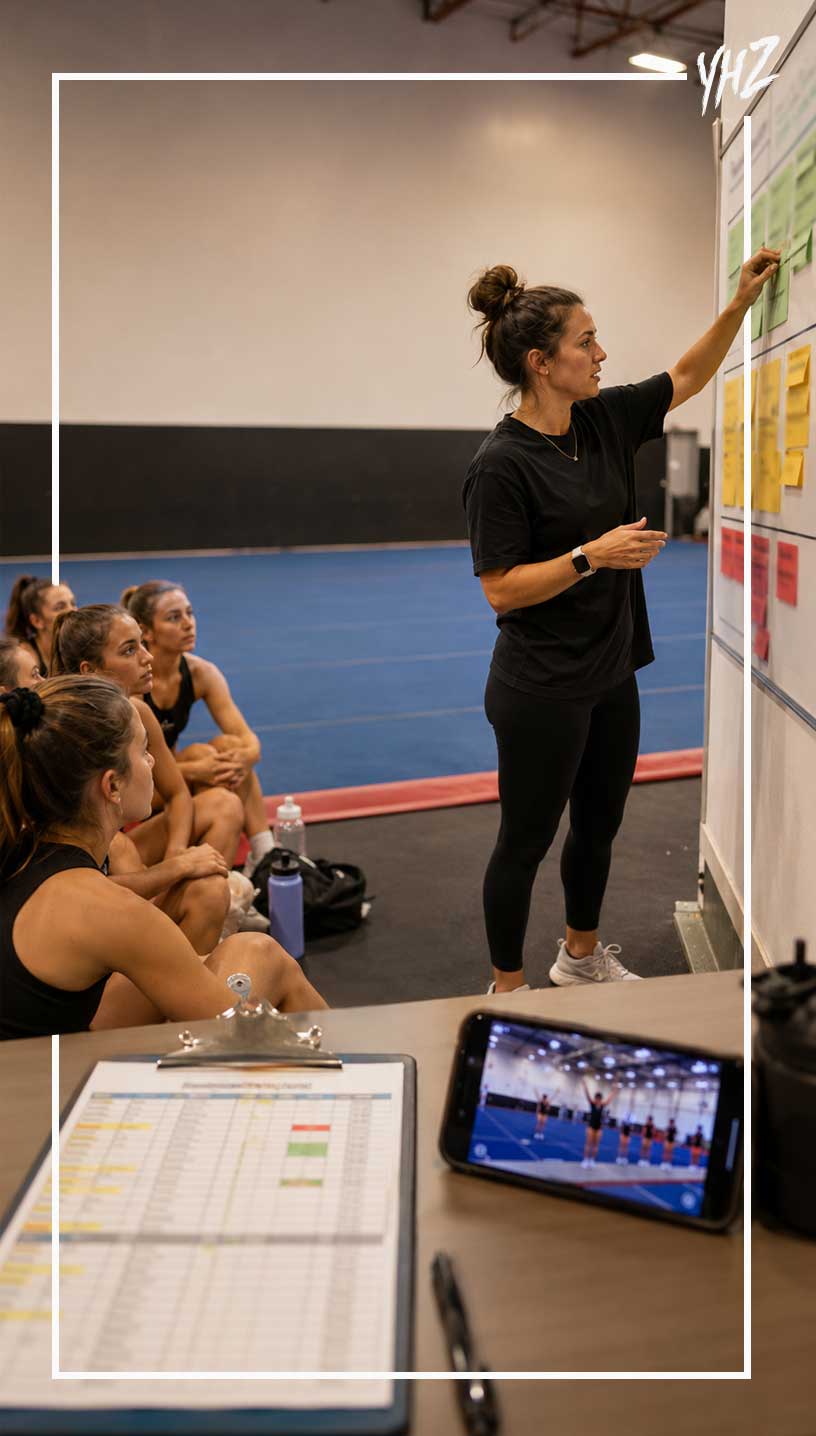
Green skills are ready. They hit most of the time. Athletes understand the timing. Coaches do not have to stop practice every time the skill appears. The skill can handle counts, music, and pressure.

Yellow skills are close. They hit sometimes, but they still need help. Timing changes. Technique slips. Groups need extra resets. These skills may work in a routine if the coach builds a backup plan.

Red skills are not ready. They miss too often, need heavy spotting, create safety concerns, or only work when conditions are perfect. Red skills belong in training, not choreography.

The categories should stay flexible. A yellow skill can become green. A green skill can become yellow when the team adds movement or music. The audit is not a one-day verdict. It is a way to keep the routine honest.

Need Competition Music Blue 1

Audit stunts first

Stunts deserve the first audit because they take the most time to fix after choreography. A shaky stunt section does not stay isolated. It affects formations, transitions, pyramid timing, music pacing, athlete confidence, and the rest of practice. If a coach builds the routine around stunt skills that are not ready, the team spends the whole season chasing the routine instead of cleaning it.

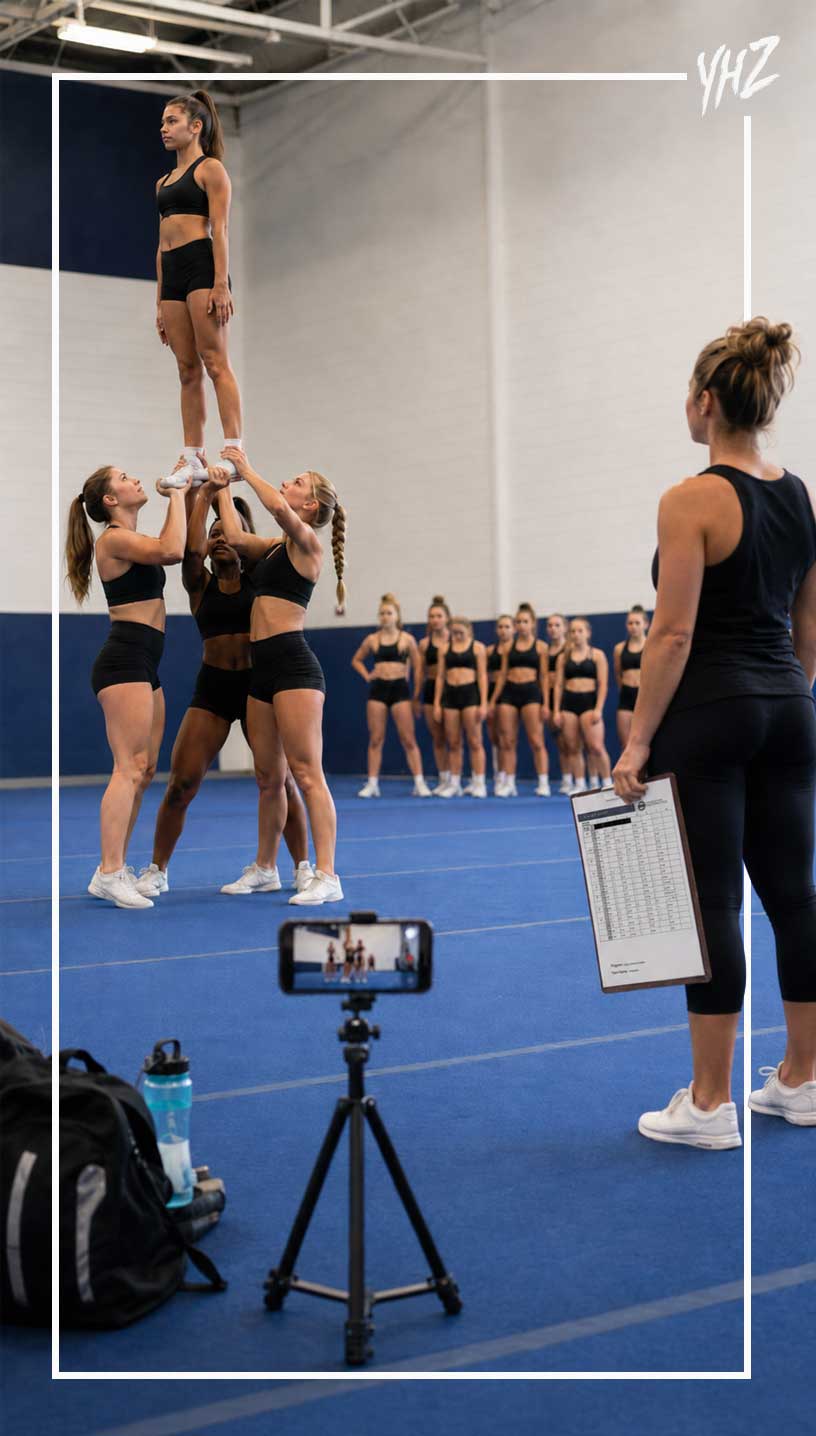
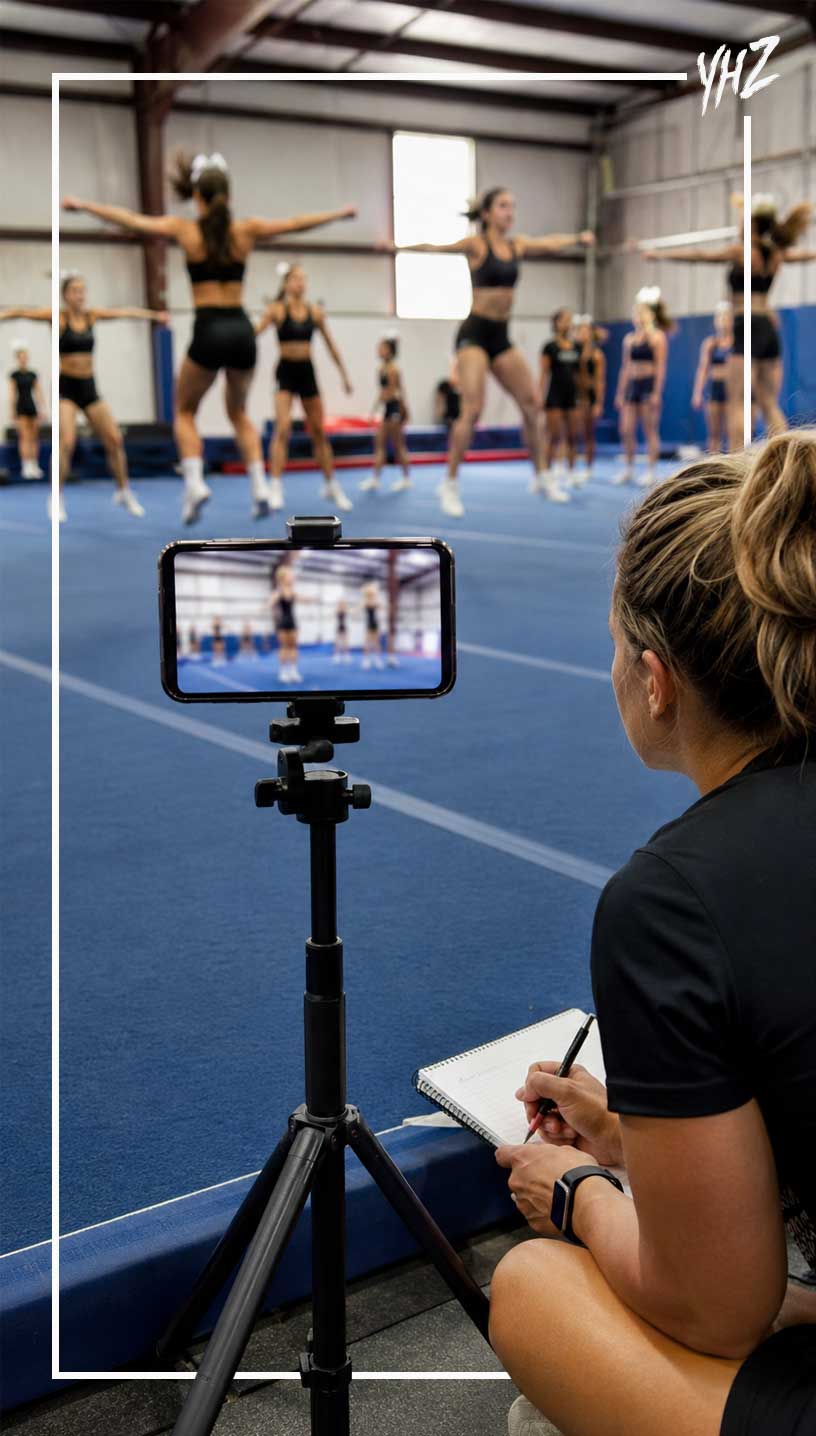
Start with each stunt group by itself. Ask the group to perform the skill ten times. Track clean hits, shaky hits, missed grips, late dips, unstable body positions, rough dismounts, and coach saves. Don’t count a skill as clean just because nobody fell.

A clean hit should look controlled. The flyer should show the intended body position. Bases should stay under the stunt. The back spot should not rescue every rep. The dismount should land safely. Athletes should know where they go next.

Then test the skill in motion. Add the entrance. Add counts. Add the transition before it. Add the transition after it. Add nearby groups. Add music when possible.

This is where the truth usually shows up. A stunt that looks good in isolation may not survive the routine. That does not make the skill useless. It tells the coach where the skill belongs.

Maybe it stays in training. Maybe it moves later in the routine. Maybe it gets simplified. Maybe only one group performs it. Maybe it becomes an upgrade after the first competition. That decision is easier in July than October.
summer skills audit

Do not let one strong stunt group trick you

One strong group can make a team look more advanced than it is. That group hits the elite skill. Everyone gets excited. The routine gets built around that level of difficulty. Then the other groups spend months trying to catch up.

This is a bad trade.

Competition routines are judged as full-team products. If one group looks great and two groups fight for survival, the routine does not look strong. It looks uneven. The summer skills audit should judge the team, not the best group.

If only one group can hit the skill, the coach has a choice to make. Feature that group intentionally, or choose a skill the full section can hit. Both choices can work. Pretending the whole team owns the skill does not work.

A clean stunt section with slightly lower difficulty will usually age better than a high-difficulty section that scares everyone in the gym.

Audit tumbling under routine conditions

Tumbling is another place where coaches overcount skills.

An athlete may have a pass. That does not mean the pass belongs in the routine.

Test tumbling in the way the routine will use it. If the athlete has to run from a corner, test that corner. If the pass comes after jumps, test it after jumps. If the pass comes after a long transition, test it after movement. If the athlete has to wait on music, test the timing.

A tumbling pass should not count as routine-ready until the athlete can land it with the same setup they will use in the routine.

Coaches should also separate technical readiness from performance readiness.

A pass may be legal and land safely, but still look messy. Bent legs, low chest, uncontrolled rebounds, and scary landings can hurt the routine. They can also make the athlete less confident over time.

Some passes need more training. Some need a different placement. Some need to come out until the athlete can hit them without the whole section holding its breath.

That is not negative coaching. That is good routine design.

Audit jumps without lying to yourself

Jumps often get treated as a small section. They should not.

A weak jump section can make a polished routine look unfinished fast. Bent knees, low height, loose arms, bad timing, and messy landings are easy to see. Judges do not need replay to notice them.

A summer jump audit should test three things: technique, timing, and recovery. Technique asks whether the jumps have the shape the coach wants. Timing asks whether the team can hit together. Recovery asks whether athletes can land and move into the next skill without falling apart.

That last part matters. Many jump sections look acceptable until the team has to tumble, transition, or stunt immediately after. If the jumps drain the athletes so much that the next section suffers, the coach needs to know that now.

Do not build the jump section around the one athlete with great flexibility. Build it around what the team can hit together. Clean, synchronized jumps usually beat ambitious jump combinations that land like popcorn.
cheer routine planning

Audit pyramids in pieces

Pyramids can fool coaches because small pieces may work even when the full structure is not ready. Start with the parts.

Can each group hit its job? Can the bracers stay connected? Can flyers maintain body positions? Can bases move safely? Can the team hit the timing without a coach talking them through every count? Then connect the pieces.

This is where pyramid problems usually appear. Groups that hit alone may not travel well. Bracers may arrive late. Flyers may look unsure. Transitions may take more counts than expected. The pyramid may technically hit, but the visual may not read from the front.

The audit should include a front-view check. Record the pyramid from the judges’ angle and watch it without sound. If the visual does not make sense on video, music will not fix it. Pyramid difficulty should serve the routine. It should not become a maze the team barely survives.

Audit transitions like skills

Transitions are skills. Coaches do not always treat them that way, but they should.

A transition needs timing, spacing, body control, traffic awareness, and performance quality. Bad transitions make strong skills look worse. They also create avoidable stress for athletes.

During the summer audit, coaches should identify the athletes who struggle with spacing, speed, direction changes, and formation responsibility. That information should shape choreography.

Some teams can handle fast, layered transitions. Some teams need cleaner pathways and simpler movement. Some teams need extra counts because they have younger athletes, mixed experience levels, or big formation changes. That does not mean the routine has to feel slow. It means the routine has to move in a way the team can execute.

A coach who ignores transition skill level will end up cleaning the same traffic problems all season.

Film everything

Video makes the audit harder to argue with.

Athletes often feel like a skill hit because they survived it. Coaches may remember the best rep because it was exciting. Parents may hear that a skill is close and assume it should go in the routine.

Film solves a lot of that.

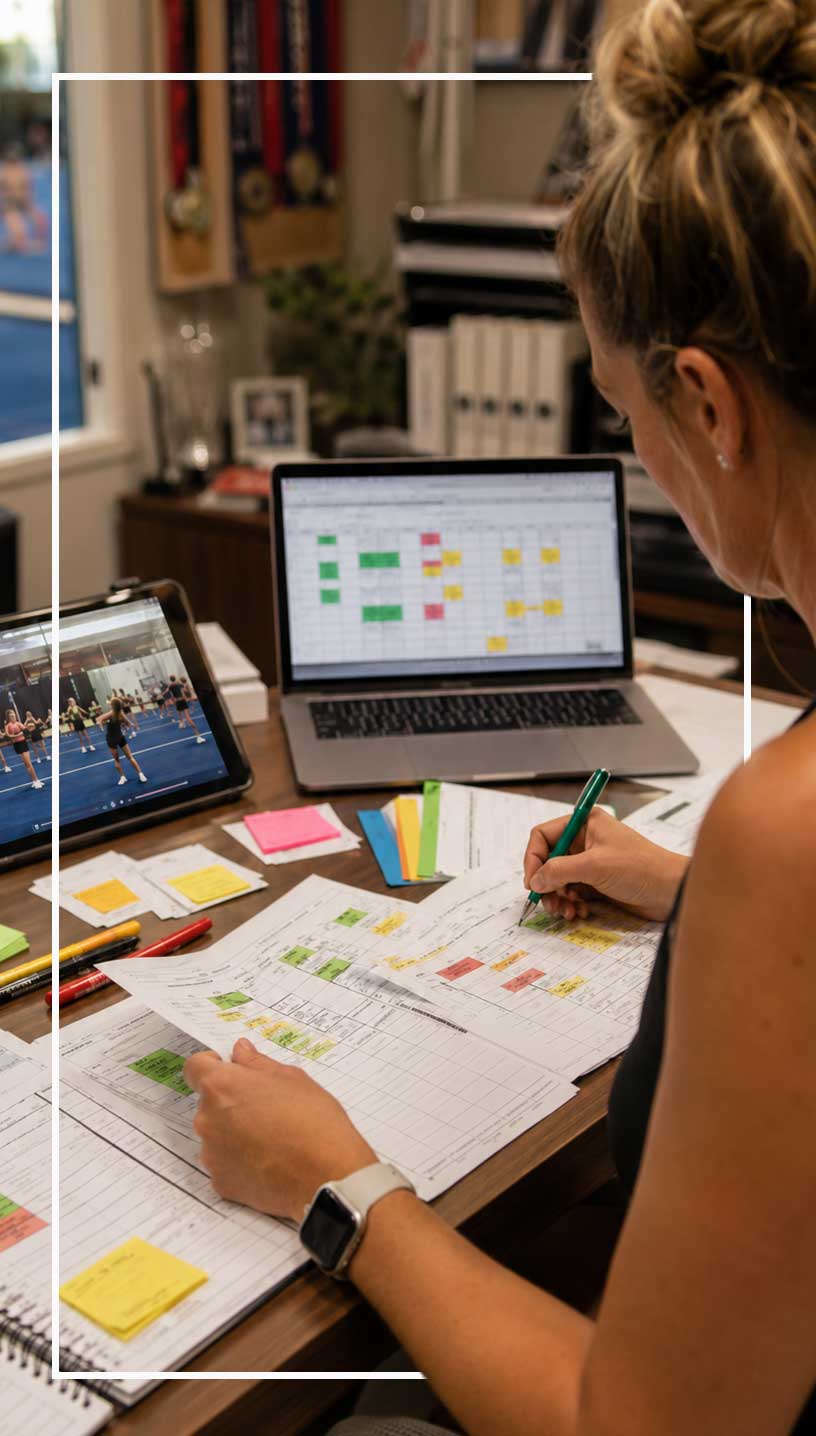
Record stunt reps, tumbling passes, jump sections, pyramid pieces, and short routine-style sequences. Watch them from the front. Watch them without stopping after the first hit. Watch the misses too.

The camera shows what the judges will see.

It also helps coaches spot patterns. Maybe a stunt group misses every time the flyer rushes the body position. Maybe a tumbler changes technique when tired. Maybe the jump timing problem starts with the arms, not the legs. Maybe the transition looks messy because two athletes cross the same lane.

Those details are easy to miss live.

A summer skills audit does not need fancy software. A phone camera and honest eyes are enough.

summer skills audit

Create a no-drama scoring system

A skills audit can get emotional if athletes think every result is a judgment of their worth. Keep the language clean.

Do not label athletes as good or bad. Label skills as ready, close, or still training. That distinction matters.

A flyer is not a problem because one body position is inconsistent. A base is not a failure because one grip needs work. A tumbler is not behind as a person because one pass is not routine-ready.

The audit should help athletes see the path forward.

Use simple notes:

Ready for routine
Needs more reps
Needs technique fix
Needs safer version
Use only in featured spot
Train as upgrade
Do not use yet

That kind of language gives coaches useful information without turning the audit into a public ranking.

Build the routine with a base version and upgrades

The smartest coaches do not choose between easy and hard. They build layers.

Start with a base routine the team can hit. Then plan upgrades that can replace sections when the team earns them.

For example, a stunt group may start with a cleaner prep-level body position, while training the extended version as an upgrade. A tumbling section may start with the passes athletes can land under pressure, while keeping harder passes ready for later. A pyramid may use a safer connection first, then add a harder visual once timing improves. This approach gives the team confidence early.

It also keeps the routine from becoming stale. Athletes can work toward upgrades without feeling like the first version is a failure. The base version should still look intentional. It should not look like a watered-down placeholder. It should be choreographed to score as cleanly as possible.

If the upgrade never becomes safe or consistent, the team still has a routine. That is the point.

Set deadlines for routine decisions

A skill cannot stay “almost ready” forever. Coaches need decision deadlines. Without them, the team keeps waiting for skills that may not arrive in time.

Set a date before choreography when each major skill must prove itself. Set another date after choreography for upgrades. Set a final date before the first competition when the coach stops adding risk and starts cleaning.

The exact timeline depends on the program, but the principle stays the same. At some point, a skill either belongs in the routine or it does not. This protects the team. It also protects practice time.

A team that changes major routine sections too late loses cleaning reps. Athletes get nervous. Coaches get frustrated. Music edits pile up. The routine starts to feel temporary. Temporary routines do not perform with confidence.
cheerleading tumbling audit

Watch for the “one more week” trap

“Give it one more week” can become a season-long habit. Sometimes one more week makes sense. A group may need reps. An athlete may be coming back from vacation. A stunt may need one technical fix. But coaches should ask what will actually change in that week.

Will the team get more reps with the full group present? Will a coach fix a specific technique problem? Will the athlete get private tumbling work? Will the group drill the entry that keeps breaking?

If the answer is no, one more week may only delay the decision. Hope is not a training plan.

When a skill stays inconsistent after repeated chances, the coach should move it out of the routine and keep training it separately. That choice may feel disappointing in the moment. It usually saves the routine later.

Match skills to the team’s identity

The summer audit should not only ask what the team can do. It should ask what the team can sell.

Some teams are explosive. Some are sharp and clean. Some have strong stunt technique. Some have big personalities. Some have excellent dancers. Some have powerful tumbling but need simpler transitions. Some have young athletes who perform better when the routine is clear and confident. The routine should fit that reality.

Do not build a routine that hides the team’s best qualities because everyone is chasing difficulty. Use the audit to find what the team can own.

If the team has strong jumps, give the jump section a real moment.

If the team has one standout tumbler, feature that pass without forcing everyone else into skills they cannot match.

If the team performs well, give them music and choreography that let them connect with the crowd.

If the team has clean stunts, do not bury them inside overcomplicated transitions.

A good routine makes the team look more like itself. A bad routine makes the team look like it is pretending.

Use the audit to guide music and count sheets

The skills audit should feed directly into the count sheet.

If the team needs extra time for stunt setups, the count sheet should show that. If a transition needs more room, plan the counts before the music gets built. If the pyramid has one major visual, make sure the music supports that moment. If jumps need a clean recovery before tumbling, do not cram the next section too close.

Music cannot solve a routine that ignores skill readiness. A producer can help with pacing, energy, voiceovers, sound effects, and section changes. But the coach has to know what the team can actually execute.

The audit gives the music producer better information. It also helps the choreographer make smarter choices. This is where planning pays off. The routine feels less forced because the counts, skills, and music all come from the same honest picture of the team.

What to do when parents push for harder skills

Parents hear what their athlete says. Athletes often say the skill is close. That can create pressure.

A parent may ask why a stunt is not in the routine. An athlete may say they hit it at practice. Another parent may compare the team to a rival program. Someone may post a video of one successful rep and wonder why the coach will not use it. This is where the audit helps.

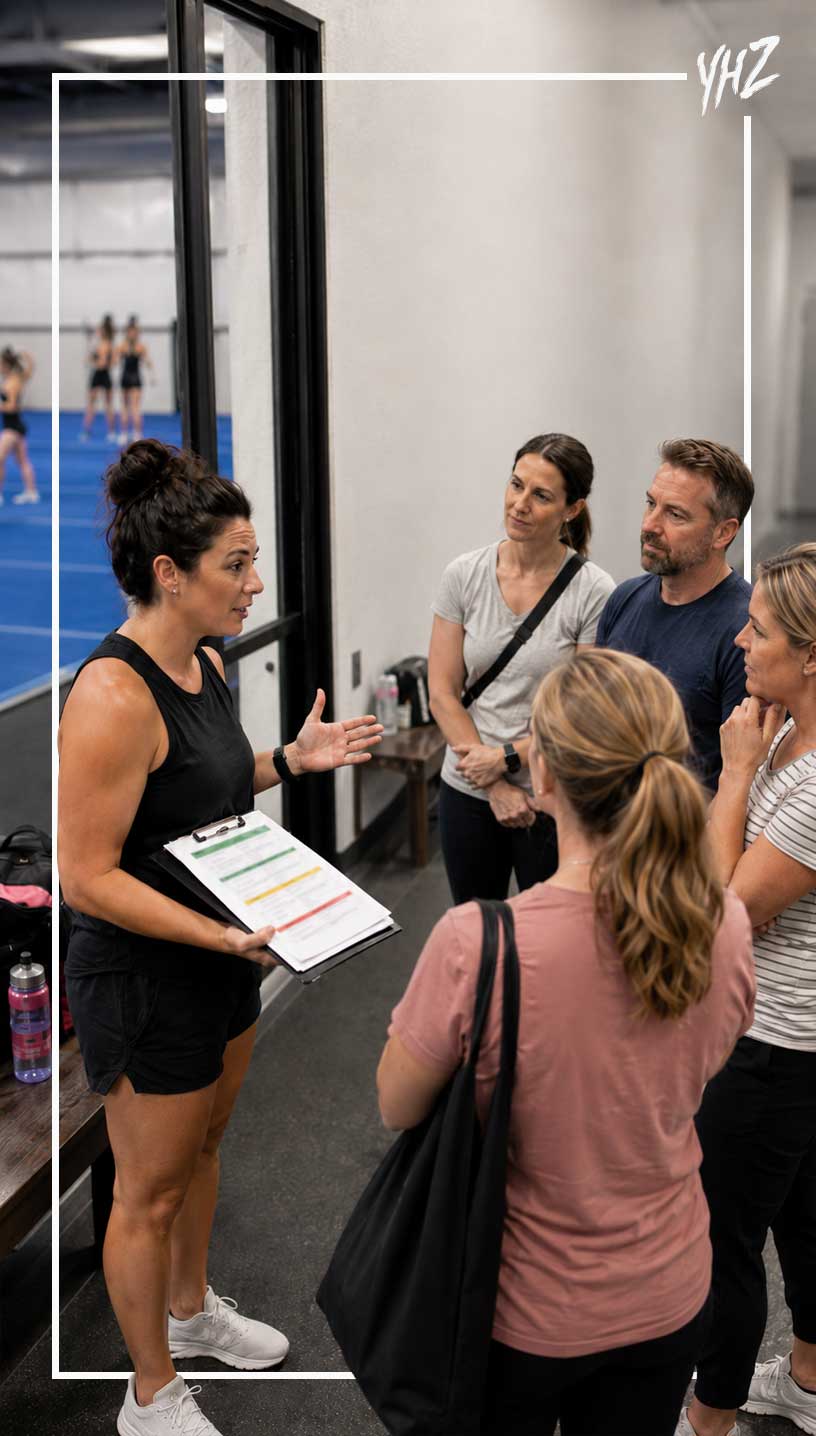
The coach can explain that routine decisions come from consistency, safety, and full-team execution. One hit does not decide choreography. Ten reps tell a better story. Routine conditions tell an even better one. Keep the message simple.

The team will train upgrades. The routine will use the skills that give the team the best chance to hit. The goal is not to avoid difficulty. The goal is to earn it.

Most parents can understand that when the coach explains it before emotions take over.

A sample summer skills audit plan

Coaches can run a basic audit in one or two practices. Start with stunts. Test the main skills each group wants to use. Track clean hits out of ten. Add entries and exits after the first round.

Move to tumbling. Test standing tumbling and running tumbling from routine-style setups. Record landings, timing, and consistency.
cheer tumbling readiness

Run jumps as a group. Check height, timing, arm placement, landings, and recovery into the next section. Break down pyramid pieces. Test each group, then connect sections. Film from the front.

Finish with transitions. Give athletes formation changes and watch spacing, speed, and confusion points. After practice, sort the results into green, yellow, and red.

Then make routine decisions from that list.

Green skills can go into the first choreography plan.

Yellow skills need backup versions.

Red skills stay in training until they prove they are ready.

The audit does not need to be complicated. It needs to be honest.

The coach’s real job

Cheer coaches live between ambition and reality. Push too little, and the team never grows. Push too much, and the routine becomes a weekly emergency.

The summer skills audit helps coaches find the middle. It gives athletes room to improve without letting unfinished skills take over the routine. It helps choreographers build around truth. It helps music producers support the routine instead of guessing. It helps parents understand why consistency matters more than one good video.

Most of all, it protects the team from spending the season chasing a version of itself that only exists in the coach’s imagination.

Build for the team in front of you.

Train for the team they can become.

Those are different jobs. Good coaches know when they are doing each one.

Steve Pawlyk Signature Full

IPP's Premade Mixes are USA Cheer Compliant and customizable!  Add Sound FX, swap songs, & more!  Add your Team Name to the mix for only $10! 

SLAM artwork
Full_Out_130 mp3 image
1 minute cheer mix
WAKE UP THE FIRE
SLAM artwork
WAKE UP THE FIRE
Full_Out_130 mp3 image
1 minute cheer mix

7 Routine Trends That Dominated Cheerleading Worlds 2026

cheerleading worlds 2026 routine trends

By Steve Pawlyk

Published June 23, 2026

Every coach watches Worlds looking for something to bring home: a stunt entry, a pyramid idea, a transition, a music moment, a dance section that makes the crowd lose it.

But Cheerleading Worlds 2026 told a bigger story than one new skill or one viral clip. The best teams in Orlando did not win because they crammed the most difficulty into two and a half minutes. They won because they made smart routine choices, protected their score, and gave judges a clear reason to reward every section.

The lesson from Worlds 2026 was not “go harder.” The lesson was “build smarter.”

From Top Gun TGLC winning Senior Large Coed again, to Cheer Extreme Senior Elite defending Large Senior, to The California All Stars Lady Bullets controlling Senior XSmall, the routines that stood out had more than difficulty. They had identity, structure, pacing, and discipline.

Here are the seven routine trends coaches should take from Cheerleading Worlds 2026:

all star cheer routines

1. Deductions Decided the Story

The cleanest lesson from Worlds 2026 came straight from the score sheet.

Difficulty mattered. It always matters.

But deduction control separated champions from runners-up.

Look at L6 Senior Medium Coed. Spirit of Texas Royalty posted the highest raw score in the division with a 163.4. That should put a team in position to win. But four points in deductions dropped Royalty to a 159.4 final event score. Top Gun All Stars Savannah Legends scored a 162.3 raw score, took only one point in deductions, and won the division with a 161.3.

That is not a small detail.

That is the entire division.

Senior Large told the same story. Central Jersey All Stars Bombshells outscored The Stingray Allstars Orange in raw score, 151.65 to 149.45. But Bombshells took three points in deductions. Orange took zero. Orange finished second. Bombshells finished third.

Coaches love talking about upgrades. Worlds 2026 gave everyone a reminder that an upgrade only helps if the team can hit it when the lights are brightest.

A harder elite stunt that falls does not make your routine more competitive, it makes your math worse.

What This Means for Your Routine

Before adding difficulty, ask one brutal question: Can this team hit this skill three times under pressure?

Not once in a great practice. Not once when everyone feels fresh.

Three times. Under pressure. With fatigue. With nerves. With the season on the line. If the answer is no, the skill may belong in the gym longer.

2. Zero-Deduction Routines Became the Biggest Flex

A zero-deduction routine at Worlds says more than “we hit.” It says the coaches chose the right skills, trained the right details, and built a routine athletes could handle when everything got loud. Plenty of major 2026 champions made that point.

Top Gun TGLC won L6 Senior Large Coed with a 166.1 and zero deductions. Prodigy All Stars Midnight won L6 Senior Small Coed with a 164.15 and zero deductions. Cheer Extreme Raleigh SSX won L6 Senior Small with a 163.25 and zero deductions. The California All Stars Lady Bullets won L6 Senior Extra Small with a 162.4 and zero deductions.

Those teams did not water down their routines. They made elite difficulty look stable. That difference matters.

Worlds-level judges do not reward survival. They reward control. They reward body positions that finish. They reward groups that move together. They reward tumbling that lands with confidence instead of panic. They reward routines that look like the team owns every skill.

The best routines at Worlds 2026 did not feel like athletes were hanging on. They felt trained.

What This Means for Your Routine

Clean is not boring. Clean is expensive. It takes time, reps, honest coaching, and the discipline to remove skills that only hit when everything goes perfectly. A routine that hits clean in April starts with smart decisions in summer.

Need Competition Music Blue 1

3. Program Identity Mattered More Than One Surprise Skill

The teams that people remembered had a point of view. You could feel it before awards.

Top Gun did not bring one team to Orlando with one style. The program brought different versions of the same confidence. TGLC won Senior Large Coed. Lady Jags won Senior Medium. Legends won Senior Medium Coed. Double O won International Open Large Coed Level 6. Toxic won International Open Small Coed Level 7.

Those routines did not look identical. They felt connected. That is program identity.

Cheer Extreme gave the same lesson in a different way. Courtney Smith’s Kernersville side had Senior Elite back on top in Large Senior. Kelly Helton’s Raleigh side had SSX winning Senior Small and Code Black winning International Open Coed Non-Tumbling Level 6.

Different teams. Different divisions. Same clear standard.

That matters because judges and fans can feel when a program knows exactly who it is. The routine has a tone. The athletes perform with confidence. The choreography matches the team. The music does not feel pasted on. The routine does not chase every trend at once. It commits.

What This Means for Your Routine

Your routine should not look like a highlight reel from five other gyms. Take inspiration from Worlds, but do not copy blindly.

Build around your team’s strengths, your program’s personality, and the athletes standing in front of you. A routine with a clear identity will always feel more confident than one built from random “cool parts.”

4. The Best Routines Used Pacing Like a Weapon

Worlds routines can get messy fast.

Everyone wants a big opening. Everyone wants an elite stunt. Everyone wants a basket moment. Everyone wants tumbling. Everyone wants a pyramid people remember.

The problem comes when a routine tries to scream for two and a half minutes.

The best Worlds 2026 routines understood pacing.

They gave the audience and judges a reason to keep watching. They built from section to section. They created rises and releases. They did not treat transitions as dead space. They used choreography to set up skills instead of simply filling time between them.

That is why routines like TGLC, Senior Elite, Orange, Lady Jags, Royalty, Legends, Peach, Midnight, Black Ops, and Double O kept showing up in fan conversations and replay lists. Those teams did not only perform skills. They managed attention.

That is a massive coaching skill.

A routine should not feel like a playlist of unrelated moments. It should feel like one idea that keeps developing.

cheerleading routine trends

What This Means for Your Routine

Watch your routine without music. If the structure still makes sense, you probably built something solid. If the routine only feels exciting because the music covers awkward transitions, you have work to do.

Transitions should move the story forward. They should set up formations, create visual interest, and help the next section arrive with purpose.

5. Crowd Favorites Had More Than Difficulty

Crowd reaction does not determine the score, but it tells coaches something useful.

The routines people replay after Worlds usually have a clear identity, strong pacing, and at least one moment fans want to see again. FloCheer’s most-watched Worlds 2026 list made that obvious. The Stingray Allstars Orange finished second in Senior Large, but ranked first among the most-watched routines. Spirit of Texas Royalty finished second in Senior Medium Coed, but ranked third on that replay list. Top Gun Lady Jags, Senior Elite, Legends, Peach, Midnight, TGLC, Black Ops, and Double O all landed in the top ten.

That list matters because it shows the difference between scoring well and being remembered. Coaches should care about both.

A routine does not need gimmicks to be memorable. It needs moments that feel earned. A stunt sequence that builds tension. A pyramid that resolves cleanly. A dance that matches the team’s personality. A music change that lands at the exact right second. A formation that makes the floor feel full.

The audience reacts when the routine gives them a reason.

What This Means for Your Routine

Do not add “performance value” as decoration at the end; build it into the routine from the start.

Performance value comes from confidence, pacing, musicality, formations, and athletes who know what the moment means. If your team only performs during dance, the routine will feel flat everywhere else.

6. International Programs Are No Longer Chasing From Far Behind

The international divisions made one thing clear: the gap keeps shrinking.

Unity Allstars Ruby from England won International Open Level 6 with a zero-deduction 132.05. Cheer Sport Sharks Ottawa Silky Sharks from Canada won International Open Non-Tumbling Level 6 with a zero-deduction 125.9. TR Cheer Beast from Canada won International Open Small Coed Level 5 with a zero-deduction 133.85. ACE Athletics Rouge from Canada won International Open Large Coed Level 5 with a zero-deduction 137.05. Then you had Barcelona Bears Legacy from Spain winning International Open Coed Non-Tumbling Level 7 with a zero-deduction 132.15.

That is not “international teams are improving” as a polite throwaway line, that is international programs winning divisions, hitting zero, and forcing everyone else to match their standard. The depth showed up across the results too. Canada, England, Australia, Germany, Japan, Mexico, Chile, Puerto Rico, Wales, Spain, Sweden, Ireland, and other countries appeared throughout Finals and Semi-Finals. Worlds has always been international by name, but in 2026, it felt international by competitive reality.

What This Means for Your Routine

Stop treating international teams as side stories. If you coach in the United States, the standard is no longer local, regional, or even national. The standard is global.

If you coach outside the United States, Worlds 2026 should give your athletes proof that the door is open. Programs from outside the U.S. are not just showing up. They are winning, globing, and hitting routines that belong on the biggest stage.

Worlds cheerleading results 2026

7. The Small Details Moved Teams Up the Rankings

Every coach says details matter. Worlds 2026 proved it.

Small details turned into placements. A cleaner landing. A sharper motion. A controlled body position. A stunt group that finishes together. A transition that does not waste counts. A pyramid that hits the picture without wobble.

These details do not always make the highlight clip, but they make the score sheet. The Senior Small Coed division gave coaches a perfect example. Prodigy Midnight, Brandon Senior Black, and CALI SMOED finished first, second, and third. All three hit zero-deduction routines. At that point, the division turned into a battle of execution quality, routine construction, and who could create the most complete performance without giving anything back.

That is Worlds. At lower levels, teams can sometimes survive messy details because the difficulty gap creates separation. At Worlds, every detail has a cost.

What This Means for Your Routine

Film everything. Not just full-outs. Film stunt reps. Film transitions. Film jumps. Film pyramid timing. Film athletes walking into formations. Film what happens after a skill hits. Then watch without making excuses.

If motions finish late, fix them. If groups dip at different times, fix them. If athletes travel through transitions without purpose, fix them. If your pyramid picture takes too long to settle, fix it. The fastest way to improve your routine may not be adding a skill. It may be cleaning the five seconds before the skill.

Cheerleading Worlds 2026 did not reward chaos; it rewarded control.

The champions and fan favorites had difficulty, but they also had restraint. They knew what their athletes could hit. They protected the score sheet. They built routines with identity. They gave each section a job. They created moments without letting performance value turn into clutter.

That is the real trend. Not one stunt. Not one pyramid. Not one dance move.

The best routines at Worlds 2026 looked intentional from the first count to the final pose. That should be the goal for every coach planning a new season.

Build a routine your athletes can hit. Give it a clear identity. Train the details until they look automatic. Then clean it again.

Worlds did not prove that safe routines win, it proved that smart routines win..and there’s a difference.

Steve Pawlyk Signature Full

IPP's Premade Mixes are USA Cheer Compliant and customizable!  Add Sound FX, swap songs, & more!  Add your Team Name to the mix for only $10! 

SLAM artwork
Full_Out_130 mp3 image
1 minute cheer mix
WAKE UP THE FIRE
SLAM artwork
WAKE UP THE FIRE
Full_Out_130 mp3 image
1 minute cheer mix

The Rise of Specialization in Cheerleading Coaching

Rise of Specialization in Cheerleading Coaching

By Steve Pawlyk

Published December 7, 2023

In the ever-evolving realm of cheerleading, the trend of specialization among coaches is reshaping the landscape. With cheerleading’s growing complexity, coaches focusing on specific niches such as stunt technique, choreography, or team dynamics are becoming increasingly valuable. This article explores the burgeoning world of specialized cheerleading coaching and its impact on both athletes and the sport itself.

The Shift Towards Specialization:

Gone are the days when a one-size-fits-all approach sufficed in cheerleading coaching. The landscape of cheerleading has undergone a significant transformation, evolving from a predominantly spirit-oriented activity into a highly competitive and athletic sport. This evolution demands a more nuanced approach to coaching, where specialization is no longer a luxury—it’s a necessity.

In response to this shift, coaches are increasingly focusing on specific aspects of cheerleading. This move towards specialization is driven by the recognition that the diverse elements of cheerleading, such as tumbling, stunting, and dance, require distinct skills and knowledge. By concentrating on a particular niche, coaches can offer more in-depth and advanced training, tailored to the unique needs and goals of their athletes.

For instance, tumbling specialists are equipping athletes with advanced gymnastic skills, ensuring they execute flips and tumbles with precision and safety. Similarly, coaches with a focus on stunting are delving into the mechanics of lifts and throws, emphasizing technique and teamwork essential for executing complex stunts successfully.

Moreover, the intricate choreography of modern cheer routines demands a creative and artistic approach. Coaches specializing in choreography are blending athletic rigor with expressive elements to create captivating performances. This specialization not only enhances the visual appeal of routines but also contributes to higher scores in competitions, where originality and creativity are highly valued.

The trend towards specialization also acknowledges the growing competitive nature of cheerleading. As the sport garners more recognition and becomes increasingly popular, the competition intensifies. Specialized coaches are thus vital in helping teams and individual athletes gain a competitive edge, offering training that is both cutting-edge and specific to the demands of modern cheerleading.

Need Competition Music Blue 1

Benefits of Niche Coaching

Specialized coaching in cheerleading offers a multitude of benefits, both for the athletes and the sport as a whole. By focusing on a specific niche, coaches transform into experts in their field, bringing a depth of knowledge and skill that is unparalleled. This level of expertise is crucial in a sport as multifaceted and dynamic as cheerleading.

1. Enhanced Skill Development:

Specialized coaches possess a deep understanding of their chosen area, whether it’s tumbling, stunting, or choreography. This allows them to impart high-level skills to their athletes, tailored to the specific demands of that discipline. Athletes benefit from training that is not just general in nature but is specifically designed to enhance their abilities in a particular aspect of cheerleading.

2. Improved Performance and Competitive Edge:

As coaches concentrate on their specialty, they can refine their athletes’ techniques to a much higher degree. This leads to improved overall performance, as athletes are not just competent but excel in specific elements of cheerleading. In the competitive arena, this can be the difference between a good routine and a great one, giving teams an edge over their rivals.

3. Boosted Safety:

One of the paramount benefits of niche coaching is enhanced safety. Specialized coaches are well-versed in the safety protocols and techniques specific to their area. For instance, a coach specializing in stunts will have an in-depth understanding of how to execute these elements safely, reducing the risk of injury. This focus on safety is vital in a sport that involves high-risk elements.

4. Personalized Attention to Athletes:

Specialization allows coaches to provide more personalized attention to their athletes. They can identify individual strengths and weaknesses within their specialty, offering tailored advice and training. This personalized approach helps athletes develop more rapidly and effectively.

5. Keeping Up with Evolving Techniques:

Cheerleading is a sport that continuously evolves. Specialized coaches stay abreast of the latest techniques and trends in their niche, ensuring that their athletes are learning the most current and effective methods. This continuous learning keeps teams innovative and progressive.

6. Building Athlete Confidence:

When athletes train under specialized coaches, they gain confidence in their abilities. Knowing they are receiving top-tier training in their specific area of cheerleading makes athletes more confident in their performance, which is often reflected in how they execute their routines.

Stunt Technique Mastery:

The mastery of stunts is not just about executing high-flying feats; it’s about combining skill, precision, and safety. Coaches who specialize in stunt technique play a crucial role in revolutionizing how teams perform these complex routines.

1. Understanding the Mechanics of Stunts:

A deep understanding of the mechanics behind each stunt is essential. This includes knowledge of body alignment, momentum, and force distribution. Coaches teach athletes how to properly align their bodies for maximum efficiency and safety, focusing on key aspects like core strength, balance, and coordination.

2. Emphasizing Safety in Every Aspect:

Safety is paramount in stunt execution. Specialists ensure that all stunts are performed within safety guidelines, and they train athletes in proper techniques to minimize the risk of injury. This includes teaching correct spotting techniques, where spotters learn how to effectively support and catch flyers, and ensuring that all team members understand their role in each stunt.

3. Progressive Skill Development:

Coaches should adopt a progressive approach to teaching stunts, starting with basic techniques and gradually moving to more complex ones as the athletes’ skills and confidence grow. This step-by-step approach helps in building a strong foundation, reducing the risk of injury, and ensuring long-term development.

4. Customizing Training for Individual Needs:

Understanding that each athlete has unique strengths and areas for improvement is crucial. Coaches should tailor their training to address these individual needs, helping each team member to maximize their potential in stunt performance.

5. Incorporating Conditioning and Strength Training:

Physical conditioning and strength training are vital components of stunt technique mastery. Coaches should incorporate exercises that build the strength, flexibility, and endurance necessary for executing stunts. This includes targeted workouts focusing on core strength, leg power, and upper body conditioning.

6. Utilizing Drills and Repetitions:

Repetition is key in mastering stunts. Coaches should design drills that allow athletes to practice stunts repeatedly in a controlled environment. This not only helps in perfecting the technique but also builds muscle memory, which is crucial during high-pressure situations like competitions.

7. Encouraging Teamwork and Trust Building:

Successful stunts require impeccable teamwork and trust among team members. Coaches should conduct team-building exercises that enhance trust and communication, ensuring that each member understands and executes their role flawlessly during stunts.

8. Analyzing and Refining Techniques:

Continuous analysis and refinement of stunt techniques are important. Coaches should regularly review performances, provide constructive feedback, and make necessary adjustments to techniques, ensuring continuous improvement and adaptation to evolving cheerleading standards.

Choreography and Creativity:

The role of choreography specialists is becoming increasingly pivotal. These experts bring a unique blend of athletic rigor and artistic creativity, elevating routines from mere performances to captivating displays of skill and expression

1. Crafting Visually Stunning Routines:

Choreography specialists have the unique ability to visualize and create routines that are not only technically proficient but also visually stunning. They understand the importance of formations, transitions, and synchronization, crafting sequences that are both aesthetically pleasing and challenging. This visual appeal is essential in catching the attention of judges and audiences alike.

2. Balancing Athleticism and Artistry:

One of the key strengths of choreography experts is their ability to balance athleticism with artistry. They weave complex stunts and tumbling passes into the fabric of dance and movement, creating a seamless blend that showcases the full range of cheerleading skills. This balance is crucial in competitive cheerleading, where both technical skill and creative presentation are evaluated.

3. Enhancing Team Identity and Style:

Choreographers play a significant role in defining a team’s style and identity. Through their creative vision, they can craft routines that reflect a team’s unique personality and strengths. This helps teams stand out in competitions, leaving a memorable impression on judges and spectators.

4. Pushing the Boundaries of Creativity:

These specialists are often at the forefront of innovation in cheerleading choreography. They push the boundaries of what is possible, introducing new elements and styles that keep the sport fresh and exciting. This constant innovation ensures that cheerleading continues to evolve and captivate new audiences.

5. Tailoring Routines to Maximize Scoring Potential:

Understanding competition scoring systems is another critical aspect of a choreographer’s role. They design routines that not only impress but also align with the scoring criteria, maximizing the potential for high scores. This strategic approach can make a significant difference in a team’s competitive success.

6. Inspiring Athletes:

Choreographers also play a key role in inspiring athletes. By creating routines that are enjoyable and challenging, they motivate cheerleaders to push their limits and take pride in their performances. This inspiration is crucial in building a team’s morale and enthusiasm.

Fostering Team Dynamics:

Specialists in team dynamics play a crucial role in building team cohesion and mental toughness. Their focus on communication, trust, and teamwork is crucial in a sport that relies heavily on synchronization and team effort.

1. Cultivating a Positive Team Environment:

Specialists in team dynamics are skilled in creating a positive and supportive team environment. They understand that the emotional and psychological well-being of athletes is as important as their physical skills. By fostering a positive atmosphere, these coaches help athletes feel valued and supported, which is essential for team cohesion and morale.

2. Enhancing Communication Skills:

Effective communication is vital in cheerleading, where every move needs to be perfectly synchronized. Coaches specializing in team dynamics work on developing clear and effective communication channels within the team. This includes not only verbal communication during performances but also non-verbal cues and understanding among team members.

3. Building Trust and Reliability:

Trust is the foundation of any successful cheerleading team. Specialists in team dynamics focus on exercises and activities that build trust among team members. This trust is crucial when performing complex stunts and routines, where each member must rely on their teammates for safety and performance.

4. Encouraging Teamwork and Collaboration:

These coaches emphasize the importance of teamwork and collaboration. They teach athletes that the success of the team depends on each member working together towards a common goal. This understanding helps in creating a cohesive unit where members support and uplift each other.

5. Developing Mental Toughness:

Mental toughness and resilience are critical in cheerleading, especially in competitive scenarios. Coaches focusing on team dynamics help athletes develop the mental strength to handle pressure, overcome challenges, and perform confidently under various circumstances.

6. Resolving Conflicts and Strengthening Bonds:

In any team sport, conflicts are inevitable. Specialists in team dynamics are adept at conflict resolution, ensuring that disagreements do not disrupt team harmony. They also work on strengthening the bonds between team members, fostering a sense of unity and camaraderie.

Need Competition Music Blue 1

The rise of specialization in cheer coaching is a testament to the sport’s growth and complexity. Coaches who hone specific skills and knowledge not only set themselves apart but also significantly contribute to the development and success of their athletes. As cheer continues to evolve, so will the need for specialized coaching.

Steve Pawlyk Signature Full

IPP's Premade Mixes are USA Cheer Compliant and customizable!  Add Sound FX, swap songs, & more!  Add your Team Name to the mix for only $10! 

SLAM artwork
Full_Out_130 mp3 image
1 minute cheer mix
WAKE UP THE FIRE
SLAM artwork
WAKE UP THE FIRE
Full_Out_130 mp3 image
1 minute cheer mix

New Cheerleading Music Length Rules for 2023-2024 Season: Introducing 1:45 Premade Cheer Music Mixes

New-Cheerleading-Music-Duration-Rules-for-2023-2024-Season--Introducing-1-45-Premade-Cheer-Music-Mixes

By Steve Pawlyk

Published August 16, 2023

Cheer is always changing, and the 2023-2024 season is no exception. Several leagues have announced significant changes to their music duration requirements, and IPP Music is here to ensure that cheerleading programs worldwide can adapt seamlessly.

2023 NCA/NDA College Rule Change:

In a significant move, the NCA/NDA College has adjusted the video requirements for teams competing in the Jazz, Pom, and Hip-Hop Divisions. Teams must now submit a performance routine of any style, one minute and forty-five seconds (1:45) minimum in length. This change eliminates the need for editing or split screens, focusing on the raw talent and creativity of the performers.

USASF DANCE RULES 2023-2024:

The USASF has also made adjustments to their dance rules. Each team will now have a minimum of 1 minute and 45 seconds (1:45) to a maximum of 2 minutes and 15 seconds (2:15) to demonstrate their style and expertise. The timing will begin with the first choreographed movement or note of the music and end with the last, providing a new framework for creativity and expression.

2023-2024 CDE DANCE Rule:

CDE Dance has followed suit, implementing a time limit that aligns with the other leagues. Teams will have a minimum of 1 minute and 45 seconds (1:45) to a maximum of 2 minutes and 15 seconds (2:15) to showcase their style and expertise.

Introducing 1:45 Premade Cheer Music Mixes

At IPP Music, we understand the importance of adapting to the ever-changing landscape of cheerleading. Our existing Premade Cheer Mixes, available in durations of 0:30, 0:45, 1:00, 1:30, 2:00, 2:15, and 2:30, have always been customizable with voiceovers, sound effects, song swaps, tempo adjustments, and more.

However, we recognize the specific need for 1:45 mixes, especially since customers had been paying extra to cut down 2:00 mixes to this new standard duration. To facilitate this need and save our valued customers unnecessary expenses, we are thrilled to introduce our new 1:45 Premade Cheer Music Mixes.

Priced at just $115, these mixes are crafted with the same quality and creativity that IPP Music is known for. They are available for purchase now at this link.

Need Competition Music Blue 1

The 2023-2024 season brings exciting changes to the cheerleading world, and IPP Music is committed to supporting teams as they navigate these new rules. Our 1:45 Premade Cheer Music Mixes are designed to align with the latest requirements, providing an affordable and high-quality solution for cheerleading programs everywhere.

With IPP Music, you can always hit zero and shine on the stage, no matter the rules or regulations. Explore our new 1:45 mixes today and take your performance to the next level!

Steve Pawlyk Signature Full

IPP's Premade Mixes are USA Cheer Compliant and customizable!  Add Sound FX, swap songs, & more!  Add your Team Name to the mix for only $10! 

SLAM artwork
Full_Out_130 mp3 image
1 minute cheer mix
WAKE UP THE FIRE
SLAM artwork
WAKE UP THE FIRE
Full_Out_130 mp3 image
1 minute cheer mix

5 Proven Tips for Cheerleaders to Memorize Choreography

5-Proven-Tips-for-Cheerleaders-to-Memorize-Choreography

By Steve Pawlyk

Published August 7, 2023

When it comes to cheerleading, nailing the choreography is key. A perfect routine, synchronized with your team, can make all the difference between winning the trophy and going back to the drawing board. However, remembering every step, jump, and hand movement can sometimes be challenging. So, if you find yourself forgetting moves or getting them jumbled up, here are five SEO-optimized tips to help you memorize your team’s choreography like a pro!

1. Break it Down Into Sections:

Often, looking at the entire routine can be overwhelming. Instead, divide the choreography into smaller, manageable chunks. This can be based on the count, song sections, or particular moves. Once you’ve mastered one section, move on to the next. It’s easier to connect smaller mastered sections than trying to memorize everything at once.

2. Repetition, Repetition, Repetition:

There’s a reason this word is repeated thrice! The more you practice, the more muscle memory you develop. Repetition will not only help you remember the moves but also improve your execution. Set aside specific times each day to run through the routine or the sections you’re focusing on.

3. Visualization:

Even when you’re not physically practicing, you can mentally run through the routine. Before sleeping or during any idle time, visualize yourself performing the choreography from start to finish. This mental rehearsal can reinforce your memory and even boost your confidence.

Need Competition Music Blue 1

4. Record and Review:

In today’s digital age, use your phone or camera to your advantage. Record yourself or your team performing the routine. Watching the playback helps in identifying areas that need improvement. Plus, it offers a third-person perspective that can be invaluable for spotting mistakes or inconsistencies.

5. Teach Someone Else:

This one might be the most effective of all these tips. Once you feel you’ve got a good grip on the choreography, teach it to someone else – a teammate, friend, or even a family member. The process of teaching forces you to recall each move in detail, further cementing the choreography in your memory.  This works incredibly well for creating strong memories that can be recalled in an sub-conscious manner.

Memorizing choreography can initially seem daunting, but with consistent effort and the right techniques, it becomes second nature. Embrace the process, stay patient with yourself, and remember that every champion was once a beginner. So, set your sights high, use these tips, and soon enough, you’ll be executing those routines flawlessly!


Steve Pawlyk Signature Full

IPP's Premade Mixes are USA Cheer Compliant and customizable!  Add Sound FX, swap songs, & more!  Add your Team Name to the mix for only $10! 

SLAM artwork
Full_Out_130 mp3 image
1 minute cheer mix
WAKE UP THE FIRE
SLAM artwork
WAKE UP THE FIRE
Full_Out_130 mp3 image
1 minute cheer mix

When Choosing Cheerleading Music, Consider This: The Ultimate Guide for Perfect Performance Music

When Choosing Cheerleading Music Consider This: The Ultimate Guide for Perfect Performance Cheerleading Music

By Steve Pawlyk

Published May 16, 2023

Cheerleading has evolved into a dynamic display of athleticism, spirit, and yes, music. Choosing the right cheerleading music can make or break your team’s routine, and at IPP Music, we understand that. So, how do you select the best cheerleading music that will make your team stand out at the next competition? Here are some key points to consider.

1. Picking the Right Tempo:

One of the first things to think about when choosing cheerleading music is the tempo. The tempo sets the pace for your entire routine, whether it’s a fast-paced, high-energy performance, or a more slow and dramatic display. At IPP Music, we offer a diverse range of premade and custom music options so that you can find the perfect beat for your team’s unique style and routine.

2. Matching the Music to the Moves:

A good cheerleading routine is like a well-choreographed dance—it pairs perfectly with the music. When picking your music, it should enhance and complement the moves in your routine. At IPP Music, our tracks can be customized to match your choreography, ensuring a seamless performance that will impress the judges and the audience alike.

3. Ensuring Your Music Is Licensed:

One of the major considerations when choosing cheerleading music is copyright laws. Using music without the appropriate license could lead to legal issues or even disqualification from competitions. IPP Music offers fully licensed music, giving you peace of mind knowing your team can perform legally and ethically.

4. Customizing Your Music:

When it comes to cheerleading music, one size does not fit all. Your music should reflect your team’s unique personality and style. At IPP Music, our custom music service allows you to tailor your tracks to your needs. You can choose the tempo, mix different songs, and even add in sound effects or voiceovers to make your performance truly one-of-a-kind.

5. Considering the Audience and Judges:

Finally, remember that your music isn’t just for your team—it’s also for the audience and the judges. Choose music that will engage the audience and impress the judges. If you’re unsure, our experienced team at IPP Music can help guide you in selecting tracks that are popular and impactful while still fitting your routine.

Conclusion:

Choosing the right cheerleading music is a vital part of creating a standout performance. It requires careful thought and consideration, and that’s where IPP Music can assist. We offer a range of licensed, customizable music options tailored to cheerleading teams. So whether you’re looking for premade tracks or want to create a unique mix, IPP Music has got you covered. 

Remember, when it comes to cheerleading music, consider the tempo, choreography, licensing, customization, and audience appeal. Get in touch with IPP Music today and let’s create the perfect soundtrack for your next cheerleading performance.

Steve Pawlyk Signature Full

SHARE YOUR CART