Category Archives: Schedules

Why Winning Your Division Might Beat Your Score: A Worlds Bid Strategy Guide

worlds paid bid strategy 2026 2027

By Steve Pawlyk

Published October 21, 2026

Here’s a scene most of us have lived through. Your Senior team hits zero, the scoresheet looks great, and you’re sitting in awards feeling pretty good about that Paid bid. Then the bids go out and you don’t hear your name. A team from a different division with a lower score just walked off with it.

Under Varsity’s October 2026 bid declaration, that’s going to happen more often. And honestly? It’s not a glitch. It’s the design.

The new declaration puts division champions at the center of how Paid bids get handed out. So the question you need to ask about a bid event isn’t just “can we score high enough?” anymore. It’s “can we win our division at this event, and does winning it actually put us in line for a Paid bid?”

This post won’t rehash every table in the declaration. You can read the documents yourself, and you should. Instead, we’re going to walk through some made-up teams, look at where winning your division gives you an edge, and finish with a couple of decision trees you can use before you sign a check for a big travel event.

Worlds Paid bid strategy

The short version of what changed

For years, a lot of us thought about Paid bids as a scoreboard. Get the highest score among eligible teams and you’re probably getting one.

That’s not how it works anymore. At many qualifying events, some Paid bids are now set aside for division champions before score ranking even comes into play.

Take an event offering three Paid bids under the general declaration. One goes to a Senior All Girl champion. One goes to a Senior Coed champion. Only one goes to the highest-scoring eligible team under the rules that apply.

So two of those three bids aren’t about who scored highest across the whole event. They’re about who won their division.

The big events don’t all follow the general rules, either. NCA, CHEERSPORT, JAMfest and One Up each have their own declarations with their own twists. Bid counts vary a lot, too. CHEERSPORT is listing 10 full Paid bids for 2026-27, while One Up Grand Nationals lists 4 and CHAMPS Grand Nationals lists 2. The number of bids matters, but how they’re split matters just as much.

The takeaway: before you look at your scores from last season, pull up the declaration for the specific event you’re considering and find out how many of its Paid bids go to champions.

Four teams, four very different bid outlooks

These teams are made up. The situations aren’t. You’ll probably recognize your own program in at least one of them.

For all four, picture the same event: three Paid bids, split the way the general declaration describes. One for a Senior All Girl champion, one for a Senior Coed champion, one for the top eligible score.

Team A: the big fish in a small division

Team A is a Senior Coed squad. They’re solid but not elite. On a good day they’re scoring a few tenths behind the best All Girl teams in the region.

Here’s the thing, though. At this event, only four teams are registered in their Senior Coed division, and Team A has beaten all four at least once this year.

Under the old way of thinking, Team A would never chase this bid. Their score wouldn’t touch the top of the event. Under the new declaration, they might be the favorite for the Coed champion bid. If they win their division, they don’t need to outscore anybody else in the building.

The lesson: a team that can’t win on raw score might win on placement. Look at who’s actually in your division before you write off an event.

Team B: the high scorer stuck behind a powerhouse

Team B is an All Girl team with big numbers. They’d be top three in score at most events. Problem is, they share a division with a national powerhouse that beats them by half a point every time.

Team B is likely to finish second in division. That means the All Girl champion bid probably isn’t theirs. Their only real shot is the one bid that goes to the highest eligible score, and they’ll be fighting every non-champion at the event for it.

It gets tougher. If the powerhouse already has a Paid bid from an earlier event, check how that event’s declaration handles it. Some declarations pass a bid down to the next eligible team in the division. Some open it up across divisions. That one detail can swing Team B’s chances a lot.

The lesson: a great score doesn’t help much if you keep running into the same team. Sometimes the smart move is to find an event that powerhouse isn’t attending.

Need Competition Music Blue 1

Team C: the team that already has a bid

Team C picked up a Paid bid in December. Now they’re signed up for a February event with a strong field.

They can’t earn a second Paid bid. But they can still win their division. And if they win, that champion bid usually doesn’t vanish. Depending on the declaration, it can pass to another team, which is great news for whoever finishes behind them.

For Team C, this event is about getting the routine in front of judges one more time before Worlds. That’s still a fine reason to go. Just be honest with your parents about why you’re going.

The lesson: once you have your bid, your schedule should change. You’re competing for different reasons now.

Team D: the team chasing an At-Large-to-Paid upgrade

Team D earned an At-Large bid at their first event. They’d love a Paid bid to ease the cost for families.

Team D has to look at every remaining event the same way. Can we win our division? If not, can we beat every other non-champion for the score-based bid? If both answers are “probably not,” a big travel event isn’t going to change that, no matter how good their routine looks in practice.

The lesson: hope isn’t a strategy. Count the bids, count the champions, and do the math.

How this changes which events you pick

The old habit was simple. Go to the biggest event you can afford, because more bids means more chances.

That’s not always true now. A huge event with 10 Paid bids can be a worse bet than a smaller one with 3, depending on your division.

Your division’s field matters more than the event’s size

If most of an event’s Paid bids go to division champions, the question becomes: how many teams in my division are registered, and how many of them can beat me?

A small event where your division has three teams you match up well against might give you a better shot than a giant event where your division has fifteen teams and two Worlds medalists.

Registration lists usually aren’t final until close to the event. But last year’s results for the same event will tell you a lot about who tends to show up. A few texts to coaches you know will fill in the rest.

Watch for powerhouses that already have bids

This one sounds backwards, but stick with me. If the team that always wins your division already has a Paid bid when they show up, that can actually help you. Depending on how that event handles a champion who’s already holding a Paid bid, the bid may roll down to the next team in your division.

Read that part of the declaration closely. The rules aren’t the same everywhere, and some only pass the bid down if the next team places high enough in the division.

cheerleading Paid bids

Senior vs. non-Senior gets more lopsided

If an event’s champion bids are reserved for Senior All Girl and Senior Coed champions, then non-Senior teams are fighting over fewer bids. That doesn’t mean they can’t get one. It means the score-based bids get more crowded.

If you coach an Open or Limited team, count how many Paid bids at a given event are realistically available to you after the champion allocations. That number might be one.

The math on cost

A Paid bid is worth real money to your families. But a travel event can cost a family more than the bid covers, once flights and hotel rooms get added on top of registration.

So it’s worth putting the two numbers side by side. Roughly what will this trip cost each athlete? And honestly, what are your odds of a Paid bid at this specific event? If those odds are low, you might be spending more chasing a bid than the bid would give back.

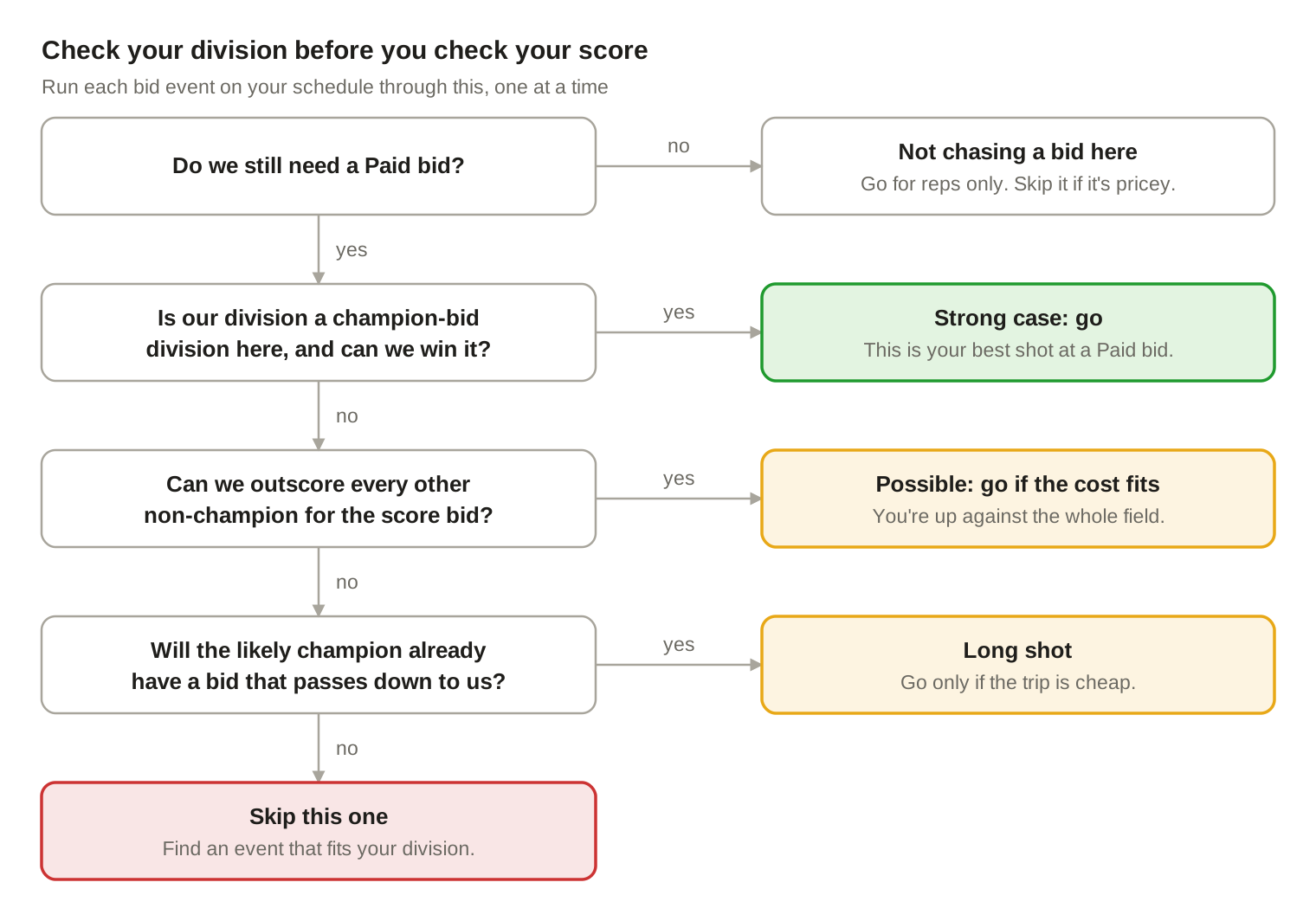
A decision tree for every bid event on your schedule

Take each bid event you’re considering and walk it through this. Start at the top and answer honestly. If you have to squint to get a “yes,” call it a “no.”

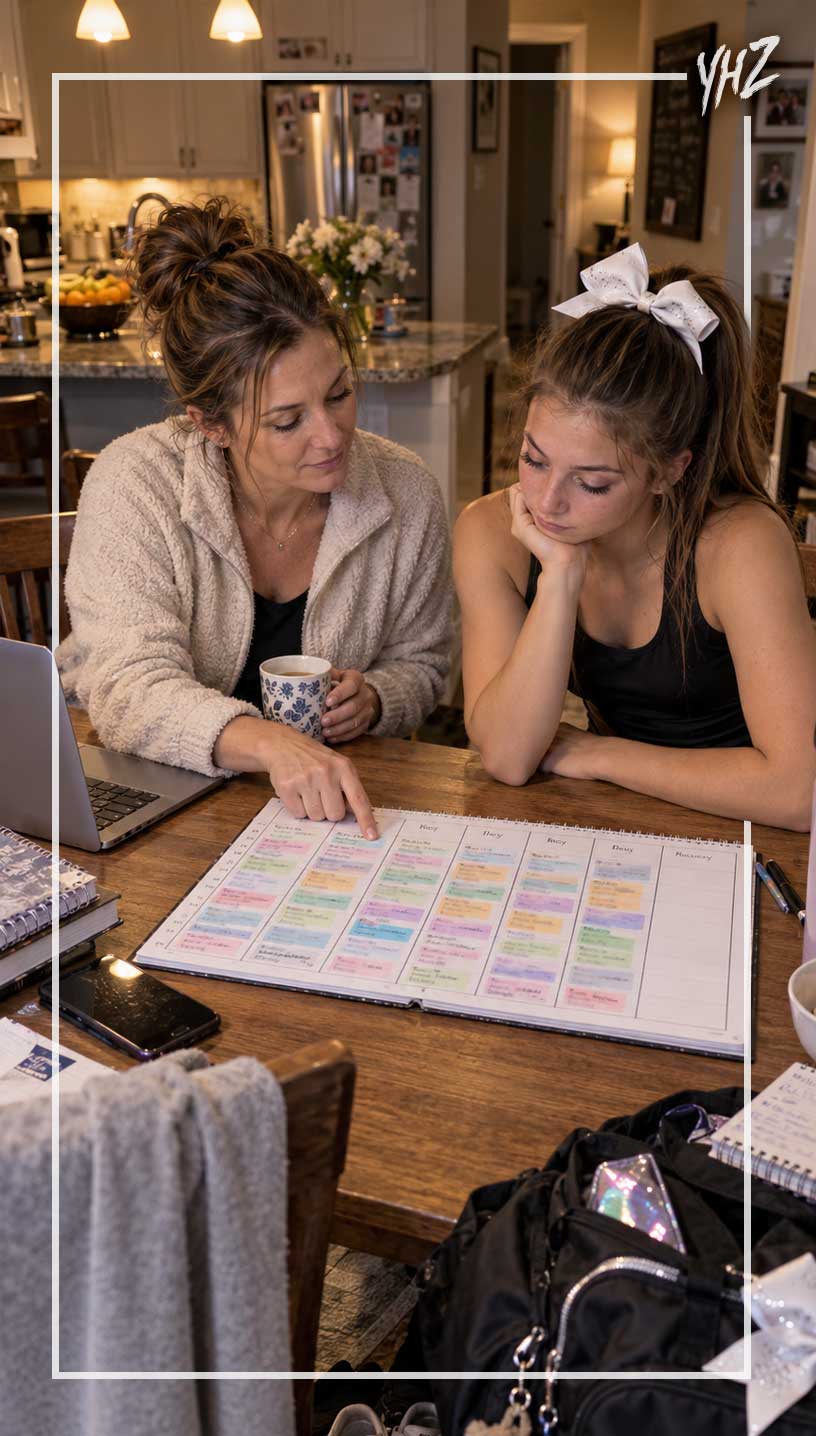
bid decision tree

The order matters. Winning your division comes before your score, because at a lot of events that’s where most of the Paid bids are now. Only if that path is closed should you start counting on the score-based bid or a pass-down.

A quick tip for using it with a full season: run every event through the tree, then line them up by outcome. If you’ve got two “strong case” events and three “long shots,” you probably know which ones to cut. If everything comes out as a long shot, that’s a sign to rethink the bid goal for this team, not to book more travel.

Questions to answer before you commit thousands to a travel event

Print these out. Answer them with your staff before you announce the schedule to parents. If you can’t answer one, that’s your homework.

Varsity Worlds bids

About the event

How many Paid bids does this event offer for the 2026-27 season?

  1. How many of those are reserved for division champions, and which divisions?
  2. Does this event use the general declaration or its own (like NCA, CHEERSPORT, JAMfest or One Up)?
  3. What happens to a champion bid if that champion already has a Paid bid?

About your division

  1. Is my team’s division one of the champion-bid divisions at this event?
  2. Who attended this event in my division last year, and who won?
  3. Have we beaten the likely division winner at any point this season

About your team

  1. Are we realistically a division champion here, or are we chasing the score-based bid?
  2. If it’s the score-based bid, how many other non-champion teams could outscore us?
  3. Do we already have a bid? If so, why are we going?

About your families

  1. What’s the rough cost per athlete for this trip, all in?
  2. If we don’t get a Paid bid, will parents feel the trip was still worth it?

The bottom line

Your score still matters. It always will. But this season, where you finish in your division might matter more than where you finish in the building.

The coaches who do well under this system won’t be the ones who just pick the biggest events. They’ll be the ones who know exactly who’s in their division and build a schedule around the bids they can realistically win.

So before you lock in that February trip, sit down with the declaration and run your team through the tree above. It takes about half an hour. It might save your families a lot more than that 😊

Steve Pawlyk Signature Full

IPP's Premade Mixes are USA Cheer Compliant and customizable!  Add Sound FX, swap songs, & more!  Add your Team Name to the mix for only $10! 

SLAM artwork
Full_Out_130 mp3 image
1 minute cheer mix
WAKE UP THE FIRE
SLAM artwork
WAKE UP THE FIRE
Full_Out_130 mp3 image
1 minute cheer mix

All-Star and School Cheer: How Coaches Can Manage Two-Team Workloads

all star and school cheer

By Steve Pawlyk

Published September 8, 2026

Many athletes participate in all-star and school cheer during the same season. Each coach may see a reasonable schedule, while the athlete experiences something very different. School practices, games, tumbling classes, all-star practices, and weekend travel can fill every day. Homework and sleep must fit around whatever time remains.

Doing both programs can work for some athletes. It can also create an exhausting schedule that neither coach fully understands. The problem starts when each program acts like the other one does not exist. An athlete only has one body, regardless of how many uniforms hang in the closet.

Coaches do not need to fight over ownership of an athlete. They need to see the complete workload and make informed decisions. That requires honest schedules, protected recovery, and clear attendance rules before the season begins.

all star cheer and high school cheer

Two Cheer Teams Create One Combined Workload

School and all-star cheer may have different goals, but they use many of the same physical skills. Both programs can include tumbling, jumps, stunts, baskets, pyramids, conditioning, and full-out routines. The athlete does not recover separately for each team. Every repetition contributes to the same weekly load.

A school coach may schedule two practices, a football game, and a Saturday competition. The all-star coach may add three practices, a tumbling class, and a Sunday event. Neither schedule looks extreme when viewed alone. Together, they can leave the athlete without a full recovery day.

This situation differs from seasonal participation in two distinct sports. All-star and school cheer repeat many of the same movements and impact patterns. The athlete may perform running tumbling for both teams within several hours. They may also base, backspot, or fly through dozens of added stunt repetitions.

The American Medical Society for Sports Medicine warns against simultaneous participation on multiple teams in the same sport. Its guidance links overscheduling with overtraining, injury, illness, sleep problems, stress, and burnout.

USA Cheer also recognizes the schedule problem. Its youth and junior national team guidance discourages athletes from joining multiple cheer teams during national team preparation. USA Cheer cites the number of required practices as the reason.

That does not mean every athlete must choose one team. It means coaches should stop treating dual participation as a harmless scheduling detail.

Coaches Usually See Only Half the Problem

A coach knows when an athlete attends that coach’s practice. They may not know what happened during the previous six hours. The athlete could arrive from another practice after completing full-outs, tumbling passes, or repeated elite stunts.

Young athletes often describe every practice as “fine.” They may worry that honest fatigue will cost them a position. Some athletes also believe that constant soreness proves commitment. That silence prevents both coaches from adjusting the workload.

Parents may know the schedule but lack the technical context. Two hours of choreography does not place the same demand on an athlete as two hours of full-outs. A game may include long breaks, while a stunt clinic may produce hundreds of high-effort contacts. Total hours matter, but the contents of those hours matter too.

Every dual-team athlete needs one complete weekly schedule. That schedule should include both teams, games, competitions, tumbling classes, private lessons, open gyms, strength work, and required school events. Travel time also affects recovery, even when it does not count as training.

Build a Weekly Cheer Workload Sheet

You do not need expensive tracking software. A shared spreadsheet or weekly form can expose the problem quickly. The athlete or parent can update it each Sunday. Both coaches can review it before planning the week.

Track these details:

Workload Item

What to Record

School cheer practices

Date, duration, and planned sections

All-star practices

Date, duration, and planned sections

Games and performances

Call time, performance time, and physical demands

Competitions

Warmups, performance rounds, travel, and return time

Tumbling classes

Duration and approximate number of passes

Stunt classes or privates

Position, skills, and approximate repetitions

Full-outs

Full routine, marked routine, or section full-out

Strength and conditioning

Duration, exercises, and intensity

Pain or unusual soreness

Area, activity that caused it, and whether it changed movement

Sleep

Approximate hours and major disruptions

Academic demands

Tests, projects, and weeks with unusual school pressure

The sheet does not need perfect numbers. Its job is to reveal crowded days, repeated high-impact sessions, and missing recovery. A blank calendar can make six practices look manageable. A detailed calendar may show three straight days of tumbling and full-outs.

Coaches should also mark each session as low, medium, or high demand. A film review may carry low physical demand. Stunt sections and repeated tumbling may carry medium or high demand. Full-outs, competitions, and intense double sessions usually belong in the high-demand category.

Do not use these labels to compete with the other coach. Use them to decide when an athlete needs reduced repetitions, modified conditioning, or a different practice assignment.

Need Competition Music Blue 1

Count Repetitions, Not Only Practice Hours

Two practices of equal length can place very different demands on an athlete. One practice may focus on motions, counts, and transitions. The other may include repeated baskets, standing tumbling, and full-outs. Counting both as “two hours” hides the difference.

Track the skills that create the greatest load for each athlete. Flyers may need extra attention after repeated baskets, inversions, and body positions. Bases and backspots may need adjustments after heavy stunt sessions. Tumblers may need reduced passes after clinics, private lessons, or competitions.

You do not need an exact count for every motion. Approximate counts can still reveal patterns. “About 30 running passes” provides more useful information than “one tumbling class.” “Five full-outs” tells the other coach what happened before the athlete entered the next practice.

Ask athletes to report added training outside both programs. Open gym, backyard tumbling, and private lessons still create physical load. Optional training does not become invisible because neither head coach assigned it.

two cheer teams

Protect Real Recovery Days

Medical groups differ slightly on the number of recommended rest days. They agree that young athletes need regular recovery.

The American Academy of Pediatrics recommends at least one or two days off each week from competition and sport-specific training. It also recommends two or three months away from one sport each year. The AAP connects insufficient recovery with overuse injuries, overtraining, lower performance, and burnout.

AMSSM advises young athletes to keep organized sports to five or six days each week. The organization also recommends at least one full day away from sports. NATA takes a stronger position and recommends two days away from organized training and competition.

At minimum, protect one complete rest day every week. Aim for two when the competition calendar permits it. A “rest day” cannot include tumbling privates, open gym, conditioning, or another team’s practice. Walking through choreography may also defeat the purpose when the athlete never gets a mental break.

Recovery cannot depend on whichever program gives in first. Coaches and families should identify the protected day before the season. When an event takes that day, move the recovery day somewhere else. Do not simply erase it.

Use Age-Based Hours as a Warning Light

NATA recommends that young athletes avoid more weekly organized sport hours than their age in years. Under that guidance, a 13-year-old should avoid more than 13 organized hours each week. The recommendation includes practices, competitions, classes, and other organized training.

This age-based measure cannot account for every athlete or practice. A low-impact instructional session does not equal two hours of full-outs. Still, the measure gives families and coaches a useful warning light. A 12-year-old logging 18 organized hours needs closer review.

Do not wait until the athlete crosses a number before paying attention. Rapid schedule increases can create problems even when total hours appear acceptable. The AAP recommends gradual increases in weekly training time and repetitions. Two programs can accidentally create a sudden increase because neither coach sees the combined change.

Need Competition Music Blue 1
cheerleading workload

Decide Which Coach Adjusts the Load

Both programs cannot demand maximum effort every day. Someone must adjust when high-demand sessions overlap. That does not require one program to surrender authority to the other.

Start with the complete schedule. Identify games, competitions, choreography, camps, and required practices. Then mark dates when both programs plan high-demand work. Address those dates before the athlete reaches them.

The adjustment may involve fewer tumbling passes, marked sections, limited stunt repetitions, or removal from conditioning. Coaches can also assign film review, counts, motions, or leadership work. The athlete can still contribute without repeating every high-impact skill.

Do not make the athlete negotiate two coaches during practice. The adults should settle foreseeable conflicts before the session. A teenager should not have to choose which coach to disappoint while both wait for an answer.

When direct coach communication fits program policy, get written permission from the parent or guardian. Keep the exchange factual and limited to scheduling, workload, injuries, and attendance. Do not discuss routine strategy, athlete rankings, or another program’s private information.

Set Attendance Priorities Before the Season

Schedule conflicts will happen. Football games, pep rallies, choreography, all-star competitions, and school events do not coordinate themselves. Waiting for the first conflict guarantees anger and rushed decisions.

Both programs should publish their non-negotiable dates before athletes commit. Families should compare the calendars and identify every known conflict. Coaches should then approve the plan in writing. An athlete should not learn in October that both programs claim the same weekend.

A program can reasonably refuse dual-team participation when the schedule cannot work. Coaches also have the right to set attendance standards. They should state those standards before accepting the athlete. A clear “no” before the season causes less damage than a forced choice during competition week.

Do not punish an athlete for following a preapproved conflict plan. Extra conditioning adds physical load to a schedule that already caused concern. It also turns communication into punishment. Handle repeated unapproved absences through your normal attendance policy.

The athlete should know which event takes priority when both programs compete. School rules, contracts, and governing policies may decide the answer. When no rule applies, the coaches and family must agree before the season. “We will figure it out later” is not a plan.

Watch for Changes in the Athlete

Coaches should not diagnose overtraining or medical conditions. They should notice changes and involve qualified healthcare professionals when needed.

The AAP lists fatigue, mood changes, sleep problems, poor academic performance, and declining athletic performance among possible warning signs. Persistent muscle or joint complaints also deserve attention. AAP guidance explains that excessive training without enough recovery can affect physical and psychological health.

Watch for these changes:

  • Skills that suddenly lose consistency
  • Unusual fear during previously comfortable skills
  • Repeated complaints of heavy or tired legs
  • Pain that changes technique or movement
  • Irritability or emotional withdrawal
  • Trouble staying focused during practice
  • Falling asleep during travel or team meetings
  • Declining school performance
  • Frequent minor illnesses
  • Loss of interest in either team
  • Anxiety about disappointing coaches
  • Soreness that never appears to improve

One rough practice does not prove that an athlete has exceeded their limits. A repeated pattern deserves action. Speak privately with the athlete and parent. Ask about the complete schedule, sleep, pain, school pressure, and recent changes.

Remove the athlete from activity when you suspect a concussion or serious injury. Follow your organization’s emergency and return-to-play rules. A workload spreadsheet cannot replace an athletic trainer, physician, or other qualified professional.

Sleep and School Still Count

An athlete can follow every practice plan and still lack enough recovery. Travel, homework, early school hours, and family responsibilities affect the same body. Weekend competition travel can remove sleep before Monday’s practice. Late games can create the same problem during the school week.

Do not treat academic decline as an unrelated issue. The AAP lists poor academic performance among the possible signs of excessive training or inadequate recovery. AMSSM also warns that overscheduling can damage academic and athletic performance. School success belongs in the workload discussion.

Ask families about major exams, school projects, and travel weeks. A short practice adjustment during finals may protect both performance and attendance. Coaches often gain more from a rested athlete on Friday than an exhausted athlete who survived every practice.

Stop Rewarding Athletes for Hiding Fatigue

Cheer culture often praises athletes who push through everything. That attitude can make honest communication feel weak. Athletes may hide pain or exhaustion because they fear losing their spot. Coaches create that fear when every modification carries a punishment.

cheer practice schedule

Tell athletes that reporting workload will not automatically remove them from the routine. Explain how you use the information. You may adjust repetitions, change conditioning, or ask a healthcare professional for guidance. Silence creates more risk than an honest report.

Do not praise an athlete for completing two full practices while injured or exhausted. Effort matters, but judgment matters too. Coaches should model the difference between normal training discomfort and symptoms that need attention.

Your team culture should reward athletes who communicate early. Early reports give you more options. Late reports often arrive after the athlete loses skills, misses school, or needs a longer break.


Give Dual-Team Athletes a Written Plan

A short dual-team participation agreement can prevent many conflicts. This document does not need legal language. It should record what the athlete, family, and coaches already discussed. Everyone should receive the same copy.

Include these items:

  • Names and contact information for both programs
  • Complete practice and competition calendars
  • Known date conflicts
  • Attendance priorities
  • Protected weekly recovery day
  • Private lessons and outside training
  • Process for reporting pain or unusual fatigue
  • Process for schedule changes
  • Rules for injury information
  • Conditions that may require reduced participation
  • Person responsible for updating the master schedule
  • Review dates during the season

Review the plan after choreography, during competition season, and before major travel. A schedule that worked in September may fail in February. Added practices and bid events can change the load quickly. The plan should change when the season changes.

Parents Must Manage the Master Calendar

Coaches control their own practices, but parents usually see the athlete’s complete life. They should maintain the master calendar and disclose schedule changes. They should also include private lessons, school demands, and optional training. Leaving out “extra” sessions defeats the process.

Parents should not use the second team to pressure either coach. “The other coach allows it” does not settle a safety or attendance question. Each program can set its own standards. The family must decide whether those standards can coexist.

Parents also need to protect sleep and recovery. An open day does not always need another class. More training can produce worse results when the athlete never absorbs the work. Improvement happens after the body gets time to recover.

cheer burnout

When Doing Both No Longer Works

Some athletes can handle school and all-star cheer with good planning. Others cannot maintain both schedules safely or successfully. Age, skill level, travel, schoolwork, sleep, injuries, and program demands all affect that decision.

Do not frame leaving one team as failure. The athlete may need to protect their health, grades, or long-term development. Reducing commitments can help the athlete perform better for the remaining program. It can also help them enjoy cheer again.

Set specific reasons to review dual participation:

  • The athlete cannot keep a weekly recovery day
  • The schedule repeatedly violates attendance rules
  • Pain or fatigue keeps returning
  • School performance declines
  • Sleep remains inadequate
  • Skills continue to regress
  • The athlete loses interest or shows persistent distress
  • Coaches cannot coordinate necessary adjustments
  • Competition conflicts have no workable solution

When these problems continue, the family may need to choose one program. Make that decision before an emergency or major competition. Coaches can provide honest information, but the family should make the final participation choice. Healthcare professionals should guide decisions involving injury or illness.

Frequently Asked Questions About All-Star and School Cheer

Can You Do All-Star and School Cheer at the Same Time?

Yes, some athletes successfully participate in both programs. The schedules must allow adequate recovery, schoolwork, sleep, and required attendance. Families should compare both calendars before committing. Coaches also need to consider the athlete’s combined physical workload.

How Many Days Per Week Should a Young Cheerleader Practice?

AAP and AMSSM guidance supports at least one full rest day each week. NATA recommends two days away from organized training and competition. The athlete’s age, health, schedule, and practice demands may require more recovery. A tumbling class or open gym does not count as rest.

What Should Coaches Count as Cheer Workload?

Count practices, games, competitions, tumbling classes, stunt privates, conditioning, open gyms, and full-outs. Also record high-impact repetitions and travel that reduces sleep. Total hours provide only part of the answer. Coaches need to know what the athlete did during those hours.

Which Team Should Take Priority?

School rules, program contracts, and published attendance policies may decide priority. When they do not, both coaches and the family should agree before the season. The athlete should not make the choice during a conflict. Programs should publish non-negotiable dates before accepting dual-team athletes.

What Are Possible Signs of Too Much Training?

Possible signs include persistent fatigue, sleep changes, mood changes, recurring pain, declining performance, and academic problems. These signs do not prove a specific condition. Coaches should speak with the family and refer medical concerns to qualified professionals. Suspected concussions and serious injuries require immediate action.


The Athlete Has One Body

School cheer and all-star cheer can both give an athlete valuable experiences. That does not make every combined schedule reasonable. Each coach must consider what happens outside their own gym. Ignoring the other program does not make its workload disappear.

Build one calendar, track demanding repetitions, protect recovery, and settle conflicts before the season. Listen when the athlete reports fatigue or pain. Adjust the plan when the workload grows. If two programs cannot share the athlete responsibly, the athlete should not carry the cost.

Steve Pawlyk Signature Full

IPP's Premade Mixes are USA Cheer Compliant and customizable!  Add Sound FX, swap songs, & more!  Add your Team Name to the mix for only $10! 

SLAM artwork
Full_Out_130 mp3 image
1 minute cheer mix
WAKE UP THE FIRE
SLAM artwork
WAKE UP THE FIRE
Full_Out_130 mp3 image
1 minute cheer mix

Cheer camp is over: Your 30-day camp-to-season plan

Cheer camp is over 30 day camp to season plan

By Steve Pawlyk

Published August 4, 2026

Cheer camp can make a team feel like it improved an entire season in four days.

Athletes learn new stunts. Captains come home motivated. Coaches have videos, notes, cheers, dances, warmups and corrections they swear they will remember. Everyone is tired, sore and excited about what the team could become.

Then regular practice starts.

Two weeks later, half the new material has disappeared. The stunt that hit at camp will not hit in your gym. Athletes remember different versions of the same motion sequence. Coaches move on to the next deadline before deciding which camp lessons belong in the season plan.

That is why every program needs a cheer camp follow-up plan.

Many teams are returning from camp right now. Recent NCA cheer camps included sessions at Shippensburg University from July 27 through August 3, the Gaylord Texan from July 30 through August 2 and the Renaissance Esmeralda from August 3 through August 6. UCA also held a University of Texas camp from July 23 through July 26.

The timing matters. What coaches do during the first month after camp will decide whether those four days become part of the team’s season or simply become a collection of videos on everyone’s phone.

Soooo…here’s a practical 30-day plan for turning camp progress into cleaner practices, safer skills and material your athletes can still perform when the season picks up

Why cheer camp material disappears so quickly

Camp is a controlled environment.

Your team has long practice blocks, instructors standing nearby and very few outside responsibilities. Athletes are surrounded by other teams working hard. They get immediate corrections and more repetitions than they normally would during a school-week practice.

That environment helps athletes learn quickly. It can also give coaches a misleading picture of what the team owns.

cheer camp follow up plan

A stunt that hits twice with an instructor nearby is not automatically ready for a football game. A dance athletes performed after learning it that morning may look completely different a week later. A team can leave camp understanding a correction without having repeated it enough to make it a habit.

NCA overnight camps include both game day and performance training, while other camp formats may concentrate on leadership, skills, non-building material or custom instruction. Home camps can also be adjusted to spend more time on areas such as stunts, pyramids or baskets.

Your follow-up plan should match what your team actually worked on. A squad that spent four days learning game day material needs a different first month than a team that used camp to rebuild stunt technique.

The problem starts when coaches try to keep everything.

You do not need every cheer, dance, transition and stunt variation taught at camp. You need the material that fits your athletes, your schedule and the jobs your team must perform this season.

Before the first practice back, meet with your staff

Do not wait until athletes walk into the gym to decide what happens next. Set aside 45 minutes for the coaching staff. Include assistants, choreographers and any captains who need to understand the plan.

Bring your camp notes, score sheets, instructor feedback and videos. Put everything in one shared folder before the meeting. If four coaches each have different clips on their phones, nobody has a complete record of what happened.

During the meeting, answer these questions:

  1. What improved most during camp?
  2. Which corrections did athletes hear repeatedly?
  3. Which skills only worked with instructor assistance?
  4. Which material fits our actual season?
  5. What caused the team the most trouble?
  6. Did anyone leave camp injured, unusually sore or mentally discouraged?
  7. What do we want to look different 30 days from now?

Be specific.  “The stunts got better” isn’t super helpful…“Our main bases stopped stepping forward during full-ups after the instructor changed their starting position” gives you something you can coach.

“Game day improved” is too broad….“The team’s volume dropped whenever they added signs and poms” tells you what to test at home.

End the meeting with no more than 4 priorities for the month. Your team may have learned 20 things at camp. They can’t treat all 20 as equally urgent.

Need Competition Music Blue 1

Sort every piece of camp material

Create one list of everything the team brought home. Include:

  • Cheers and chants
  • Band dances and timeout material
  • Fight song changes
  • Stunts and stunt variations
  • Pyramid ideas
  • Basket drills
  • Tumbling corrections
  • Jump drills
  • Warmups and conditioning
  • Leadership exercises
  • Team traditions
  • Practice-management ideas

Give each item one of four labels:

Ready now

The team remembers it, can perform it safely and has an immediate use for it.

This might include a sideline cheer, a motion correction or a conditioning drill you want to use every week.

Needs work

The material fits your team, but the athletes do not own it yet.

Most new stunts and dances will probably land here. That is fine. “Needs work” means the material earns practice time. It does not mean you should put it into a performance immediately.

Save for later

The idea may help during basketball season, competition season or a future phase of training, but it does not deserve time right now.

Save the video and notes. Add a date for reviewing it again. Without a review date, “later” usually means “never.”

Cut it

Some camp material will not fit your team.

Maybe the cheer is too long. Maybe the stunt requires a top athlete you do not have. Maybe another team in your conference already uses the same dance. Maybe you simply dislike it.

Cutting material is part of coaching. Camp gave you options. It did not give you an obligation to use every option.

Days 1 through 3: Recover, review and take inventory

Your first practice after camp should not be a test of toughness.

Athletes may be dealing with sore wrists, ankles, backs or shoulders. Some will have bruises they ignored during camp because they wanted to keep participating. Others may be mentally drained after several long days of learning and performing.

Start practice with a physical check-in. Ask athletes to report pain, not just general soreness. Make it clear that honesty will not cost them a position.

The USA Cheer Cheerleading Safety Manual covers performer readiness, medical responsibilities, spotting and skill progression. Those standards still apply when a team returns home excited about new skills. A camp success does not replace your normal readiness and progression requirements.

Use the first practice to see what athletes remember without turning it into a pass-or-fail evaluation.

Ask the team to perform camp material in small sections. Record each attempt. Do not provide several minutes of reminders before the first run. You need to see what remained after the athletes left the camp environment.

You will probably find three kinds of memory:

  • Material the athletes remember accurately
  • Material they remember with small differences
  • Material they barely remember at all
cheer camp practice plan

Do not spend an hour rebuilding a routine nobody retained. Save the video, decide whether the material is worth relearning and keep practice moving.

A sample first practice back

Try this structure for a two-hour practice:

First 15 minutes: Athlete check-in, light movement and mobility

Next 20 minutes: Review cheers, dances and motions without extensive coaching

Next 25 minutes: Revisit stunt grips, body positions and timing on the ground or at a reduced level

Next 10 minutes: Water break and staff discussion

Next 30 minutes: Test the two or three camp skills most likely to become part of the season

Next 15 minutes: Review the correction that helped the team most at camp

Final 5 minutes: Explain the 30-day plan and tell athletes what they should review before the next practice

The goal is to collect information. You are not trying to recreate the final night of camp.

Days 4 through 7: Test camp skills in your own environment

Camp conditions are different from home.

The floor may feel different. Ceiling height may change what athletes are comfortable throwing. Your normal practice could be shorter. An instructor who helped identify a timing problem is no longer standing beside the group.

This week, find out which improvements survive those changes.

Start new stunts below their highest camp level. Check grips, feet, timing and athlete confidence before adding difficulty. If the group learned a full-up to extension, begin with the entry at prep level. If they learned a new pyramid connection, test each piece separately.

You are looking for repeatability.

A stunt that hits once and falls four times is not ready. A stunt that requires a different save on every attempt is not ready. A skill that only works when the strongest coach spots one side is not ready.

That does not mean the stunt was a bad choice. It means you have found its current place in the progression.

Track the following for each stunt group:

  • Number of attempts
  • Number of clean hits
  • Where the skill breaks down
  • Whether the same mistake repeats
  • How much coaching or spotting is required
  • Whether athletes can explain the correction themselves

The last point matters. Athletes who understand why a correction works are more likely to reproduce it when the coach moves to another group.

Keep the language athletes heard at camp

Ask athletes what words the instructor used when the skill improved.

Maybe the instructor said “wait for the dip,” “hips under,” “finish through the top” or something else that clicked with the group. Write that language down and use it consistently.

Coaches sometimes replace a successful correction with their own preferred wording. That can create unnecessary confusion. If the camp cue worked and it is technically sound, keep it.

Week 2: Decide what stays in the season plan

By the second week, the excitement has settled enough for you to make better decisions.

Review your videos from camp and your first week at home. Move each item into one of these categories:

  • Use immediately
  • Continue developing
  • Revisit on a specific date
  • Remove from the plan

Be honest about your practice time.

If you have two 90-minute practices each week, you cannot maintain the same amount of material as a team practicing four days a week. Keeping too much creates rushed practices and half-clean performances.

Choose material based on where your team will use it.

For sideline and game day material

Ask:

  • Can athletes perform it while watching the game?
  • Is the wording easy for the crowd to follow?
  • Does it work with your signs, poms or megaphones?
  • Can the team maintain volume while moving?
  • Is it different enough from your existing material to earn a place?
  • Does it fit the moments your team regularly encounters?

A cheer can look great in a quiet camp setting and fall apart beside a loud student section. Practice it with noise. Have someone call out game situations. Make athletes find their spacing quickly instead of walking into perfect lines.

For competition material

Ask:

  • Does the skill fit your division and routine needs?
  • Can the team perform it when tired?
  • Does it connect cleanly to the skills before and after it?
  • Will the skill score well enough to justify its risk and practice time?
  • Do you have backup athletes who understand the positions?
  • Can the group hit it without constant coach intervention?

Do not place a camp stunt into choreography simply because athletes love it.

Athletes usually love the newest and hardest option. Your job is to decide whether it makes the routine better.

For practice drills

Keep drills that solve a problem you see regularly.

A drill may have helped one stunt group at camp but be unnecessary for the rest of the team. Another drill may be useful enough to become part of every warmup.

Assign each drill a purpose. Athletes should know whether it is improving timing, strength, body position, technique or confidence. Randomly repeating camp drills will make practice feel busy without making it productive.

cheer camp follow up plan

Week 2 is also the time to reset expectations

Camp can temporarily change team dynamics.

An athlete may have won an individual award and returned with more confidence. Another athlete may have struggled in front of instructors and returned questioning her role. Captains may expect the team to maintain camp-level intensity at every practice.

Talk about it.

Explain what camp results mean and what they do not mean.

An award recognizes what an athlete showed during camp. It does not settle every lineup decision for the season. Struggling with one skill does not erase an athlete’s value. A great final-day performance does not mean the team can stop drilling fundamentals.

Give athletes clear jobs for the next two weeks.

One athlete may need to review material before practice. Another may need to improve her conditioning. A stunt group may need ten focused repetitions of the same entry at every practice.

Athletes handle corrections better when they know what success looks like.

Week 3: Connect camp lessons to regular practice

By the third week, camp should stop feeling like a separate event.

The useful parts should now appear in your normal practice structure.

If the team learned a better jump warmup, put it into the warmup. If athletes improved their motion placement, hold that standard during every cheer. If a stunt correction worked, use it across groups instead of treating it as a one-time camp note.

This is where coaches often lose progress. They review camp material for two weeks, then return to the same practice habits they used before camp.

Choose one camp lesson for each part of practice:

  • Warmup
  • Motions and jumps
  • Stunts
  • Tumbling
  • Game day material
  • Conditioning
  • Team communication

You do not need a new lesson in every category. Use only what made a measurable difference.

Give athletes ownership without handing over practice

Captains and experienced athletes can help maintain camp material, but their role needs boundaries.

Assign one athlete to call a cheer review. Ask another to check whether a stunt group is using the agreed starting position. Have captains maintain the shared video folder.

Do not ask athletes to correct advanced technique they are not qualified to coach. Athlete leadership works best when the assignment is specific.

“Help everyone remember camp” is vague.

“Run the first five minutes of the sideline review using the videos in our folder” is clear.

Week 3 pressure test

Once material looks comfortable, change the conditions.

You are checking whether the team can perform the material while handling the distractions that come with the season.

Clean skills should survive small changes.

For game day material:

  • Add crowd noise
  • Use poms and signs
  • Put athletes in their actual sideline spacing
  • Call cheers from unexpected situations
  • Require athletes to react without a long setup
  • Run material after jumps or conditioning

For stunt material:

  • Run the skill after a normal practice block
  • Change which side of the floor the group uses
  • Add the transition before the stunt
  • Require the group to reset within a time limit
  • Test backup athletes at safe progression levels
  • Record from the front and side

Week 4: Record a new baseline

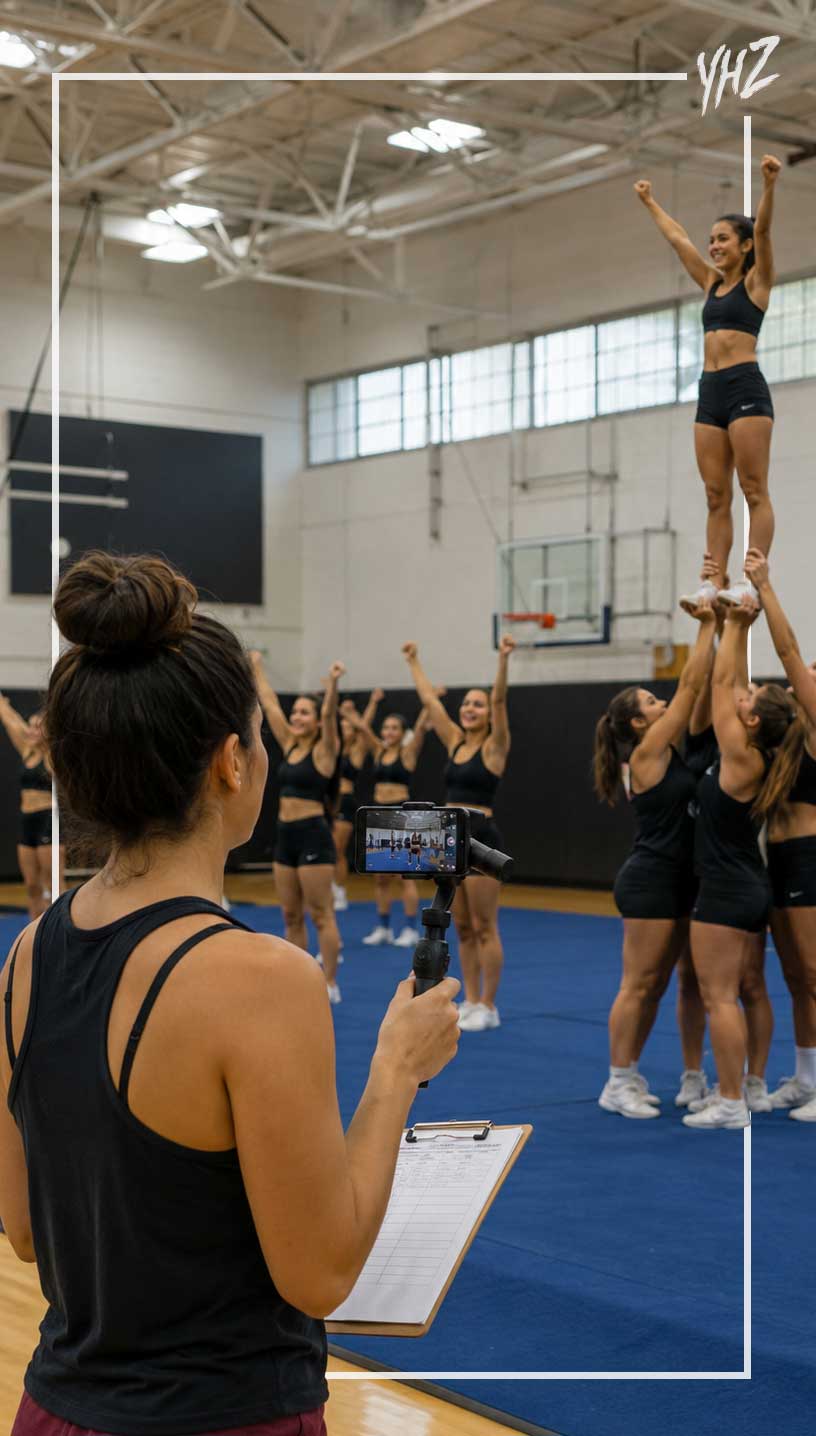
At the end of 30 days, film the same material you recorded during your first practice back. Use the same angle whenever possible. Do not choose only the best attempt. Record enough repetitions to show the team’s normal level.

Compare the videos with your staff & look for specific changes:

  • Are motions arriving together?
  • Has stunt timing become more consistent?
  • Are athletes using the corrections without reminders?
  • Can the team perform while tired?
  • Is game day material loud and easy to follow?
  • Did any pain or fear appear as repetitions increased?
  • Has the material earned a permanent place in practice?

Share selected comparisons with athletes. Showing the team that its work produced visible improvement can be more effective than another speech about effort.

You should also identify what did not improve. Maybe the stunt is still inconsistent. Maybe the dance takes too much practice time. Maybe the cheer is difficult for the crowd to understand. Removing something after 30 days is not failure. It is a coaching decision based on evidence.

What to do when a camp stunt stops working

This happens every year: The stunt hit at camp. The group felt confident. Everyone came home expecting to use it. Now it will not stay in the air.

Start by comparing the camp video with your current attempts.

Check:

  • Starting positions
  • Grip placement
  • Dip speed
  • Footwork
  • Flyer timing
  • Base spacing
  • Where athletes are looking
  • Whether the group pauses between counts
  • Which person begins correcting the stunt after a miss

Do not let the group redesign the skill after every attempt. Pick one correction, reduce the difficulty and repeat the corrected version. If the group cannot perform the lower progression consistently, stay there. Athletes may see that as moving backward. It is usually the fastest way forward.

Also consider whether the camp environment hid a personnel problem. An instructor may have provided a spot that changed the group’s confidence or timing. Another athlete may have filled a position for part of the session. The group may have attempted the stunt while fresher than it is during regular practice.

None of that makes the camp success fake. It tells you what support the group still needs.

cheer coaches practice planning

What to do with all those camp videos

Create one shared folder for the team. Do not rely on social media posts or group-message history. Those are difficult to search, and important clips will disappear beneath hundreds of unrelated messages.

Organize the folder by subject:

  • Cheers
  • Dances
  • Stunts
  • Pyramids
  • Tumbling
  • Jumps
  • Instructor corrections
  • Team performances
  • Leadership notes

Name files clearly. “IMG_4837” tells you nothing. “Varsity full-up correction, left group, day two” is much easier to find in October.

Keep a second folder for coaches only. Use it for lineup discussions, injury information, athlete evaluations and anything else that should not be shared with the full team. Choose a few team videos for at-home review. Do not send athletes 40 clips and expect them to know which ones matter.

A simple camp follow-up assignment for athletes

Give each athlete a short reflection during the first week back.

Ask them to answer:

  1. What correction helped you most?
  2. What skill do you understand better now?
  3. What material do you need to review?
  4. Where did you struggle?
  5. What is one job you can take responsibility for this month?
  6. Is there any pain, fear or confusion the coaching staff should know about?

This gives quieter athletes a chance to communicate without speaking in front of the team. Read the answers. If athletes take the time to be honest and nothing changes, they will stop giving you useful information.

The biggest mistakes coaches make after cheer camp

Trying to keep every piece of material

Camp gives you a menu. Choose what your team needs.

Throwing new skills into performances too soon

A stunt that worked at camp still needs to pass your normal safety and consistency standards.

Forgetting the exact corrections that worked

Write down the instructor’s language while it is fresh.

Running a punishing first practice back

Tired and sore athletes do not need to prove their commitment by taking unnecessary repetitions.

Treating camp awards as permanent rankings

Use awards as recognition, not as the entire basis for lineup decisions.

Returning to the old practice routine

If camp taught your team a better way to warm up, communicate or correct skills, put it into the weekly plan.

Waiting too long to review material

The longer you wait, the more time you will spend reteaching.

30 day checklist cheer camp download

Your 30-day cheer camp follow-up checklist

Before practice resumes

  • Collect coach and athlete videos
  • Save instructor feedback
  • Hold a staff debrief
  • Identify injured or unusually sore athletes
  • Choose the month’s top priorities
  • Sort material into ready, needs work, later or cut

During the first week

  • Test what athletes remember
  • Rebuild stunts through safe progressions
  • Keep the camp cues that worked
  • Record the first attempts
  • Choose which material deserves practice time
  • Explain the follow-up plan to athletes

During the second week

  • Make final keep-or-cut decisions
  • Assign athlete review responsibilities
  • Connect material to actual game or competition needs
  • Set measurable standards for each skill
  • Speak privately with athletes whose confidence changed at camp

During the third week

  • Add useful camp lessons to regular practice
  • Test material under realistic conditions
  • Practice transitions and equipment
  • Check whether athletes can self-correct
  • Introduce backup personnel where appropriate

At the end of 30 days

  • Record a new baseline
  • Compare it with the first week
  • Review pain, fear and readiness
  • Remove material that has not earned its place
  • Set the next month’s priorities
  • Tell athletes what improved and what comes next

Cheer camp should change something

Camp does not need to transform your entire program.

It should change something specific.

Maybe your stunt groups now understand timing. Maybe your sideline material is cleaner. Maybe captains communicate better. Maybe your staff finally found language that helps athletes understand a correction.

The coach’s job is to notice what worked, build it into practice and let go of the rest.

Thirty days from now, your team probably will not remember every cheer it learned at camp. That is normal. The goal is for your athletes to retain the lessons that make them safer, cleaner and easier to coach throughout the season.

That is how cheer camp becomes more than four exhausting days in the summer. ☺️

Steve Pawlyk Signature Full

IPP's Premade Mixes are USA Cheer Compliant and customizable!  Add Sound FX, swap songs, & more!  Add your Team Name to the mix for only $10! 

SLAM artwork
Full_Out_130 mp3 image
1 minute cheer mix
WAKE UP THE FIRE
SLAM artwork
WAKE UP THE FIRE
Full_Out_130 mp3 image
1 minute cheer mix

Frequently asked questions about cheer camp follow-up

How soon should a team practice after cheer camp?

The answer depends on travel, athlete soreness and your normal schedule. Avoid returning immediately to full-intensity repetitions when athletes are unusually tired or experiencing pain. Your first practice should include a physical check-in and a controlled review of what the team learned.

Should we use every cheer and dance learned at camp?

No. Keep material that fits your team’s game day responsibilities, identity and available practice time. Save other material for later or remove it from the plan.

When is a stunt learned at camp ready to perform?

A stunt is ready when athletes can perform it safely and repeatedly under normal practice conditions without unusual assistance. Coaches should also test the entry, exit, transitions and athlete readiness before using it in public.

How can athletes remember cheer camp material?

Record clear videos, organize them in a shared folder and assign small review sections before practice. Review the material within the first few days instead of waiting several weeks.

What should coaches discuss after cheer camp?

Coaches should review athlete health, repeated corrections, skill readiness, material retention, season needs and which camp lessons should become part of regular practice.

Roadmap to Success: Major Cheerleading Competitions 2025–2026

Roadmap to Success Major Cheerleading Competitions 2025–2026

By Steve Pawlyk

Published May 9, 2025

Between May 2025 and May 2026, cheerleading teams around the world are gearing up for some of the sport’s most prestigious competitions. In the United States, events like NCA & NDA College Nationals, The Cheerleading Worlds, and the Allstar World Championship draw elite talent. Across the Atlantic, the UK’s Future Cheer Internationals dominates the scene, while Australia’s AASCF Nationals, Japan’s All Japan Cheerleading & Dance Championship, South Korea’s national championship, and Mexico’s ONP National Grand Championship showcase top-tier teams in their regions.

Below we break down each major competition—including dates and unique characteristics—and provide detailed 6–9 month training roadmaps for two scenarios: (1) teams starting from scratch and (2) returning advanced teams. These roadmaps include timelines for skills training, choreography, conditioning, recovery, and crucial administrative deadlines (registration, music licensing, uniforms, bid qualifications). For convenience, each roadmap is accompanied by a downloadable .ics calendar file.

NCA & NDA College Nationals 2026 (USA) - NEW

Date & Venue: April 5–10, 2026 in Daytona Beach, Florida. This is the pinnacle of college cheer and dance, famous for its beachfront Bandshell finals. Teams qualify via summer camps or video bids, then spend months preparing to “go to Daytona.” A hallmark of NCA College Nationals is the required crowd-leading cheer section in routines and the electrifying atmosphere of performing on the outdoor stage. Top teams need difficult stunts and pyramids, sharp crowd appeal, and endurance to hit solid routines on both prelims and finals days. (As NCA says, it’s a journey “from NCA College Camp to NCA Nationals,” all for that moment on the Bandshell.

Roadmap for New Teams (Starting from Scratch)

For a new college team aiming for Daytona, the focus is on building fundamental skills and securing a Nationals bid early:

  • Summer (May–Aug 2025): Hold tryouts in late spring and immediately begin off-season conditioning. Attend an NCA Summer Camp in July–Aug 2025 to learn game day material and earn a Nationals bid (camp attendees can receive an automatic bid)varsity.com. Start basic stunt group training and coed stunt basics; emphasize tumbling drills and motions technique.

  • Fall 2025: With the bid secured, kick off regular team practices by August. Spend September on stunting technique and pyramids, gradually increasing difficulty as skills solidify. In October, begin choreographing the competition routine’s outline – including the crowd cheer segment (signs, chants, megaphones) and the music section. By November, finalize music selection and ensure it’s properly licensed. (If the team didn’t attend camp, submit a video bid by the November deadline to qualify for NCA Nationals.) In late fall, ramp up full-out practice repetitions.

  • Winter 2025–26: Hold a routine choreography camp in early January 2026 to put together the full routine with a professional choreographer. January and February are for cleaning up the routine and improving endurance – aim to be able to run full-outs back-to-back (remember, at NCA College Nationals teams often compete on both BandShell and indoor stage). Register for Nationals by the on-time registration deadline (likely February) to avoid late fees. In February, attend a local tune-up competition or showcase to simulate performing under pressure.

  • Spring 2026 (Pre-Nationals): Clean and polish the routine throughout March, focusing on tumbling passes and pyramids hitting consistently with zero deductions. Plan a friends-and-family showcase in late March as a dress rehearsal. Finalize uniform orders by March to ensure they arrive; coordinate logistics (travel to Daytona, hotel, music proof, etc.). Allow a short taper the week before competition to keep athletes fresh. Arrive in Daytona a day or two early to practice on strips of the actual performance surface if possible (outdoor elements like wind and sun can be a factor on the Bandshell).

  • Competition: Compete in prelims and, if you advance, finals between April 5–10, 2026. Aim to “hit zero” (no deductions) in both performances, showcasing strong crowd-leading in the cheer section and stellar technique in the music section. Use any feedback from prelim judges to make minor adjustments for finals. Most importantly – soak in the experience of Daytona Beach and keep the team calm and focused for the high-energy environment.


Download New Team Calendar (.ics): Below is a calendar of key dates and milestones for a new team’s journey to NCA College Nationals 2026 (from tryouts through Nationals). You can import this into your calendar app for a detailed timeline.

NCA & NDA College Nationals 2026 (USA) - ADVANCED

Roadmap for Returning Advanced Teams

Experienced college teams (especially those returning to Daytona or defending titles) can streamline early-season prep and push difficulty further:

  • Early Off-Season (May–July 2025): After the 2025 Nationals, give athletes a short break to recover (mental and physical rest is important). By June, start optional workouts focusing on maintaining conditioning and rehabbing any injuries. Many top teams still attend an NCA College Camp in summer – not only to secure their bid (if not already obtained via video) but also to practice game-day elements and bond as a team. Use camp to identify any skill gaps and set goals (“Go Be Great” initiative and spirit showcases add motivational fire).

  • Fall 2025: With many veterans returning, you can start at a higher difficulty level. In August and September, introduce new elite stunts, pyramids, and tumbling passes that build on last year’s routine – push creativity and difficulty since these teams aim to wow judges. Analyze score sheets from 2025 to address any relative weaknesses (for example, if tumbling difficulty was maxed out, focus on stunt innovation, etc.). By October, have a preliminary routine outline and begin full routine choreography earlier than a novice team would. Using the fall, perform at pep rallies or exhibitor events to get comfortable performing in front of crowds. Ensure music is mix-mastered by winter and fully compliant with licensing rules (Varsity requires use of licensed music providers).

  • Winter 2025–26: Many returning teams aim to have the bulk of their routine ready by the holidays so they can spend January–March cleaning and refining. Schedule full-out routines multiple times per week starting in January 2026. Because NCA scores execution heavily, allocate practice time to perfect stunt timing, toss technique, and pyramids dismount landings. Simulate the Daytona environment in practice – for example, practice outdoors in a breeze for the Bandshell feel, or run from a mock prelim to a finals routine on back-to-back days to build stamina. By February, all sections (including the game-day cheer segment) should be hitting consistently.

  • Pre-Nationals Spring 2026: In March, host a mock competition with impartial judges (maybe alumni or local coaches) to score the routine and provide feedback. Use this feedback to make final adjustments – seasoned teams might increase difficulty in a section if they’ve been consistently hitting zero, knowing the payoff in score could be worth the risk. Finalize all logistics (travel, accommodations at Daytona, practice schedules) well ahead of time. A week or so before Nationals, hold a high-energy send-off performance in front of the school/community to build confidence and excitement. Then taper activity slightly to keep athletes fresh and injury-free.

  • Competition: Arrive at NCA Nationals ready to handle the pressure. Experienced teams know to treat prelims as finals – a strong Day 1 can secure a favorable draw/order for finals. At the event (April 2026), pay attention to NCA’s scoring nuances: e.g., the crowd segment – ensure signs, poms, and motions are sharp and the crowd effect is maximized (NCA judges reward effective crowd-leading). Between prelims and finals, coaches should review routine video for any bobbles to fix. By this stage, an advanced team’s muscle memory and experience take over. The result: a confident, aggressive finals performance in Daytona to contend for a national title.


Download New Team Calendar (.ics): Below is a calendar of key dates and milestones for a new team’s journey to NCA College Nationals 2026 (from tryouts through Nationals). You can import this into your calendar app for a detailed timeline.

The Cheerleading Worlds 2026 (USA) - NEW

Date & Venue: April 24–27, 2026 at ESPN Wide World of Sports, Orlando (Walt Disney World). The Cheerleading Worlds is the premier international all-star championship, where elite Level 6/7 teams from around the globe compete. Over 500 teams from 25+ nations converge for this event, each having earned a bid throughout the season. Routines are all music (no cheer segment) and are scored on difficulty, technique, creativity, and perfection – hitting a zero-deduction routine is crucial in this “pinnacle of the sport’s most prestigious stage”. With prelims, semi-finals, and finals in many divisions, teams often must perform multiple days. Scoring emphasis: Tumbling and stunt difficulty at the absolute maximum of the scoring grid, impeccable execution, and standout choreography (transitions, visual effects) to set teams apart. Small details like uniform design and performance showmanship can even make a difference at this level.

Roadmap for New All-Star Teams

A newly formed all-star Worlds team (perhaps a gym’s first Worlds team) has a steep road: they must build skills and secure a Worlds bid during the season:

  • Spring–Summer 2025 (Formation & Basics): Hold tryouts by May 2025 once the previous season ends. Select athletes who meet the age and level requirements for a Worlds team (typically Level 6 or 7). Start training in June with a focus on basics: establish technique for tosses, standing tumbling (fulls/doubles), and stunt group assignments. Over summer, schedule extra clinics for specialty skills like baskets and tumbling upgrades. Also, choose a competition schedule targeting bid-qualifying events (e.g., USA Cheer or Varsity competitions that offer Worlds bids).

  • Choreography & Routine Building (Late Summer 2025): By July or August, host a choreography camp to create a first draft of the Worlds routine. Since difficulty is paramount at Worlds, incorporate the hardest skills the team can safely execute – but ensure to design routine sections that highlight athletes’ strengths (e.g., if you have strong tumblers, emphasize synchronized tumbling passes). By the end of summer, you should have a routine that hits all score sheet elements (stunts, pyramid, running and standing tumbling, jumps, dance). Obtain music from a licensed producer (the mix often includes voice-overs highlighting team name/theme).

  • Fall 2025 (Routine Reps & Early Comps): Use the fall months to condition the athletes for full 2:30 routines. Initially, break the routine into sections for cleaning. Start doing full-outs by October. It’s wise for a new team to attend an early-season competition (Nov or Dec 2025) to get feedback. Even a local competition can serve as a reality check for stamina and where deductions occur. Adjust choreography if needed – for example, if a stunt is not hitting consistently by December, consider simplifying it to ensure a clean routine by Worlds.

  • Bid Qualification (Winter 2025–26): Worlds bids (Paid, At-Large) are typically up for grabs starting mid-season. Plan to attend at least one major nationals or bid event in Jan/Feb 2026. Many teams target events like CHEERSPORT, NCA All-Star Nationals (late February), or UCA International All-Star Championship in March to secure their bid. If your team is still growing, consider smaller bid events for an At-Large bid. Keep in mind: teams must have a bid to attend Worlds, so this is a critical milestonecheermedia.com. Once a bid is earned, immediately take care of Worlds registration and payment by the stated deadline (usually by late March). Also coordinate travel early – Orlando fills up with cheer teams during Worlds week.

  • Spring 2026 (Pre-Worlds Prep): After securing the bid, intensify focus on execution. March is the time to max out your routine – add that extra tumbling pass or trick if the team can handle it, because difficulty can separate teams at Worlds. Many gyms attend Showcase events or even The U.S. All Star Federation’s Worlds Send-Off in April to practice performing in front of a crowd one last time. Keep athletes healthy: incorporate recovery days, sports therapy sessions, and mindset training (the Worlds stage can be overwhelming for first-timers).

  • Worlds Week (April 2026): Arrive in Orlando a few days early to get acclimated. Practice on spring floors at the venue’s scheduled practice times. Prelims/Semis: Treat every performance like finals – in a huge field, you often must hit multiple clean routines to even make finals. Trust the training and emphasize performing with confidence and energy (judges at Worlds look for difficulty and flawless execution). By April 24–27, 2026, you’ll take the mat at Worldscheermedia.com representing your gym and possibly your country, aiming to hit a routine that impresses both judges and the world streaming online.

The Cheerleading Worlds 2026 (USA) - ADVANCED

Roadmap for Returning Advanced Teams

Top Worlds teams (many of them world champions or medalists) treat the season as a marathon where they fine-tune every detail. For a returning Worlds team:

  • May–July 2025: Conduct tryouts soon after Worlds 2025 to fill any open roster spots (many athletes will return, but aging out or injuries may require new members). Set season goals (e.g., “increase stunt difficulty by X,” “score 5 points higher in performance scores”) in a kickoff meeting. Start summer practices focusing on skill upgrades – for instance, if last year’s routine lacked back tucks in jumps or certain coed stunt releases, incorporate drills to add those. Many elite teams invite outside experts for tumbling or flexibility clinics in summer.

  • Routine Construction (Summer/Early Fall 2025): By mid-summer, the coaching staff often has a game plan for the routine theme and construction. High-level teams sometimes get choreography done as early as August or September to give maximum time for mastery. Use skills from the new Worlds score sheet update (if any changes for 2025–26 season) to ensure you’re choreographing to maximize points. Emphasize innovative elements – judges at Worlds love novel transitions, creative pyramids, and “wow factor” moments. By the end of September, aim to have a routine that can score near full difficulty when executed.

  • Competition Season (Fall 2025–Winter 2026): Rather than waiting, many returning teams compete at major competitions mid-season to secure a Paid bid and test their routine under pressure. For example, attend an early bid event in November or December 2025; some U.S. teams go to events like the All Star Challenge or America’s Best (or for international teams, perhaps an early national championship) to grab a bid. Securing a Paid Bid by January means less financial stress and more focus on training. Through January and February, practice is relentless: full-outs 3–4 times a week, cross-training for endurance (some teams do swimming or extra cardio sessions), and frequent cleaning sessions (drilling tumbling landings, fixing any form breaks in stunts).

  • Peak and Taper (March–April 2026): March is about peaking – difficulty and performance should reach their zenith. It’s common for elite teams to hold a showcase or send-off in late March or early April for family and fans, performing the routine in uniform exactly as they will at Worlds. This provides one last performance rep and confidence boost. After that, focus on mental preparedness and slight tapering of physical intensity to keep athletes fresh. By now, all logistics for Worlds (travel, Disney park tickets, practice gym bookings) are finalized. The team might also review tape of top competitors (if available from other comps) to understand how they can stand out.

  • Worlds 2026: Arrive with time to adjust to the venue. For veterans, the Worlds arena atmosphere – massive crowd, cameras, and pressure – is familiar, but remind any newer athletes what to expect. Usually, there’s a prelim/semifinal round: treat it like finals, hitting a solid routine to advance.

An advanced team might hold back nothing, knowing consistency is their strong suit. By finals day, rely on experience: trust that the routine you’ve competed all year can hit one more time. Often the difference at this level is mental – staying calm, confident, and aggressive on the mat. Aim to hit that perfect routine and leave the rest to the scores. Regardless of placement, a returning team’s success is measured by improvement and executing a routine at the limit of what’s possible in cheerleading.

Allstar World Championship 2026 (USA) - NEW TEAM

Date & Venue: April 16–19, 2026 in Orlando, Florida (Orange County Convention Center). The Allstar World Championship (often dubbed “Allstar Worlds”) is a relatively new international event produced by the Open Championship Series, and it’s quickly become one of the world’s largest cheer and dance competitions. In 2025 it featured over 1,500 teams across all ages and level, and 2026 is expected to be just as massive. Teams qualify by earning bids at independent (non-Varsity) events throughout the season. The competition has a unique format with “Battle Rounds” and Finals on separate days, meaning teams might compete multiple times in a tournament-style progression. Scoring emphasis: Since many teams come from various independent event brands, scoring aligns with industry standards (difficulty & execution), but performance/showmanship is huge – the crowd energy at Allstar Worlds is high, with programs trying to prove themselves on a world stage outside the USASF/IASF Worlds framework. This event also includes more divisions (including Allstar prep and international divisions) in a big celebration of cheer.


Roadmap for New Teams

For a gym that’s aiming to send a team to Allstar Worlds for the first time, here’s how to navigate the season:

  • Summer 2025 (Team Assembly): After tryouts in May, confirm the team’s division and level (Allstar Worlds has divisions for various levels, not just Level 6/7 like USASF Worlds). Ensure you attend Open Championship Series competitions during the year, since a bid is requiredcheermedia.com. Identify a target event in your region that offers Allstar Worlds bids (these could be independent events like Cheer LTD, Champion Cheer, etc., throughout fall/winter). Begin routine choreography by end of summer, focusing on a fun theme or wow factor – Allstar Worlds crowds love entertaining routines.

  • Fall 2025: Train fundamentals and run routine sections in practice. Because some athletes might be younger (if lower levels are competing at Allstar Worlds), instill good technique early. Attend at least one local competition by November 2025 to get feedback. Use that to adjust stunt difficulty or sequencing. Also, apply for/secure music licensing – even independent events require proof of licensed music, so use a service that provides documentation. Uniforms should be ordered by fall if new, to ensure arrival for the first competitions.

  • Bid Events (Winter 2025–26): Compete at your chosen bid event when ready – possibly December 2025 or January 2026. If you don’t win a bid on the first try, have backup competitions planned in Feb or even early March (the Open Series often has later bid comps). An At-Large bid will suffice to attend, though a Paid bid helps financially. Once the bid is secured, celebrate briefly, then refocus on cleaning up for Allstar Worlds. Submit all required bid acceptance paperwork and register for Allstar Worlds by their deadline (likely in March 2026).

  • Pre-Event Prep (March–Apr 2026): Practice the routine in the “Battle Round” format – at Allstar Worlds, you might perform on Day 1 (battle) and only some advance to Day 2 finalscheermedia.com. Prepare two days of energy. If your division has a large number of teams, you may compete twice before finals. Stamina training (running full-outs on back-to-back days in practice) will help. Focus on performance showmanship: facials, sharp motions, and engaging choreography can set your team apart in a field of many.

  • Allstar Worlds Event (April 2026): Arrive in Orlando with time to adjust (like Worlds, this is at a huge venue). Attend the check-in and any opening ceremonies to get athletes excited. On competition day, bring the fun and passion – judges and crowd here appreciate a joyful, high-energy performance as much as difficulty. If you advance past battles to finals, treat finals like a fresh start (scores often don’t carry over fully). The goal for a new team should be hitting a personal best routine on that Worlds stage and making memories at this international showdown.

  • Bid Qualification (Winter 2025–26): Worlds bids (Paid, At-Large) are typically up for grabs starting mid-season. Plan to attend at least one major nationals or bid event in Jan/Feb 2026. Many teams target events like CHEERSPORT, NCA All-Star Nationals (late February), or UCA International All-Star Championship in March to secure their bid. If your team is still growing, consider smaller bid events for an At-Large bid. Keep in mind: teams must have a bid to attend Worlds, so this is a critical milestonecheermedia.com. Once a bid is earned, immediately take care of Worlds registration and payment by the stated deadline (usually by late March). Also coordinate travel early – Orlando fills up with cheer teams during Worlds week.

  • Spring 2026 (Pre-Worlds Prep): After securing the bid, intensify focus on execution. March is the time to max out your routine – add that extra tumbling pass or trick if the team can handle it, because difficulty can separate teams at Worlds. Many gyms attend Showcase events or even The U.S. All Star Federation’s Worlds Send-Off in April to practice performing in front of a crowd one last time. Keep athletes healthy: incorporate recovery days, sports therapy sessions, and mindset training (the Worlds stage can be overwhelming for first-timers).

  • Worlds Week (April 2026): Arrive in Orlando a few days early to get acclimated. Practice on spring floors at the venue’s scheduled practice times. Prelims/Semis: Treat every performance like finals – in a huge field, you often must hit multiple clean routines to even make finals. Trust the training and emphasize performing with confidence and energy (judges at Worlds look for difficulty and flawless execution). By April 24–27, 2026, you’ll take the mat at Worldscheermedia.com representing your gym and possibly your country, aiming to hit a routine that impresses both judges and the world streaming online.

Allstar World Championship 2026 (USA) - ADVANCED

Roadmap for Returning Teams

Gyms that have been to Allstar Worlds before (or regularly attend) will approach the season with confidence and perhaps aim for higher placement or a Paid bid:

  • Summer 2025: Solidify the team early and plan the competition schedule to hit key bid events. An experienced team might go for a Paid Bid at a major Open Championship in fall. Since Allstar Worlds allows multiple levels, if this is a senior team of a lower level (say Level 4 or 5), ensure the athletes maintain skills after the previous season – no time for a long break. Conduct a skills camp in July focusing on upgrading tumbling passes or stunt technique.

  • Fall 2025: Complete routine choreography by the start of fall so that by October you’re running full routines. Consider attending The Open branded events or Champion’s Cup in November if they offer bids – snagging an early bid can ease the road. Use fall competitions to test risky elements; if all goes well, keep them, if not, adjust by January.

  • Winter 2025–26: Once a bid is secured (hopefully a Paid Bid by late fall), utilize December–February to polish. Because Allstar Worlds isn’t Varsity-run, there may be slight differences in score focus – research judging feedback from 2025’s event to see what was rewarded (maybe creativity and pyramid difficulty were big). Incorporate those insights. Continue to keep the routine fun and engaging – returning teams often bring back signature moves or themes that the Allstar Worlds crowd remembers.

  • Spring 2026: As Allstar Worlds approaches, simulate the Battle Round format in practices. For example, have the team do a full-out in the morning (as if Day 1) and another in the afternoon (as if Day 2 finals) to build confidence that they can hit twice. Fine-tune the routine pace so athletes have the endurance to finish strong (judges notice if energy fades at the end). Take advantage of any “last chance” comps only if needed – otherwise, focus on practice.

  • At the Championship: A returning team knows to soak in the unique atmosphere – an enormous convention center with multiple floors and a festival-like atmosphere. Remind athletes to stay focused amid the spectacle. The team can also lean on past years’ experience: e.g., if last year they lost points on a minor deduction, they know now to avoid that mistake. Execute the battle round with confidence to advance to finals. In finals, aim to outperform your own Day 1 routine – the goal is to peak at the right moment.

Future Cheer Internationals 2025 (UK) - NEW TEAMS

Date & Venue: June 20–22, 2025 at the Bournemouth International Centre (BIC) in Bournemouth, UK. Future Cheer Internationals (often called “FC Internationals” or just “Future Cheer Nationals”) is the largest cheerleading competition in the UK and Europe. It attracts programs from across Britain and even abroad, all competing under one roof just steps from the beach. Uniquely, registration for this event opens extremely early (September of the prior year) due to high demand, and it reaches capacity quickly. Teams range from tiny novice to elite worlds-level, performing on a sprung floor in multiple arenas. Scoring emphasis: Generally aligns with USASF/IASF standards, but showmanship and cleanliness are key. Judges often come from international backgrounds, so they look for sharp motions, synchronized technique, and creative choreography. This event also often offers bids to USASF Worlds and other end-of-season championships, so top teams choreograph with those score sheets in mind too.

Roadmap for New Teams

If a new team or program in the UK is aiming to compete at Future Cheer Internationals 2025, their season might look like this:

  • Team Formation (Autumn 2024): UK teams typically kick off in September with the new school year. Hold tryouts or team placements in early September 2024. Register for FC Internationals as soon as registration opens (Sept 16, 2024) – it’s first-come, first-served until they hit capacity, so a new team must secure their spot. Begin weekly practices focusing on core skills (stunts at level, tumbling basics, dance).

  • Late 2024: By November, start routine choreography or at least stunt sequence construction. Many UK teams bring in choreographers in the winter. Plan music production by December so you can get proper licensing (usually via companies like ASCAP-covered producers or using sites aligned with the UK music guidelines). Over the winter break, athletes should maintain conditioning, as January will ramp up.

  • Early 2025: Aim to have your full routine choreographed by January. Future Cheer’s Early Bird payment deadline is January 6, 2025, so ensure fees are sorted to get the discount. Use January and February to drill technique – UK competitions often deduct for form issues (bent legs, incomplete twists), so clean those up. Consider attending a smaller regional competition in Feb or March (Future Cheer and other organizations host events like “Heart of England” or “Legacy” etc.) as a trial run. This gives athletes experience and the coaches insight into any changes needed.

  • Mid-season Adjustments (Spring 2025): By March, incorporate any judge feedback from the regional comp. The on-time registration payment deadline is March 10, 2025futurecheer.net, so finalize your roster and ensure all paperwork (insurance, music licenses, athlete IDs) are submitted by then. Order any new uniforms by the spring if you haven’t yet – you’ll want them by May. Through April and May, intensify full-outs. UK events don’t usually have prelims/finals – it’s one-shot performances – so practice executing the routine perfectly first try. Emphasize stamina: a 2 minute 30 second routine should be solid from start to end.

  • Pre-Competition (June 2025): Hold a showcase or open practice in early June to perform in front of supporters – this boosts confidence. Taper training slightly the week of the event to avoid injuries, but keep athletes’ bodies active. Bournemouth is a travel destination, so finalize travel plans (coaches often book hotels and transport well in advance). Remind athletes to stay hydrated and rested – June can be warm, and excitement will be high.

  • Competition (June 20–22, 2025): Arrive at the BIC, enjoy the atmosphere (multiple halls of cheer routines!). For a new team, the goal is to hit a clean routine and have an unforgettable experience. The crowd and judges will appreciate big smiles and confident performance. Because this is “Internationals,” remember that winning isn’t everything – hitting zero and showing improvement is a huge success for a first-timer on such a big stage. If your division awards bids (e.g., to Cheerleading Worlds or Summit), an extra clean routine might even earn you onefuturecheer.net! Regardless, celebrate the journey – from a brand-new team to competing at Europe’s biggest competition in just 9 months.

Future Cheer Internationals 2025 (UK) - ADVANCED

Roadmap for Returning Advanced Teams

For a veteran UK team aiming to top their division or grab Worlds bids at Future Cheer:

  • Summer 2024: Training might continue year-round for top teams; however, official practice ramps up in August. As soon as dates are announced, ensure the team is registered (an experienced coach will sign up on Sept 16 at 9:00am sharp!). Analyze the 2024 scores—where can you gain points? Perhaps tumbling difficulty or pyramid creativity. Set those targets early.

  • Fall 2024: Implement a skills camp or invite a US choreographer in early autumn to inject fresh ideas. By October, have the routine mostly set. Since this team has competed together, you can push difficulty sooner. Compete at one or two winter events (like Future Cheer’s “Winter Wonderland” in December) to see how the routine scores. Use these outings to test any risky elements under pressure.

  • Winter/Spring 2025: Pay close attention to deadlines: though you likely paid by January, confirm everything by March. If aiming for a USASF Worlds bid at FC Internationals, tailor sections of your routine to the Worlds score sheet (e.g., include more elite combo passes for tumbling, as Worlds values that). Through spring, focus on maximizing the execution score – a difficult routine only wins if performed cleanly. Conduct weekly mock-judging sessions: have coaches score portions of the routine and demand those last minor deductions be cleaned (pointed toes, synchronized landings, etc.). Conditioning is key – athletes should be able to finish the routine strong; consider extra cardio or full-out back-to-back runs.

  • Pre-Competition: As a seasoned team, host a big showcase right before Internationals, inviting media or recording it for social. This not only hypes the athletes but also puts a bit of pressure to simulate the event. At this point, trust in the training – avoid over-practicing the final week. Keep everyone healthy (maybe schedule physio for anyone with nagging pains, enforce good nutrition and sleep).

  • Competition Weekend: Arrive in Bournemouth with confidence. The team knows the arena and what nationals feels like. Their aim is likely to win or hit a specific score threshold. Remind them to enjoy it too – an authentic, confident performance can impress judges as much as pure technique. During the routine, veteran athletes will know how to adapt if something small goes awry (e.g., save a wobbly stunt) – this composure is your advantage. When that final beat hits, a seasoned team should be smiling because they know they just delivered something special. In awards, you might secure not only a trophy but possibly a bid to Worlds or other postseason events if offered – a valuable prize for all that hard work.

AASCF Nationals 2025 (Australia) - NEW TEAMS

Date & Venue: November 20–24, 2025 at the Melbourne Convention & Exhibition Centre (Australia). The Australian All Star Cheerleading Federation (AASCF) Nationals is the largest cheer event in Australia, featuring over 2,000 routines and 11,000+ athletes across cheer and dance. It’s the culmination of the Aussie season (which typically runs February–November). This championship is notable for its “Road to Worlds” segment on the final day, where top teams vie for bids to the USASF Cheerleading Worlds. With divisions from Tiny Novice to Level 7, it’s a marathon event over 5 days. Scoring emphasis: Similar to other all-star events (difficulty & execution), but given the scale, consistency matters – teams often compete once (finals only) except some Level 7 that might have Day 2. AASCF’s score system aligns with ICU/IASF standards. Unique to 2025: Monday, Nov 24 is dedicated to Worlds bid performances, so teams aiming for bids must keep some energy in reserve for an extra run.


Roadmap for New Teams

For a new Australian all-star team working towards their first Nationals:

  • Summer 2024–25 (Dec–Jan): Australia’s season starts in the new year (many tryouts happen in Dec or Jan). So, hold tryouts in January 2025 right after the holiday break. Begin training in February focusing on fundamentals. Set attendance at AASCF State Championships mid-year as a goal – these regional comps (around August/September) will prepare the team for Nationalsinstagram.com.

  • Feb–May 2025: Use the first few months for skill building. If it’s a Level 2 team, for example, ensure all stunt groups master extended stunts by May, and all tumblers have solid back handsprings, etc. Choreography can be planned for winter – perhaps in June or July – when the team is skill-ready and right before competition season picks up. Also, early in the year, sort out administration: AASCF membership, music licensing (APRA AMCOS in Aus covers some, or use USA cheer music providers), uniform design and orders (many Aussie teams get new uniforms by Nationals; ordering by mid-year is wise).

  • Mid-Year 2025 (June–Sept): Have a choreography camp by June or July. Right afterward, attend a mid-year competition (AASCF Winterfest or state competition in July/August) to test the routine. State Championships (each state’s qualifier, usually Aug/Sept) are key – they not only give competitive experience but also serve as a de facto qualifier for Nationals (though technically AASCF Nationals is open, doing well at State gives confidence). By September, identify weak spots from judges’ critiques at State and refine those sections. Registration for Nationals will be due around early fall – make sure to register the team and book travel to Melbourne if you’re from another region.

  • Oct–Nov 2025 (Pre-Nationals): October is crunch time. Increase full-outs and focus on endurance, as Nationals is a long event day (and if the schedule runs late, teams might perform later than expected). If the team is in a bid-eligible division (Level 5–7), consider that if you place top 3, you might perform again on Monday for Worlds bids – so practice doing an extra routine run after a short break (simulate Sunday performance, then Monday performance). Finalize all details: music proof of licensing, pack spare uniform pieces, etc. Many gyms have a Nationals showcase in early November – perform the routine in front of family/friends for confidence.

  • Nationals Week (Nov 2025): Arrive in Melbourne with a day to practice on-site or at a local gym. The event spans five days – know which day your division competes and plan your trip accordingly (you may not need to be there all days unless supporting other teams). On competition day, do a solid warm-up and trust your training. Unique consideration: If your division’s awards are Sunday night but you’re in contention for a Worlds bid, be mentally prepared to gear up for Monday’s Road to Worlds event. For a new team, that’s unlikely the first year, but not impossible! Regardless, soak in the spectacle of AASCF Nationals – the size and energy (30,000+ spectators) is like nothing else in Australia. A clean hit routine on that Nationals floor is a victory in itself.

As you prepare your team for the intense cheer season ahead, remember that a well-planned roadmap can make all the difference. Whether you’re a new program aiming for your first Nationals or a seasoned team looking to defend your title, the right mix of skill progression, strategic choreography, and mental toughness will set you up for success.

Use the downloadable calendars above to keep your training on track, and don’t forget to celebrate every small win along the way. After all, the journey to the mat is just as important as the final performance.

Steve Pawlyk Signature Full

IPP's Premade Mixes are USA Cheer Compliant and customizable!  Add Sound FX, swap songs, & more!  Add your Team Name to the mix for only $10! 

SLAM artwork
Full_Out_130 mp3 image
1 minute cheer mix
WAKE UP THE FIRE
SLAM artwork
WAKE UP THE FIRE
Full_Out_130 mp3 image
1 minute cheer mix

Planning for Perfection: A Cheer Coach’s Guide to Organizing Practice Sessions Effectively

Cheer Coachs Guide to Organizing Practice Sessions Effectively

By Steve Pawlyk

Published November 5, 2024

Organizing a productive cheer practice requires careful planning to ensure every minute is used to advance the team’s skills, conditioning, and confidence. With the right structure, coaches can help their teams not only perform at their best but also keep athletes motivated and engaged. Below is a step-by-step guide to planning an efficient cheer practice session from start to finish, complete with practical examples.

Step 1: Pre-Practice Preparation

Set Clear Objectives: Before practice even begins, define specific goals for the session. These can range from mastering a specific stunt sequence to improving synchronization in a dance routine. For example, if today’s focus is perfecting a pyramid, make that your main objective and communicate it to your athletes. Clarity ensures everyone is on the same page and working towards the same goal.

Create a Detailed Practice Plan: Write down the agenda and break the practice into blocks of time. Having a clear plan minimizes wasted time and helps you stay on track. Consider using a whiteboard or a shared document app (like Google Docs) that both coaches and athletes can access, ensuring everyone knows what to expect. Here’s an example:

  • Warm-Up: 10 minutes
  • Stretching and Conditioning: 15 minutes
  • Tumbling Drills: 20 minutes
  • Stunt Rehearsal: 30 minutes
  • Routine Run-Throughs: 20 minutes
  • Cool-Down: 5 minutes

Being flexible is also key—having a 2-3 minute buffer for each section will help adapt if needed.

Step 2: Start with Warm-Ups (10-15 minutes)

Dynamic Warm-Up: Start with a warm-up that not only prepares athletes physically but also keeps them engaged. Consider incorporating games like relay races or “Follow the Leader” to make it interactive and fun.

Example Warm-Up Routine:

  • High Knees: 1 minute
  • Butt Kicks: 1 minute
  • Arm Circles and Swings: 1 minute
  • Relay Race: 2 minutes

Adding these elements makes the warm-up less repetitive and helps build team spirit, which is essential for a strong group dynamic.

Step 3: Stretching and Conditioning (15 minutes)

Stretching: Flexibility is crucial in cheerleading. Utilize a progression approach to stretching:

  • Beginner Stretch: Start with hamstring stretches while seated on the floor.
  • Advanced Stretch: Move on to partner-assisted splits to push flexibility further.

Conditioning: Conditioning builds the strength needed for stunts and tumbling. To make conditioning more fun, turn it into a game. For instance, do “Last Athlete Standing” for wall sits, where athletes challenge each other to hold the wall sit as long as possible. Example conditioning exercises include:

  • Progressive Planks: Start with regular planks, then progress to shoulder tap planks or one-arm planks.
  • Wall Sits: Turn them into a friendly competition to motivate everyone.
Need Competition Music Blue 1

Step 4: Skill Drills (20-30 minutes)

Tumbling Drills: Break down tumbling into manageable progressions and set up multiple stations. For example:

  • Station 1: Spotted drills for back handsprings.
  • Station 2: Flexibility practice using resistance bands.
  • Station 3: Tumbling passes on mats.

Stunt Drills: Focus on the key components of each stunt. Break it down into entry, execution, and dismount:

  • Entry Practice: Use colored markers on the floor to indicate where each base and flyer should stand, making entries quick and precise.
  • Execution Practice: Ensure flyers hit sharp positions and bases maintain stability.
  • Dismount Practice: Focus on cradle drills to develop timing and proper catching technique.

Rotating through stations keeps athletes engaged and helps minimize downtime.

Step 5: Routine Run-Throughs (20 minutes)

Sectional Practices: Instead of running the entire routine repeatedly, focus on breaking it into sections and practice each part separately. Start at half-speed, then progress to full speed to ensure every athlete understands the timing and flow.

Full Routine Run-Through: After sectional work, conduct a full routine run-through with music. Assign one athlete as the “spotlight” for each run-through, rotating this role to ensure everyone gets personalized feedback. Recording these run-throughs for later analysis helps athletes visualize where improvements are needed.

Step 6: Cool-Down (5-10 minutes)

Static Stretching: Use static stretches to relax muscles, prevent soreness, and improve flexibility. Hold each stretch for at least 30 seconds, focusing on key muscle groups used throughout practice.

Team Reflection: Use this time to reflect on the practice. Highlight successes, identify areas for improvement, and encourage athletes to share their thoughts. This helps build communication and keeps everyone motivated.

Step 7: Post-Practice Review

Coach’s Notes: After practice, jot down observations to tailor future sessions. For instance:

  • Goal Achieved: The pyramid sequence was performed with clean transitions.
  • Focus for Next Practice: Spend more time on tumbling synchronization and flyer body control during stunts.

Keeping these notes will help you adjust and create effective practices in the future.

Practical Tips for Maximizing Practice Efficiency

  1. Use Timers: Keep a timer handy to stick to your schedule and maintain efficiency. Set a timer for each drill to prevent overspending time on one activity.
  2. Station Work: Set up stations for different drills—like tumbling, flexibility, and stunting—so that athletes can rotate every 10 minutes. This reduces waiting time and keeps everyone engaged.
  3. Assistant Coaches or Leaders: Utilize assistant coaches or experienced athletes as small group leaders. This allows for more individual attention and faster progression.
  4. Adapt Based on Energy Levels: If the team seems fatigued, spend more time on stretching or less intense skills to prevent injury and maintain morale.

Sample Practice Schedule

  • 5:00 – 5:10 PM: Warm-Up (Dynamic stretches and cardio)
  • 5:10 – 5:25 PM: Stretching and Conditioning (Static stretches, planks, wall sits)
  • 5:25 – 5:55 PM: Skill Drills (Tumbling and Stunt Progressions)
  • 5:55 – 6:15 PM: Routine Sectional Practice (Focus on transitions and timing)
  • 6:15 – 6:35 PM: Full Routine Run-Through and Video Review
  • 6:35 – 6:45 PM: Cool-Down and Team Reflection

Effective cheer practice planning is all about making sure each minute is used with purpose. By setting clear objectives, breaking down skills, utilizing drills, and ensuring proper pacing, coaches can help their athletes progress efficiently throughout the season. Remember that every practice builds towards competition day, so a well-structured practice plan can be the difference between a good routine and a great one. With the strategies above, your team will be ready to shine on the mat.

Steve Pawlyk Signature Full

IPP's Premade Mixes are USA Cheer Compliant and customizable!  Add Sound FX, swap songs, & more!  Add your Team Name to the mix for only $10! 

SLAM artwork
Full_Out_130 mp3 image
1 minute cheer mix
WAKE UP THE FIRE
SLAM artwork
WAKE UP THE FIRE
Full_Out_130 mp3 image
1 minute cheer mix

2024 UCA NATIONAL HIGH SCHOOL CHEERLEADING CHAMPIONSHIP SCHEDULE (searchable)

2024 UCA NATIONAL HIGH SCHOOL CHEERLEADING CHAMPIONSHIP SCHEDULE searchable

By Steve Pawlyk

Published February 5, 2024

SCROLL TO WARMUPS
SCROLL TO SCHEDULE

The 2024 UCA National High School Cheerleading Championship is gearing up to be an unforgettable spectacle of spirit, athleticism, and competition at the ESPN Wide World of Sports Complex at Walt Disney World Resort®. As teams from across the country converge on Orlando, Florida, from February 9th through 12th, the air is buzzing with anticipation for what promises to be a weekend full of high-flying stunts, intricate routines, and spirited performances.

The Universal Cheerleaders Association, founded in 1974 by Jeff Webb, has been at the forefront of transforming cheerleading into the dynamic sport it is today, blending high-level skills with traditional crowd-leading elements. UCA HS Nationals a big deal; the culmination of hard work and dedication from over 50 regional events nationwide, showcases the very best in high school cheerleading, from gravity-defying stunts and tumbling to energetic crowd-leading it’s gonna be a truly awesome 4 days.

Last year’s championship was a testament to the skill and spirit of high school cheer teams, with over 1,125 teams from 33 states demonstrating their prowess in various divisions. As we look ahead to this weekend’s competition, three teams stand out as ones to watch, thanks to their exceptional performances last year:

  • Lake Mary High School from Lake Mary, FL, clinched the Super Varsity Division I title, showcasing their unparalleled skill and team cohesion. Their routine, marked by precision and athleticism, set the bar high for this year’s competitors.
  • Live Oak High School from Watson, LA, dominated the Large Varsity Division I category with a routine that perfectly balanced difficulty and creativity, earning them top honors and marking them as a formidable team in this year’s lineup.
  • James Clemens High School from Madison, AL, emerged victorious in the Small Varsity Division I, demonstrating that dynamism and spirit can indeed come in small packages. Their performance was a masterclass in cheerleading excellence, making them a team to keep an eye on.
Need Competition Music Blue 1

As teams prepare to take the stage, they do so not just for the thrill of competition but to embody the spirit of their schools and communities. The championship is more than a display of cheerleading talent; it’s a celebration of hard work, leadership, and the role cheerleaders play in fostering school spirit and pride.

This year, the championship will once again be live-streamed on Varsity TV, ensuring fans across the globe can witness the breathtaking routines and spirited performances. Additionally, ESPN2 and ESPNU will broadcast the event, bringing the excitement of competitive cheerleading to millions of homes.

The warm-up areas, strategically located in the Arena North, East, South, and West Pavilions, will be buzzing with teams fine-tuning their routines, each aspiring to capture the national title in their division. With the backdrop of Walt Disney World Resort®, the championship promises an unforgettable experience for participants and spectators alike.


As we count down to the 2024 UCA National High School Cheerleading Championship, the excitement is palpable. With returning champions and eager newcomers alike setting their sights on the coveted national titles, this weekend is set to showcase the incredible talent, athleticism, and spirit of high school cheerleaders from across the nation.

Let the competition begin!

Warm Up Areas are:

Arena North Warmup in Northeast Pavilion

Arena East Warmup in Northeast Pavilion

Arena South Warmup in Northwest Pavilion

Arena West Warmup in Northwest Pavilion

Location of Event:

Walt Disney World Resort

ESPN Wide World of Sports Complex

700 S. Victory Way

Orlando, FL 34747

2024 UCA NATIONAL HIGH SCHOOL CHEERLEADING CHAMPIONSHIP SCHEDULE
DayDivisionLocationTime
Day 1Small Varsity Division I "A" PrelimsThe State Farm Field House9:00am - 12:45pm
Day 1Small Varsity Division I "D" PrelimsThe State Farm Field House9:04am - 12:49pm
Day 1Small Varsity Coed Division I "A" PrelimsThe State Farm Field House9:08am - 12:41pm
Day 1Small Varsity Division I "B" PrelimsThe State Farm Field House1:30pm - 5:11pm
Day 1Small Varsity Division I "E" PrelimsThe State Farm Field House1:34pm - 5:15pm
Day 1Small Varsity Coed Division I "B" PrelimsThe State Farm Field House1:38pm - 4:59pm
Day 1Small Varsity Division I "C" PrelimsThe State Farm Field House6:00pm - 8:38pm
Day 1Small Varsity Division I "F" PrelimsThe State Farm Field House6:04pm - 8:42pm
Day 1Medium Varsity Division I Game Day "A" PrelimsThe Athletic Center8:00am - 11:18am
Day 1Large Varsity Division I Game Day "A" PrelimsThe Athletic Center8:04am - 11:10am
Day 1Super Varsity Division I Game Day "A" PrelimsThe Athletic Center8:08am - 11:14am
Day 1Medium Varsity Division I Game Day "B" PrelimsThe Athletic Center12:00pm - 3:18pm
Day 1Large Varsity Division I Game Day "B" PrelimsThe Athletic Center12:04pm - 3:10pm
Day 1Super Varsity Division I Game Day "B" PrelimsThe Athletic Center12:08pm - 3:14pm
Day 1Medium Varsity Division I Game Day "C" PrelimsThe Athletic Center3:45pm - 6:54pm
Day 1Large Varsity Division I Game Day "C" PrelimsThe Athletic Center3:49pm - 6:58pm
Day 1Super Varsity Division I Game Day "C" PrelimsThe Athletic Center3:53pm - 6:42pm
Day 1Medium Varsity Division I "A" PrelimsArena North (Yellow)10:00am - 11:45am
Day 1Small Non Tumbling Division I "A" PrelimsArena North (Yellow)10:04am - 1:51pm
Day 1Medium Varsity Division I "B" PrelimsArena North (Yellow)12:19pm - 1:51pm
Day 1Small Non Tumbling Division I "B" PrelimsArena North (Yellow)12:19pm - 3:02pm
Day 1Medium Varsity Division I "C" PrelimsArena North (Yellow)3:30pm - 6:08pm
Day 1Varsity Coed Non Tumbling Division I Semi-FinalsArena North (Yellow)3:34pm - 6:12pm
Day 1Medium Non Tumbling Division I Semi-FinalsArena North (Yellow)7:00pm - 8:12pm
Day 1Junior Varsity Non Tumbling Division I Semi-FinalsArena North (Yellow)7:04pm - 8:16pm
Day 1Medium Non Tumbling Division I Game Day "A" PrelimsArena East (Blue)2:15pm - 4:40pm
Day 1Super Non Tumbling Division I Game Day Semi-FinalsArena East (Blue)2:19pm - 4:26pm
Day 1Medium Non Tumbling Division I Game Day "B" PrelimsArena East (Blue)12:19pm - 1:51pm
Day 1Small Non Tumbling Division I Game Day "A" PrelimsArena East (Blue)2:15pm - 4:40pm
Day 1Large Non Tumbling Division I Game Day "A" PrelimsArena East (Blue)-2:19pm - 4:26pm
Day 1Small Non Tumbling Division I Game Day "B" PrelimsArena East (Blue)5:15pm - 7:32pm
Day 1Large Non Tumbling Division I Game Day "B" PrelimsArena East (Blue)5:19pm - 7:28pm
Day 1Varsity Coed Non Tumbling Division I Game Day "A" PrelimsArena East (Blue)8:00pm - 9:40pm
Day 1Varsity Coed Non Tumbling Division I Game Day "B" PrelimsArena East (Blue)8:04pm - 9:36pm
Day 1Junior High Non Tumbling Semi-FinalsArena South (Red)10:00am - 12:51pm
Day 1Large Junior High Semi-FinalsArena South (Red)10:04am - 12:42pm
Day 1Small Coed Division I Game Day Semi-FinalsArena West (Green)9:30am - 12:30pm
Day 1Small Junior High Game Day Semi-FinalsArena West (Green)9:34am - 12:20pm
Day 1Small Junior High "A" PrelimsArena West (Green)1:15pm - 2:25pm
Day 1Small Junior Varsity "A" PrelimsArena West (Green)3:00pm - 4:00pm
Day 1Small Junior High "B" PrelimsArena West (Green)3:04pm - 3:56pm
Day 1Small Junior Varsity "B" PrelimsArena West (Green)5:00pm - 8:14pm
Day 1Medium Non Tumbling Division I Game Day SemisArena West (Green)5:04pm - 8:10pm
Day 2Medium Varsity Division I Semi-FinalsThe State Farm Field House8:00am - 1:51pm
Day 2Large Varsity Division I Semi-FinalsThe State Farm Field House8:04am - 1:49pm
Day 2Super Varsity Division I Semi-FinalsThe State Farm Field House8:08am - 1:41pm
Day 2Medium Varsity Division II 'A' PrelimsThe State Farm Field House2:15pm - 5:38pm
Day 2Medium Coed Semi-FinalsThe State Farm Field House2:19pm - 5:42pm
Day 2Small Coed Division I Semi-FinalsThe State Farm Field House2:23pm - 5:34pm
Day 2Varsity Game Day LIVE Semi-FinalsThe State Farm Field House6:15pm - 6:55pm
Day 2Medium Varsity Division I 'B' PrelimsThe State Farm Field House7:15pm - 9:21pm
Day 2Large Varsity Coed Semi-FinalsThe State Farm Field House7:19pm - 7:55pm
Day 2Junior Varsity Coed Semi-FinalsThe State Farm Field House8:09pm - 9:17pm
Day 2Announce on VTV Medium Division II 'B' Semi-FinalistsThe State Farm Field House10:15pm - 10:30pm
Day 2Medium Non Tumbling Division II Game Day 'A' PrelimsArena East (Blue)Following Large Non Tumbling DII
Day 2Large Varsity Division II Game Day 'A' PrelimsThe Athletic Center8:00am - 11:01am
Day 2Medium Varsity Division I Game Day 'A' PrelimsThe Athletic Center8:04am - 10:53am
Day 2Small Varsity Division II Game Day 'A' PrelimsThe Athletic Center8:08am - 10:57am
Day 2Large Varsity Division II Game Day 'B' PrelimsThe Athletic Center11:15am - 2:36pm
Day 2Medium Varsity Division II Game Day 'B' PrelimsThe Athletic Center11:18am - 2:28pm
Day 2Small Varsity Division II Game Day 'B' PrelimsThe Athletic Center11:22am - 2:32pm
Day 2Small Varsity Division I Game Day Semi-FinalsThe Athletic Center3:00pm - 5:39pm
Day 2Medium Varsity Division II Game Day 'C' PrelimsThe Athletic Center3:03pm - 5:43pm
Day 2Small Varsity Division II Game Day 'C' PrelimsThe Athletic Center3:07pm - 5:47pm
Day 2Medium Varsity Division I Game Day Semi-FinalsThe Athletic Center6:15pm - 10:35pm
Day 2Large Varsity Division I Game Day Semi-FinalsThe Athletic Center6:18pm - 10:27pm
Day 2Super Varsity Division I Game Day Semi-FinalsThe Athletic Center6:22pm - 9:59pm
Day 2Announce on VTV Super Div I Game Day FinalistsThe Athletic Center11:00pm - 11:10pm
Day 2Announce on VTV Large Div I Game Day FinalistsThe Athletic Center11:30pm - 11:40pm
Day 2Announce on VTV Medium Div I Game Day FinalistsThe Athletic Center11:30pm - 11:40pm
Day 2Large Non Tumbling Division I Semi-FinalsArena North (Yellow)8:00am - 9:41am
Day 2Small Non Tumbling Division I Semi-FinalsArena North (Yellow)8:03am - 10:28am
Day 2Super Non Tumbling Division I Semi-FinalsArena North (Yellow)9:45am - 10:32am
Day 2Medium Non Tumbling Division I FinalsArena North (Yellow)10:45am - 11:10am
Day 2Awards Medium Non Tumbling Division IArena North (Yellow)11:45am - 12:00pm
Day 2Small Varsity Division I 'A' PrelimsArena North (Yellow)12:30pm - 2:08pm
Day 2Small Varsity Division II 'D' PrelimsArena North (Yellow)12:33pm - 2:12pm
Day 2Small Varsity Division I 'B' PrelimsArena North (Yellow)2:45pm - 4:37pm
Day 2Small Varsity Division I 'E' PrelimsArena North (Yellow)2:48pm - 4:40pm
Day 2Small Varsity Division II 'C' PrelimsArena North (Yellow)5:15pm - 7:07pm
Day 2Small Varsity Division II 'F' PrelimsArena North (Yellow)5:18pm - 7:10pm
Day 2Small Non Tumbling Division II 'A' PrelimsArena North (Yellow)7:30pm - 9:52pm
Day 2Small Non Tumbling Division II 'B' PrelimsArena North (Yellow)7:33pm - 9:48pm
Day 2Announce on VTV Small NT Division II 'A' & 'B'Arena North (Yellow)11:00pm - 11:10pm
Day 2Varsity Coed Non Tumbling Division II Game Day Semi-FinalsArena East (Blue)8:30am - 11:38am
Day 2Large Non Tumbling Division II Game Day Semi-FinalsArena East (Blue)8:33am - 11:34am
Day 2Medium Non Tumbling Division II Game Day 'A' PrelimsArena East (Blue)12:30pm - 2:57pm
Day 2Small Non Tumbling Division II Game Day 'A' PrelimsArena East (Blue)12:33pm - 2:48pm
Day 2Medium Non Tumbling Division II Game Day 'B' PrelimsArena East (Blue)3:15pm - 5:32pm
Day 2Small Non Tumbling Division II Game Day 'B' PrelimsArena East (Blue)3:18pm - 5:28pm
Day 2Super Non Tumbling Division II Game Day Semi-FinalsArena East (Blue)6:15pm - 8:27pm
Day 2Small Non Tumbling Division II Game Day 'C' PrelimsArena East (Blue)6:18pm - 8:23pm
Day 2Small Non Tumbling Division II Game Day 'D' PrelimsArena East (Blue)8:45pm - 10:04pm
Day 2Announce on VTV Small NT Div II Game Day 'D' Semi-FinalsArena East (Blue)11:10pm - 11:30pm
Day 2WSCC ExhibitionsArena South (Red)8:00am - 9:04am
Day 2Small Junior High Semi-FinalsArena South (Red)9:15am - 11:04am
Day 2Small Junior Varsity Division I Semi-FinalsArena South (Red)9:19am - 11:00am
Day 2Large Junior Varsity Division I Semi-FinalsArena South (Red)11:15am - 12:54pm
Day 2Junior Varsity Division II Semi-FinalsArena South (Red)11:19am - 12:50pm
Day 2Varsity Non Building Division I Semi-FinalsArena South (Red)1:30pm - 3:24pm
Day 2Junior Varsity Non Tumbling Division II Semi-FinalsArena South (Red)1:34pm - 2:18pm
Day 2Junior Varsity Non Tumbling Division I FinalsArena South (Red)2:44pm - 3:20pm
Day 2Awards in Junior Varsity NT Division IArena South (Red)3:45pm - 4:00pm
Day 2Junior High Non Tumbling FinalsArena South (Red)4:00pm - 5:18pm
Day 2Large Junior High FinalsArena South (Red)4:04pm - 5:04pm
Day 2Awards Large Junior HighArena South (Red)5:30pm - 5:45pm
Day 2Awards Junior High Non TumblingArena South (Red)5:45pm - 6:00pm
Day 2Small Varsity Division I "A/B/C" Quarter FinalsArena South (Red)6: 15pm - 9:45pm
Day 2Small Varsity Division | "D/E/F" Quarter FinalsArena South (Red)6:19pm - 9:42pm
Day 2Announce on VTV Small Div | "D/E/F" Semi-FinalistsArena South (Red)10:45pm - 11:00pm
Day 2Announce on VTV Small Div I "A/B/C" Semi-FinalistsArena South (Red)10:45pm - 11:00pm
Day 2WSCC ExhibitionArena West (Green)8:00am - 8:52am
Day 2Recreational Game Day Semi-FinalsArena West (Green)9:04am - 10:40am
Day 2Large Junior Varsity Division I Game Day Semi-FinalsArena West (Green)9:04am - 10:40am
Day 2Junior Varsity Division II Game Day Semi-FinalsArena West (Green)11:00am - 11:48am
Day 2Junior Varsity Non Tumbling Division II Game Day SemisArena West (Green)11:04am - 11:40am
Day 2Small Coed Division II Game Day Semi-FinalsArena West (Green)12:30pm - 3:13pm
Day 2Super Varsity Division II Game Day Semi-FinalsArena West (Green)12:34pm - 3:17pm
Day 2Varsity Non Building Division I Game Day Semi-FinalsArena West (Green)3:45pm - 5:48pm
Day 2Small Junior Varsity Division | Game Day Semi-FinalsArena West (Green)3:49pm - 5:40pm
Day 2Large Junior High Game Day FinalsArena West (Green)6:30pm - 8:02pm
Day 2Junior High Non Tumbling Game Day FinalsArena West (Green)6:34pm - 7:58pm
Day 2Small Junior High Game Day FinalsArena West (Green)8:15pm - 9:10pm
Day 2Junior Varsity Non Tumbling Division I Game Day FinalsArena West (Green)8:19pm - 8:47pm
Day 2Awards Large JH & JH Non Tumbling Game DayArena West (Green)9:15pm - 9:40pm
Day 2Awards Small JH & JV on Tumbling DI Game DayArena West (Green)9:40pm - 10:00pm
Day 3Small Varsity Division I Semi-FinalsThe State Farm Field House8:30am - 11:57am
Day 3Medium Varsity Division Il Semi-FinalsThe State Farm Field House8:33am - 11:54am
Day 3Large Varsity Division II Semi-FinalsThe State Farm Field House8:37am - 11:18am
Day 3Super Varsity Division II Semi-FinalsThe State Farm Field House11:29am - 12:01pm
Day 3Medium Varsity Division | FinalsThe State Farm Field House12:30pm - 3:50pm
Day 3Large Varsity Division I FinalsThe State Farm Field House12:34pm - 3:31pm
Day 3Super Varsity Division | FinalsThe State Farm Field House12:38pm - 3:13pm
Day 3Awards Super Varsity Division IThe State Farm Field House4:00pm - 4:15pm
Day 3Awards Large Varsity Division IThe State Farm Field House4: 15pm - 4:30pm
Day 3Awards Medium Varsity Division IThe State Farm Field House4:30pm - 5:00pm
Day 3Small Varsity Division I FinalsThe State Farm Field House6:00pm - 9:18pm
Day 3Medium Coed FinalsThe State Farm Field House6:04pm - 8:08pm
Day 3Small Coed Division I FinalsThe State Farm Field House6:09pm - 8:55pm
Day 3Large Coed FinalsThe State Farm Field House8:31pm - 9:04pm
Day 3Awards Small Coed Division IThe State Farm Field House9:30pm - 10:00pm
Day 3Awards Medium & Large CoedThe State Farm Field House10:00pm - 10:30pm
Day 3Awards Small Varsity Division IThe State Farm Field House10:30pm - 10:45pm
Day 3Varsity Game Day LIVE FinalsThe Athletic Center8:30am - 8:46pm
Day 3Small Junior Varsity Division I Game Day FinalsThe Athletic Center9: 15am - 10:00am
Day 3Large Junior Varsity Division | Game Day FinalsThe Athletic Center9:19am - 9:55am
Day 3Awards Varsity Game Day LIVEThe Athletic Center10:15am - 10:30am
Day 3Awards Small JV & Large JV Game DayThe Athletic Center10:30am - 11:00am
Day 3Small Coed Division I Game Day FinalsThe Athletic Center11:00am - 1:18pm
Day 3Medium Coed Game Day FinalsThe Athletic Center11:04am - 12: 16pm
Day 3Small Varsity Division | Game Day FinalsThe Athletic Center11:09am - 12:56pm
Day 3Large Coed Game Day FinalsThe Athletic Center12:34pm - 1:14pm
Day 3Awards Small Division | Game DayThe Athletic Center1:30pm - 1:45pm
Day 3Awards Medium Coed & Large Coed Game DayThe Athletic Center1:45pm - 2:00pm
Day 3Awards Small Coed Division | Game DayThe Athletic Center2:00pm - 2: 15pm
Day 3Medium Varsity Division II Game Day Semi-FinalsThe Athletic Center2:30pm - 5:57pm
Day 3Small Varsity Division I| Game Day Semi-FinalsThe Athletic Center2:33pm - 6:05pm
Day 3Large Varsity Division Il Game Day Semi-FinalsThe Athletic Center2:37pm - 5:26pm
Day 3Medium Varsity Division | Game Day FinalsThe Athletic Center6:30pm - 9:13pm
Day 3Large Varsity Division I Game Day FinalsThe Athletic Center6:33pm - 9:17pm
Day 3Super Varsity Division | Game Day FinalsThe Athletic Center6:37pm - 9:10pm
Day 3Awards Super Varsity Division I Game DayThe Athletic Center9:30pm - 9:45pm
Day 3Awards Medium Varsity Division | Game DayThe Athletic Center9:45pm - 10:00pm
Day 3Awards Large Varsity Division I Game DayThe Athletic Center10:00pm - 10:15pm
Day 3Varsity Coed Non Tumbling Division Il Semi-FinalsArena North (Yellow)8:00am - 10:03am
Day 3Large Non Tumbling Division I| Semi-FinalsArena North (Yellow)8:04am - 9:55am
Day 3Medium Non Tumbling Division II Semi-FinalsArena North (Yellow)10:30am - 1:08pm
Day 3Small Non Tumbling Division Il Semi-FinalsArena North (Yellow)10:34am - 1:04pm
Day 3Varsity Non Building Division II Semi-FinalsArena North (Yellow)2:00pm - 3:56pm
Day 3Varsity Coed Non Tumbling Division I FinalsArena North (Yellow)2:04pm - 3:38pm
Day 3Awards Varsity Coed Non Tumbling Division IArena North (Yellow)4:15pm - 4:30pm
Day 3Small Junior Varsity Division I FinalsArena North (Yellow)4:30pm - 5:25pm
Day 3Large Junior Varsity Division I FinalsArena North (Yellow)4:34pm - 5:18pm
Day 3Awards Small JV & Large JV Division |Arena North (Yellow)5:45pm - 6:15pm
Day 3Large Non Tumbling Division I FinalsArena North (Yellow)6:30pm - 7:20pm
Day 3Super Non Tumbling Division | FinalsArena North (Yellow)6:34pm - 7:10pm
Day 3Small Non Tumbling Division | FinalsArena North (Yellow)7:30pm - 8:45pm
Day 3Varsity Non Building Division I FinalsArena North (Yellow)7:34pm - 8:26pm
Day 3Awards Large & Super Non Tumbling Division IArena North (Yellow)8:45pm - 9:00pm
Day 3Awards Small Non Tumbling Division IArena North (Yellow)9:00pm - 9:30pm
Day 3Awards Varsity Non Building Division IArena North (Yellow)9:30pm - 9:45pm
Day 3Small Non Tumbling Division I Game Day Semi-FinalsArena East (Blue)8:30am - 10:12am
Day 3Varsity Non Building Division II Game Day Semi-FinalsArena East (Blue)8:42am - 9:58am
Day 3Large Non Tumbling Division I Game Day Semi-FinalsArena East (Blue)10:30am - 12:02pm
Day 3Varsity Coed Non Tumbling Division I Game Day Semi-Finals Super Non Tumbling Division I Game Day FinalsArena East (Blue)10:34am - 11:58am 12:45pm - 2:11pm
Day 3Small Non Tumbling Division I Game Day FinalsArena East (Blue)12:49pm - 1:57pm
Day 3Awards Small & Super Non Tumbling Division I Game DayArena East (Blue)2:15pm - 2:45pm
Day 3Varsity Non Building Div I Game Day FinalsArena East (Blue)3:00pm - 4:00pm
Day 3Large Non Tumbling Division I Game Day FinalsArena East (Blue)3:04pm - 4:04pm
Day 3Junior Varsity Division II Game Day FinalsArena East (Blue)4:15pm - 4:42pm
Day 3Junior Varsity Non Tumbling Division |I Game Day FinalsArena East (Blue)4:19pm - 4:39pm
Day 3Awards Varsity Non Building Division | Game DayArena East (Blue)4:45pm - 5:00pm
Day 3Awards Large Non Tumbling Division I Game DayArena East (Blue)5:00pm - 5:15pm
Day 3Awards JV Div II Game Day & JV NT Div I| Game DayArena East (Blue)5:15pm - 5:30pm
Day 3Medium Non Tumbling Division I Game Day FinalsArena East (Blue)6:00pm - 6:46pm
Day 3Awards Medium Non Tumbling Division I Game DayArena East (Blue)7:15pm - 7:30pm
Day 3Varsity Coed Non Tumbling Div I Game Day FinalsArena East (Blue)7:45pm - 8:45pm
Day 3Recreational Game Day FinalsArena East (Blue)7:49pm - 8:41pm
Day 3Awards JH NT & Medium Non Tumbling Div I Game DayArena East (Blue)8:45pm - 9:15pm
Day 3Awards Varsity Coed NT Div | & Recreational Game DayArena East (Blue)9:15pm - 9:45pm
Day 3Traditional Rec Non Affiliated 10U Semi-FinalsArena South (Red)9:00am - 9:48am
Day 3Traditional Rec Affiliated 10U Semi-FinalsArena South (Red)9:04am - 9:24am
Day 3Traditional Rec Non Affiliated 12U Semi-FinalsArena South (Red)10:15am - 11:30am
Day 3Traditional Rec Affiliated 12U Semi-FinalsArena South (Red)10:19am - 11:27am
Day 3Traditional Rec Non Affiliated 14U Semi-FinalsArena South (Red)12:15pm - 1:30pm
Day 3Traditional Rec Affiliated 14U Semi-FinalsArena South (Red)12:19pm - 1:27pm
Day 3Small Coed Division I| Semi-FinalsArena South (Red)2:00pm - 3:22pm
Day 3Small Junior High FinalsArena South (Red)4:00pm - 5:43pm
Day 3Junior Varsity Coed FinalsArena South (Red)4:04pm - 4:40pm
Day 3Junior Varsity Division II FinalsArena South (Red)5:19pm - 5:47pm
Day 3Junior Varsity Non Tumbling Division II FinalsArena South (Red)6:00pm - 6:15pm
Day 3Awards Small Junior HighArena South (Red)6:15pm - 6:30pm
Day 3Awards Junior Varsity Coed & Junior Varsity Division I|Arena South (Red)6:30pm - 7:00pm
Day 3Awards Junior Varsity Non Tumbling Division I|Arena South (Red)7:00pm - 7:30pm
Day 3WSCC Junior HighArena West (Green)1:00pm - 1:20pm
Day 3WSCC Junior High & Junior Varsity Non TumblingArena West (Green)1:04pm - 1:48pm
Day 3WSCC Junior Varsity & Junior Varsity CoedArena West (Green)1:24pm - 1:52pm
Day 3WSCC Medium Varsity Non TumblingArena West (Green)1:52pm - 2:04pm
Day 3WSCC Small VarsityArena West (Green)1:56pm - 2:08pm
Day 3WSCC Adaptive Abilities Game DayArena West (Green)2:08pm - 2:12pm
Day 3WSCC Medium VarsityArena West (Green)2:30pm - 2:54pm
Day 3WSCC Small Varsity Non TumblingArena West (Green)2:33pm - 3:26pm
Day 3WSCC Large VarsityArena West (Green)2:58pm - 3:08pm
Day 3WSCC Super VarsityArena West (Green)3:12pm - 3:30pm
Day 3WSCC Awards Session IArena West (Green)3:45pm - 4:45pm
Day 3WSCC Large & Medium Varsity Non TumbingArena West (Green)5:00pm - 5:44pm
Day 3WSCC Small & Medium Varsity CoedArena West (Green)5:04pm - 5:16pm
Day 3WSCC Large Varsity CoedArena West (Green)5:28pm - 5:40pm
Day 3WSCC Awards Session I|Arena West (Green)6:00pm - 6:30pm
Day 3WSCC Traditional Rec 10U, 12U & 14UArena West (Green)7:00pm - 8:29pm
Day 3WSCC Super Varsity Non TumblingArena West (Green)7:03pm - 7:14pm
Day 3WSCC Varsity Coed Non TumblingArena West (Green)7:17pm - 8:17pm
Day 3WSCC Varsity Game DayArena West (Green)8:20pm - 8:24pm
Day 3WSCC Traditional Rec (Int Only)Arena West (Green)8:29pm - 8:42pm
Day 3Awards Session I|Arena West (Green)8:45pm - 9:45pm
Day 4Small Varsity Division I Semi-FinalsThe State Farm Field House10:00am - 12:20pm
Day 4Announce Small Varsity Division I FinalistsThe State Farm Field House12:45pm - 1:00pm
Day 4Small Coed Division II FinalsThe State Farm Field House1:00pm - 2:05pm
Day 4Medium Varsity Division I FinalsThe State Farm Field House1:05pm - 2:30pm
Day 4Super Varsity Division II FinalsThe State Farm Field House2:10pm - 2:35pm
Day 4Awards for Small Coed Division IIThe State Farm Field House2:45pm - 3:00pm
Day 4Awards for Super Varsity Division IIThe State Farm Field House3:00pm - 3:15pm
Day 4Awards for Medium Varsity Division IIThe State Farm Field House3:15pm - 3:45pm
Day 4Small Varsity Division II FinalsThe State Farm Field House3:45pm - 6:25pm
Day 4Large Varsity Division II FinalsThe State Farm Field House4:55pm - 6:30pm
Day 4Awards for Large Varsity Division IIThe State Farm Field House6:45pm - 7:00pm
Day 4Awards for Small Varsity Division IThe State Farm Field House7:00pm - 7:30pm
Day 4Medium Varsity Division I Game Day FinalsThe Athletic Center10:30am - 12:10pm
Day 4Large Varsity Division II Game Day FinalsThe Athletic Center10:34am - 12:06pm
Day 4Awards for Large & Medium Division I Game DayThe Athletic Center12:30pm - 1:30pm
Day 4Small Non Tumbling Division I Game Day FinalsThe Athletic Center2:30pm - 4:50pm
Day 4Small Varsity Division I Game Day FinalsThe Athletic Center2:34pm - 4:30pm
Day 4Awards for Small NT & Small Division II Game DayThe Athletic Center5:00pm - 5:45pm
Day 4Large Non Tumbling Division II Game Day FinalsThe Athletic Center6:00pm - 7:30pm
Day 4Medium Non Tumbling Division I Game Day FinalsThe Athletic Center6:04pm - 7:20pm
Day 4Awards for Large & Medium Non Tumbling Division II Game DayThe Athletic Center6:45pm - 8:15pm
Day 4Traditional Rec Non Affiliated 10U FinalsArena North (Yellow)10:30am - 10:58pm
Day 4Traditional Rec Affiliated 10U FinalsArena North (Yellow)10:34am - 10:54am
Day 4Traditional Rec Non Affiliated 12U FinalsArena North (Yellow)11:15am - 11:51am
Day 4Traditional Rec Affiliated 12U FinalsArena North (Yellow)11:19am - 11:55am
Day 4Traditional Rec Non Affiliated 14U FinalsArena North (Yellow)12:30pm - 1:06pm
Day 4Traditional Rec Affiliated 14U FinalsArena North (Yellow)12:34pm - 1:10pm
Day 4Awards Traditional Rec Non AffiliatedArena North (Yellow)1:15pm - 1:45pm
Day 4Awards Traditional Rec AffiliatedArena North (Yellow)1:45pm - 2:15pm
Day 4Medium Non Tumbling Division II FinalsArena North (Yellow)2:45pm - 3:52pm
Day 4Large Non Tumbling Division II FinalsArena North (Yellow)2:49pm - 3:33pm
Day 4Awards Medium NT & Large NT Division IIArena North (Yellow)4:00pm - 4:30pm
Day 4Varsity Coed Non Tumbling Division II FinalsArena North (Yellow)5:00pm - 6:00pm
Day 4Varsity Non Building Division |I FinalsArena North (Yellow)5:04pm - 6:04pm
Day 4Small Non Tumbling Division II FinalsArena North (Yellow)6:15pm - 7:15pm
Day 4Super Non Tumbling Division II FinalsArena North (Yellow)6:19pm - 6:31pm
Day 4Awards Coed NT & Varsity Non Building Division I|Arena North (Yellow)7:15pm - 7:45pm
Day 4Awards Small NT & Super NT Division IArena North (Yellow)7:45pm - 8:15pm
Day 4Small Non Tumbling Division I| Game Day Semi-FinalsArena East (Blue)9:00am - 12:37pm
Day 4Varsity Coed Non Tumbling Division |I Game Day FinalsArena East (Blue)9:33am - 10:24am
Day 4Medium Non Tumbling Division || Game Day Semi-FinalsArena East (Blue)11:13am - 12:42pm
Day 4Awards Varsity Coed Non Tumbling Division II Game DayArena East (Blue)12:45pm - 1:00pm
Day 4Announce Medium Non Tumbling Division II Game Day FinalistsArena East (Blue)1:00pm - 1:15pm
Day 4Announce Small Non Tumbling Division II Game Day FinalistsArena East (Blue)1:15pm - 1:30pm
Day 4Super Non Tumbling Division || Game Day FinalsArena East (Blue)2:00pm - 2:52pm
Day 4Varsity Non Building Division II Game Day FinalsArena East (Blue)2:04pm - 2:48pm
Day 4Awards Varsity Non Building Division I| Game DayArena East (Blue)3:15pm - 3:30pm
Day 4Awards Super Non Tumbling Division I| Game DayArena East (Blue)3:30pm - 3:45pm
Day 4Super Varsity Division |I Game Day FinalsArena East (Blue)4:00pm - 5:08pm
Day 4Small Coed Division I| Game Day FinalsArena East (Blue)4:04pm - 5:04pm
Day 4Awards Small Coed Division II Game DayArena East (Blue)5:30pm - 5:45pm
Day 4Awards for Super Varsity Division |I Game DayArena East (Blue)5:45pm - 6:00pm

Steve Pawlyk Signature Full

IPP's Premade Mixes are USA Cheer Compliant and customizable!  Add Sound FX, swap songs, & more!  Add your Team Name to the mix for only $10! 

SLAM artwork
Full_Out_130 mp3 image
1 minute cheer mix
WAKE UP THE FIRE
SLAM artwork
WAKE UP THE FIRE
Full_Out_130 mp3 image
1 minute cheer mix

image dredits: Kickapoo High School, Crestwood Cheer, St. Edward’s Athletics

SHARE YOUR CART