
 •







Oct


By Steve Pawlyk
Published October 21, 2026
Here’s a scene most of us have lived through. Your Senior team hits zero, the scoresheet looks great, and you’re sitting in awards feeling pretty good about that Paid bid. Then the bids go out and you don’t hear your name. A team from a different division with a lower score just walked off with it.
Under Varsity’s October 2026 bid declaration, that’s going to happen more often. And honestly? It’s not a glitch. It’s the design.
The new declaration puts division champions at the center of how Paid bids get handed out. So the question you need to ask about a bid event isn’t just “can we score high enough?” anymore. It’s “can we win our division at this event, and does winning it actually put us in line for a Paid bid?”
This post won’t rehash every table in the declaration. You can read the documents yourself, and you should. Instead, we’re going to walk through some made-up teams, look at where winning your division gives you an edge, and finish with a couple of decision trees you can use before you sign a check for a big travel event.

The short version of what changed
For years, a lot of us thought about Paid bids as a scoreboard. Get the highest score among eligible teams and you’re probably getting one.
That’s not how it works anymore. At many qualifying events, some Paid bids are now set aside for division champions before score ranking even comes into play.
Take an event offering three Paid bids under the general declaration. One goes to a Senior All Girl champion. One goes to a Senior Coed champion. Only one goes to the highest-scoring eligible team under the rules that apply.
So two of those three bids aren’t about who scored highest across the whole event. They’re about who won their division.
The big events don’t all follow the general rules, either. NCA, CHEERSPORT, JAMfest and One Up each have their own declarations with their own twists. Bid counts vary a lot, too. CHEERSPORT is listing 10 full Paid bids for 2026-27, while One Up Grand Nationals lists 4 and CHAMPS Grand Nationals lists 2. The number of bids matters, but how they’re split matters just as much.
The takeaway: before you look at your scores from last season, pull up the declaration for the specific event you’re considering and find out how many of its Paid bids go to champions.
Four teams, four very different bid outlooks
These teams are made up. The situations aren’t. You’ll probably recognize your own program in at least one of them.
For all four, picture the same event: three Paid bids, split the way the general declaration describes. One for a Senior All Girl champion, one for a Senior Coed champion, one for the top eligible score.
Team A: the big fish in a small division
Team A is a Senior Coed squad. They’re solid but not elite. On a good day they’re scoring a few tenths behind the best All Girl teams in the region.
Here’s the thing, though. At this event, only four teams are registered in their Senior Coed division, and Team A has beaten all four at least once this year.
Under the old way of thinking, Team A would never chase this bid. Their score wouldn’t touch the top of the event. Under the new declaration, they might be the favorite for the Coed champion bid. If they win their division, they don’t need to outscore anybody else in the building.
The lesson: a team that can’t win on raw score might win on placement. Look at who’s actually in your division before you write off an event.
Team B: the high scorer stuck behind a powerhouse
Team B is an All Girl team with big numbers. They’d be top three in score at most events. Problem is, they share a division with a national powerhouse that beats them by half a point every time.
Team B is likely to finish second in division. That means the All Girl champion bid probably isn’t theirs. Their only real shot is the one bid that goes to the highest eligible score, and they’ll be fighting every non-champion at the event for it.
It gets tougher. If the powerhouse already has a Paid bid from an earlier event, check how that event’s declaration handles it. Some declarations pass a bid down to the next eligible team in the division. Some open it up across divisions. That one detail can swing Team B’s chances a lot.
The lesson: a great score doesn’t help much if you keep running into the same team. Sometimes the smart move is to find an event that powerhouse isn’t attending.

Team C: the team that already has a bid
Team C picked up a Paid bid in December. Now they’re signed up for a February event with a strong field.
They can’t earn a second Paid bid. But they can still win their division. And if they win, that champion bid usually doesn’t vanish. Depending on the declaration, it can pass to another team, which is great news for whoever finishes behind them.
For Team C, this event is about getting the routine in front of judges one more time before Worlds. That’s still a fine reason to go. Just be honest with your parents about why you’re going.
The lesson: once you have your bid, your schedule should change. You’re competing for different reasons now.
Team D: the team chasing an At-Large-to-Paid upgrade
Team D earned an At-Large bid at their first event. They’d love a Paid bid to ease the cost for families.
Team D has to look at every remaining event the same way. Can we win our division? If not, can we beat every other non-champion for the score-based bid? If both answers are “probably not,” a big travel event isn’t going to change that, no matter how good their routine looks in practice.
The lesson: hope isn’t a strategy. Count the bids, count the champions, and do the math.
How this changes which events you pick
The old habit was simple. Go to the biggest event you can afford, because more bids means more chances.
That’s not always true now. A huge event with 10 Paid bids can be a worse bet than a smaller one with 3, depending on your division.
Your division’s field matters more than the event’s size
If most of an event’s Paid bids go to division champions, the question becomes: how many teams in my division are registered, and how many of them can beat me?
A small event where your division has three teams you match up well against might give you a better shot than a giant event where your division has fifteen teams and two Worlds medalists.
Registration lists usually aren’t final until close to the event. But last year’s results for the same event will tell you a lot about who tends to show up. A few texts to coaches you know will fill in the rest.
Watch for powerhouses that already have bids
This one sounds backwards, but stick with me. If the team that always wins your division already has a Paid bid when they show up, that can actually help you. Depending on how that event handles a champion who’s already holding a Paid bid, the bid may roll down to the next team in your division.
Read that part of the declaration closely. The rules aren’t the same everywhere, and some only pass the bid down if the next team places high enough in the division.

Senior vs. non-Senior gets more lopsided
If an event’s champion bids are reserved for Senior All Girl and Senior Coed champions, then non-Senior teams are fighting over fewer bids. That doesn’t mean they can’t get one. It means the score-based bids get more crowded.
If you coach an Open or Limited team, count how many Paid bids at a given event are realistically available to you after the champion allocations. That number might be one.
The math on cost
A Paid bid is worth real money to your families. But a travel event can cost a family more than the bid covers, once flights and hotel rooms get added on top of registration.
So it’s worth putting the two numbers side by side. Roughly what will this trip cost each athlete? And honestly, what are your odds of a Paid bid at this specific event? If those odds are low, you might be spending more chasing a bid than the bid would give back.
A decision tree for every bid event on your schedule
Take each bid event you’re considering and walk it through this. Start at the top and answer honestly. If you have to squint to get a “yes,” call it a “no.”
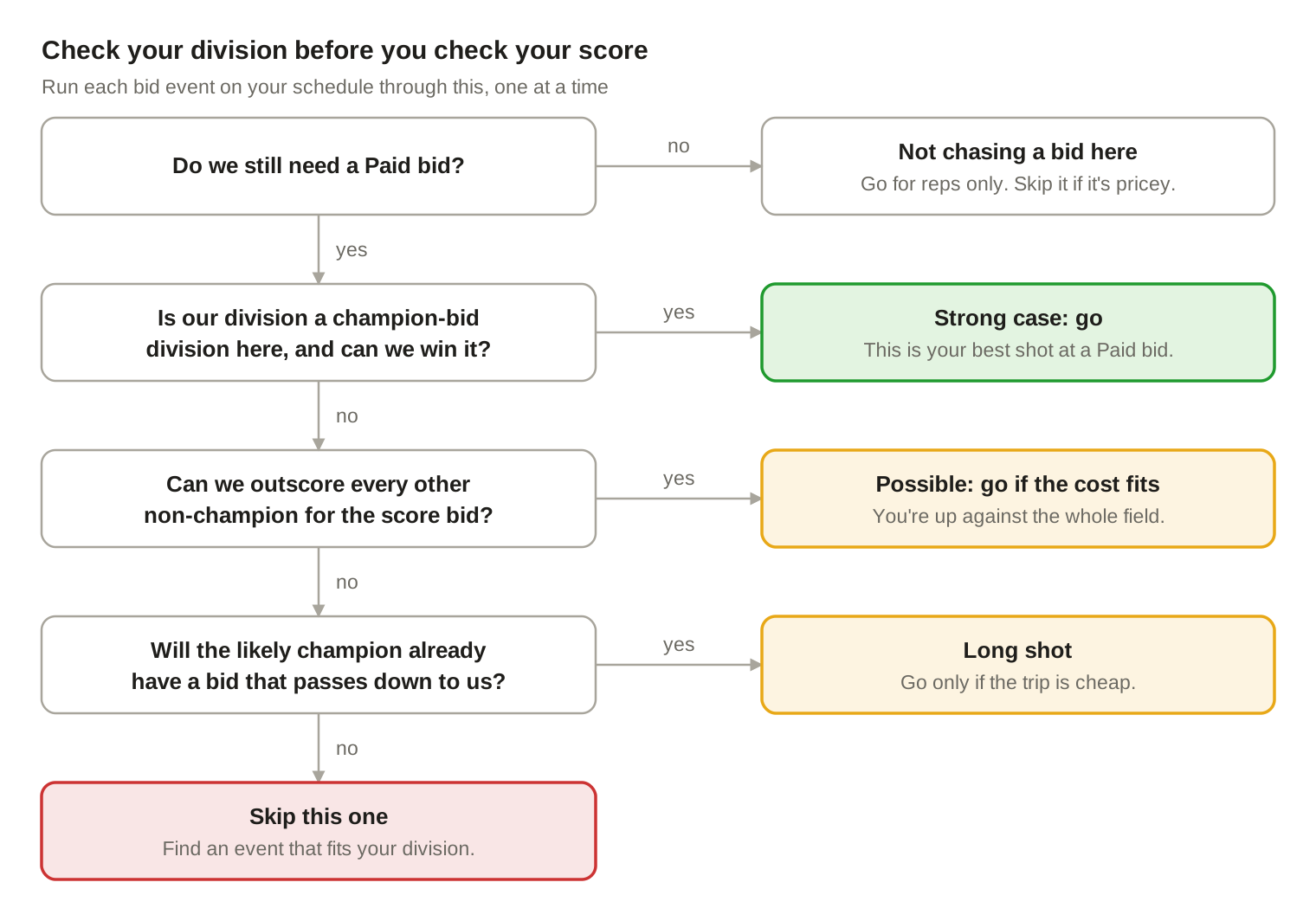
The order matters. Winning your division comes before your score, because at a lot of events that’s where most of the Paid bids are now. Only if that path is closed should you start counting on the score-based bid or a pass-down.
A quick tip for using it with a full season: run every event through the tree, then line them up by outcome. If you’ve got two “strong case” events and three “long shots,” you probably know which ones to cut. If everything comes out as a long shot, that’s a sign to rethink the bid goal for this team, not to book more travel.
Questions to answer before you commit thousands to a travel event
Print these out. Answer them with your staff before you announce the schedule to parents. If you can’t answer one, that’s your homework.

About the event
How many Paid bids does this event offer for the 2026-27 season?
- How many of those are reserved for division champions, and which divisions?
- Does this event use the general declaration or its own (like NCA, CHEERSPORT, JAMfest or One Up)?
- What happens to a champion bid if that champion already has a Paid bid?
About your division
- Is my team’s division one of the champion-bid divisions at this event?
- Who attended this event in my division last year, and who won?
- Have we beaten the likely division winner at any point this season
About your team
- Are we realistically a division champion here, or are we chasing the score-based bid?
- If it’s the score-based bid, how many other non-champion teams could outscore us?
- Do we already have a bid? If so, why are we going?
About your families
- What’s the rough cost per athlete for this trip, all in?
- If we don’t get a Paid bid, will parents feel the trip was still worth it?
The bottom line
Your score still matters. It always will. But this season, where you finish in your division might matter more than where you finish in the building.
The coaches who do well under this system won’t be the ones who just pick the biggest events. They’ll be the ones who know exactly who’s in their division and build a schedule around the bids they can realistically win.
So before you lock in that February trip, sit down with the declaration and run your team through the tree above. It takes about half an hour. It might save your families a lot more than that 😊

IPP's Premade Mixes are USA Cheer Compliant and customizable! Add Sound FX, swap songs, & more! Add your Team Name to the mix for only $10!




 Cheer Mixes
 Past-Season Mixes (50% off!)
 You Hit Zero Cheer Blog
 Spotify Playlists
 Quick Quote Video Tutorial