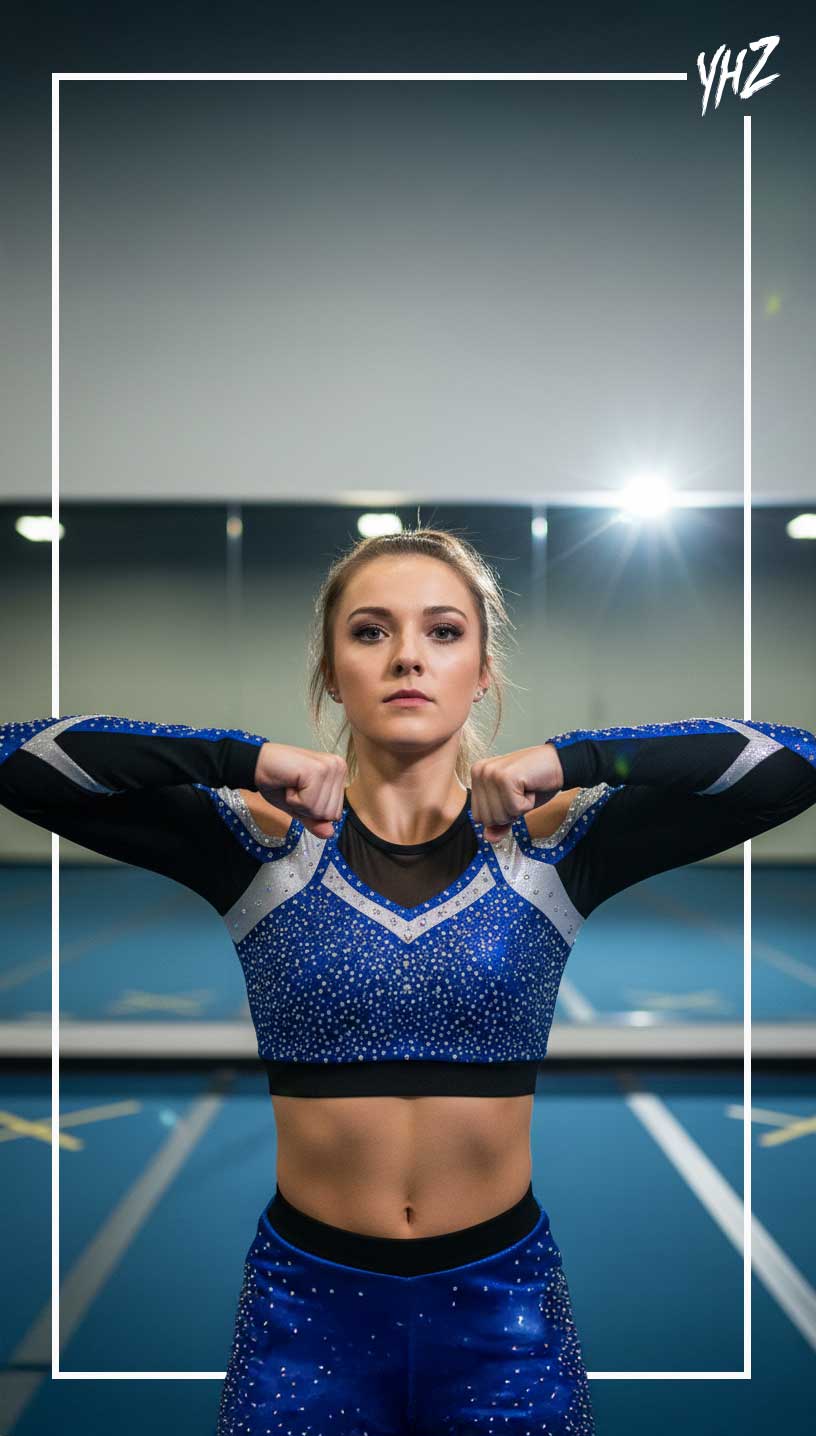
Tag Archives: motion synchronization cheer

How to Build Muscle Memory for Strong, Consistent Motions Through Repetition Drills

How to Build Muscle Memory for Strong Consistent Motions Through Repetition Drills

By Steve Pawlyk

Published November 18, 2025

Consistency in motion execution is what makes a cheer team look professional and synchronized under pressure. Every perfect hit, clean line, and timed transition is the product of muscle memory – the body’s ability to reproduce movement automatically after enough structured repetition. Building that memory isn’t about doing endless reps; it’s about doing the right reps, with precision, timing, and awareness.
This guide provides All-Star and High School coaches with a system for teaching athletes how to engrain sharp motions into their neuromuscular patterns through progressive drills, cue phrasing, and conditioning that reinforce strength and accuracy over fatigue.

Understanding Muscle Memory in Cheer Technique

Definition:
Muscle memory is the automatic execution of a movement pattern through repeated neural reinforcement. When taught correctly, it allows athletes to hit perfect motions even under stress or fatigue.

How It Works:

  1. Cognitive Stage: Athlete consciously focuses on technique and positioning.
  2. Associative Stage: Movements become smoother as the brain refines timing and coordination.
  3. Autonomous Stage: The athlete executes motions without conscious effort – consistency achieved.

Key Principle:
Repetition alone doesn’t create good muscle memory – perfect repetition does. Poorly executed reps hardwire bad habits.
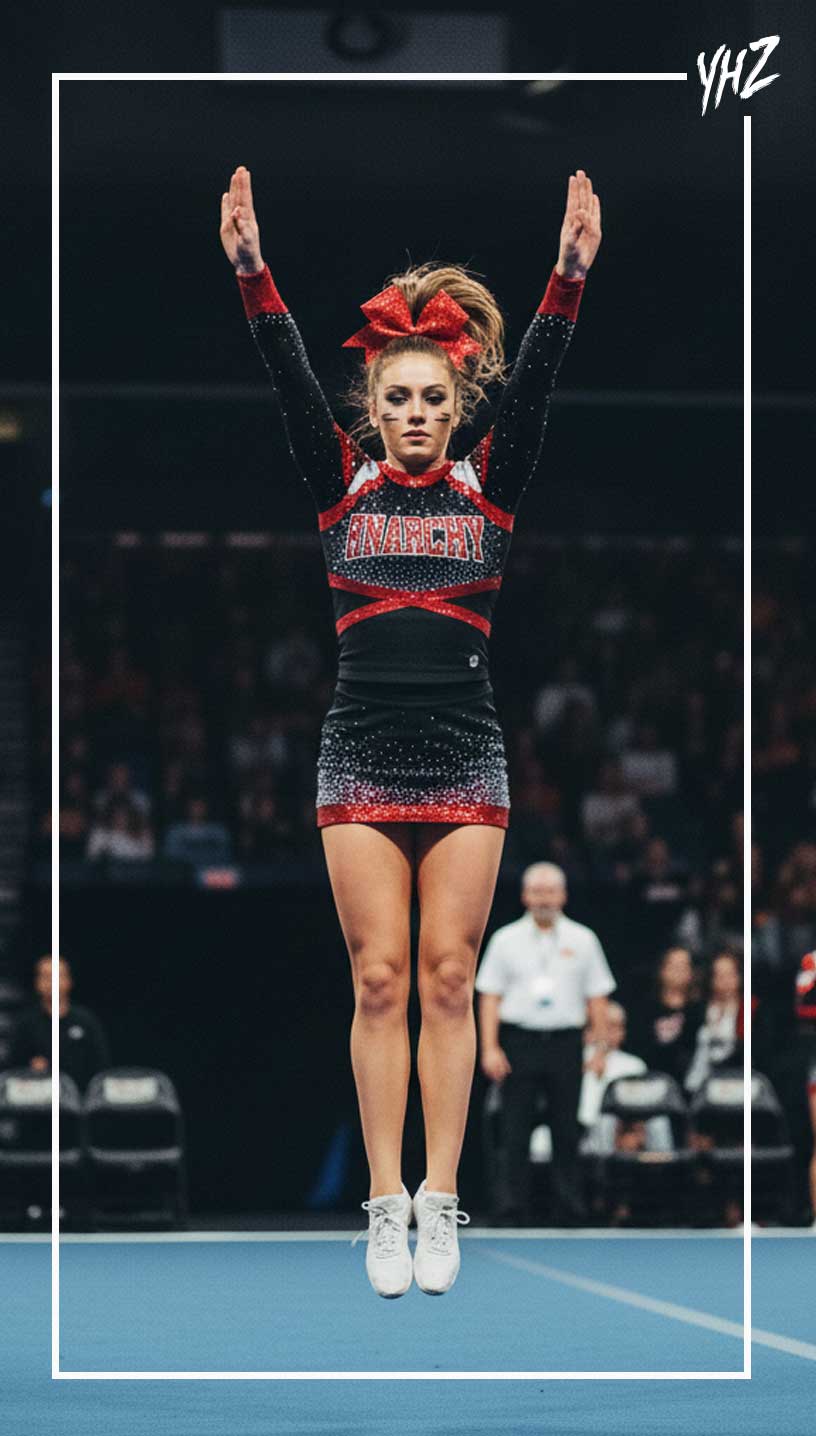
cheer muscle memory

Step-by-Step: Building Muscle Memory One-on-One

Step 1: Lock in Perfect Form

Before any repetition begins, correct form must be flawless.
Cue: “You’re not training speed yet – you’re training accuracy.”

  • Have the athlete hold each motion (High V, T, Low V, etc.) for 10 seconds.
  • Check alignment: wrists, elbows, shoulders, and posture.
  • Only when it’s perfect, begin repetitions.

Step 2: Use Isolated Reps

Perform each motion independently for 20–30 reps.

  • Start slow (counted tempo).
  • Cue: “Every hit should feel identical – no freelancing.”
  • Record video for self-analysis if possible.

Step 3: Add Controlled Transitions

After form mastery, link two or three motions together (e.g., T → High V → Low V).
Cue: “Same path, same stop, same body tension every time.”

Step 4: Integrate Feedback Loops

Have the athlete perform 10 reps, pause, and assess one technical element (e.g., wrist height).
This breaks the mindless repetition cycle and keeps focus on micro-correction.

Teaching Small Groups

Step 1: Repetition Blocks

Group athletes in sets of 3–5 and assign a “motion captain.”

  • The captain counts rhythm and monitors alignment.
  • After 20 reps, rotate captains to develop peer correction habits.

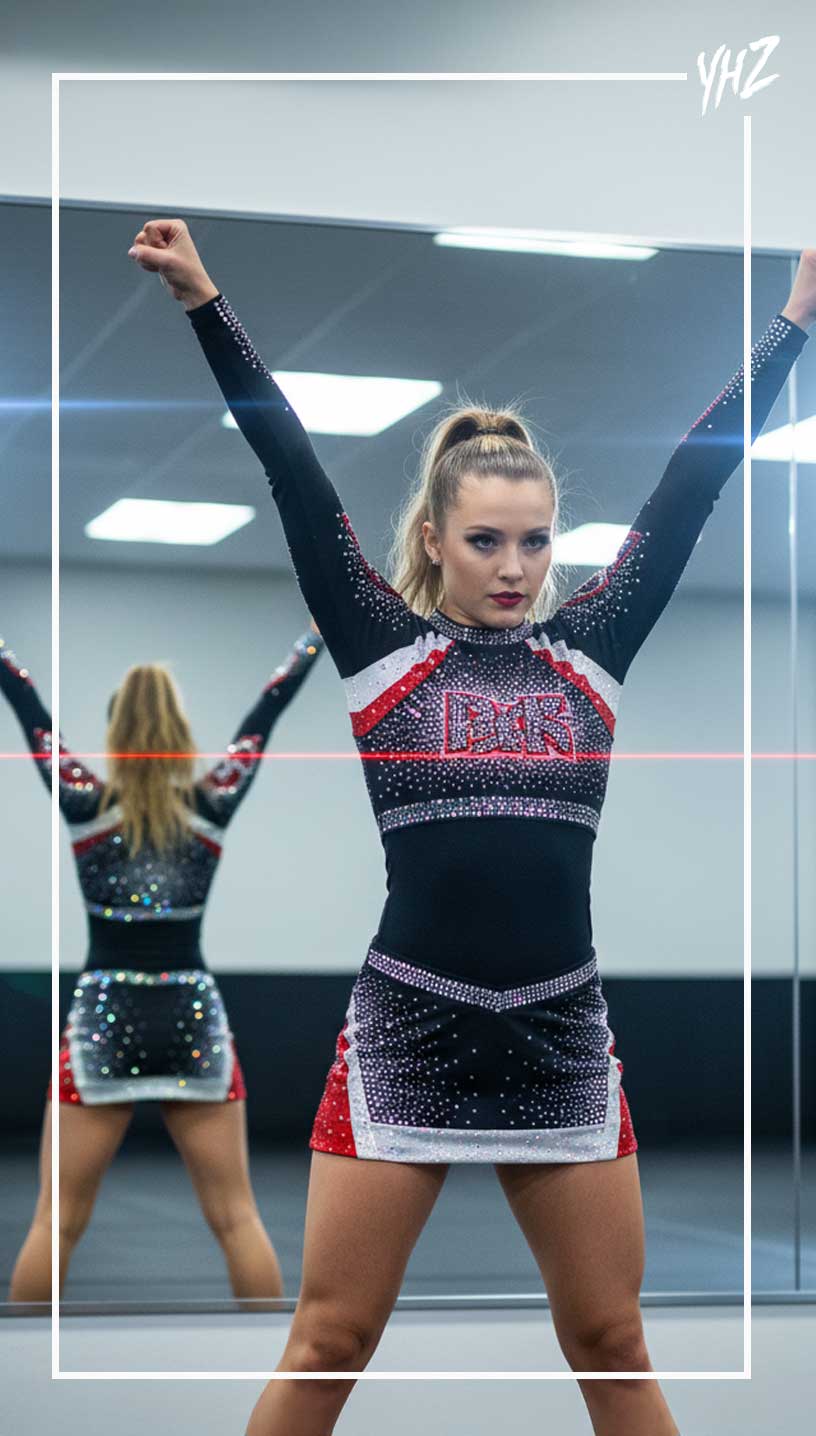
Step 2: The “Mirror Wall” Method

Line up facing mirrors. Perform the same motion sequence simultaneously.
Cue: “Every reflection should move as one body.”

Step 3: Accountability Through Counting

Use a metronome or voice count (“1-2-HIT”) to unify timing.
If anyone breaks rhythm or position, the group restarts.
Encourages focus, teamwork, and precise repetition.

Teaching Full-Team Consistency

Step 1: Team Motion Circuits

Design circuits combining 4–6 motions repeated for 8-count cycles.
Example: High V → T → Punch → Low V → High V → T
Run for 4 sets of 8 counts each, resting 15 seconds between.

Cue: “Every rep builds your muscle’s memory bank – make it count.”

Step 2: Layered Speed Progression

  1. Slow drills for angle control.
  2. Medium-speed drills for rhythm.
  3. Full-speed music drills for endurance and performance readiness.

Step 3: Coach’s Visual Consistency Check

Record full-team reps from multiple angles.
Freeze frames to compare arm levels, tension, and spacing.

Need Competition Music Blue 1

Coaching Language That Reinforces Repetition Quality

Effective Cues:

  • “Precision over pace.”
  • “Your body learns what you repeat – teach it the right thing.”
  • “Every rep is a blueprint.”
  • “Consistency lives in your shoulders and core.”
  • “Don’t just move – memorize.”

Avoid:

  • “Again!” without feedback – it trains errors.
  • “Faster!” before accuracy is built.

Common Athlete Errors and How to Correct Them

Error

Cause

Correction Strategy

Inconsistent arm height

Visual feedback missing

Mirror or video recording between reps.

Fatigue leading to slouch

Weak shoulder/core endurance

Add plank variations and static V-holds.

Speed sacrificing control

Overemphasis on tempo

Return to half-speed repetitions with counts.

Bent elbows mid-rep

Poor tension control

Cue: “Steel arms, soft shoulders.” Use resistance bands.

Uneven motion timing

Lack of auditory rhythm

Drill with metronome or 8-count track.

Drills to Build Long-Term Muscle Memory

  1. Timed Repetition Sets
    Perform 30 seconds of continuous motions, focusing on identical form each rep. Rest 15 seconds. Repeat 3 sets.
  2. Mirror Match Drill
    Partner athletes to mirror one another’s timing and motion accuracy. Visual reinforcement builds synchronization.
  3. Count Control Drill
    Run 8-count transitions slowly, freezing on each count. Forces awareness of arm path and pause integrity.
  4. “Fade Test” Drill
    Perform 25 perfect reps, then 5 more at fatigue level. Evaluate how form deteriorates. Reinforces endurance awareness.
  5. Endurance Ladder
    Add one rep per round (10 → 11 → 12, etc.). Athletes must maintain quality under load.

Conditioning for Muscle Memory Retention

Muscle memory relies on neural efficiency and physical endurance. Integrate these supportive exercises:

  • Shoulder isometric holds: 3×30 seconds per position.
  • Core rotations: 3×15 to maintain torso control through motion.
  • Scapular pushups: 3×20 to reinforce shoulder stability.
  • 8-count repetition drills: 4 rounds at full speed to simulate performance pressure.

Cue: “Train your body to remember perfect, not just repeat motion.”
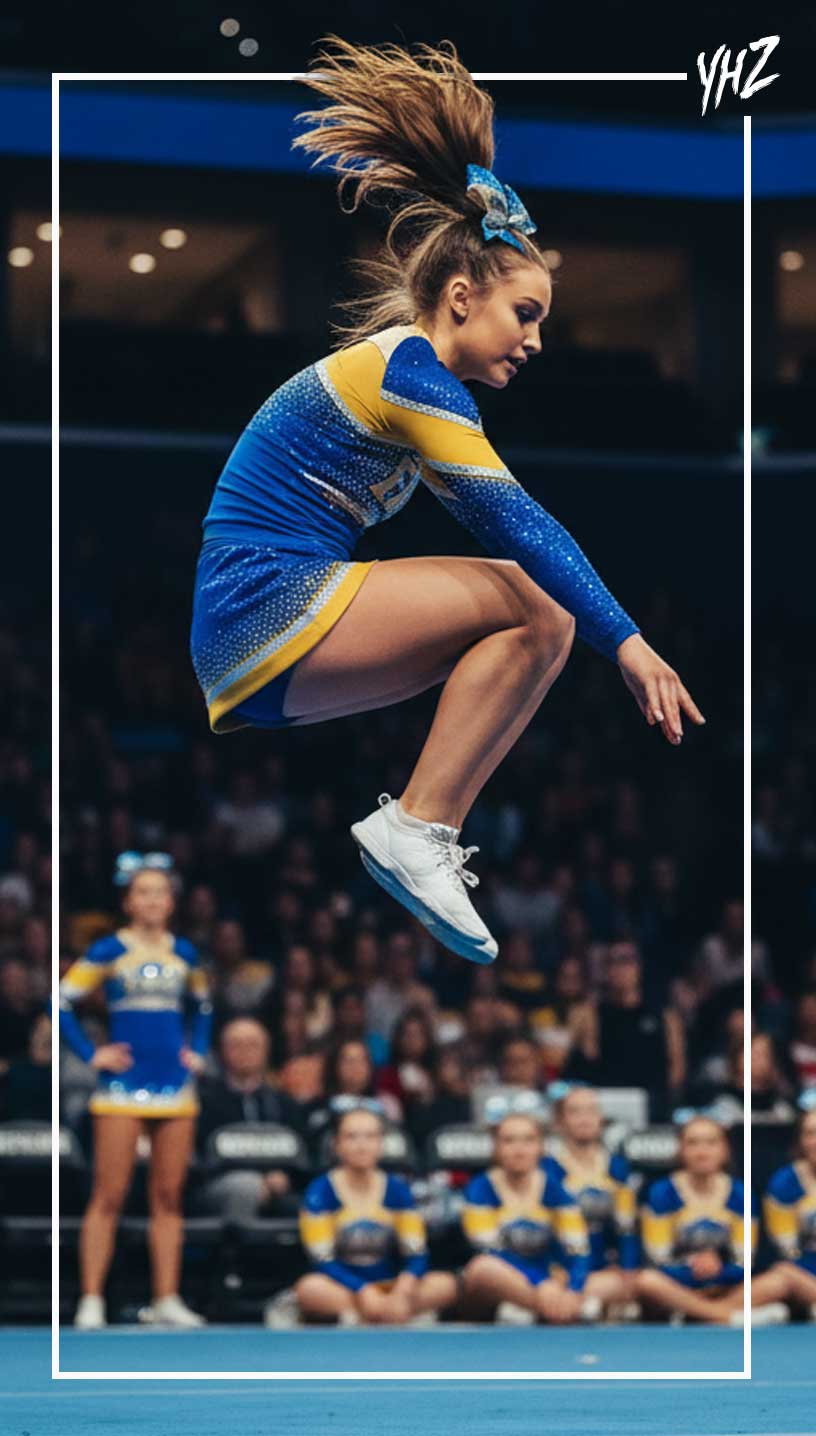
cheer repetition drills

Repetition is only effective when it’s intentional. Muscle memory develops through technical accuracy, consistent cueing, and mindful pacing. As an All-Star coach, your job is to make every repetition meaningful – teaching athletes that quality repetition builds confidence and reliability under competition stress. Perfect repetition creates automatic excellence.

Steve Pawlyk Signature Full

IPP's Premade Mixes are USA Cheer Compliant and customizable!  Add Sound FX, swap songs, & more!  Add your Team Name to the mix for only $10! 

SLAM artwork
Full_Out_130 mp3 image
1 minute cheer mix
WAKE UP THE FIRE
SLAM artwork
WAKE UP THE FIRE
Full_Out_130 mp3 image
1 minute cheer mix

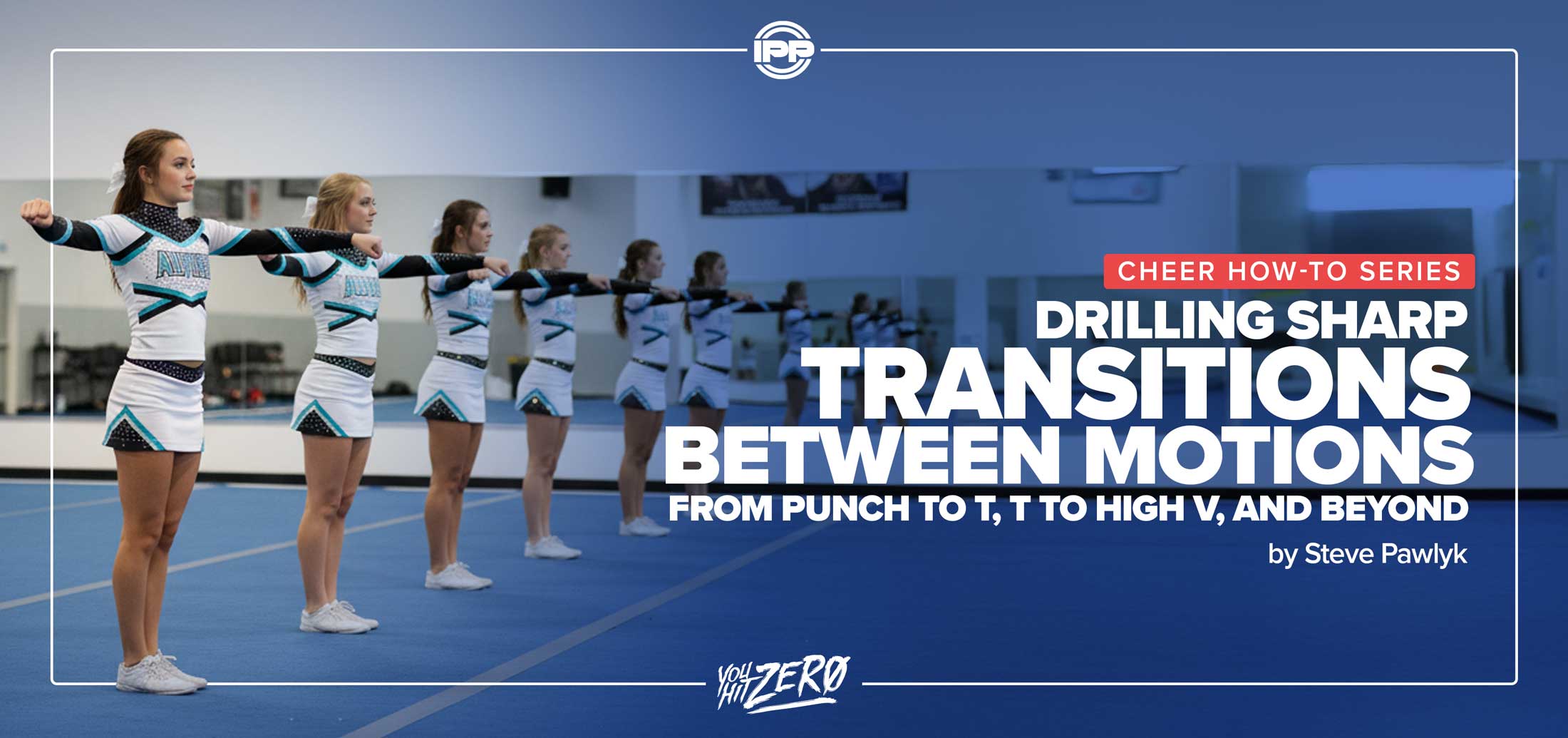
Drilling Sharp Transitions Between Motions: From Punch to T, T to High V, and Beyond

Drilling Sharp Transitions Between Motions From Punch to T T to High V and Beyond

By Steve Pawlyk

Published November 12, 2025

Sharp transitions are what separate a good routine from a championship-level one. Every clean line depends not only on where a motion lands but how it gets there. In All-Star cheer, those split-second pathways between positions – Punch to T, T to High V, High V to Low V – are where most visual sloppiness occurs. This guide explains how to teach precise, fast, and uniform transitions step-by-step, with drills and cue language that create muscle memory, synchronization, and control across your entire team.

cheer motion transitions

Understanding Motion Transitions

Definition:
A motion transition is the controlled movement connecting two defined positions in a routine. The transition must travel the shortest, most direct path with even tension and zero bounce at the endpoint.

Core Mechanics:

  • Economy of Motion: The arms travel the smallest path possible between positions.
  • Constant Tension: Shoulders, core, and wrists stay engaged throughout.
  • Timing: Every athlete hits the new motion on the same count.
  • Stillness Between Movements: Once a position hits, there is no residual wobble.

Common Transition Types:

  1. Linear: Straight pathways (e.g., T → High V).
  2. Rotational: Turning the arms around the axis of the shoulders (e.g., Punch → T).

3. Sequential: Linked multi-position changes (e.g., T → High V → Low V).

Step-by-Step: Teaching Sharp Transitions One-on-One

Step 1: Isolate the Start and End Points

Begin by teaching each motion independently until the athlete can hold both perfectly.
Cue: “You can’t travel cleanly between two crooked spots.”

Once the endpoints are mastered, have the athlete slowly connect them — pausing halfway to confirm arm path and shoulder control.

Step 2: Slow-Motion Rehearsal

Execute the transition in four counts:

  • Count 1–2: Travel halfway.
  • Count 3–4: Arrive at endpoint and freeze.
    Cue: “No swinging. No bouncing. Just slide and stop.”

Step 3: Gradual Acceleration

Once technique is clean, reduce to 2 counts, then 1 count, maintaining the same pathway discipline.
Use a metronome (90–120 BPM) to build rhythmic consistency.

Step 4: Add Visual Checkpoints

Use mirrors or record video to ensure elbows and wrists track symmetrically.
Cue: “Both hands should take the same route, same speed, same finish.”

Need Competition Music Blue 1

Teaching Small Groups

Step 1: Synchronization Drills

  • Have 3–5 athletes perform T → High V together to an 8-count.
  • Assign one athlete as “visual lead.” Others mirror their timing and endpoint.
  • Cue: “If you can see another arm move before yours, you’re late.”

Step 2: Mirror Pair Work

Partners face each other and perform transitions simultaneously.
Each athlete watches for delay, angle deviation, or path wobble.
Swap partners every 30 seconds for fresh observation.

Step 3: Pathway Consistency

Use painter’s tape on the mirror or wall to mark arm travel paths.
Have athletes trace those lines visually while transitioning.

cheer technique drills

Teaching the Whole Team

Step 1: Sectional Isolation

Work in formation lines. Each line executes a single transition (e.g., Punch → T) repeatedly on count 8.
Front line serves as timing reference for the rest of the team.

Step 2: Layered Tempo Progression

Run the same transition series at three speeds:

  1. Half-tempo with pauses for alignment.
  2. Full-tempo to counts.
  3. Music-speed under pressure.

Record each version for video review.

Step 3: Full-Team Transition Pyramid

Group the team by skill level: beginners drill T ↔ High V, intermediates add Low V, advanced groups run sequential combos.
Cue across levels: “Fast is fine, sloppy is not.”

cheer motion transitions

Coaching Language That Reinforces Clean Transitions

Effective Cues:

  • “Travel tight – elbows scrape your ribs.”
  • “Path, not power.”
  • “Snap through, don’t swing through.”
  • “Freeze like the motion owes you money.”
  • “Speed without chaos.”

Avoid:

  • “Faster!” – without form reference, it causes flailing.
  • “Bigger!” – encourages over-rotation

Drills to Build Transition Precision

  1. Four-Count Path Drill
Execute one transition in four controlled counts. Builds awareness of midpoint control.
  2. Metronome Timing Drill
Perform continuous transitions to beats at 100–120 BPM; freeze on downbeat. Develops rhythm discipline.
  3. Laser Line Drill
Use a low laser or elastic cord to mark shoulder height. Arms should never cross below or above during T → High V.
  4. Mirror Snap Challenge
Athletes face mirrors; coach calls random transitions (“T → Punch,” “High V → Low V”). Points for exact count accuracy.
    5. Full-Team Transition Ladder
Entire team runs a chain of motions (Punch → T → High V → Low V → T). Each error restarts the ladder. Builds endurance and focus.

Common Athlete Errors and How to Correct Them

Error

Cause

Correction Strategy

Arm swing too wide

Lack of spatial awareness

Tape floor/mirror lines; cue “Shortest path wins.”

Delay between counts

Weak timing control

Use audible 8-counts or metronome to reinforce rhythm.

Over-rotation or bounce

No core engagement

Add planks and hollow holds; cue “Stop from your ribs.”

Elbows bent mid-path

Fatigue or poor triceps activation

Strengthen with resistance bands; cue “Lock then travel.”

Unsynchronized finishes

Visual dependency

Drill “eyes closed” reps to develop proprioception.

Conditioning for Transition Endurance

Sharp transitions demand explosive muscle control and sustained tension. Integrate:

  • Shoulder raises: 3×12 front/lateral combo sets.
  • Core twists with med ball: 3×20 for torso stabilization.
  • 8-count motion circuits: Repeat 3 rounds nonstop for stamina.

Cue: “You don’t just hit motions — you connect them with power.”


Transitions define the rhythm, cleanliness, and energy of your choreography. Precision between motions communicates professionalism and teamwork.
Teach your athletes to value the space between counts as much as the counts themselves. Clean transitions are a learned habit — built through repetition, awareness, and exact language from you, the coach.

Steve Pawlyk Signature Full

IPP's Premade Mixes are USA Cheer Compliant and customizable!  Add Sound FX, swap songs, & more!  Add your Team Name to the mix for only $10! 

SLAM artwork
Full_Out_130 mp3 image
1 minute cheer mix
WAKE UP THE FIRE
SLAM artwork
WAKE UP THE FIRE
Full_Out_130 mp3 image
1 minute cheer mix
SHARE YOUR CART