Tag Archives: all star cheer

College Cheer Recruiting Starts Now. Are Your Athletes Ready?

college cheer recruiting

By Steve Pawlyk

Published June 9, 2026

Something worth telling your athletes about happened in Sweden this past weekend.

The FISU World University Championships wrapped in Gothenburg on June 7. University teams from across the world competed for cheer titles. Team Canada came home with two medals.

Canada took silver in All Female Elite and bronze in Coed Premier. The All Female Elite squad came entirely from the University of Alberta. The Coed Premier team came from the University of British Columbia.

Australia won the All Female Elite title with a score of 70.64. Canada, the defending champion, finished at 61.82.

So a university team from Australia just beat a university team from Canada for a world title. Your athletes probably have no idea this event exists. That gap is the opportunity.

cheer recruiting tips

Why this matters to the kids on your mat

Most of your athletes think cheer ends after high school or their last all-star season. They do not see a road past 18. The mat feels like a countdown clock to them.

That road exists, and it keeps getting wider every year. College programs compete for national titles. National teams compete at world championships. Now university squads compete on a world stage too.

Think about what that means for a 15-year-old on your team. She can train today with a real shot at a college floor in three years. She just needs someone to tell her the floor is there.

When a parent asks “where can this actually go,” you finally have a clean answer. You can point to a college team, a national team tryout, or a world championship floor. That answer changes how families weigh the time and money they pour in.

It also changes how your athletes show up to practice. A kid chasing a college spot trains differently than a kid running out the clock.

Two pathways your athletes should understand

There are two separate international routes, and people mix them up constantly. Knowing the difference makes you the coach parents trust.

The first is the ICU World Championships. Athletes try out and represent their country on a national team. Team USA won its fourth straight All Girl Premier title at ICU Worlds in April. The USA program also chased a ninth straight Coed Premier crown this year.

That route is national pride at the highest level. Your athlete wears the flag, not a school logo.

The second is the FISU route you just read about. Athletes compete for their university, not their country directly. The University of Alberta and UBC athletes earned those Canadian medals as students first. They made a college team, then reached the world stage through it.

Both routes start the exact same way. An athlete keeps training past the age where most kids walk away. Skills do not disappear at graduation unless your athlete lets them.

There is also a closer target most families forget. College cheer nationals in Daytona Beach draw programs from every division each spring. That floor is reachable for far more of your athletes than a world championship.

Need Competition Music Blue 1

What you can do this off-season

You do not need a new program or a bigger budget to open this door. You need to talk about it out loud and often.

Start by naming the pathway at practice this week. Tell your older athletes that college cheer and national teams are real goals, not fantasies. Say it to the whole gym, not just your standout flyer.

Then help them prepare like it counts. Capture clean film of their stunting, tumbling, and jumps now, while the season is fresh. Shoot it in good light against a plain background, and keep each clip short.

College coaches scan film fast. They want a full standing tumbling pass, a running pass, and a clean stunt sequence. Give them that in the first thirty seconds or they move on.

Male athletes have a real edge here, so push your boys especially hard. College coed teams hunt for strong male bases every single year. Many of those spots come with scholarship money attached.

Build a short list of programs with your athletes too. Match a kid’s skills to schools that compete at their level. A realistic target beats a dream school with no roster spot.

cheer after high school college cheer scholarships

The takeaway

Cheer is no longer a sport kids age out of at graduation.

The floor in Gothenburg proved that again this weekend.

Your job is to make sure your athletes know the door is open. Point at it early and name it often. Back it up with film, and watch how their training changes when the goal feels real.

Steve Pawlyk Signature Full

IPP's Premade Mixes are USA Cheer Compliant and customizable!  Add Sound FX, swap songs, & more!  Add your Team Name to the mix for only $10! 

SLAM artwork
Full_Out_130 mp3 image
1 minute cheer mix
WAKE UP THE FIRE
SLAM artwork
WAKE UP THE FIRE
Full_Out_130 mp3 image
1 minute cheer mix

Varsity Killed Flex Divisions. Then They Brought Them Back. Here’s What to Do With Your 2026-27 Roster.

Varsity Killed Flex Divisions Then They Brought Them Back Heres What to Do With Your 2026 27 Roster

By Steve Pawlyk

Published May 6, 2026

The whiplash

On March 19, 2026, Varsity Spirit told program owners they would eliminate Flex divisions starting the 2026-27 season. Six days later, on March 25, they walked it back. Flex now lives for one more year and dies in 2027-28.

If you missed the first announcement and only caught the second, you might think nothing changed. That would be a mistake. The clock just started ticking on a roster strategy a lot of gyms have been quietly relying on.

What Flex actually was

USASF added Youth Flex and Junior Flex for the 2025-26 season. The whole point was to give programs more wiggle room with age ranges on a single team. A smaller gym that couldn’t quite field a Junior 3 could fold in a couple of Youth athletes and still compete.

Flex was provisional from day one. USASF said they would evaluate at the end of the season. Now we know how that evaluation went, even if Varsity later fuzzed the timeline.

flex divisions competitive cheer

Why Varsity wants Flex gone

Varsity has been pretty consistent in their reasoning. Age-based divisions, they say, create cleaner developmental tracks and clearer evaluation standards. They also pointed at “team culture” and “competitive balance,” which is corporate code for “older kids dominating teams of younger kids isn’t a great look.”

There’s a real argument here. A 14-year-old and a 9-year-old are not the same athlete. Putting them on the same team can blur what each of them actually needs.

The counter argument is also real. Small programs in small towns just can’t always hit roster minimums in strict age bands.

You can have your own opinion on which one wins. Varsity has made the decision for you either way.

What this means for your 2026-27 season

If you already planned to run a Flex team next season, run it. Nothing about the reversal changes your immediate plans. You have one more year to use this format the way you intended.

But if you were going to build a multi-year roster around Flex, stop. The 2027-28 cliff is real, and you need to plan backward from it now. Any athlete you bring into a Flex team in fall 2026 needs a home in fall 2027 without Flex.

That sounds obvious. In practice, gyms screw this up all the time because next August feels far away.

It isn’t.

Need Competition Music Blue 1

The age math you need to run before summer

Pull up your projected 2026-27 Flex roster. For every athlete on it, figure out their 2027-28 birth year and what divisions they’ll qualify for in a Flex-free world.

You’re going to find three groups.

Group one is athletes who can move cleanly into a standard age division on a team that will exist anyway. These kids are fine.

Group two is athletes who will age into a division where you can build a team around them. You might need to pair them with kids you don’t have on your roster yet. That means recruiting starts now, not in spring 2027.

Group three is the painful one. These athletes need divisions your gym can’t field a team in, because you’re a smaller program and the numbers just aren’t there.

You have three options for each kid in this group. You can develop them up a level so they can play on a team you do have. You can be honest with the family early so they have time to consider another gym.

Or you can use the 2026-27 season to build a recruiting pipeline that brings in age-eligible teammates for 2027-28.

None of these are quick fixes. All of them work better when you start in May than when you start in October.

flex divisions varsity spirit cheer
Need Competition Music Blue 1
flex divisions competitive cheer

The Division 2 reality

If your gym is at or under the 125-elite-athlete threshold, this hits you harder. Flex existed exactly for programs your size. Losing it changes how you have to think about every roster decision for the next 18 months.

The extra year matters here. Use it to either grow your athlete count past the math problem, or to specialize hard in the divisions you can actually compete in. Trying to hold the same shape your gym had in 2025-26 will not work.

What this signal is really about

Pay attention to what Varsity has been doing across the board. They’ve consolidated around stricter age divisions.

They launched the Pro Cheer League with a clean professional age cutoff. They’re partnering with Curv AI to push more objective competitive measurement.

Flex was an experiment in flexibility. The Flex experiment ended quickly. The direction is toward tighter, more standardized division structure, even when that direction makes life harder for smaller programs.

If you build your gym’s strategy assuming Varsity will keep adding loopholes, those loopholes will keep disappearing on you. Build for what’s actually coming.

What to do this week

Three things will save you the most pain a year from now.

First, audit your Flex roster math against the 2027-28 grid. Highlight the kids in Group three above. They’re your priority.

Second, talk to those families now, before spring 2027 surprises them. You don’t need a solution yet. You need them to know you’re thinking about it.

Third, look at your current 6 to 9 year old recruiting funnel. Two years from now, those kids fill out the divisions that the 27-28 grid will require you to actually build. Recruiting today is roster planning for the cliff.

The extra year is a head start. Don’t waste it.

Steve Pawlyk Signature Full

IPP's Premade Mixes are USA Cheer Compliant and customizable!  Add Sound FX, swap songs, & more!  Add your Team Name to the mix for only $10! 

SLAM artwork
Full_Out_130 mp3 image
1 minute cheer mix
WAKE UP THE FIRE
SLAM artwork
WAKE UP THE FIRE
Full_Out_130 mp3 image
1 minute cheer mix

Teaching Perfect Arm Angles How to Correct Chicken Wings Dropped Elbows and Soft Wrists

Teaching Perfect Arm Angles How to Correct Chicken Wings Dropped Elbows and Soft Wrists

By Steve Pawlyk

Published November 7, 2025

In competitive All-Star cheerleading, sharp motions define the difference between a clean, high-scoring routine and one that looks unrefined. Teaching athletes how to execute crisp, dynamic arm movements with precision and body control is fundamental to building strong visuals and synchronicity across your team. This guide walks All-Star coaches through a technical, step-by-step process for teaching sharp motions effectively – from individual drills to full-team synchronization – while addressing common errors, timing issues, and body alignment problems that often hold athletes back.

Understanding the Mechanics of Sharp Motions

Definition:
A “sharp motion” is a quick, controlled movement that stops abruptly at a precise endpoint with visible muscle engagement. It requires correct arm path, shoulder alignment, and total-body engagement.

Core Elements of Sharpness:

  • Tension: Muscles are fully engaged without appearing rigid.
  • Accuracy: Arm placement hits exact angles (e.g., 45°, 90°).
  • Timing: Motion reaches its final position simultaneously across athletes.
  • Control: Movement stops cleanly, with no bounce or wobble.

Key Muscles Used:
Deltoids, trapezius, latissimus dorsi, biceps/triceps, and core stabilizers.

cheer arm angles

Step-by-Step: Teaching Sharp Motions One-on-One

Step 1: Establish Muscle Awareness

  • Drill: Have the athlete hold a High V for 10 seconds. Then cue:
    “Tighten your arms until they feel like steel – now breathe without letting the arms move.”
  • This develops static control and shoulder stability.

Step 2: Teach Arm Pathways

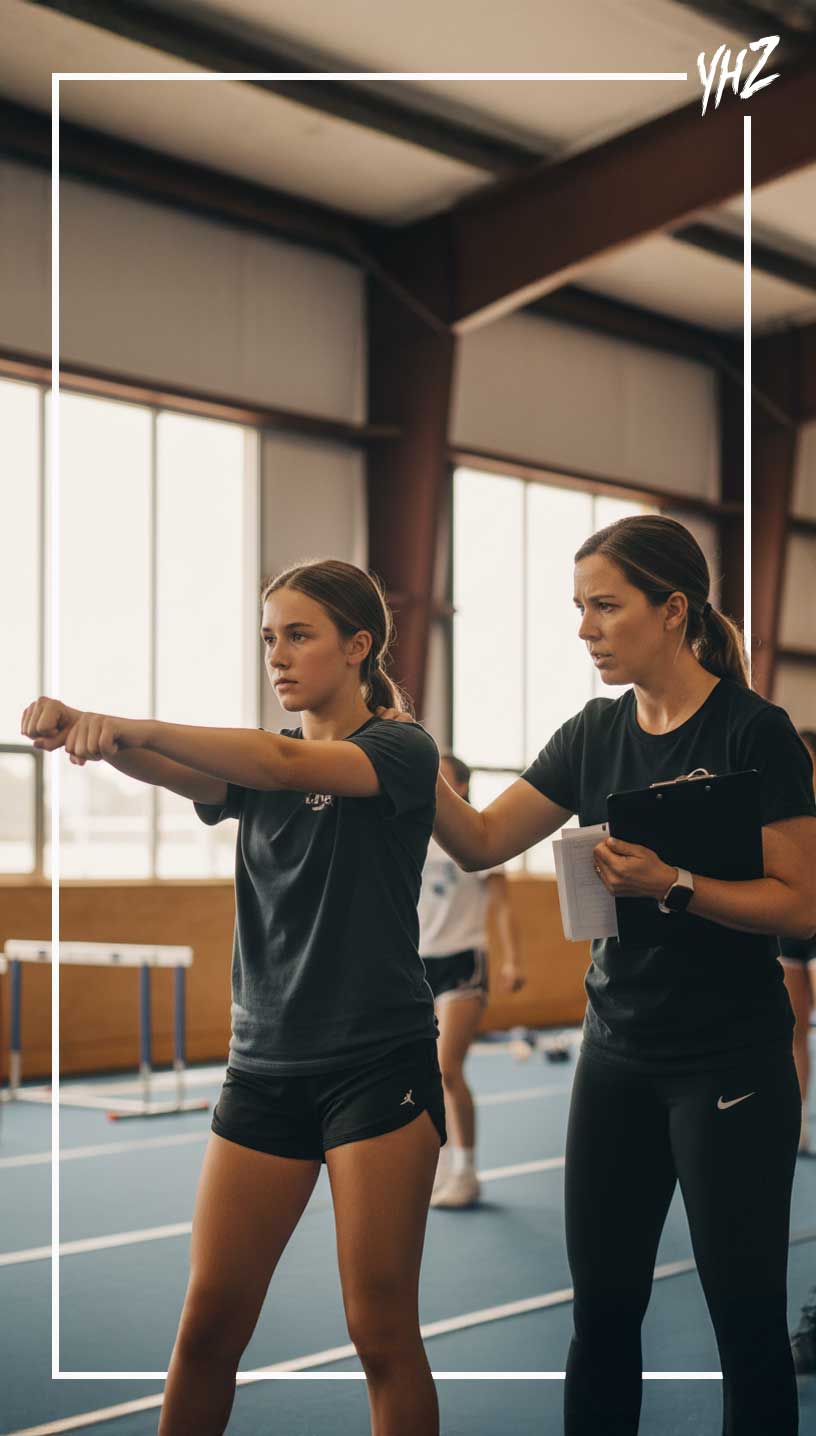
  • Use mirror feedback. Demonstrate a motion slowly, tracing the arm path.
  • Cue: “Travel through the air like you’re slicing – not floating.”
  • Have the athlete practice T → High V → Low V transitions at half-speed, then full-speed, maintaining tight paths and deliberate stops.

Step 3: Reinforce Visual Symmetry

  • Correct uneven elbows by cueing: “Both elbows should look like twins – same height, same line.”
  • Photograph or record the athlete mid-motion for visual correction.

Step 4: Add Controlled Speed

  • Once the athlete can execute cleanly at half-speed, use a metronome or counts.
  • Cue: “Hit, hold, snap back – no extra noise in between.”

One-on-One Focus: Keep feedback specific and immediate – correct after every rep. For developing athletes, emphasize “clean over fast.”

Teaching Small Groups: Building Consistency

When moving from individual correction to group work (3-5 athletes), the goal shifts from precision to uniformity.

Step 1: Synchronization Drills

  • Drill: Assign one athlete as the “lead” and have others match their timing and stop point.
  • Use 8-count tracks at 100 – 120 BPM for consistency.

Step 2: Peripheral Awareness

  • Cue athletes to use side vision to check alignment:
    “Your arms should land in the same line as your neighbor’s. If you see a hand out of place, match it.”

Step 3: Micro-Timing Adjustments

  • Record group motions in slow-motion.
  • Identify the athlete who hits early or late, then isolate and re-sync.
  • Use rhythmic clapping or verbal counts (“1-and-HIT”) to reinforce team timing.

Teaching Full-Team Precision

Step 1: Formations and Spacing

  • Sharp motions lose impact when spacing drifts. Tape lines on the floor to keep spacing exact (arms-length apart).
  • Cue: “Your visual space is part of the motion – protect your square.”

Step 2: Layered Instruction

  1. Start with silent run-throughs – no music, just visual hits.
  2. Progress to count-based: “5-6-7-8!”
  3. End with music-speed execution and pause drills between counts to check visuals.

Step 3: Visual Synchronization Drills

  • Use video playback and freeze frames at key motions (High V, T, Punch, etc.) to identify misalignments.
  • Assign “correction partners” – athletes who check each other’s arm levels and tension before full runs.
Need Competition Music Blue 1

Coaching Language That Works

The phrasing you use directly influences athlete response. Avoid abstract cues like “be sharp” or “hit harder.” Replace them with sensory and mechanical instructions.

Effective Coaching Phrases:

  • “Imagine your arms are blades cutting the air.”
  • “Snap into place like a magnet hitting metal.”
  • “Hold tension like you’re trying to flex your arms into the floor.”
  • “Freeze, don’t bounce.”
  • “Clean lines over fast arms.”

Common Athlete Errors and How to Correct Them

Error

Cause

Correction

Bent elbows

Weak triceps or poor tension awareness

“Lock but don’t lock out – think steel, not wood.” Drill with 3-lb dumbbells.

Uneven arms

Shoulder misalignment or hand dominance

Train both sides equally. Use mirror or laser alignment drills.

Wobbly stops

Lack of core engagement

Add plank and hollow hold conditioning. Cue: “Freeze from your ribs, not your wrists.”

Soft wrists

Weak tension through forearm

Incorporate “blade hand” drills – open palm tension holds for 8 counts.

Sloppy transitions

Rushed counts or overextension

Slow down, isolate each transition. “Every path is a punch, not a wave.”

Progressive Drills for Mastery

  1. Isolation Drill: Perform each motion slowly to counts – no transitions. Focus only on angle accuracy.
  2. Snap Drill: Hit T → High V → Low V → T in rhythm to a metronome, pausing between each to check angles.
  3. Mirror Match Drill: Two athletes face each other and mirror motions simultaneously. Immediate visual feedback reinforces synchronization.
  4. Resistance Band Drill: Attach light bands to wrists. Perform motions while maintaining band tension – builds strength and control.
  5. Full-Team Clean Hit Challenge: Every athlete must freeze at the end of each motion; any visible bounce or movement restarts the count.

Building Endurance for Sharp Motions

Sharp motions require not only precision but also endurance. Incorporate these conditioning elements:

  • Shoulder holds: 3 sets of 30-second High Vs with light dumbbells.
  • Core stabilization: Hollow holds and plank variations to reduce upper-body wobble.
  • Repetition drills: 50-count sets of full-out motions to simulate routine fatigue.

Cue during conditioning: “Your arms should look the same on count 1 as they do on count 50.”

chicken wings cheer

When an Athlete Struggles

Common Struggles:

  • Arms aren’t hitting sharp or fast enough:

    • Cause: Lack of muscle engagement or understanding of “motion lock.”

    • Fix: Have the athlete perform slow-motion hits against light resistance bands to feel the tension through shoulders, triceps, and wrists. Cue “lock from the shoulder, not the elbow.” Reinforce with short-count drills — e.g., “1–hit, 2–freeze.”

  • Elbows bend or wrists flop at the end of the motion:

    • Cause: Weak upper-arm engagement or fatigue during repetition.

    • Fix: Add static arm holds (10 seconds per motion) and isometric presses against a wall. Cue “squeeze through your arms like you’re cracking glass.”

  • Angles inconsistent between left and right sides:

    • Cause: Poor proprioception or shoulder imbalance.

    • Fix: Drill in front of a mirror or record video feedback. Have the athlete hit one motion at a time and freeze for visual alignment checks. Cue “match the mirror, not your memory.”

  • Athlete can’t find visual uniformity in team formations:

    • Cause: Over-focusing on personal execution instead of spatial awareness.

    • Fix: Use “mirror pairs” — partner the athlete beside your cleanest performer and run synchronized drills. Cue “your job is to disappear into the line.”

  • Timing late or early on counts:

    • Cause: Overthinking or reacting visually instead of audibly.

    • Fix: Practice hitting on a metronome beat or 8-count track. Cue “hit the sound, not the sight.”

Coach Tip:
When a particular athlete struggles to “feel” the sharpness, try tactile feedback. Have the athlete hold a lightweight resistance band across both wrists or a small towel between hands — this creates tangible tension through the arms and instantly teaches them what “tight” actually feels like. The goal isn’t punishment; it’s awareness. Once they feel it, they can replicate it without the tool.

Teaching sharp motions isn’t about speed — it’s about accuracy, control, and tension. Start slow, demand consistency, and build synchronization from the ground up. The payoff is visual cleanliness, team unity, and a routine that commands attention from judges the moment the first motion hits.

Stay tuned for more coaching tips from our Cheer How-To Series 

Steve Pawlyk Signature Full

IPP's Premade Mixes are USA Cheer Compliant and customizable!  Add Sound FX, swap songs, & more!  Add your Team Name to the mix for only $10! 

SLAM artwork
Full_Out_130 mp3 image
1 minute cheer mix
WAKE UP THE FIRE
SLAM artwork
WAKE UP THE FIRE
Full_Out_130 mp3 image
1 minute cheer mix
SHARE YOUR CART