
 •
• English
 日本語
日本語 Español
 Português
 Français
 Polski
 Deutsch
 Italiano
 Nederlands
 한국어
한국어 Русский
 简体中文
简体中文






Nov



By Steve Pawlyk
Published November 12, 2025
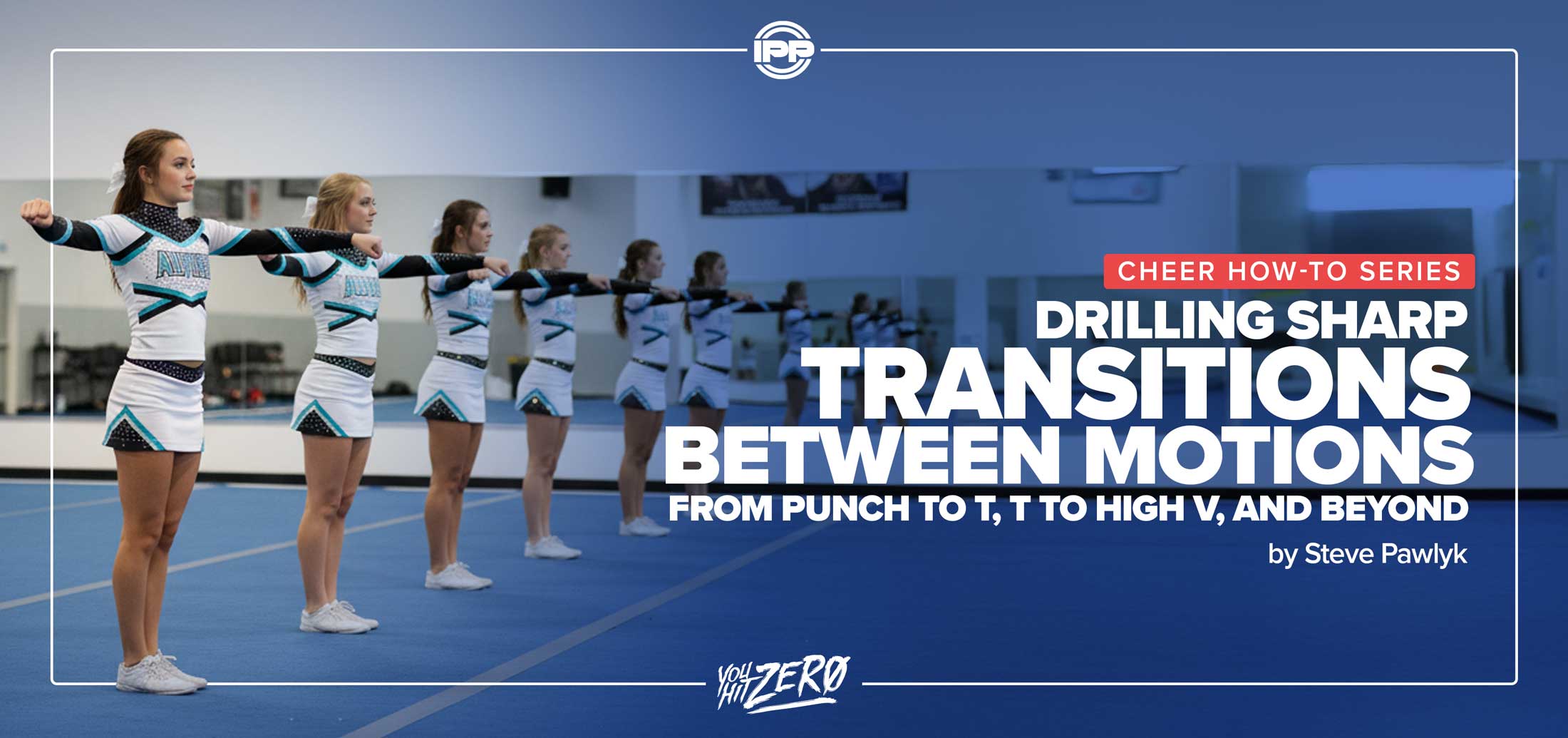
Sharp transitions are what separate a good routine from a championship-level one. Every clean line depends not only on where a motion lands but how it gets there. In All-Star cheer, those split-second pathways between positions – Punch to T, T to High V, High V to Low V – are where most visual sloppiness occurs. This guide explains how to teach precise, fast, and uniform transitions step-by-step, with drills and cue language that create muscle memory, synchronization, and control across your entire team.
Understanding Motion Transitions
Definition:
A motion transition is the controlled movement connecting two defined positions in a routine. The transition must travel the shortest, most direct path with even tension and zero bounce at the endpoint.
Core Mechanics:
- Economy of Motion: The arms travel the smallest path possible between positions.
- Constant Tension: Shoulders, core, and wrists stay engaged throughout.
- Timing: Every athlete hits the new motion on the same count.
- Stillness Between Movements: Once a position hits, there is no residual wobble.
Common Transition Types:
- Linear: Straight pathways (e.g., T → High V).
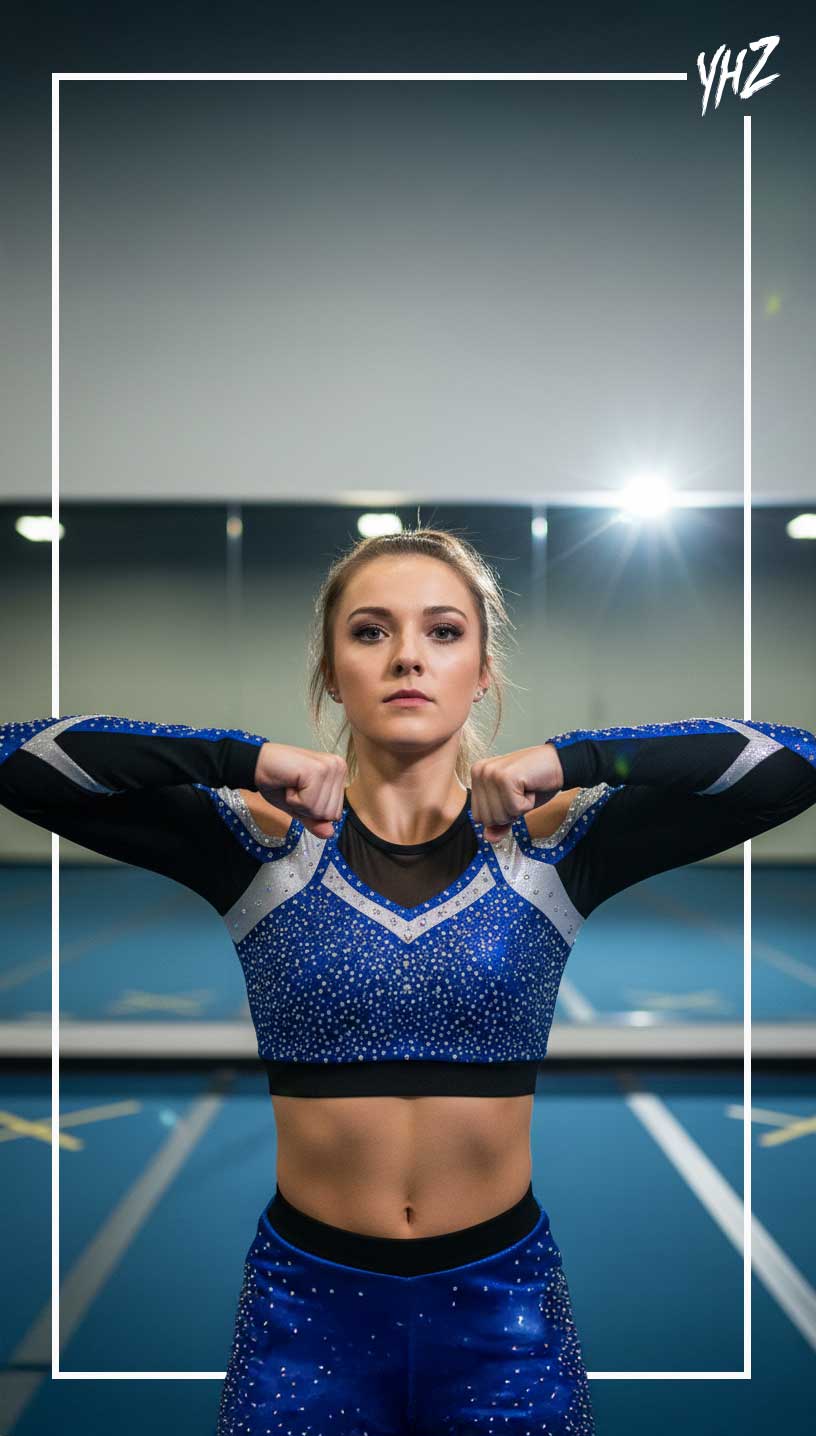
- Rotational: Turning the arms around the axis of the shoulders (e.g., Punch → T).
• 3. Sequential: Linked multi-position changes (e.g., T → High V → Low V).
Step-by-Step: Teaching Sharp Transitions One-on-One
Step 1: Isolate the Start and End Points
Begin by teaching each motion independently until the athlete can hold both perfectly.
Cue: “You can’t travel cleanly between two crooked spots.”
Once the endpoints are mastered, have the athlete slowly connect them — pausing halfway to confirm arm path and shoulder control.
Step 2: Slow-Motion Rehearsal
Execute the transition in four counts:
- Count 1–2: Travel halfway.
- Count 3–4: Arrive at endpoint and freeze.
Cue: “No swinging. No bouncing. Just slide and stop.”
Step 3: Gradual Acceleration
Once technique is clean, reduce to 2 counts, then 1 count, maintaining the same pathway discipline.
Use a metronome (90–120 BPM) to build rhythmic consistency.
Step 4: Add Visual Checkpoints
Use mirrors or record video to ensure elbows and wrists track symmetrically.
Cue: “Both hands should take the same route, same speed, same finish.”

Teaching Small Groups
Step 1: Synchronization Drills
- Have 3–5 athletes perform T → High V together to an 8-count.
- Assign one athlete as “visual lead.” Others mirror their timing and endpoint.
- Cue: “If you can see another arm move before yours, you’re late.”
Step 2: Mirror Pair Work
Partners face each other and perform transitions simultaneously.
Each athlete watches for delay, angle deviation, or path wobble.
Swap partners every 30 seconds for fresh observation.
Step 3: Pathway Consistency
Use painter’s tape on the mirror or wall to mark arm travel paths.
Have athletes trace those lines visually while transitioning.
Teaching the Whole Team
Step 1: Sectional Isolation
Work in formation lines. Each line executes a single transition (e.g., Punch → T) repeatedly on count 8.
Front line serves as timing reference for the rest of the team.
Step 2: Layered Tempo Progression
Run the same transition series at three speeds:
- Half-tempo with pauses for alignment.
- Full-tempo to counts.
- Music-speed under pressure.
Record each version for video review.
Step 3: Full-Team Transition Pyramid
Group the team by skill level: beginners drill T ↔ High V, intermediates add Low V, advanced groups run sequential combos.
Cue across levels: “Fast is fine, sloppy is not.”
Coaching Language That Reinforces Clean Transitions
Effective Cues:
- “Travel tight – elbows scrape your ribs.”
- “Path, not power.”
- “Snap through, don’t swing through.”
- “Freeze like the motion owes you money.”
- “Speed without chaos.”
Avoid:
- “Faster!” – without form reference, it causes flailing.
- “Bigger!” – encourages over-rotation
Drills to Build Transition Precision
- Four-Count Path Drill Execute one transition in four controlled counts. Builds awareness of midpoint control.
- Metronome Timing Drill Perform continuous transitions to beats at 100–120 BPM; freeze on downbeat. Develops rhythm discipline.
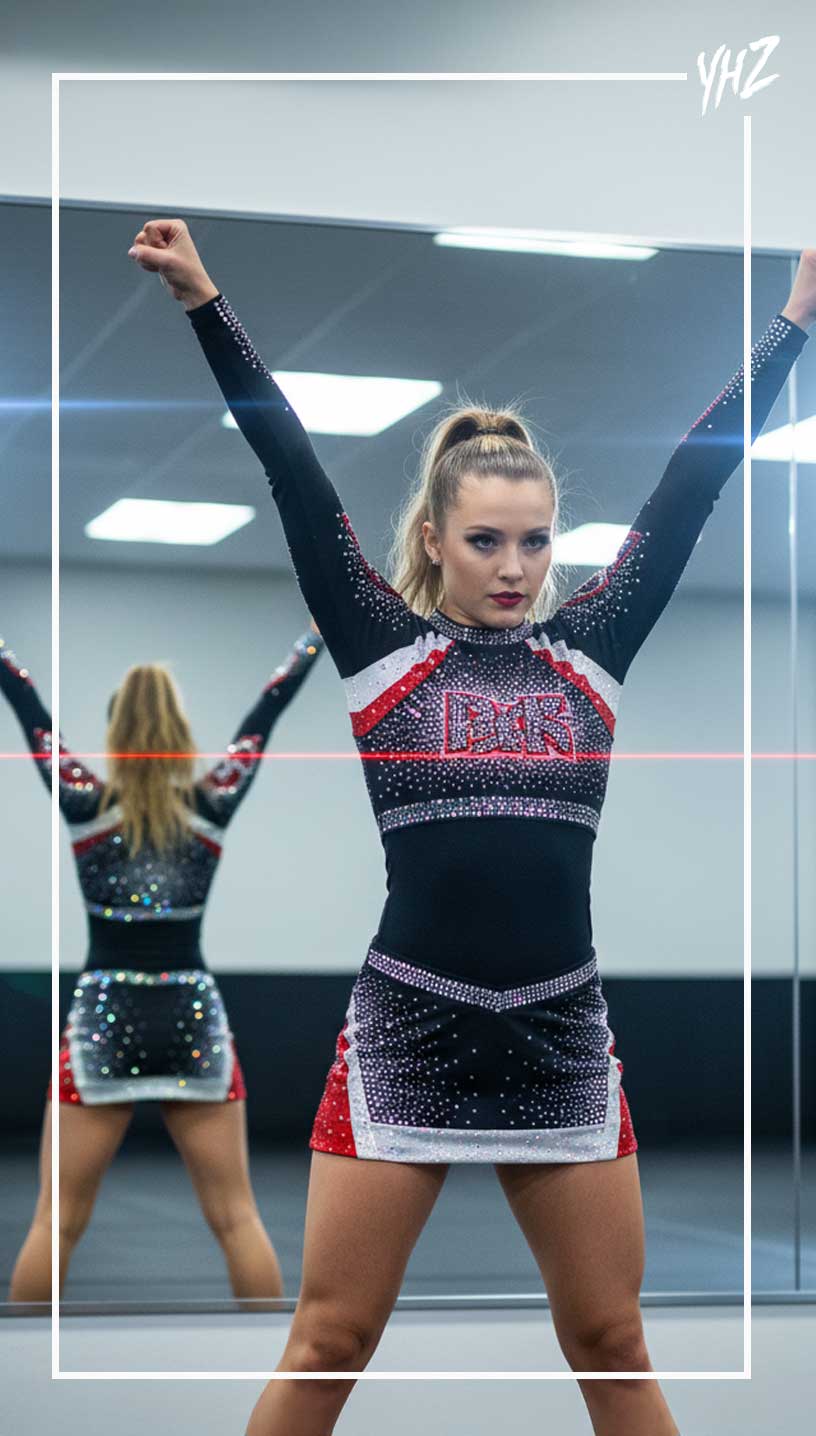
- Laser Line Drill Use a low laser or elastic cord to mark shoulder height. Arms should never cross below or above during T → High V.
- Mirror Snap Challenge
Athletes face mirrors; coach calls random transitions (“T → Punch,” “High V → Low V”). Points for exact count accuracy.
5. Full-Team Transition Ladder Entire team runs a chain of motions (Punch → T → High V → Low V → T). Each error restarts the ladder. Builds endurance and focus.
Common Athlete Errors and How to Correct Them
|
Error |
Cause |
Correction Strategy |
|
Arm swing too wide |
Lack of spatial awareness |
Tape floor/mirror lines; cue “Shortest path wins.” |
|
Delay between counts |
Weak timing control |
Use audible 8-counts or metronome to reinforce rhythm. |
|
Over-rotation or bounce |
No core engagement |
Add planks and hollow holds; cue “Stop from your ribs.” |
|
Elbows bent mid-path |
Fatigue or poor triceps activation |
Strengthen with resistance bands; cue “Lock then travel.” |
|
Unsynchronized finishes |
Visual dependency |
Drill “eyes closed” reps to develop proprioception. |
Conditioning for Transition Endurance
Sharp transitions demand explosive muscle control and sustained tension. Integrate:
- Shoulder raises: 3×12 front/lateral combo sets.
- Core twists with med ball: 3×20 for torso stabilization.
- 8-count motion circuits: Repeat 3 rounds nonstop for stamina.
Cue: “You don’t just hit motions — you connect them with power.”
Transitions define the rhythm, cleanliness, and energy of your choreography. Precision between motions communicates professionalism and teamwork.
Teach your athletes to value the space between counts as much as the counts themselves. Clean transitions are a learned habit — built through repetition, awareness, and exact language from you, the coach.

IPP's Premade Mixes are USA Cheer Compliant and customizable! Add Sound FX, swap songs, & more! Add your Team Name to the mix for only $10!



 Cheer Mixes
 Past-Season Mixes (40% off!)
 You Hit Zero Cheer Blog
 Spotify Playlists
 Quick Quote Video Tutorial