
 •





Nov



By Steve Pawlyk
Published November 24, 2026
Yes. A harder stunt can lower your team’s score when the additional difficulty credit is smaller than the execution losses or penalties that accompany it. An upgrade can also add physical challenge without earning any additional difficulty credit under the applicable rubric.
That makes cheerleading stunt difficulty vs execution a practical routine-building decision. Before replacing a dependable sequence, identify what the proposed version can earn, what your athletes currently give back, and whether the change affects the sections around it.
Consider a sequence that stays in the air but requires moving bases, hurried body positions, and a late dismount. Calling it a hit tells the coaching staff very little about its scoring value. The useful comparison is between the complete performances of the two options, including their entries, transitions, and exits.
Scoring resources checked November 20, 2026. The numerical examples below use a stated United Scoring context. They are hypothetical coaching comparisons, not official scores or formulas for every competition.
How stunt difficulty and execution are scored
Begin with the scoring system your event uses for your specific division. United Scoring, USASF scoring, and other event-specific systems should not be treated as interchangeable. United publishes separate divisional rubrics, master sheets, execution documents, and deduction resources. Match those documents before assigning point values. United Scoring’s 2026–27 resources
For a concrete reference, the United All Star Elite Level 2–6 master sheet allocates 10 raw points to stunts: 4.5 for difficulty, 1.5 for difficulty drivers, and 4.0 for execution. The full master sheet totals 50 raw points. These are category values on that sheet, not a claim that every published event result uses the same presentation or conversion. United All Star Elite master score sheet
Difficulty depends on what qualifies for credit
The United Level 1–5 rubric covering the listed Tiny, Mini, Youth, Junior, and Senior divisions, excluding Coed, considers skill variety, group quantity, and how skills are performed together. Its additional stunt drivers evaluate degree of difficulty and participation. It also requires control for full stunt credit. Use the actual division listing on the document’s first page to establish applicability. United Level 1–5 rubric, version October 15, 2026
For an upgrade review, write down the exact requirement that would change. “This version looks harder” is not enough. Identify the relevant skill classification, required number of groups, and any conditions governing when or how they perform. If the staff cannot show where the extra credit comes from, record the gain as unconfirmed.
Execution evaluates how the team performs
In United’s standard 2026–27 execution document, stunt execution starts at 4.0. Judges can reduce each driver by 0.1, 0.2, or 0.3 for minor, multiple, or widespread technical issues, with a maximum reduction of 0.3 per driver. Evaluation considers all athletes performing the skill; stylistic differences do not affect execution. The stunt and pyramid drivers cover:
- Top person: body control, flexibility uniformity, and leg and toe position.
- Bases and spotters: stability, stance, and stationary feet.
- Transitions: entries, dismounts, and control between skills.
- Synchronization: timing.
The document also specifies an automatic 0.3 synchronization reduction when the stated minimum of a level-appropriate transition by two or more groups is not met in stunts and pyramids. Read that provision when considering a simplified sequence. United execution rubric, version October 15, 2026
Use these drivers to organize video observations. Do not turn every visible correction into a separate invented deduction. A review note should describe the evidence first: which groups moved, when control changed, and whether the timing problem recurred.
Worlds requires a separate scoring review
USASF’s official scoring page confirms that USASF Club divisions at The Cheerleading Worlds 2027 move from a 170-point format to 100 points. It describes the change primarily as a scale conversion and identifies a capped jump category as the notable rubric adjustment. That announcement does not make the United stunt values above applicable to Worlds. USASF scoring resources
If your team is preparing for that event, use our 2027 Worlds scoring changes guide for context, then work from the official documents for your Worlds division. Recalculate your comparison whenever the event’s scoring system changes.

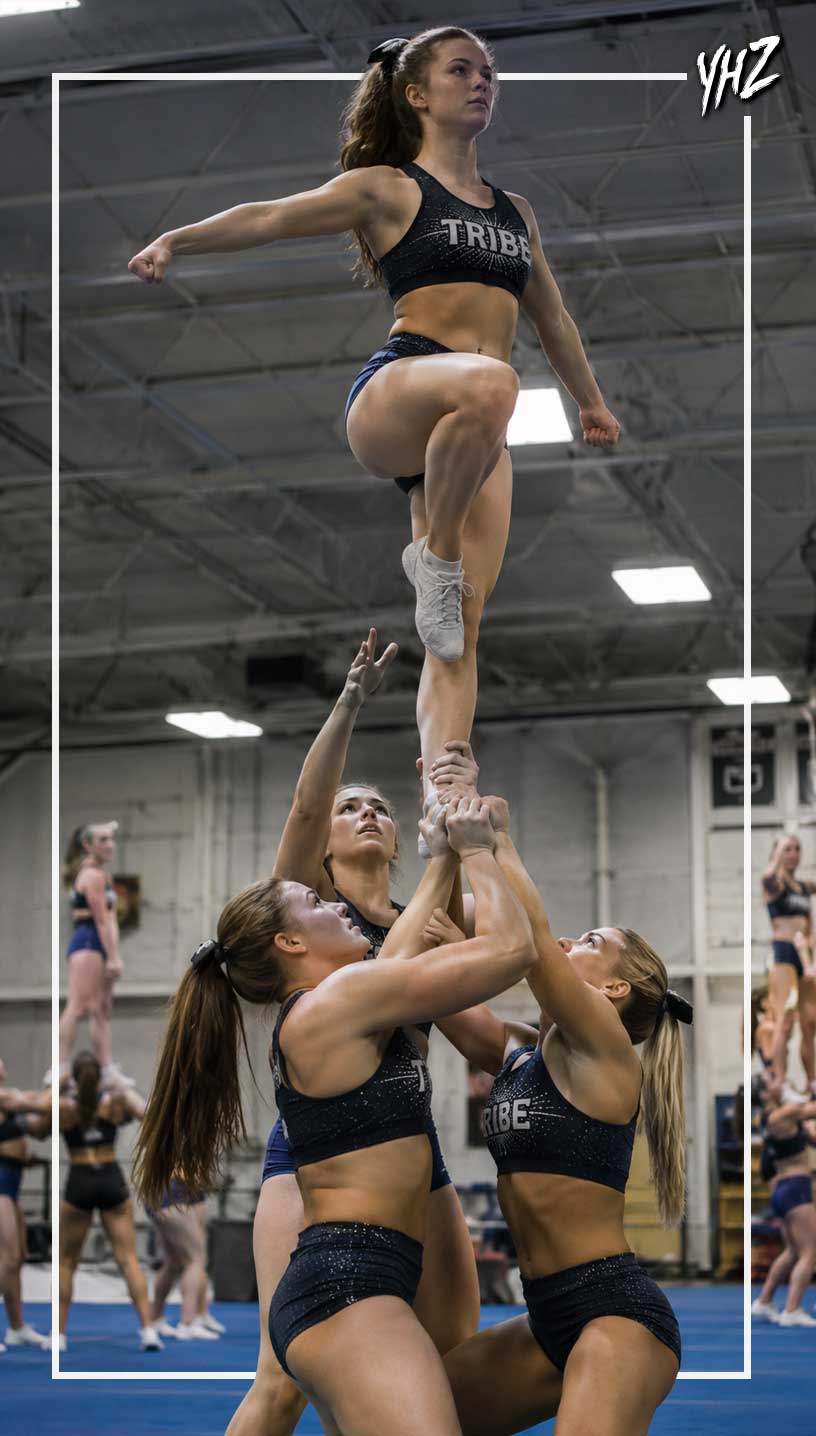
Why a more difficult stunt is not automatically a better scoring decision
A proposed upgrade needs two separate explanations: why it earns more credit and why this team can deliver that credit in the routine.
Imagine that one group learns a harder variation while the others retain the original sequence. Depending on the applicable quantity requirement, that change might not increase the difficulty score. It could still have a choreographic purpose, but the coach should not budget a difficulty gain without verifying it.
Alternatively, all the required groups may perform the upgrade, yet their execution deteriorates. A successful catch does not settle whether the entire section improved. Compare the footage from the first setup through the next formation, looking for new corrections or delays that the original version did not require.
There is also a practice-planning cost. If one upgrade repeatedly absorbs the time allocated to cleaning transitions or teaching a backup formation, record that tradeoff. Practice time is not a scoring category, but it is a resource the coach controls. A small potential gain may deserve less attention than a correctable weakness elsewhere in the routine.
Technique reductions versus bobble and fall penalties
Execution scoring and incident deductions answer different questions. Execution addresses technical quality. The deduction document classifies specific performance incidents and rule violations. A routine can avoid a fall penalty and still lose execution credit.
United’s October 15, 2026 deduction sheet lists these building incident values:
|
Incident classification |
Listed deduction |
|
Building bobble |
0.25 |
|
Building fall |
0.75 |
|
Major building fall |
1.25 |
These values belong to that deduction system. Its inclusion and exclusion lists determine how an incident is classified. Do not label every wobble a building bobble or every interrupted stunt a building fall. Consult the full definitions and the event’s review process. United deduction system
Keep technique observations, lost difficulty credit, and assessed incident penalties on separate lines in your review. They are different scoring mechanisms, although the same sequence may raise questions in more than one area. Do not assume that a fall produces only its listed penalty, or automatically add an execution reduction of your own for the same incident.
Also distinguish a legal skill from a well-scoring skill. Confirm legality through the applicable rules and official review channel before evaluating competitive value. A favorable score estimate is never a reason to perform a prohibited or unsafe skill.
Three hypothetical difficulty-versus-execution comparisons
The following examples use the United All Star Elite stunt category described above. Difficulty credit combines the base difficulty score and its additional drivers, for a maximum of 6.0; execution has a maximum of 4.0.
All values are fictional. Assume the applicable rubric supports the difficulty estimates, every skill is legal, there are no incident penalties, and all other routine scores remain unchanged. The subtotals are raw stunt-category points, not final competition scores.
|
Scenario and routine version |
Difficulty credit |
Execution |
Stunt subtotal |
|
1. Current sequence |
5.5 |
3.9 |
9.4 |
|
1. Harder sequence |
5.7 |
3.6 |
9.3 |
|
2. Current sequence |
5.5 |
3.9 |
9.4 |
|
2. Harder sequence with no additional qualifying credit |
5.5 |
3.7 |
9.2 |
|
3. Current sequence |
5.5 |
3.8 |
9.3 |
|
3. Prepared upgrade |
5.8 |
3.7 |
9.5 |
1. The upgrade earns more difficulty but loses the comparison
In the first scenario, the coach expects an additional 0.2 in difficulty credit. Execution drops by 0.3, leaving the stunt subtotal 0.1 lower. No fall is necessary for this result.
The useful next step is to locate the execution difference. For example, the staff might find that the new entry causes several groups to correct their timing before they can continue. The upgrade can remain a training objective while the current version stays in the competition routine.
2. The extra challenge earns no additional difficulty credit
In the second scenario, the added challenge does not satisfy a new scoring requirement. The difficulty estimate stays at 5.5 while execution drops by 0.2.
Before spending more time on the variation, determine whether changing group participation or the sequence would create legitimate scoring value. If no additional difficulty credit is available, evaluate any proposed visual benefit separately. Do not count an assumed improvement in creativity as guaranteed compensation.
3. The upgrade produces a worthwhile improvement
In the third scenario, difficulty improves by 0.3 and execution declines by only 0.1. The resulting stunt subtotal is 0.2 higher.
That makes the upgrade a candidate for inclusion, subject to readiness and full-routine review. It does not establish that the team will receive those scores at competition. The staff still needs evidence that the estimated improvement persists across ordinary rehearsals and does not create problems in the next section.
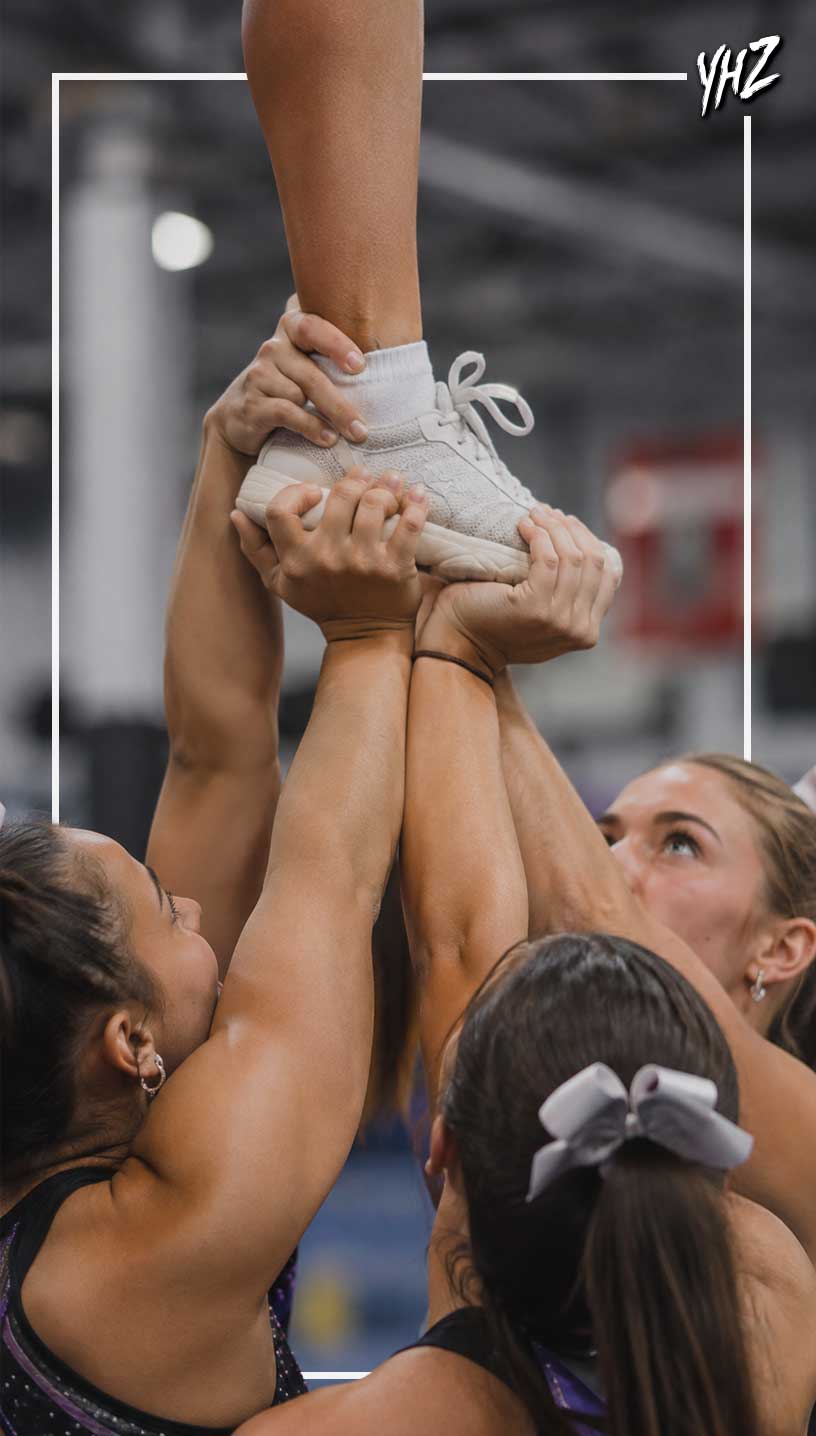
A score-comparison worksheet for your next upgrade
Complete one worksheet per proposed change. Use ranges where the evidence is uncertain, and attach the relevant rubric provision rather than relying on memory.
Team/division: ____________________ Event/scoring system: ____________________
Document versions: ____________________ Review date: ____________________
|
Review item |
Current version |
Proposed version |
Evidence or annotation |
|
Exact skill sequence |
|
|
Include the entry and exit, not just the featured skill. |
|
Legality confirmed |
|
|
Record the applicable rule or official response. |
|
Qualifying groups and skill classifications |
|
|
Check quantity against the current roster. |
|
Base difficulty plus additional drivers |
|
|
Identify the specific credit that changes. |
|
Execution estimate or range |
|
|
Use dated footage and the applicable drivers. |
|
Raw stunt subtotal |
|
|
Add only values on the same raw scale. |
|
Incident deductions observed |
|
|
Record official classifications where available; flag uncertainty. |
|
Effect on other sections |
|
|
Note changed spacing, timing, or omitted content. |
|
Decision and next review |
|
|
Keep, revise, or continue training; name the responsible coach. |
For a category comparison without penalties, the arithmetic is straightforward: change in stunt subtotal = change in difficulty credit + change in execution. A negative execution change offsets part or all of the difficulty gain.
For a final-score comparison, use the event’s actual calculation. Establish whether scores are converted, weighted, or averaged and where deductions enter that calculation. Do not subtract a penalty from a raw category subtotal merely because both numbers are called points.
If the result depends on optimistic estimates, show that explicitly. A proposed version estimated at 9.2–9.5 does not clearly outperform a current version consistently estimated at 9.4. The uncertainty itself is useful information for the decision.
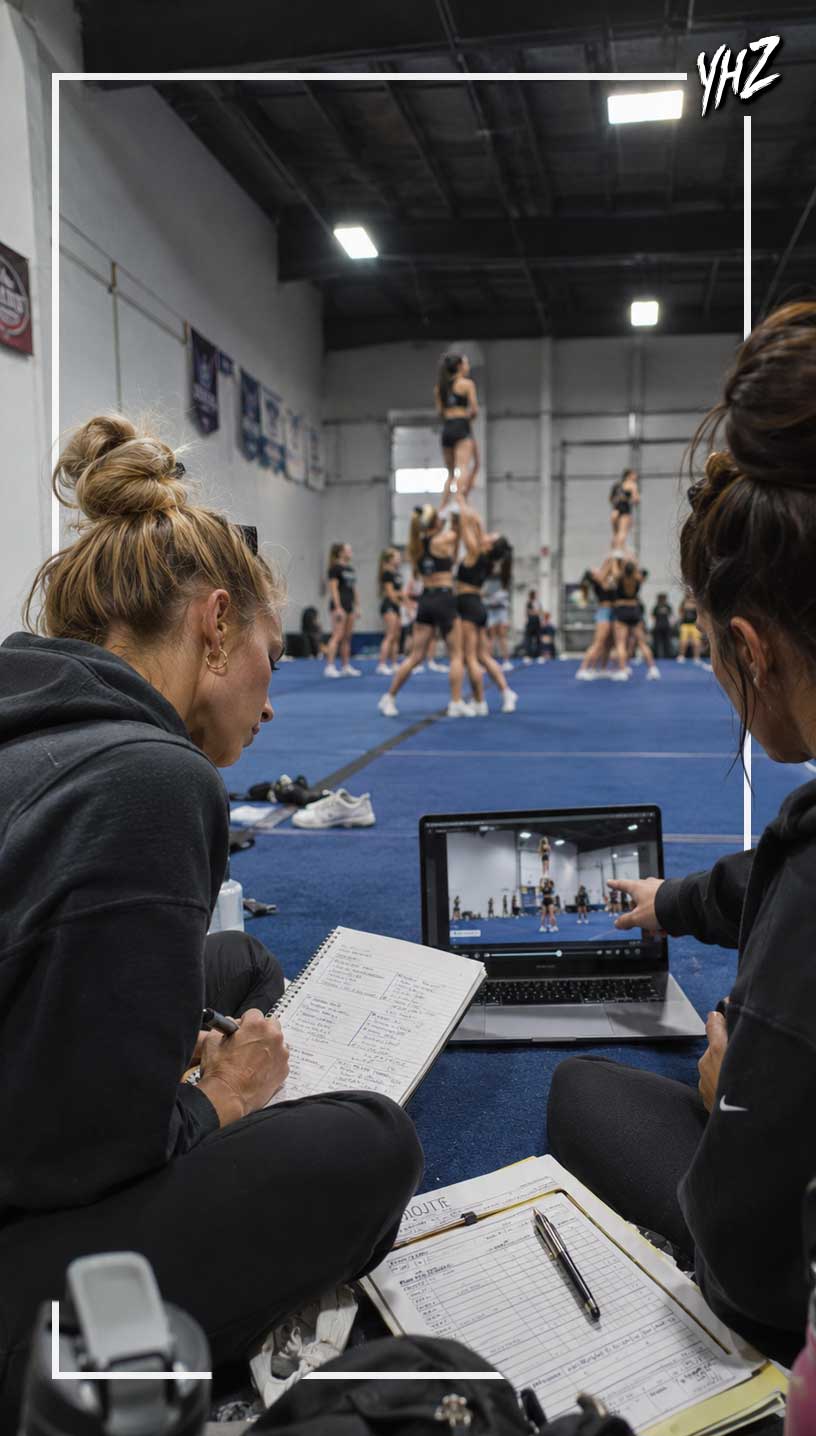
How to test whether an upgrade is ready
Use the worksheet alongside a short evidence log. Our summer skills audit provides a broader starting point for separating current routine skills from future upgrades. Any practice hit-rate benchmark is a coaching tool, not an official scoring requirement or a guarantee of safety.
Define a successful attempt before reviewing footage
Describe the intended outcome in observable terms: the planned groups complete the sequence with control, on the assigned counts, and arrive ready for the next section. Record incomplete attempts and corrections as well as successful repetitions. A collection of selected highlights cannot answer how repeatable the sequence is.
Use simple review labels such as controlled, completed with corrections, and incomplete. Add the actual observation beside the label. “Completed with corrections: right group moved forward and exited late” is more useful than “messy.”
Assess every group that the scoring plan depends on
Keep group-level notes alongside the team summary. If the planned credit requires several groups, the readiness of the strongest group cannot establish readiness for the section.
Record who performed, which sequence was used, and whether the attempt required assistance outside the planned routine. When personnel change, review the affected group again rather than carrying forward results from a different lineup.
Progress into routine context
Once the coach determines the skill is ready for integration, assess it with the preceding movement, neighboring groups, music, and the intended exit. Spread observations across appropriate practice sessions. Do not manufacture exhaustion or continue unsafe attempts to produce a larger sample.
Review the same window for both versions. If the upgrade takes extra counts, include what those counts displace. If the current sequence gives athletes time to reach the pyramid setup and the upgrade does not, that difference belongs in the decision.
Ask for a second review when credit is uncertain
Have another qualified coach review the footage and the relevant rubric without first telling them which version you prefer. Ask them to identify credit conditions and visible technical issues. Where the event offers an official scoring or legality inquiry process, use it for unresolved questions. Keep estimates distinct from an official response.
When to simplify a stunt
Simplify when the current version presents a safety concern, when the intended credit remains unsupported, or when repeated evidence shows a worse overall result than the alternative. A change in roster or an athlete’s availability should also trigger a fresh review of the sequence.
Make the smallest useful change. The problem may sit in an entry, a connection, or the time allowed for a dismount rather than in the central skill. Reworking that portion can preserve much of the scoring plan while making the sequence easier to perform as intended.
Check the simplified version against the rubric again. Removing a transition may change variety, participation, or synchronization requirements. “Easier” should describe the athletes’ task; it should not substitute for a scoring analysis.
Build an upgrade plan that protects the rest of the routine
Give each candidate upgrade a defined place in the count sheet, a coach responsible for tracking progress, and a review date. Set that date according to the time your team needs to rehearse either outcome. This is an internal planning decision, not a competition deadline.
Keep the current version rehearsed while the upgrade develops. Where practical, preserve compatible entrances, exits, and formation paths so that a decision about one stunt does not require rebuilding several sections. If the count structure changes, update the count sheet and music cues together before evaluating the revised routine.
At the review, make a specific decision: include the upgrade, revise one part and reassess, or retain the current version for the next event. Explain the evidence to the athletes in terms they can act on, such as synchronized completion and a controlled exit. Give a deferred upgrade its next training objective so the decision does not become a vague rejection.
After competition, compare the actual feedback with the worksheet. Investigate where the estimate was wrong: qualifying credit, execution, incident classification, or effects elsewhere in the routine. Use that finding to choose the next correction. The worksheet becomes useful over time when it improves the staff’s decisions, not merely when it justifies the version they already wanted.

IPP's Premade Mixes are USA Cheer Compliant and customizable! Add Sound FX, swap songs, & more! Add your Team Name to the mix for only $10!



 Cheer Mixes
 Past-Season Mixes (50% off!)
 You Hit Zero Cheer Blog
 Spotify Playlists
 Quick Quote Video Tutorial