
 •
• English
 日本語
日本語 Español
 Português
 Français
 Polski
 Deutsch
 Italiano
 Nederlands
 한국어
한국어 Русский
 简体中文
简体中文




Nov



By Steve Pawlyk
Published November 7, 2025
In competitive All-Star cheerleading, sharp motions define the difference between a clean, high-scoring routine and one that looks unrefined. Teaching athletes how to execute crisp, dynamic arm movements with precision and body control is fundamental to building strong visuals and synchronicity across your team. This guide walks All-Star coaches through a technical, step-by-step process for teaching sharp motions effectively – from individual drills to full-team synchronization – while addressing common errors, timing issues, and body alignment problems that often hold athletes back.
Understanding the Mechanics of Sharp Motions
Definition:
A “sharp motion” is a quick, controlled movement that stops abruptly at a precise endpoint with visible muscle engagement. It requires correct arm path, shoulder alignment, and total-body engagement.
Core Elements of Sharpness:
- Tension: Muscles are fully engaged without appearing rigid.
- Accuracy: Arm placement hits exact angles (e.g., 45°, 90°).
- Timing: Motion reaches its final position simultaneously across athletes.
- Control: Movement stops cleanly, with no bounce or wobble.
Key Muscles Used:
Deltoids, trapezius, latissimus dorsi, biceps/triceps, and core stabilizers.

Step-by-Step: Teaching Sharp Motions One-on-One
Step 1: Establish Muscle Awareness
- Drill: Have the athlete hold a High V for 10 seconds. Then cue:
“Tighten your arms until they feel like steel – now breathe without letting the arms move.” - This develops static control and shoulder stability.
Step 2: Teach Arm Pathways
- Use mirror feedback. Demonstrate a motion slowly, tracing the arm path.
- Cue: “Travel through the air like you’re slicing – not floating.”
- Have the athlete practice T → High V → Low V transitions at half-speed, then full-speed, maintaining tight paths and deliberate stops.
Step 3: Reinforce Visual Symmetry
- Correct uneven elbows by cueing: “Both elbows should look like twins – same height, same line.”
- Photograph or record the athlete mid-motion for visual correction.
Step 4: Add Controlled Speed
- Once the athlete can execute cleanly at half-speed, use a metronome or counts.
- Cue: “Hit, hold, snap back – no extra noise in between.”
One-on-One Focus: Keep feedback specific and immediate – correct after every rep. For developing athletes, emphasize “clean over fast.”
Teaching Small Groups: Building Consistency
When moving from individual correction to group work (3-5 athletes), the goal shifts from precision to uniformity.
Step 1: Synchronization Drills
- Drill: Assign one athlete as the “lead” and have others match their timing and stop point.
- Use 8-count tracks at 100 – 120 BPM for consistency.
Step 2: Peripheral Awareness
- Cue athletes to use side vision to check alignment:
“Your arms should land in the same line as your neighbor’s. If you see a hand out of place, match it.”
Step 3: Micro-Timing Adjustments
- Record group motions in slow-motion.
- Identify the athlete who hits early or late, then isolate and re-sync.
- Use rhythmic clapping or verbal counts (“1-and-HIT”) to reinforce team timing.
Teaching Full-Team Precision
Step 1: Formations and Spacing
- Sharp motions lose impact when spacing drifts. Tape lines on the floor to keep spacing exact (arms-length apart).
- Cue: “Your visual space is part of the motion – protect your square.”
Step 2: Layered Instruction
- Start with silent run-throughs – no music, just visual hits.
- Progress to count-based: “5-6-7-8!”
- End with music-speed execution and pause drills between counts to check visuals.
Step 3: Visual Synchronization Drills
- Use video playback and freeze frames at key motions (High V, T, Punch, etc.) to identify misalignments.
- Assign “correction partners” – athletes who check each other’s arm levels and tension before full runs.

Coaching Language That Works
The phrasing you use directly influences athlete response. Avoid abstract cues like “be sharp” or “hit harder.” Replace them with sensory and mechanical instructions.
Effective Coaching Phrases:
- “Imagine your arms are blades cutting the air.”
- “Snap into place like a magnet hitting metal.”
- “Hold tension like you’re trying to flex your arms into the floor.”
- “Freeze, don’t bounce.”
- “Clean lines over fast arms.”
Common Athlete Errors and How to Correct Them
|
Error |
Cause |
Correction |
|
Bent elbows |
Weak triceps or poor tension awareness |
“Lock but don’t lock out – think steel, not wood.” Drill with 3-lb dumbbells. |
|
Uneven arms |
Shoulder misalignment or hand dominance |
Train both sides equally. Use mirror or laser alignment drills. |
|
Wobbly stops |
Lack of core engagement |
Add plank and hollow hold conditioning. Cue: “Freeze from your ribs, not your wrists.” |
|
Soft wrists |
Weak tension through forearm |
Incorporate “blade hand” drills – open palm tension holds for 8 counts. |
|
Sloppy transitions |
Rushed counts or overextension |
Slow down, isolate each transition. “Every path is a punch, not a wave.” |
Progressive Drills for Mastery
- Isolation Drill: Perform each motion slowly to counts – no transitions. Focus only on angle accuracy.
- Snap Drill: Hit T → High V → Low V → T in rhythm to a metronome, pausing between each to check angles.
- Mirror Match Drill: Two athletes face each other and mirror motions simultaneously. Immediate visual feedback reinforces synchronization.
- Resistance Band Drill: Attach light bands to wrists. Perform motions while maintaining band tension – builds strength and control.
- Full-Team Clean Hit Challenge: Every athlete must freeze at the end of each motion; any visible bounce or movement restarts the count.
Building Endurance for Sharp Motions
Sharp motions require not only precision but also endurance. Incorporate these conditioning elements:
- Shoulder holds: 3 sets of 30-second High Vs with light dumbbells.
- Core stabilization: Hollow holds and plank variations to reduce upper-body wobble.
- Repetition drills: 50-count sets of full-out motions to simulate routine fatigue.
Cue during conditioning: “Your arms should look the same on count 1 as they do on count 50.”
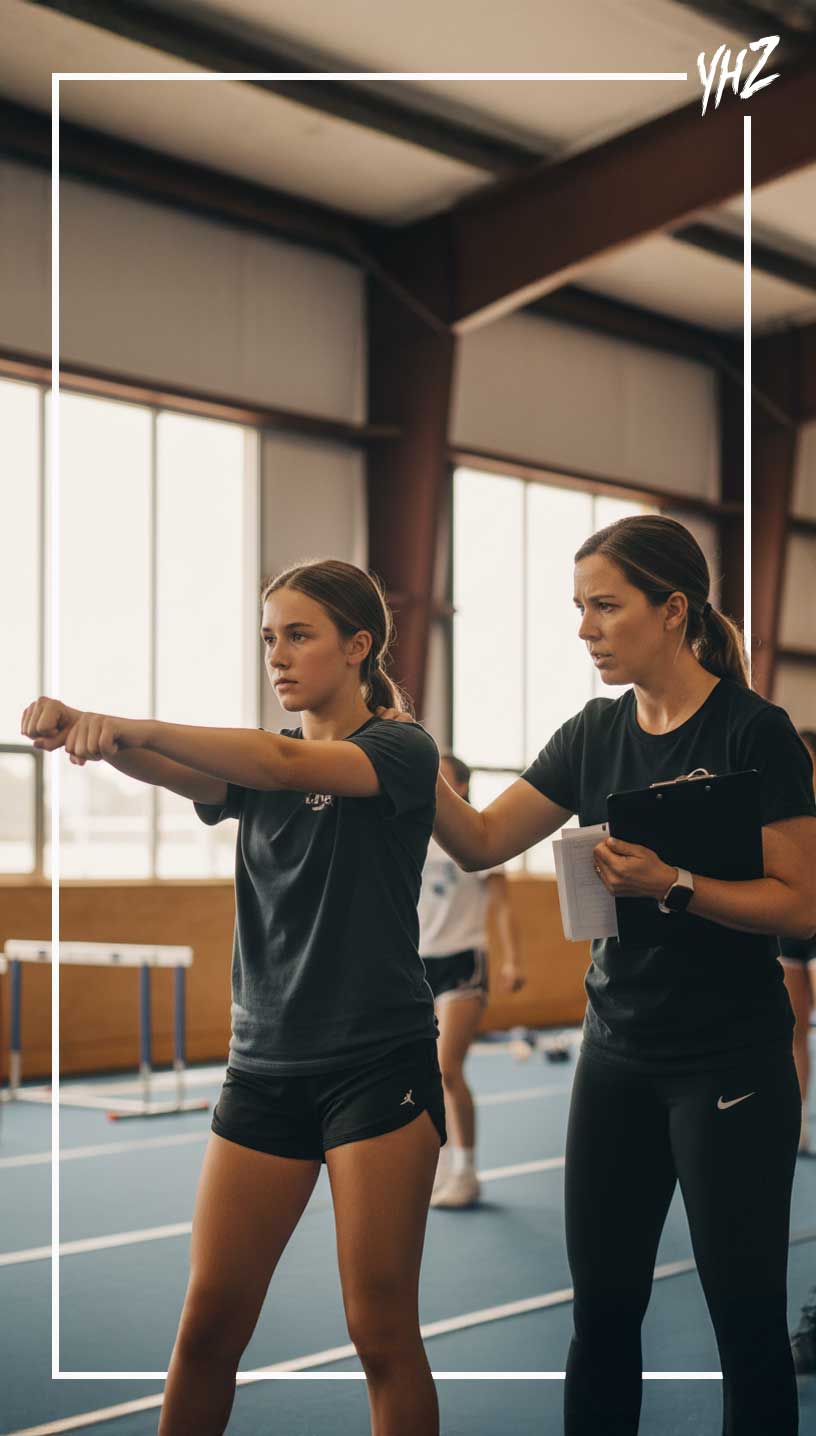
When an Athlete Struggles
Common Struggles:
-
Arms aren’t hitting sharp or fast enough:
-
Cause: Lack of muscle engagement or understanding of “motion lock.”
-
Fix: Have the athlete perform slow-motion hits against light resistance bands to feel the tension through shoulders, triceps, and wrists. Cue “lock from the shoulder, not the elbow.” Reinforce with short-count drills — e.g., “1–hit, 2–freeze.”
-
-
Elbows bend or wrists flop at the end of the motion:
-
Cause: Weak upper-arm engagement or fatigue during repetition.
-
Fix: Add static arm holds (10 seconds per motion) and isometric presses against a wall. Cue “squeeze through your arms like you’re cracking glass.”
-
-
Angles inconsistent between left and right sides:
-
Cause: Poor proprioception or shoulder imbalance.
-
Fix: Drill in front of a mirror or record video feedback. Have the athlete hit one motion at a time and freeze for visual alignment checks. Cue “match the mirror, not your memory.”
-
-
Athlete can’t find visual uniformity in team formations:
-
Cause: Over-focusing on personal execution instead of spatial awareness.
-
Fix: Use “mirror pairs” — partner the athlete beside your cleanest performer and run synchronized drills. Cue “your job is to disappear into the line.”
-
-
Timing late or early on counts:
-
Cause: Overthinking or reacting visually instead of audibly.
-
Fix: Practice hitting on a metronome beat or 8-count track. Cue “hit the sound, not the sight.”
-
Coach Tip:
When a particular athlete struggles to “feel” the sharpness, try tactile feedback. Have the athlete hold a lightweight resistance band across both wrists or a small towel between hands — this creates tangible tension through the arms and instantly teaches them what “tight” actually feels like. The goal isn’t punishment; it’s awareness. Once they feel it, they can replicate it without the tool.
Teaching sharp motions isn’t about speed — it’s about accuracy, control, and tension. Start slow, demand consistency, and build synchronization from the ground up. The payoff is visual cleanliness, team unity, and a routine that commands attention from judges the moment the first motion hits.
Stay tuned for more coaching tips from our Cheer How-To Series

IPP's Premade Mixes are USA Cheer Compliant and customizable! Add Sound FX, swap songs, & more! Add your Team Name to the mix for only $10!


 Cheer Mixes
 Past-Season Mixes (40% off!)
 You Hit Zero Cheer Blog
 Spotify Playlists
 Quick Quote Video Tutorial